1) Public choice theory focuses on the economics of:
A.fiscal and monetary policy.
B.the behavior of business firms.
C.antitrust and regulatory policy.
D.government decision making, politics, and elections.
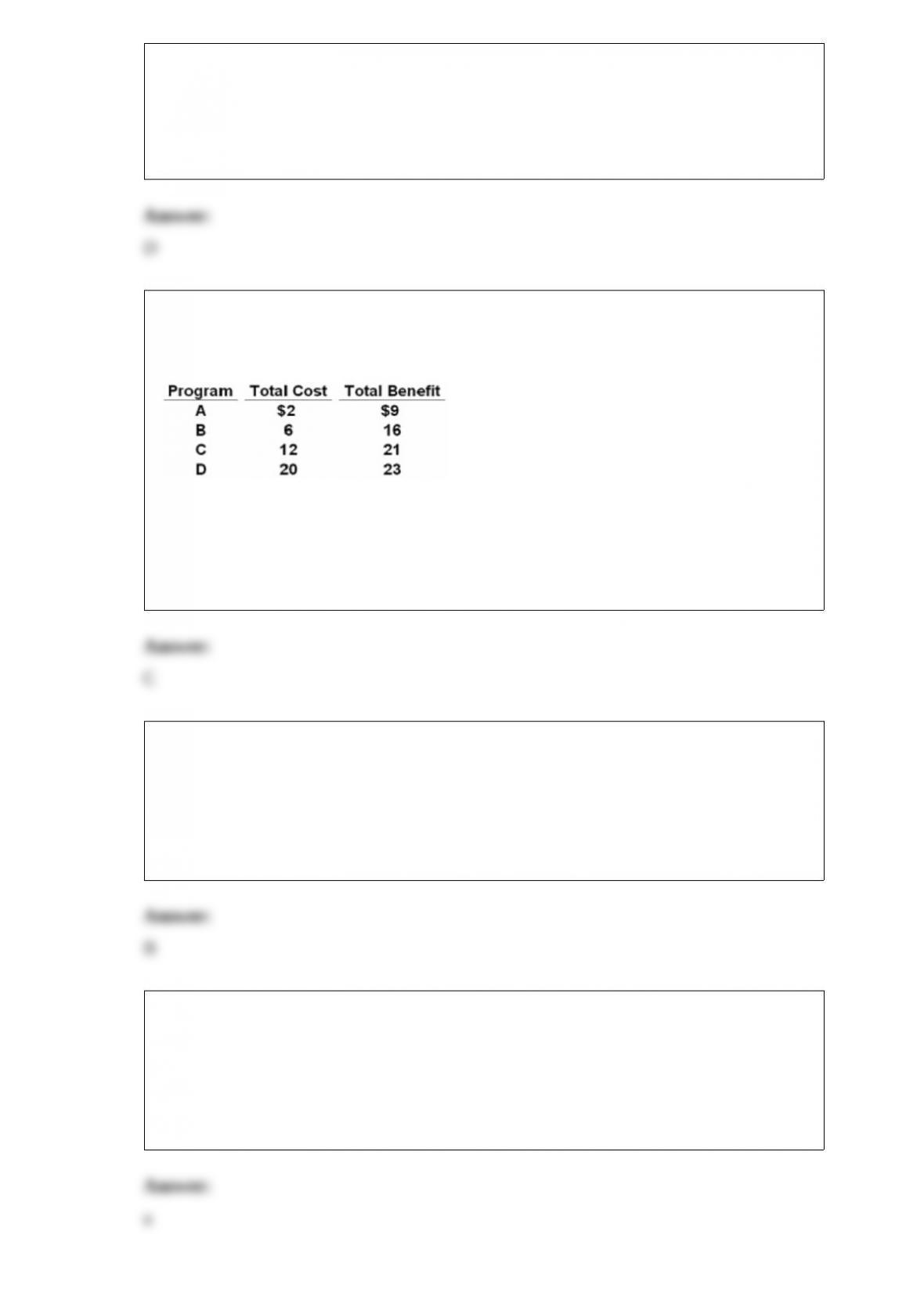
2) The following information is for four highway programs of increasing scope. All
figures are in millions of dollars.
On the basis of the above data we can say that:
A.Program D is the most efficient on economic grounds.
B.Program C is the most efficient on economic grounds.
C.Program B is the most efficient on economic grounds.
D.Program A is the most efficient on economic grounds.
3) Suppose a person pays $80 of annual interest on a loan that has a 5 percent annual
interest rate. The loan amount is:
A.$400.
B.$1,600.
C.$160.
D.$85.
4) which of the following would not be appropriate if government were trying to reduce
high unemployment?
a.an increase in tax rates
b.an increase in subsidies to businesses
c.an increase in transfer payments to households
d.an increase in government spending

5) Employers will hire more units of a resource if:
A.the price of the resource increases.
B.the productivity of the resource increases.
C.the price of the good being produced declines.
D.the price of a complementary resource rises.
6) When the public sector is added to the aggregate expenditures model:
A.the equilibrium condition becomes G + S = T + Ig + X.
B.the equilibrium condition becomes G + T = S + Ig + X.
C.the equilibrium condition becomes Ca + Ig + Xn + G + T = GDP.
D.we add a new leakage in the form of taxes and a new injection in the form of
government spending.
7) in presenting the idea of a demand curve, economists presume that the most
important variable in determining the quantity demanded is:
a.the price of the product itself.
b.consumer income.
c.the prices of related goods.
d.consumer tastes.
8) approximately what percentage of u.s. income was received by businesses (both
corporate and non-corporate) in 2007?
a.9%
b.14%
c.23%
d.32%
9) The reserve ratio refers to the ratio of a bank’s:
A.reserves to its liabilities and net worth.
B.capital stock to its total assets.
C.checkable deposits to its total liabilities.
D.required reserves and vault cash to its checkable deposits.

10) the location of the supply curve of a product depends on:
a.the technology used to produce it.
b.the prices of resources used in its production.
c.the number of sellers in the market.
d.all of these.
11) the short run is characterized by:
a.plenty of time for firms to either enter or leave the industry.
b.increasing, but not diminishing returns.
c.at least one fixed resource.
d.zero fixed costs.
12) The Lorenz curve portrays:
A.the functional distribution of income.
B.the ratio of labor to capitalist income.
C.the personal distribution of income.
D.income equality.
13) An oligopoly producing a homogeneous product is comprised of three firms that act
like a cartel. Assume that these three firms have identical cost schedules. Assume also
that if any one of these firms sets a price for the product, the other two firms charge the
same price. As long as they all charge the same price they will share the market equally;
and the quantity demanded of each will be the same.
Below are the total-cost schedule of one of these firms and the demand schedule that
confronts it when the other firms charge the same price as this firm. Complete the
marginal-cost and marginal-revenue schedules facing the firm.
(a)What price would be charged, what output would be produced, and what profit
would be made by this firm?
(b)If the firms collude to maximize joint profits, what would be the industry price,
output, and profit?
14) In the above diagram:
A.any rate of inflation is consistent with the natural rate of unemployment in the long
run.
B.inflation can occur but disinflation cannot occur.
C.unemployment rates exceeding the natural rate are permanent.
D.unemployment rates less than the natural rate are permanent.
15) (Consider This) The ratchet effect is the tendency of:
A.the price level to increase but not to decrease.
B.nominal GDP to increase more rapidly than real GDP.
C.real interest rates to fall more rapidly than nominal interest rates.
D.consumption to rise year after year regardless of what happens to disposable income.
16)
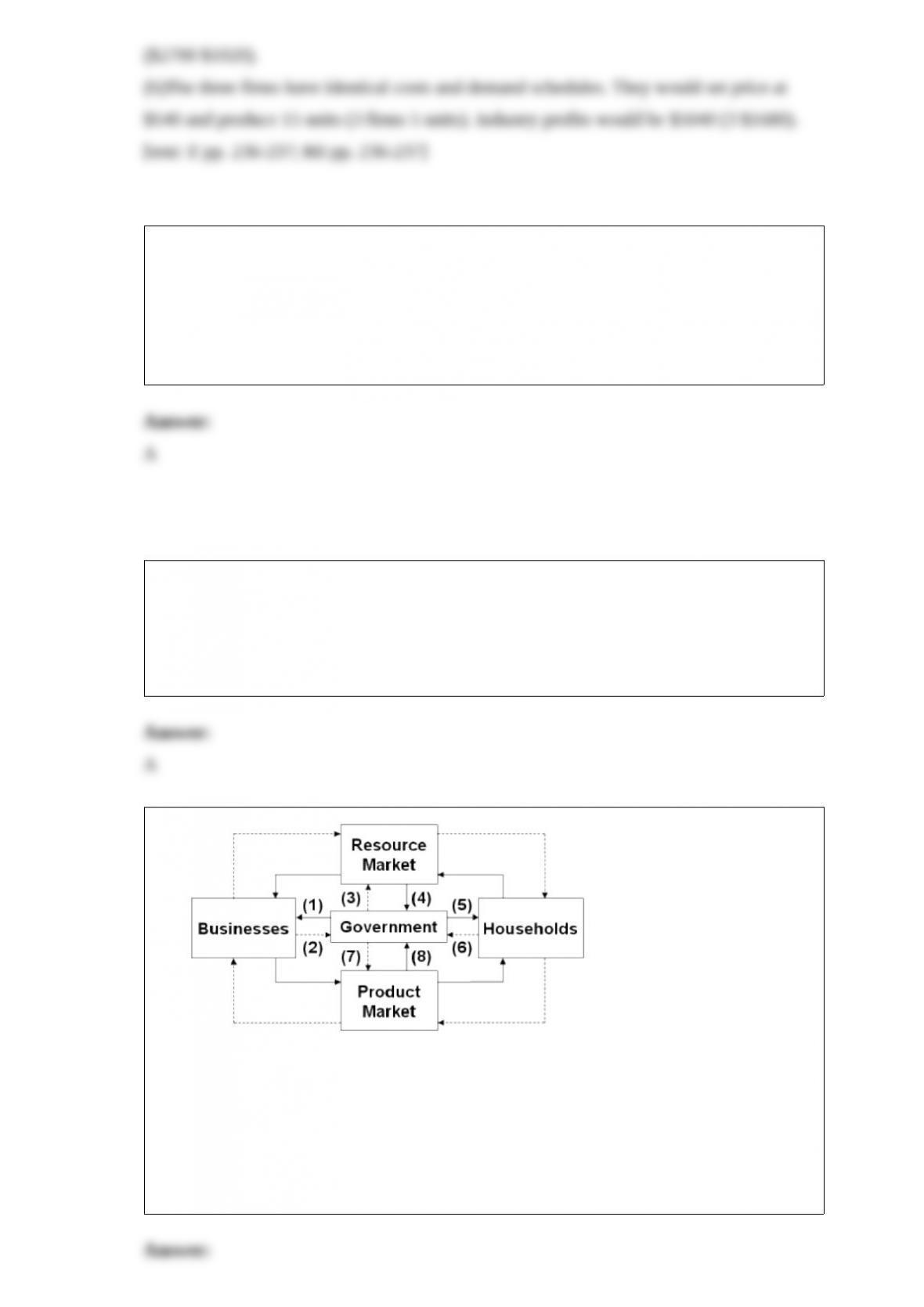
refer to the above diagram, in which solid arrows reflect real flows; broken arrows are
monetary flows. if the economy were experiencing inflation due to excess aggregate
spending, it would be most appropriate for government to:
a.increase flows (3) and (7) and reduce flows (2) and (6).
b.decrease flows (3) and (7) and increase flows (2) and (6).
c.increase flows (2) and (3) and reduce flows (6) and (7).
d.increase all of the monetary flows.
17)
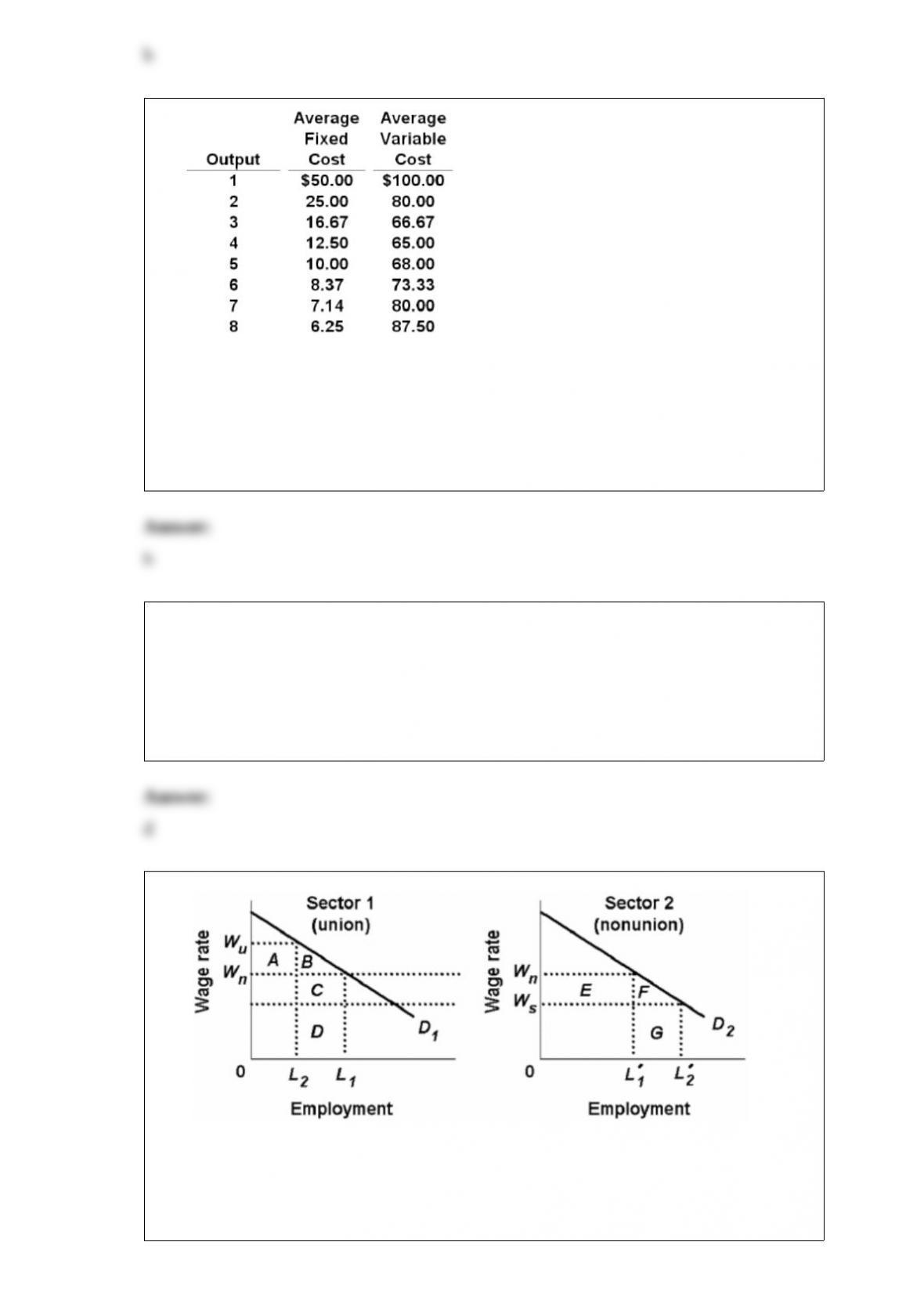
refer to the above data. if the firm closed down and produced zero units of output, its
total cost would be:
a.zero.
b.$50.
c.$150.
d.$100.
18) which of the following groups face a severe free-rider problem in providing their
services?
a.store clerks
b.tax accountants
c.college professors
d.street entertainers
19)
Assumptions: These two graphs show two sectors of the labor market for a particular
kind of labor. Relevant product markets are competitive. The two labor demand curves
are identical and initially the quantities of labor employed in the two sectors are L1and
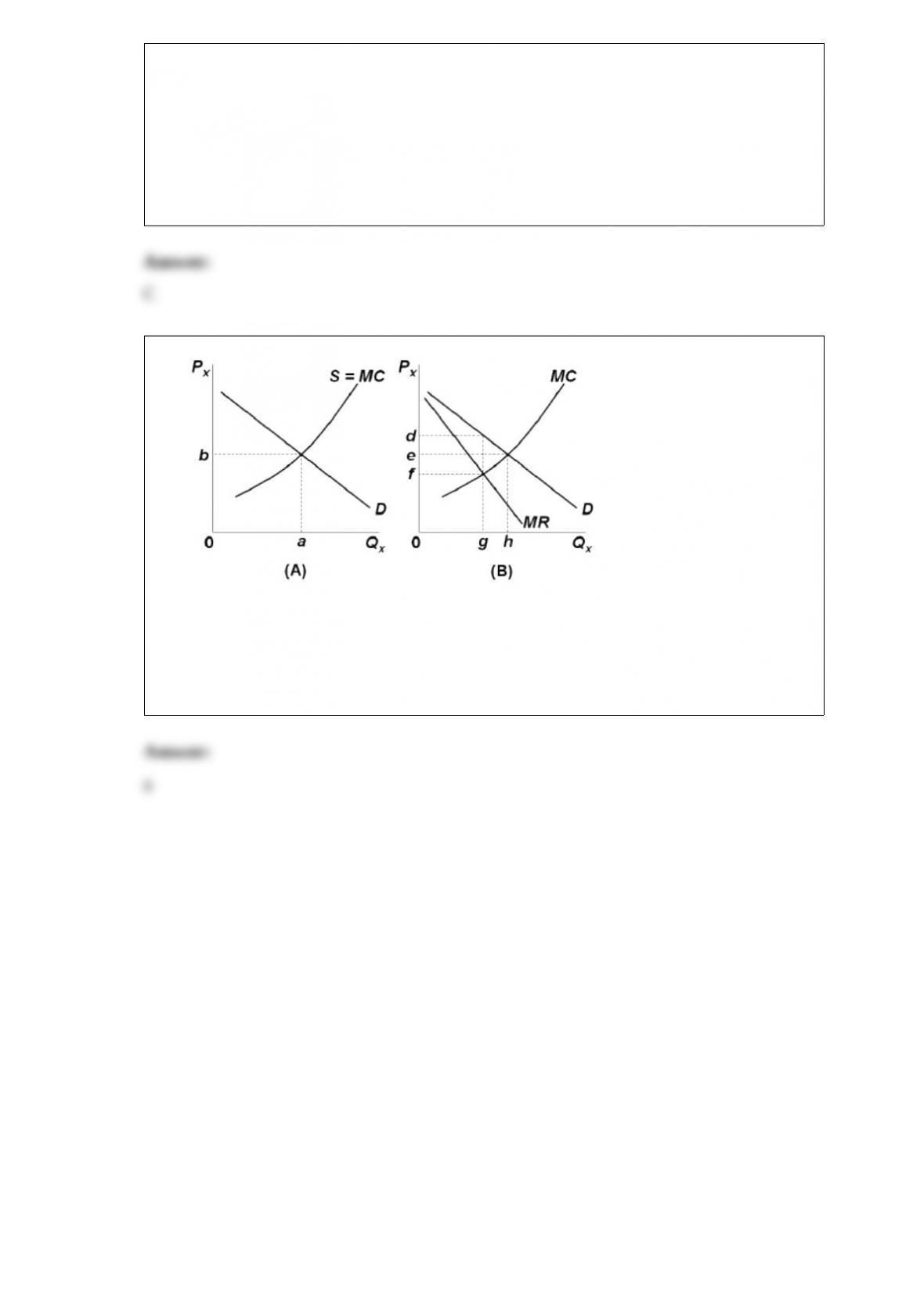
L’1and the wage rate in each sector is Wn.
Refer to the above diagram and assumptions. If a union is formed in sector 1 and the
union increases the wage rate from Wn to Wu, then employment will:
A.decrease, but we cannot determine by how much.
B.decrease by 0L2 in sector 1
C.decrease by L1L2 in sector 1
D.increase by L1L2 in sector 1
20)
refer to the above diagrams. diagram (a) represents:
a.equilibrium price and quantity in a purely competitive industry.
b.the pure monopoly model.
c.an industry in which there is productive efficiency but not allocative efficiency.
d.a single firm operating in a purely competitive industry.