
The cross elasticity of demand coefficient between Coca-Cola and Pepsi Cola would be
expected to be negative.
a. True
b. False
The Alchian and Demsetz theory of why business firms exist suggests that
a. there are only advantages to team production.
b. disadvantages of team production may outweigh the disadvantages of individual
production.
c. individual production is more efficient than team production.
d. the sum of team production is sometimes greater than the sum of individual
production.
Exhibit 34-2
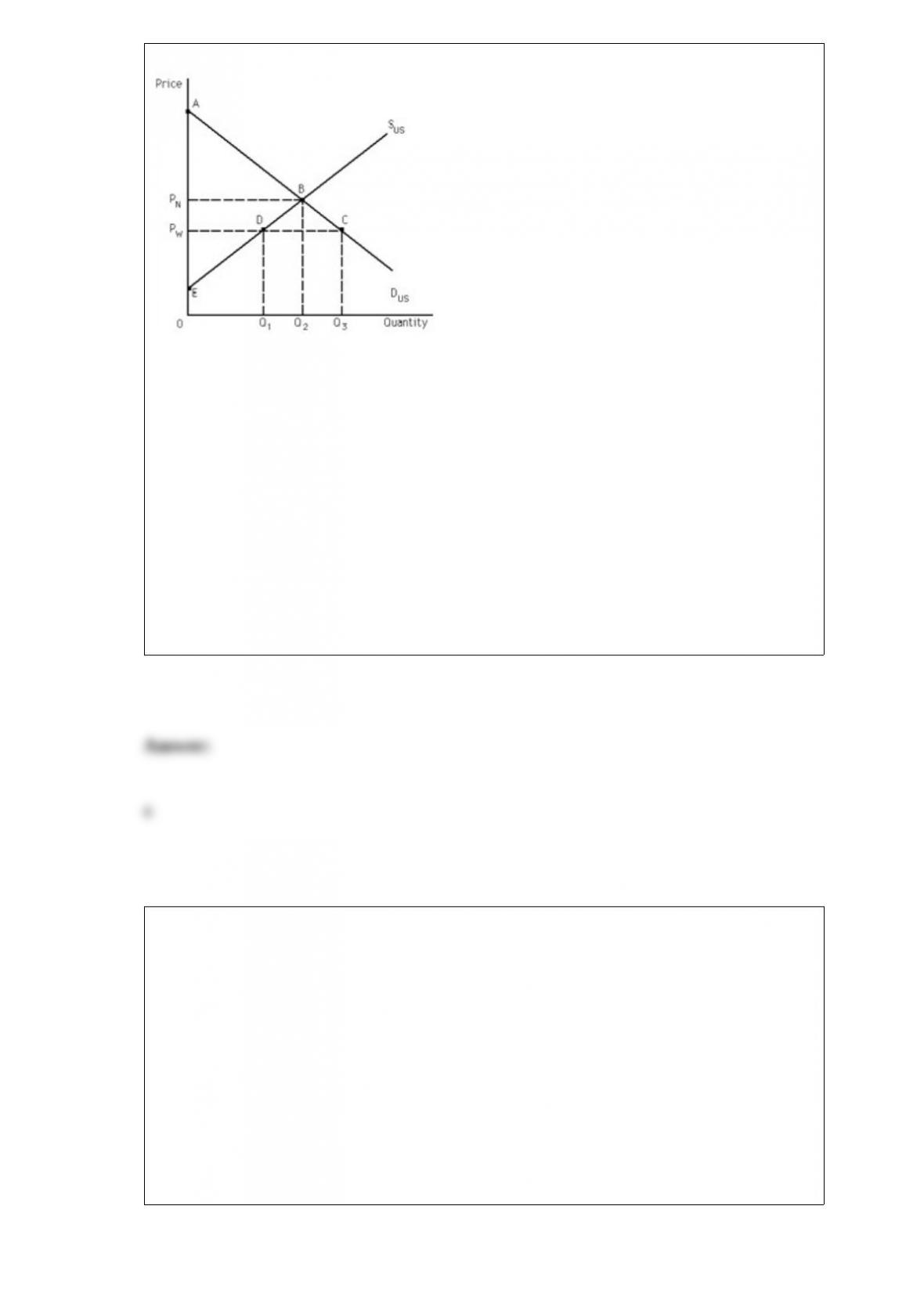
The U.S. demand and supply for a good are shown. Under a policy of free trade, the
world price is PW. At this price, what quantity of this good do U.S. consumers buy from
U.S. producers and what quantity do they import from foreign producers?
a. Q1 from U.S. producers and (Q3 – Q1) from foreign producers
b. Q2 from U.S. producers and (Q3 – Q1) from foreign producers
c. (Q3 – Q1) from U.S. producers and Q1 from foreign producers
d. Q3 from U.S. producers and nothing from foreign producers
The answer is, “This is principally used to exhibit changes in data over time.” The
question is,
a. What is a pie chart?
b. What is a 45-degree line?
c. What is a tangent line?
d. What is a line graph?
e. b and d

How is scarcity related to competition?
a. Competition is an effect of scarcity.
b. Scarcity is an effect of competition.
c. Both scarcity and competition are effects of a rationing device.
d. Both scarcity and competition are effects of opportunity cost.
e. Scarcity produces disutility and competition produces utility.
If hot dogs are an inferior good, a decrease in income will cause the equilibrium price
of hot dogs to rise.
a. True
b. False
If the relative price of one unit of good X is 5 units of good Y, then it follows that the
absolute price of good X can be __________ and the absolute price of good Y can be
__________.

a. $20,000; $10,000
b. $40,000; $8,000
c. $30,000; $5,0000
d. $5,000; $40,000
e. a and c
Situation 22-4
Joe is the owner-operator of Joe’s Haircuts Unlimited. Last year he earned $200,000 in
total revenues and paid $125,000 to his employees and suppliers. During the course of
the year, he received three offers to work for other barbers, with the highest offer being
$50,000 per year.
Is Joe earning a normal profit?
a. No, he is earning an above-normal profit.
b. No, but he is earning an accounting profit and that is all that matters.
c. Yes, but his economic profit is $0 and that is not good.
d. We cannot be sure, because “normal” profit is a subjective judgment.
e. No, his economic profit is negative.

Which of the following directly (as opposed to indirectly) raises the price of agricultural
products?
a. marketing quota system
b. acreage allotment program
c. paying farmers not to produce
d. price supports
e. all of the above
If the market supply of labor increases, the total wage income will increase if the
a. demand for labor is elastic.
b. demand for labor is inelastic.
c. supply of labor is elastic.
d. supply of labor is inelastic.
Suppose the U.S. price level rises 25 percent at a time when Japan experiences stable
prices. As a result, the U.S. demand for Japanese goods will __________, and the
Japanese demand for U.S. goods will __________; in turn, this will increase the
demand for Japanese yen and decrease the supply of Japanese yen; in turn, the dollar
will depreciate and the yen will appreciate.
a. rise; fall

b. fall; rise
c. rise; rise, too
d. fall; fall, too
The marginal factor cost of labor for a monopsonist is
a. equal to the wage rate because if the monopsonist wants to hire another worker, it can
do so at the old wage rate.
b. less than the wage rate because if the monopsonist wants to hire another worker, it
has to raise the wage rate paid to all workers.
c. less than the wage rate because if the monopsonist wants to hire another worker, it
has to lower the wage rate paid to all workers.
d. greater than the wage rate because if the monopsonist wants to hire another worker, it
has to raise the wage rate paid to all workers.
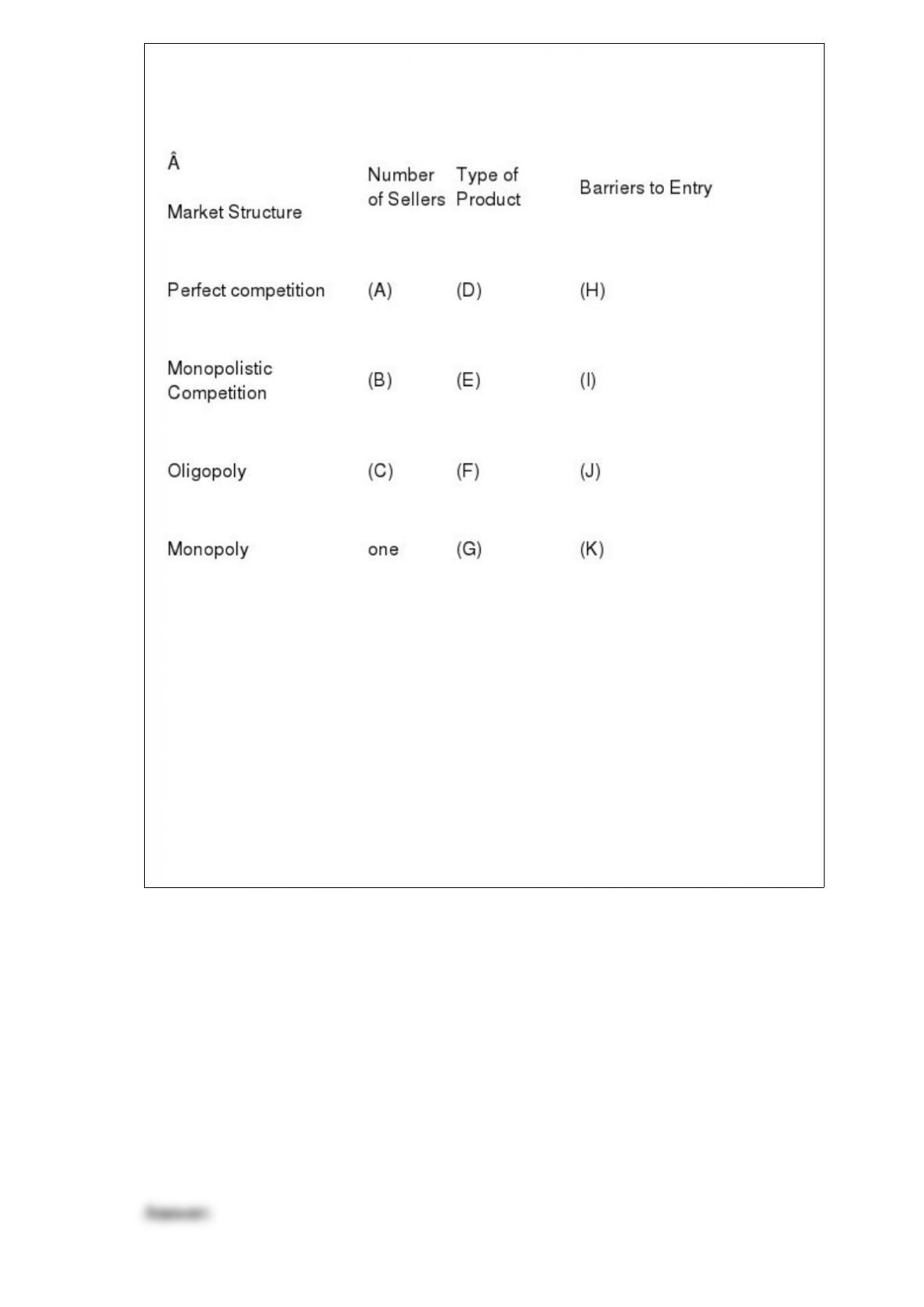
Exhibit 25-9
The number of sellers in a perfectly competitive market is ___________ [blank (A)],
the number of sellers in a monopolistic competitive market is ____________ [blank
(B)], and the number of sellers in an oligopoly is _________ [blank (C)].
a. many; many; few
b. many; few, few
c. few; many; many
d. few; few many
When marginal private cost is equal to marginal social cost,
a. the activity in question generates no positive externality.
b. the activity in question generates no negative externality.
c. all positive externalities have been internalized.
d. all negative externalities have been internalized.
e. b or d
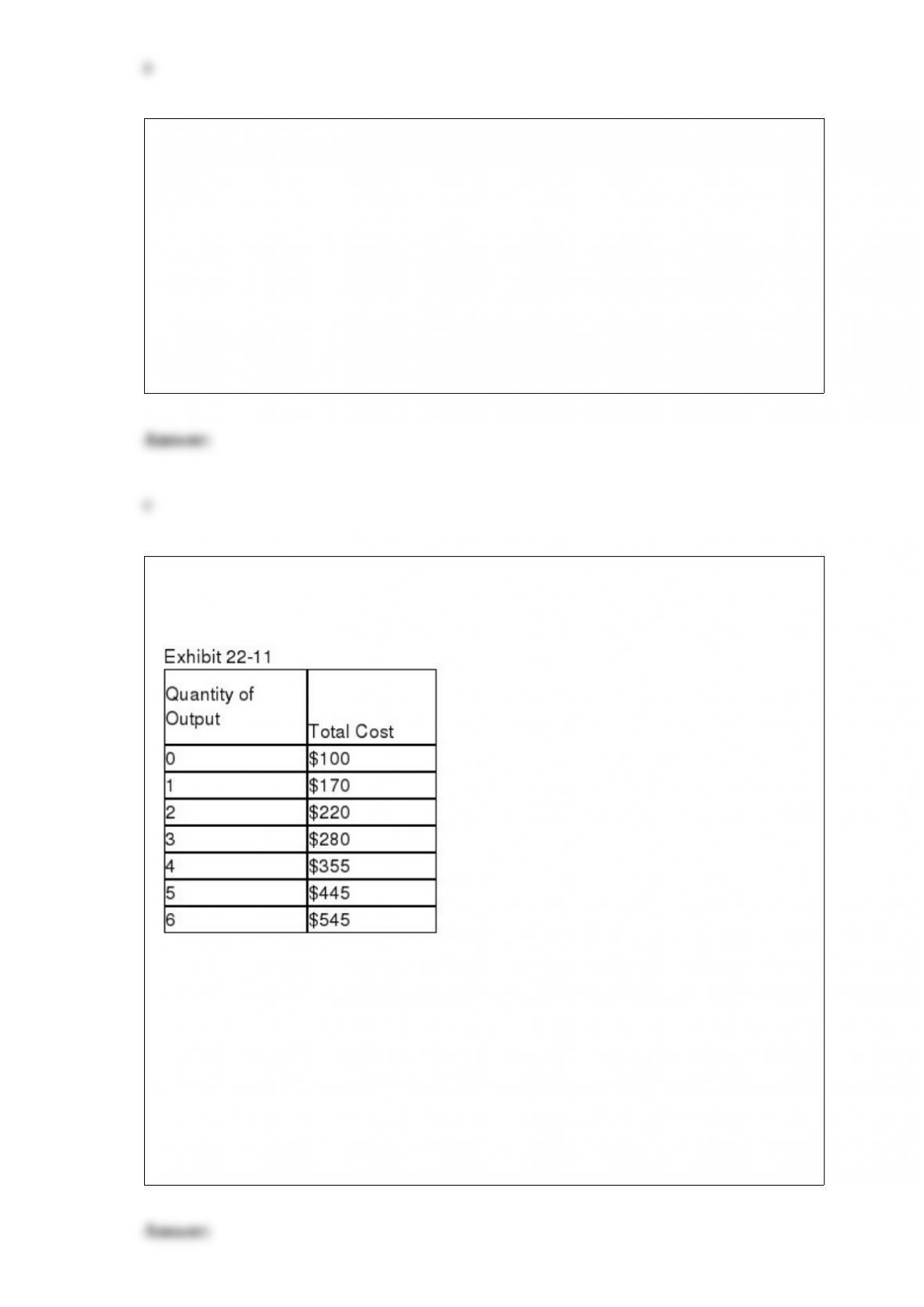
Marginal cost of the sixth unit of output is
a. $100.
b. $150.
c. $90.
d. $90.83.

Which of the following statements is true?
a. A perfectly competitive firm that seeks to maximize profits will not be
resource-allocative efficient.
b. If the demand curve and the marginal revenue curve weren’t the same curve for a
perfectly competitive firm, then the firm would not be resource-allocative efficient.
c. Resource allocative efficiency exists when a firm produces its output at the lowest
possible per unit cost (lowest ATC).
d. Productive efficiency exists when firms produce the quantity of output at which price
equals marginal cost.
e. c and d
The elasticity of demand for labor measures the percentage change in quantity
demanded of labor that occurs as a result of a percentage change in the wage rate.
a. True
b. False
Simple majority rule will almost always generate efficient outcomes.
a. True
b. False

A price searcher (monopolist, monopolistic competitor, etc.) definitely faces
a. a perfectly elastic demand curve for the product it sells.
b. a downward-sloping demand curve for the product it sells.
c. a perfectly elastic supply curve of factors.
d. an upward-sloping supply curve of factors.
e. a perfectly inelastic demand curve for the product it sells.
The firm’s factor demand curve is the
a. MRP curve if the firm is a price taker (perfectly competitive firm).
b. MRP curve if the firm is a price searcher (monopolist, monopolistic competitor,
oligopolist).
c. VMP curve if the firm is a price taker (perfectly competitive firm).
d. VMP curve if the firm is a price searcher (monopolist, monopolistic competitor,
oligopolist).
e. a, b, and c
Explain how scarcity can exist in a relatively rich country such as the United
States.Give examples to help support your answer.
Whatdoes the demand curve faced by a monopolistic competitive firm look like?
Explain why it is sloped this way, and what this implies about the relationship that
exists between price and marginal revenue under monopolistic competition.
What is the difference between the public interest theory of regulation and the public
choice theory of regulation?
Describe the type of international monetary system that is currently in use. What
advantages do proponents of this type of system cite in support of its use?What
disadvantages do its opponents cite?
Define the term scarcity and discuss two of its consequences.