
The student government associations at several universities have experimented with
purchasing bicycles to leave around campus for everyone’s use. Anyone who needs the
bike can use it, and they are not allowed to lock the bike up or take it home, but rather
must leave it on campus for someone else to use. Economic theory would predict that
a. students will take better care of these commonly owned bicycles than they do their
own bicycles.
b. students will take equally as good care of these commonly owned bicycles as they do
their own bicycles.
c. students will not take as good of care of these commonly owned bicycles as they do
their own bicycles.
d. because universities have a lot of money, these bikes will be better maintained than
the ones owned privately by college students who tend to have little money.
If the actual federal funds rate is substantially above the appropriate rate implied by the
Taylor rule, this indicates that
a. monetary policy is overly expansionary and a shift toward a more restrictive policy
would be appropriate.
b. monetary policy is too restrictive and a shift to a more expansionary policy would be
appropriate.
c. monetary policy is unable to influence interest rates, and therefore it is unable to
influence either output or prices.
d. current monetary policy is on target and no policy shifts should be made.

The random walk theory of stock prices indicates that
a. if they are willing to do a little research, even beginning investors will be able to pick
the stocks that will increase most in price in the future.
b. managed mutual funds will persistently earn a higher rate of return than indexed
funds.
c. current stock prices already reflect information about factors influencing future stock
prices that can be forecast with any degree of accuracy.
d. stock market investors can expect to earn a steady real rate of return of about 7
percent annually.
Obstacles that restrict trade, either domestic or international, will
a. reduce output, income, and the general living standard of the populace.
b. help people achieve higher income levels.
c. help promote high rates of economic growth.
d. encourage domestic business firms to expand output so they can achieve larger gains
from the adoption of mass production techniques.
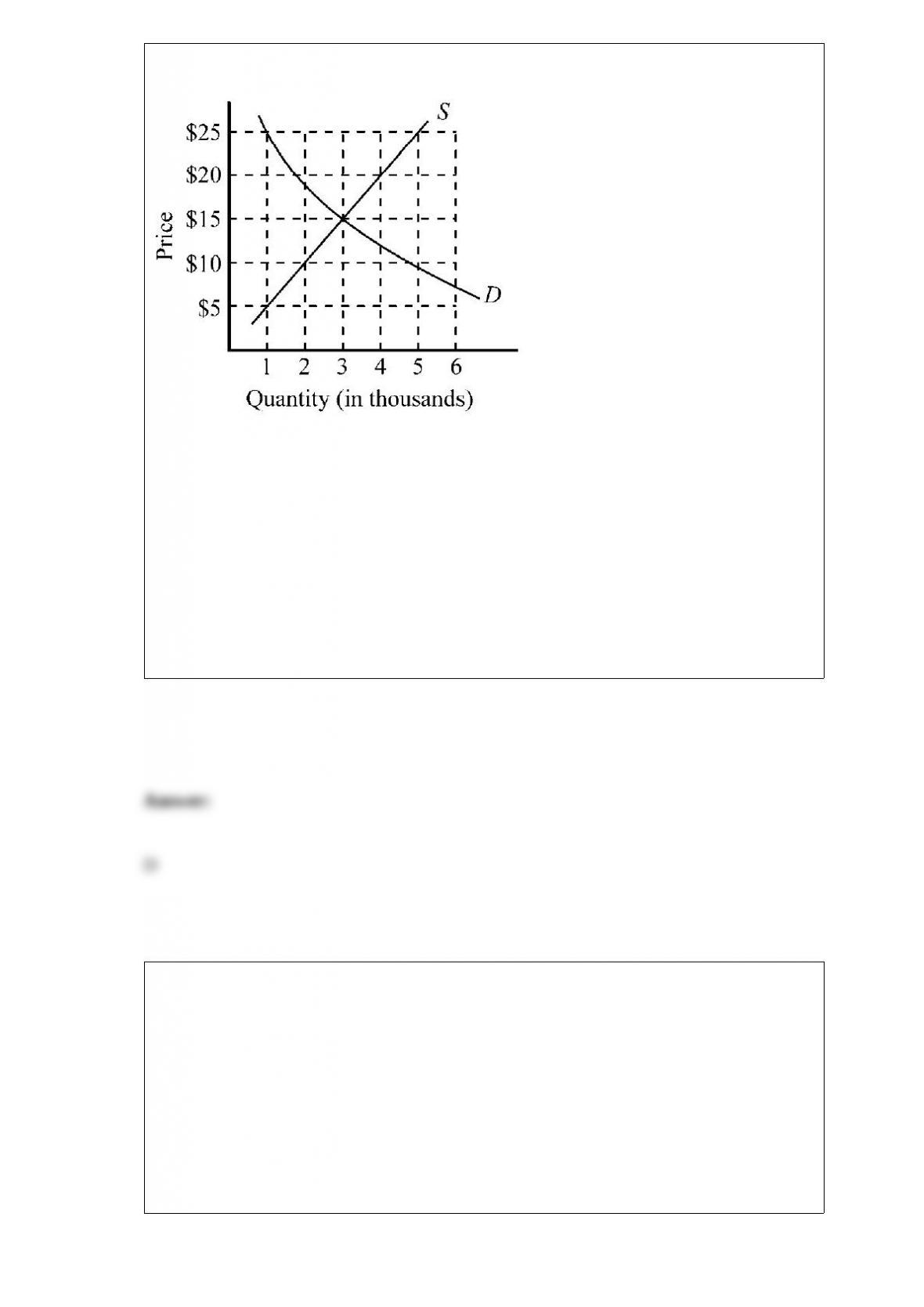
Figure 4-1
Figure 4-1 illustrates the market for compact discs. If the government imposes a price
floor of $25 for compact discs, which of the following will be true?
a. Consumers would wish to purchase 1,000 compact discs.
b. Producers would wish to sell 5,000 compact discs.
c. There would be a surplus of 4,000 compact discs.
d. All of the above are true.
Which of the following was an important source of economic stability during the two
decades following the recovery from the 1982 recession?
a. countercyclical fiscal policy instituted by Congress
b. a substantial increase in government spending as a share of the economy
c. monetary policy that kept the inflation rate low and relatively steady
d. balanced federal budgets throughout the period

Generally, the elasticity of demand for an energy source in the long run will be
a. approximately equal to its elasticity of demand in the short run.
b. considerably more elastic than in the short run.
c. slightly less elastic than in the short run.
d. considerably less elastic than in the short run.
Statistical data provided by the U.S. Department of Transportation shows that the
median income of individuals traveling on the nation’s bus systems is $18,000
compared to $65,000 for those who normally travel by air. This finding is best
explained by which of the following statements?
a. Persons with high income are more likely to fly because the opportunity cost of their
time is generally higher than those with lesser income.
b. Traditionally, lower income groups prefer slower methods of transportation.
c. Wealthy individuals own stock in the airlines and, therefore, receive preferential
treatment.
d. Low-income groups are generally located near bus stations; wealthy groups
congregate around airports.

When investment funds are allocated by government rather than by markets,
a. profitable investments are more likely to take place.
b. political influence replaces market return as the basis for allocating funds.
c. funds will consistently be channeled into wealth-creating projects.
d. projects that are political boondoggles will be unlikely to be undertaken.
Which of the following is true?
a. under the partnership form of business organization, the owners are not personally
liable for the debts of the business.
b. when employees also own a business, their incentive to shirk is removed.
c. the limited liability of stockholders under the corporate business structure makes it
easier to raise equity capital.
d. under the corporate form of business organization, the owners of the firm are
personally liable for its debts.
Predictions that natural resources such as oil will be essentially used up in the next few

decades
a. have been frequently made for the past century but have always proven to be false.
b. have usually been based on the quantity of proved reserves.
c. have ignored the role of price in governing the quantities demanded and supplied.
d. All of the above are correct.
Despite being a college graduate, Ethan cannot name any of his representatives in
Congress and he has no idea which issues are being debated and voted on this week in
Congress. According to public choice analysis, Ethan is
a. irrational.
b. considering only the welfare of society and not his own personal interests.
c. not intelligent enough to understand the issues.
d. making a rational personal choice because knowing these things gives him little
personal benefit.
Which of the following are illegal under the antitrust laws of the United States?
a. charging prices that exceed average total costs
b. charging some consumers different prices than others

c. mergers that unnecessarily create excessively large firms
d. collusive behavior or other actions designed to create a monopoly or cartel
Economic theory suggests that the standard of living of American workers would rise if:
a. the minimum wage were doubled.
b. the knowledge and skills of workers improved.
c. older workers were forced to retire earlier, opening up jobs for younger workers.
d. people bought only American products.
For each watch Denmark produces, it gives up the opportunity to make 50 pounds of
cheese. Germany can produce one watch for every 100 pounds of cheese it produces.
Which of the following is true with regard to opportunity costs in the two countries?
a. The opportunity cost of producing watches is higher in Denmark.
b. The opportunity cost of producing cheese is higher in Denmark.
c. The opportunity cost of producing cheese is identical in both countries.
d. It is impossible to compare opportunity costs because the two countries use different
currencies.
e. In both countries combined, the opportunity cost of one watch is 150 pounds of
cheese.

Dumping
a. is the sale of a good abroad at a cheaper price than what the good is sold for in the
producer’s domestic market.
b. generally hurts consumers of the nation receiving the “dumped” goods.
c. is generally encouraged by domestic producers of the product being dumped since
they are the primary beneficiaries of the dumping.
d. is the sale of a good that is illegal in the producing country to another country.
Under a system of flexible exchange rates, transactions that increase the supply of the
nation’s currency to the foreign exchange market will cause the nation’s
a. currency to depreciate in value.
b. currency to appreciate in value.
c. trade deficit to increase.
d. products to become more expensive to foreigners.
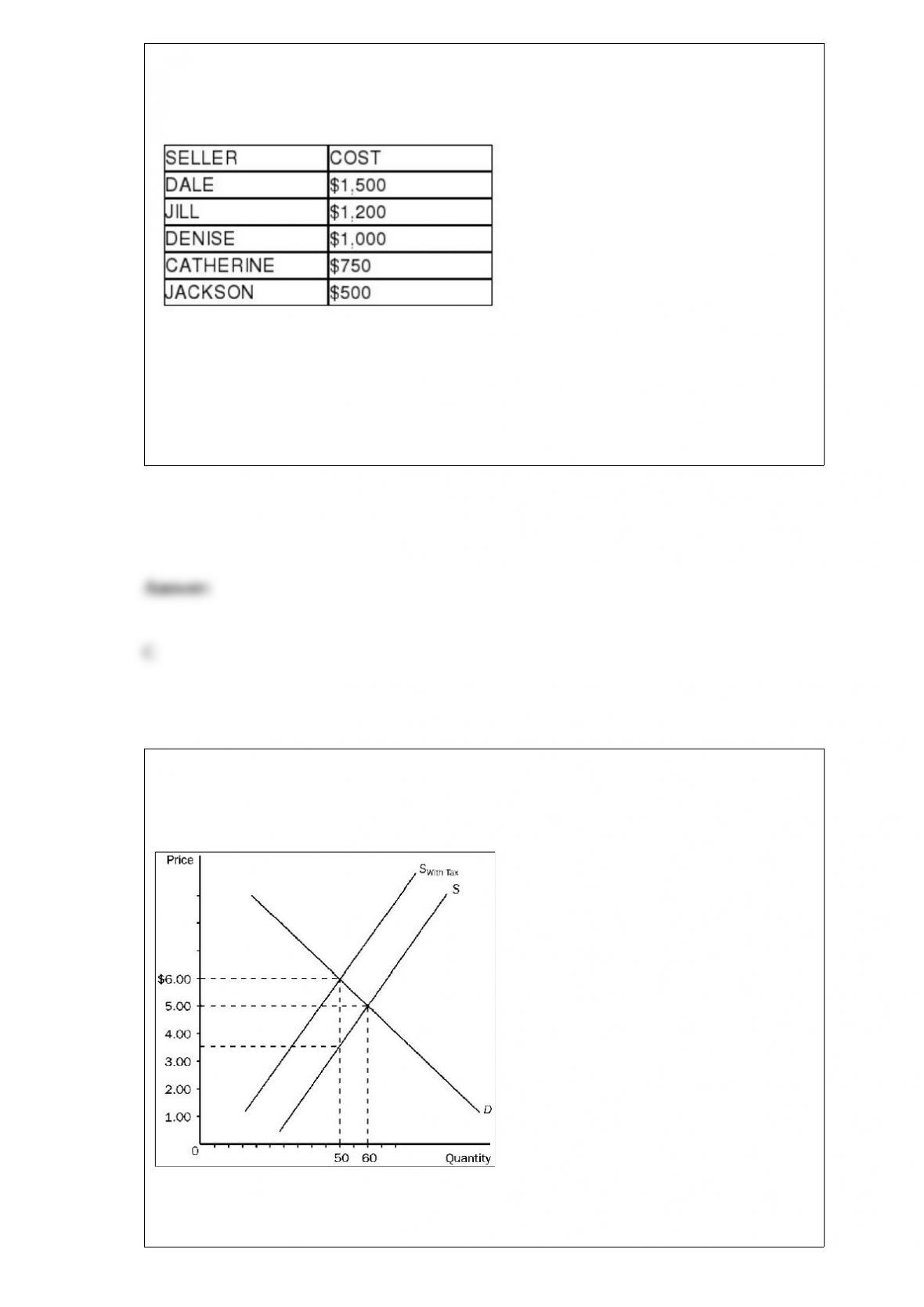
Table 3-2
Refer to Table 3-2. If the market price is $1,100, the combined total cost of all
participating sellers is
a. $3,700.
b. $2,700.
c. $2,250.
d. $1,500.
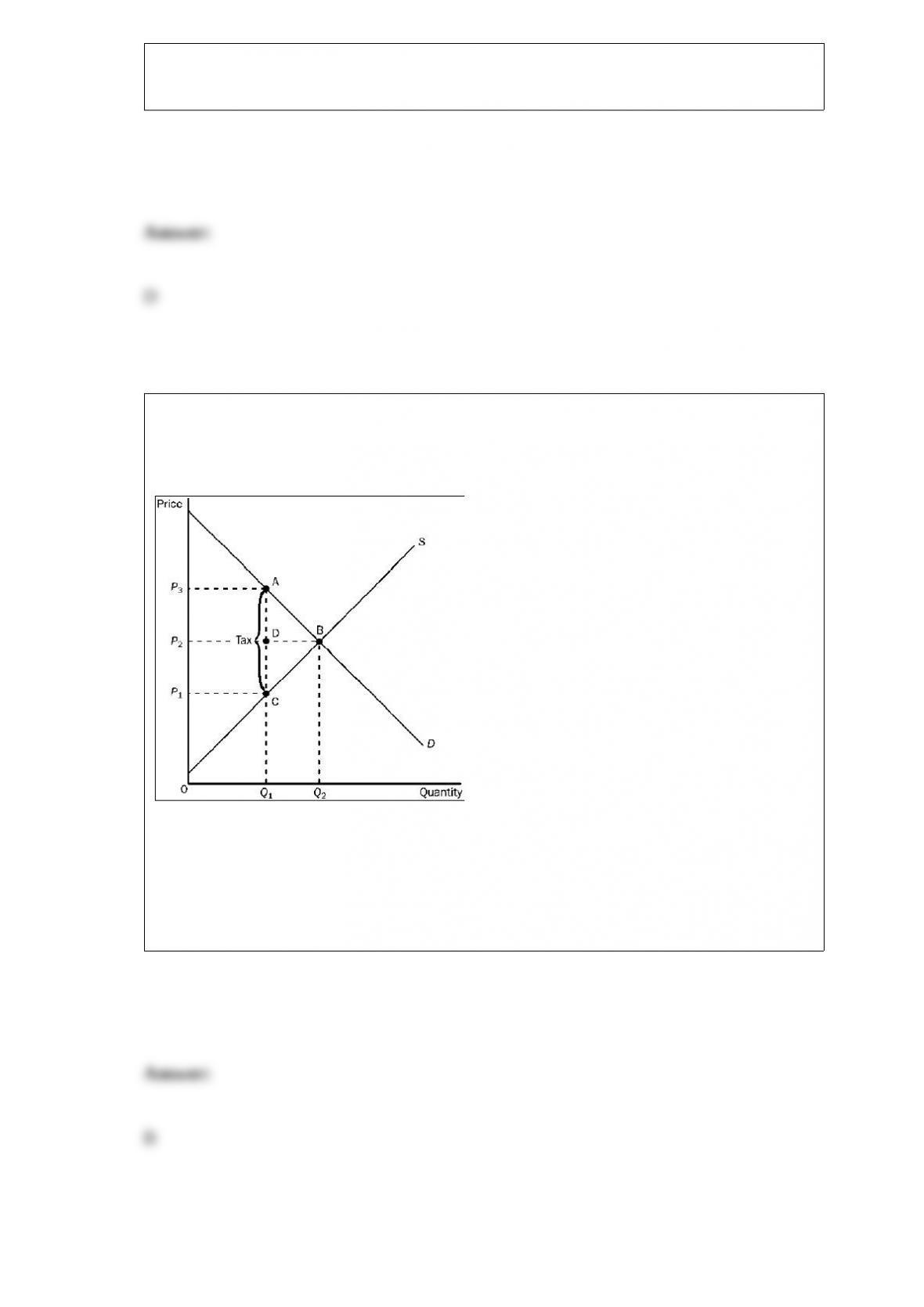
Figure 4-22
Refer to Figure 4-22. The price paid by buyers after the tax is imposed is
a. $1.00.
b. $3.50.
c. $5.00.
d. $6.00.
Figure 4-24
Refer to Figure 4-24. The amount of deadweight loss associated with the tax is equal to
a. P3 A C P1.
b. A B C.
c. P2 A D P3.
d. P1 D C P2.

When costs that vary with the level of output are divided by the output, you have
calculated
a. total changing cost.
b. total fixed cost.
c. average fixed cost.
d. average variable cost.
The price of a good will tend to rise when
a. there is excess demand for the good.
b. there is excess supply of the good.
c. demand for the good decreases.
d. the supply of the good increases.
When firms have an incentive to exit a competitive price-taker market, their exit will
a. lower market price.
b. necessarily raise the costs of firms that remain in the market.
c. raise profits for firms that remain in the market.
d. reduce demand for the product.
How would a decrease in the cost of production affect the market for video games?
a. Supply would decrease, leading to an increase in price and a reduction in quantity
sold.
b. Supply would decrease, leading to a reduction in price and a reduction in quantity
sold.
c. Supply would increase, leading to an increase in price and an increase in quantity
sold.
d. Supply would increase, leading to a reduction in price and an increase in quantity
sold.
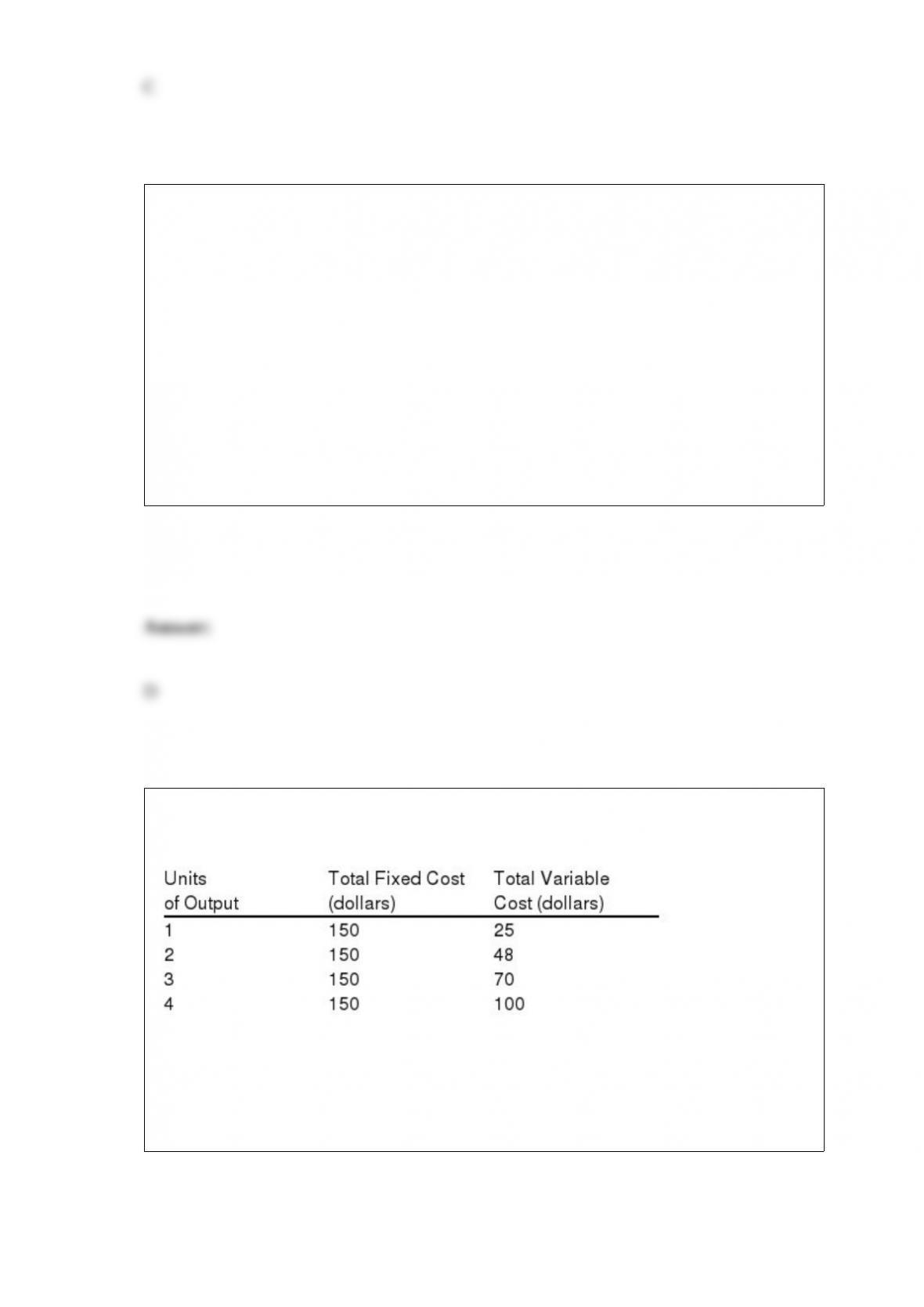
Use the table below to answer the following question.
What is the marginal cost of producing the third unit of output?
a. $22
b. $23.33
c. $73.33
d. This cannot be determined from the data.
If a group of sellers that can restrict entry into a market, they will often be able to
enlarge their total profit by
a. raising price and reducing output.
b. raising price and expanding output.
c. lowering price and expanding output.
d. raising price and leaving output unchanged.
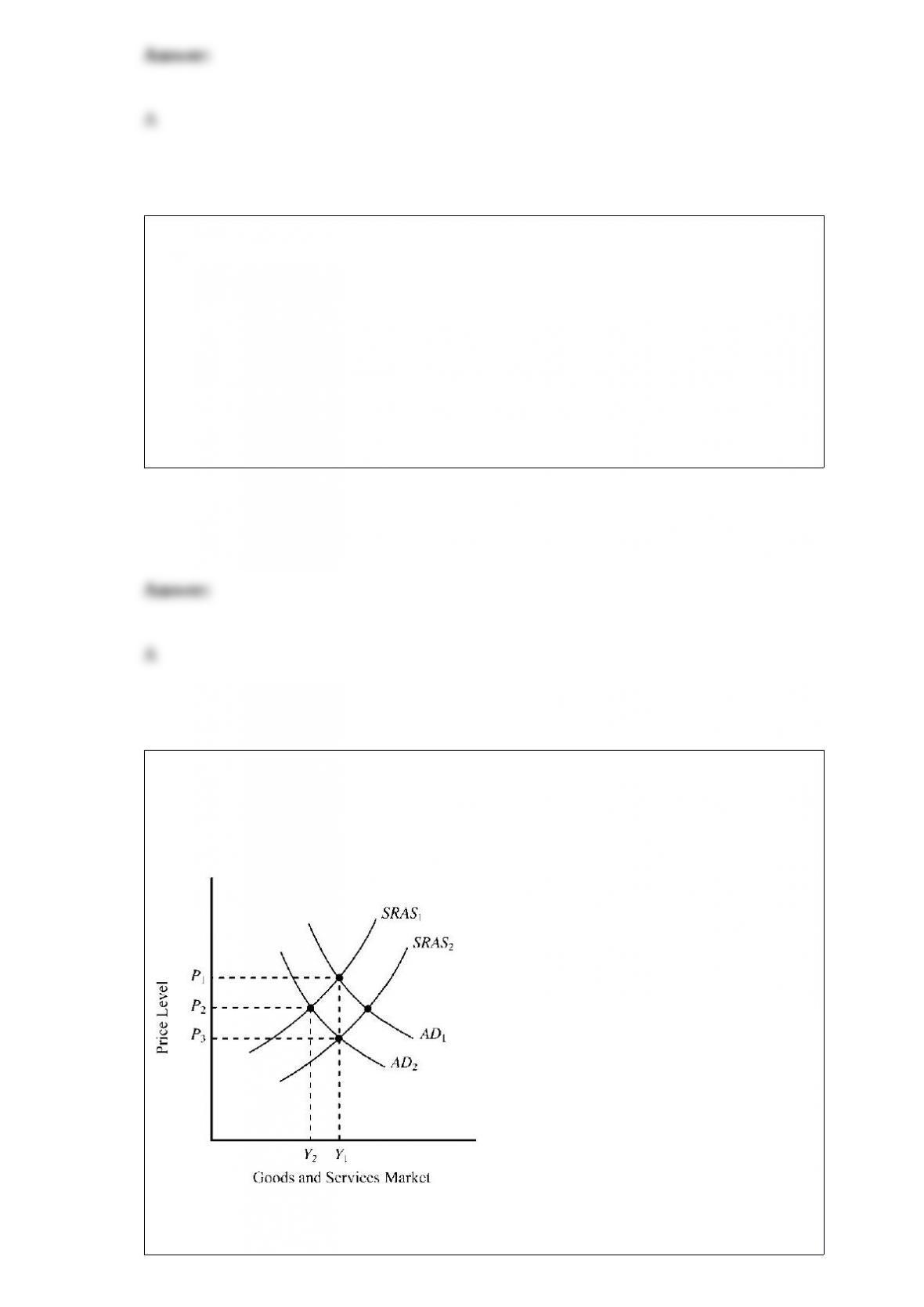
Use the figure below to answer the following question(s).
Figure 14-5
In Figure 14-5, AD1and SRAS1indicate an economy initially operating at
full-employment output level, Y1. The short-run impact of the Fed unexpectedly shifting

to a more restrictive monetary policy will be
a. a decrease in aggregate demand to AD2 and a decrease in real output to Y2.
b. a decrease in aggregate demand to AD2 but real output would remain at Y1.
c. a decrease in aggregate demand to AD2 and an increase in short-run aggregate supply
to SRAS2, causing the price level to fall to P3 and real output to remain unchanged at
Y1.
d. no change; AD and SRAS will stay at AD1 and SRAS1.
If consumers would be willing to purchase the same quantity of a good no matter what
its price was, the demand curve would
a. be a vertical line, and demand would be perfectly inelastic.
b. be a horizontal line, and the demand would be perfectly elastic.
c. not exist.
d. be identical to the supply curve for the good.
Economists refer to historical costs (irreversible costs already incurred) as
a. implicit costs.
b. sunk costs.
c. opportunity costs.
d. variable costs.

If the citizens of a country were to work harder and take less leisure time, it would
a. shift the production possibilities curve outward.
b. cause an economy to operate inside its production possibilities curve.
c. shift the production possibilities curve inward.
d. cause an economy to move from one point on the production possibilities curve to
another point on the curve.
The fact that voters perceive their votes as unlikely to actually change the outcome of
an election causes
a. voters to have little incentive to become informed about candidates and political
issues.
b. voters to spend a great deal of effort becoming informed about candidates and
political issues.
c. the percent of people who actually turn out to cast a vote on election day to be very
high.
d. people to be extremely reluctant to “waste” their votes on a third-party candidate.

Which of the following will always be true when an economy is in long-run
equilibrium?
a. The level of prices will be constant (that is, inflation will be zero).
b. Actual output will exceed the potential output.
c. The actual rate of unemployment will be less than the natural rate of unemployment.
d. The output of the economy will correspond with the full-employment output.