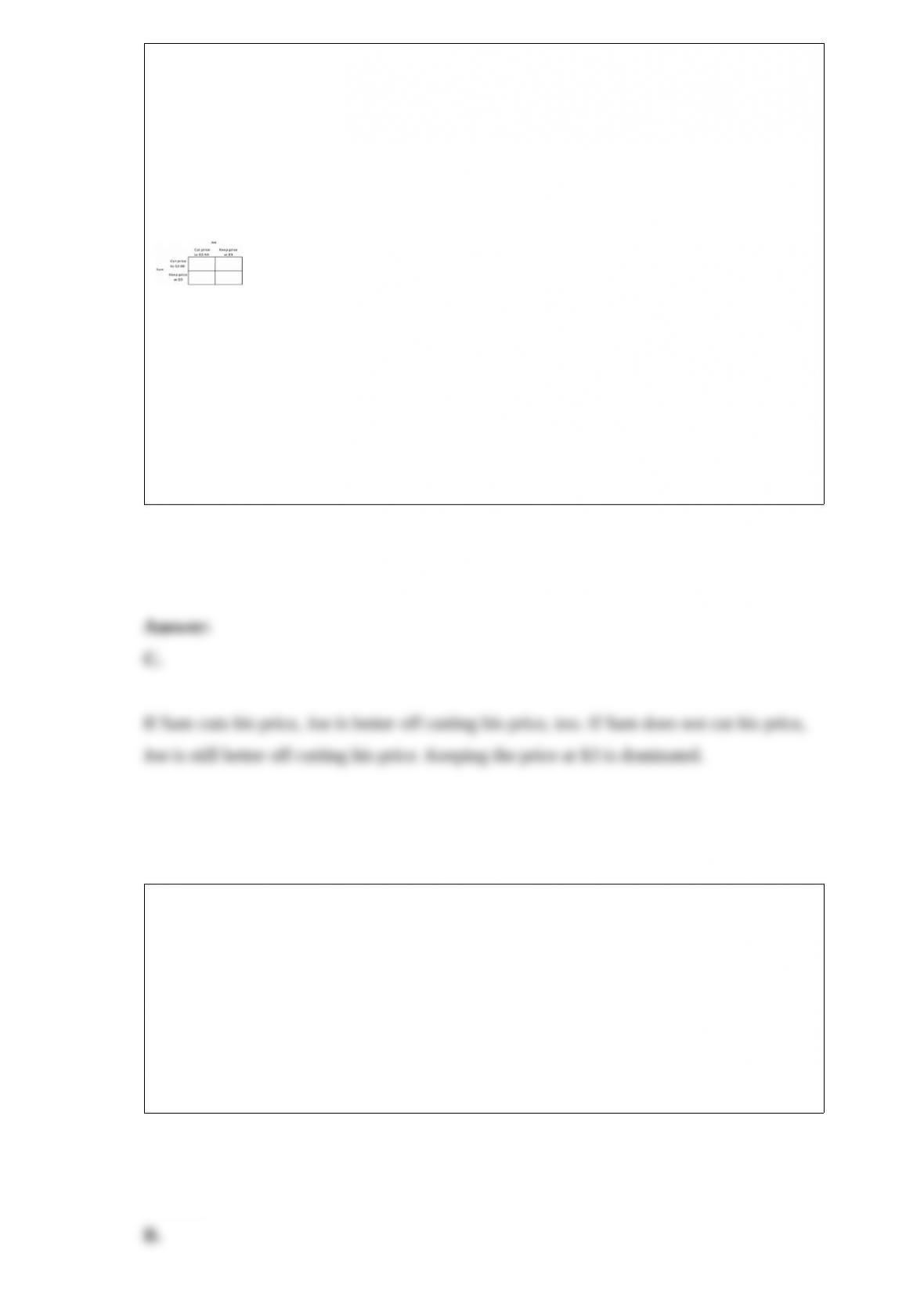
Joe is the owner of the 7-11 Mini Mart, Sam is the owner of the SuperAmerica Mini
Mart, and together they are the only two gas stations in town. Currently, they both
charge $3 per gallon, and each earns a profit of $1,000. If Joe cuts his price to $2.90 and
Sam continues to charge $3, then Joe’s profit will be $1,350, and Sam’s profit will be
$500. Similarly, if Sam cuts his price to $2.90 and Joe continues to charge $3, then
Sam’s profit will be $1,350, and Joe’s profit will be $500. If Sam and Joe both cut their
price to $2.90, then they will each earn a profit of $900. You may find it easier to
answer the following questions if you fill in the payoff matrix below.
For Joe, keeping his price at $3 per gallon is a:
A. revenue-maximizing strategy.
B. dominant strategy.
C. dominated strategy.
D. profit-maximizing strategy.
Which of the following is NOT an example of an explicit cost?
A. The overtime wages paid to workers.
B. The income the owner could have earned in his or her next best employment
opportunity.
C. The salaries paid to the managers who help run the business.
D. The rent the owner pays each month to lease office space.
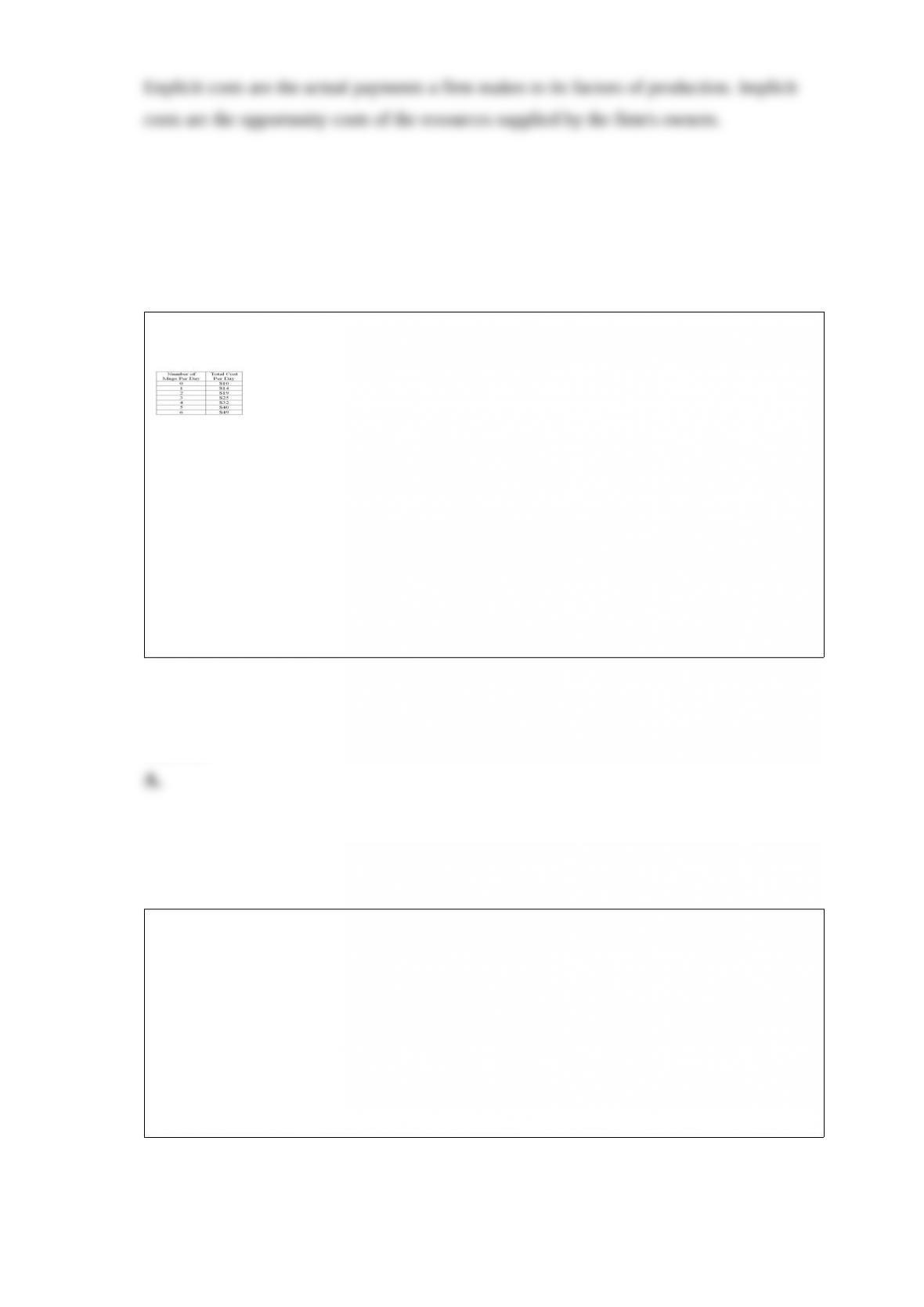
Suppose Chris is a potter who makes mugs. His total costs depend on the number of
mugs he makes each day, as shown in the table below.
If Chris’s fixed costs decrease, then in the short run his profit-maximizing level of
output will:
A. not change.
B. increase.
C. decrease.
D. only increase if he can earn a positive profit.
Where Y is GDP, C is consumption, I is investment, G is government spending, T is net
taxes, and there is no international trade, public saving equals:
A. T – G.
B. Y – T – C.
C. Y +T – G.
D. Y – C – T.
Current income minus spending on current needs equals:
A. saving.
B. wealth.
C. transfers.
D. investment.
The situation when the price of most goods and services are falling over time is called:
A. inflation.
B. disinflation.
C. a boom.
D. deflation.
The ongoing search by savers for high returns leads the bond and stock markets to
direct funds to the uses that appear:
A. most likely to be productive.
B. least likely to be productive.
C. to have the least risk.
D. to have no risk.
One hundred percent reserve banking refers to a situation in which banks’ reserves
equal 100 percent of their:
A. loans.
B. deposits.
C. profits.
D. income.
In the presence of the free-rider problem, the market will provide ______ of a good or
service.
A. more than the socially optimal quantity
B. the socially optimal quantity
C. less than the socially optimal quantity
D. either more than or less than the socially optimal quantity
Refer to the figure above. At a price of $20:
A. the market would be in equilibrium.
B. there would be excess supply of approximately 25 units.
C. there would be excess demand of approximately 25 units.
D. there would be excess demand, but it is impossible to know by how much.
A proportional tax results in:
A. a larger percentage of income going to taxes as income rises.
B. a smaller percentage of income going to taxes as income rises.
C. the same dollar amount going to taxes for all taxpayers.
D. the same percentage of income going to taxes for all taxpayers.
A good or service that is highly nonrival and highly nonexcludable is a(n) ______ good.
A. pure public
B. commons
C. collective
D. private
Which argument against enacting workplace safety regulations can be justified using
economic tools or observation?
A. If the value workers place on a safety device is greater than the cost of providing it,
then firms in a perfectly competitive labor market will want to install the device.
B. Historically, employers have provided safe working environments without
regulation.
C. According to the cost-benefit principle, the marginal cost of safety virtually always
exceeds the marginal benefit.

D. Insurance will cover most workplace injuries, so the safety regulations are
unnecessary.
Leo is a welfare recipient who qualifies for two means-tested cash benefit programs. If
he does not earn any income, he receives $225 from each program. For each dollar he
earns (which his employer is required to report to the welfare agency), his benefit from
each program is reduced by 75 cents until the benefit equals zero.If Leo values income
and not the source of the income, then if he can only earn $400 he will choose to:
A. work.
B. not work and refuse the benefits.
C. not work and accept the benefits.
D. work part time.
Refer to the figure below. If the price of a t-shirt is $10 and the price of a sweater is
$40, then the rational spending is satisfied when the consumer purchases ______
t-shirts and ______ sweaters.
A. 1; 4

B. 3; 2
C. 4; 4
D. 2; 3
Assume that this graph illustrates a perfectly competitive labor market.
Suppose a minimum wage law required the wage to be at least $20 per hour in this
market. If that happened, then:
A. there would be an excess supply of person-hours.
B. there would be excess demand for person-hours.
C. the demand for person-hours would shift to the right.
D. there would be no change the equilibrium number of person-hours.
Refer to the figure below. The marginal utility of the 4th dinner out per week is
A. 75.
B. 60.
C. 250.
D. 15.

The table below describes the relationship between the number of workers hired by a
call center each hour and the number of calls the call center can make each hour. The
call center has only 1 telephone. The telephone costs the firm $5/hour (regardless of
how many calls are made), and each worker is paid $10 per hour.
Given the information in the table above, what is the call center’s marginal cost when it
goes from making 6 to 16 calls an hour?
A. 50 cents
B. $2
C. $10
D. $20
One implication of the shape of the demand curve facing a perfectly competitive firm is
that:
A. if the firm increases its price above the market price, it will earn higher revenue.
B. if the firm decreases its price below the market price, it will earn higher revenue.
C. if the firm increases its price above the market price, it will earn zero revenue.
D. the market would be unable to reach a new equilibrium if demand changed.
Refer to the information below. It is clear that diminishing returns sets in after ______
workers per day.
A. 3
B. 4
C. 5
D. 6
The saving rate equals saving divided by:
A. wealth.
B. assets.
C. liabilities.
D. income.
A reserve requirement set by the Federal Reserve is the:
A. minimum ratio of reserves to bank deposits that commercial banks are allowed to
maintain.
B. maximum ratio of reserves to bank deposits that commercial banks are allowed to
maintain.
C. minimum amount of currency banks must hold in their vaults.
D. maximum amount of currency banks are allowed to hold in their vaults.
From society’s standpoint, positional arms races lead to outcomes that are ______.
A. dominant
B. desirable
C. inefficient
D. efficient
Public saving is negative when:

A. there is a government budget surplus.
B. there is a government budget deficit.
C. the government’s budget is balanced.
D. after-tax income of households and businesses is greater than consumption
expenditures.
Suppose that all workers value a safe job $2,000 per year more than a risky job. The
cost to firms of providing a safe job is $700 per year for each worker. Firms currently
pay workers $35,000 per year, without any effort to improve safety. If new firms began
to offer workers $34,000 per year and safe jobs, the value workers would place on the
new firms’ offer would be ______ compared to ______ at the existing firms.
A. $1,000; $0
B. $1,000; $1,000
C. $34,000; $33,000
D. $36,000; $35,000
The following data give the dates of successive turning points in U.S. economic activity
and the corresponding levels of real GDP at the time.
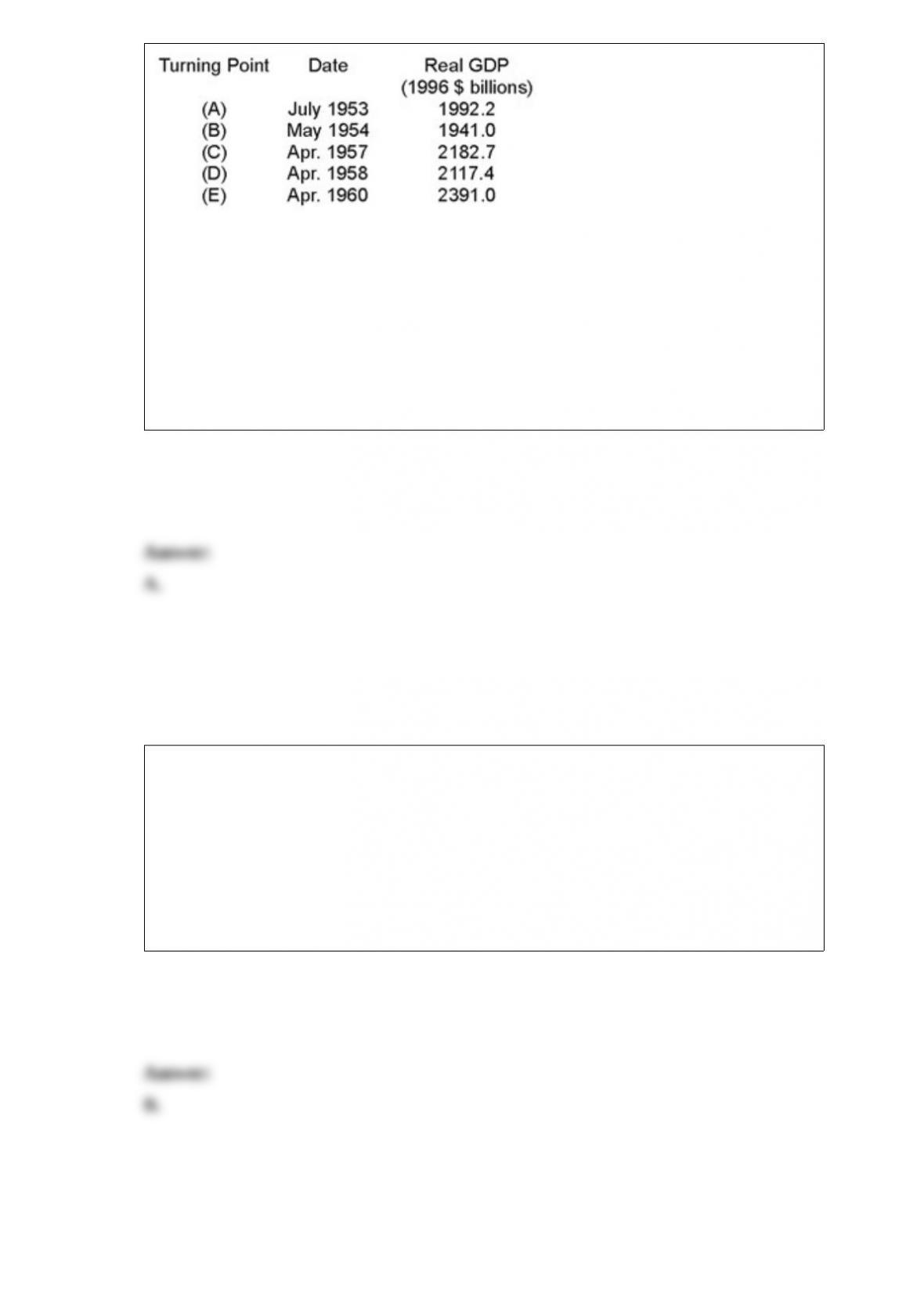
The economy experienced a recession that lasted from:
A. July 1953 to May 1954.
B. May 1954 to April 1957.
C. July 1953 to April 1957.
D. May 1954 to April 1958.
The essential cause of the tragedy of the commons is the fact that:
A. marginal costs are increasing.
B. one person’s use of a commonly held resource imposes an external cost on others.
C. people do not always specialize according to their comparative advantage.
D. governments may choose not to tax activities that generate negative externalities.
Refer to the figure above. Assume demand remains unchanged at D1. If supply shifts
from S2 to S1, then the equilibrium price will ________ and the equilibrium quantity
will __________.
A. rise; fall
B. rise; rise
C. fall; fall
D. fall; rise
Assume that the graph below describes the current labor market for nurses in a
mid-sized city and that the labor market is perfectly competitive.
If supply shifts from S0 to S1and demand shifts from D0 to D1, then
A. wages will have to rise to $60 to avoid a nursing shortage.
B. wages will have to rise to $50 to avoid a nursing shortage.
C. a wage of $40 will be sufficient to achieve equilibrium.
D. a wage of $50 will lead toan excess supply of nurses.
Which of the following is a flow?
A. Saving
B. Wealth
C. Assets
D. Money
According to the textbook, the reason the government requires safety seats for infants
who travel in cars but not for infants who travel in airplanes is that:
A. safety seats do not reduce the risk of injury when travelling by airplane.
B. people incorrectly believe that cars are more dangerous than airplanes.
C. the cost of using safety seats in airplanes outweighs their benefit.
D. airlines would lose money if infants were required to use safety seats.
Suppose that a new drug has been approved to treat a life-threatening disease. The
demand for that drug is shown on the graph below. Prior to approval of this drug, the
only treatment for this condition was any one of several non-prescription, or
over-the-counter, pain relievers. The demand for one brand of the several
non-prescription pain relievers is also shown on the graph.
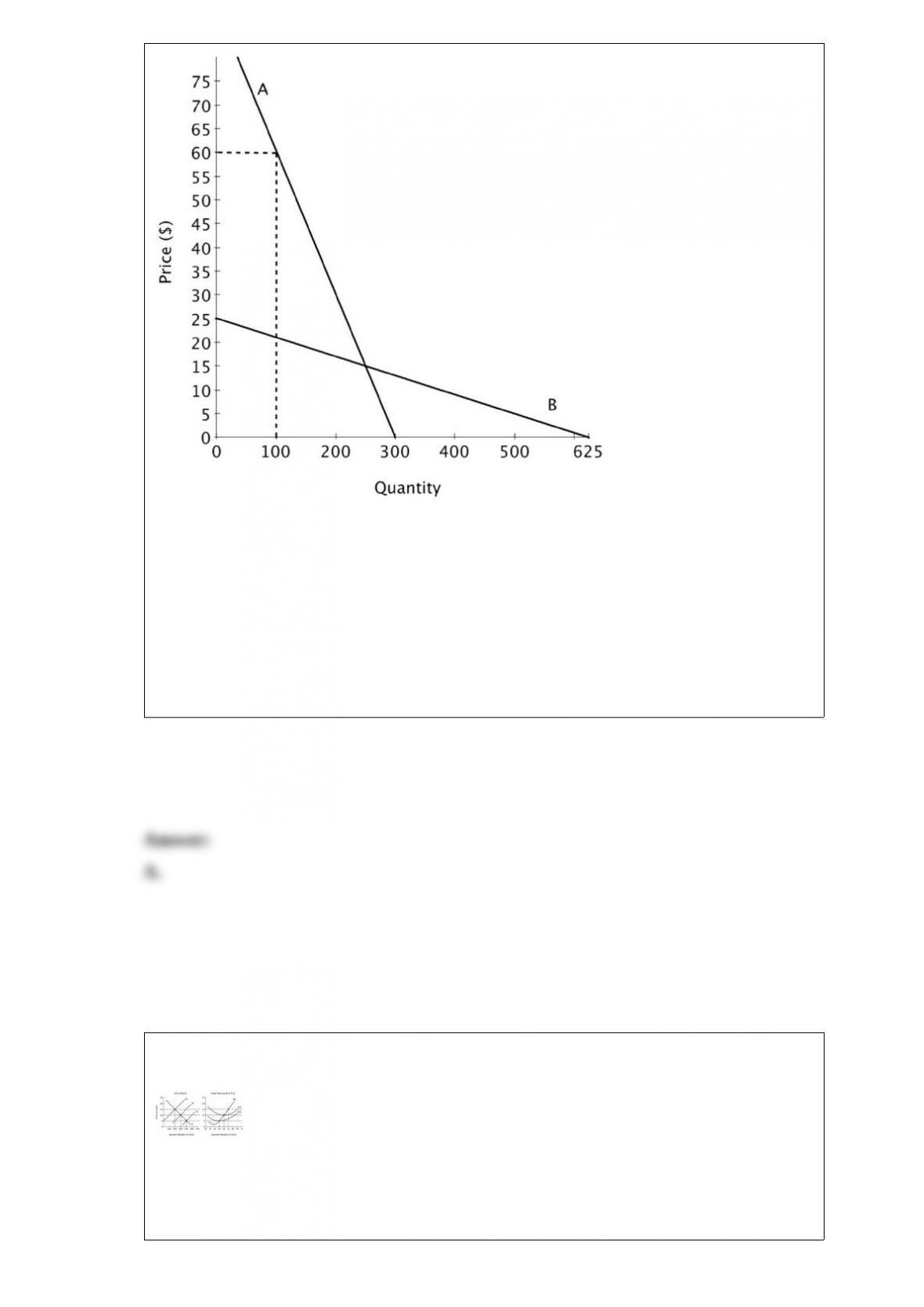
Demand for the new drug is ______ while demand for one brand of the
over-the-counter pain relievers is ______.
A. the line labeled A; the line labeled B
B. the line labeled B; the line labeled A
C. the horizontal line at $60; the line labeled B
D. the vertical line at 100; the line labeled A
Assume that all firms in this industry have identical cost curves, and that the market is
perfectly competitive.
The firm depicted in the graph on the right faces a demand curve that is:
A. horizontal at the market price.
B. less than the market demand curve.
C. the same as the marginal cost curve.
D. the same as the market demand curve.