In reality, commercial banks function most like ____ of the district Federal Reserve
Banks.
a. stockholders
b. regulators
c. customers
d. competitors
Politicians and citizens may often choose policies that reduce economic efficiency
because they are perceived as “fairer.”
a. True
b. False
One of the initial problems facing the newly elected President Clinton was a large
budget deficit.
a. True
b. False
On May 11, 2011, it cost 11.601 Mexican pesos to buy one U.S. dollar. How many U.S.
dollars did it take to buy a Mexican peso?
a. $11.11
b. $10.82
c. $8.92
d. $0.09
Firms that maximize sales always produce more than profit-maximizing firms.
a. True
b. False
When total expenditures exceed the economy’s potential GDP, the proper fiscal policy is
to
a. increase transfer payments to the poor and elderly.
b. cut personal income tax rates.
c. decrease government purchases.
d. increase purchasing power.
As a result of the Great Recession, job growth did not resume until
a. September 2008
b. March 2009
c. September 2009
d. March 2010
Economies of scale tend to create natural monopolies.
a. True
b. False
Free markets produce allocatively efficient outcomes and have no flaws.
a. True
b. False
The tax cuts of 2008 and 2009 were effective because consumers believed that they
were temporary.
a. True
b. False
Which of the following factors has the most quantitative importance on the
oversimplified multiplier formula?
a. it ignores variable imports

b. it ignores price-level changes
c. it ignores income taxes
d. All of these equally affect the oversimplified multiplier formula
If the marginal utility of apples exceeds the marginal cost of producing apples, then in a
free market production of apples will ____, with the likely result that marginal utility
will ____.
a. rise; fall
b. fall; rise
c. rise; rise
d. fall; fall
An example of an in-kind benefit is
a. a welfare payment.
b. capital gains.
c. a charitable contribution of money.
d. public housing.
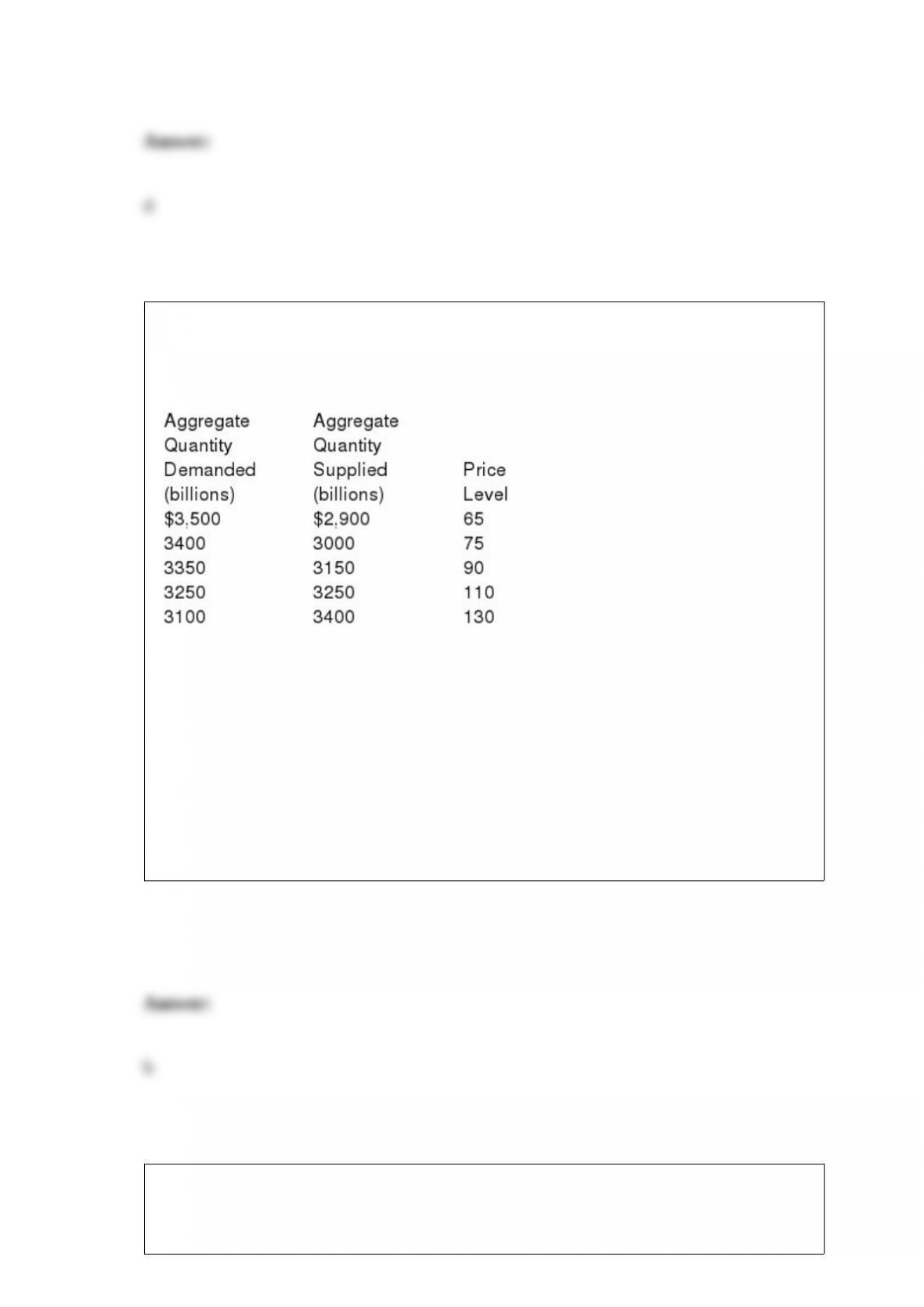
Table 10-1
In Table 10-1, if full employment occurs at $3,400 billion, then
a. the economy experiences a recessionary gap of $75 billion.
b. the economy experiences a recessionary gap of $150 billion.
c. the economy experiences an inflationary gap of $75 billion.
d. the economy experiences an inflationary gap of $150 billion.
Which of the following is a series of rules that stops trading on an exchange for a
relatively short period of time?
a. program trading
b. market limits
c. stop orders
d. circuit breakers
Economists expect the relationship between consumption and disposable income to be
a. unpredictable.
b. transitory.
c. fixed.
d. inverse
e. stable.
Recessions are periods of declining economic activity.
a. True
b. False
What rule must be followed to obtain an efficient allocation of resources?
a. P = AC.
b. P = MC.
c. P = AR.
d. MR = AC.
As the U.S. dollar’s foreign exchange value falls, we should expect to see
a. more Americans travelling abroad.
b. American import levels rising.
c. more foreigners visiting the United States.
d. increased foreign investment by American firms.

The Fed is institutionally independent. A major disadvantage of this is that monetary
policy
a. will always be coordinated with fiscal policy.
b. is not subject to democratic control as other policies are.
c. will never offset fiscal policy.
d. cannot be changed once it has been instituted.
Why is monetary policy more effective in an open economy than in a closed economy?
a. Trade deficits affect exchange rates, which can offset adverse interest rate effects.
b. Borrowers can choose to use foreign capital, so that interest rate effects are stronger
than expected.
c. Interest rate changes affect exchange rates, so that capital flows reinforce the effect of
monetary policy.
d. Banks can choose to lend to foreigners, so that interest rate effects are essentially
nullified.
Income taxes and transfer payments help prevent extreme macroeconomic fluctuations.
a. True
b. False
In the short run, an increase in the quantity of money normally
a. has no effect; in the long run, V will increase.
b. has no effect; in the long run, V will decrease.
c. results in an increase in velocity.
d. results in a decrease in velocity.
Interest is the payment for the use of funds.
a. True
b. False
The Federal Reserve may choose to monetize the debt in order to
a. reduce the burden of the national debt.
b. shift the supply curve of money outward.
c. shift the demand curve for money inward.
d. reduce the volume of reserves in commercial banks.
Assume the required reserve ratio is 10 percent and the FOMC orders an open market
sale of $50 million in government securities from member banks. If the oversimplified
money multiplier is assumed, then the money supply will
a. increase by $500 million.
b. increase by $100 million.
c. decrease by $100 million.
d. decrease by $500 million.
A society’s decision to produce more tanks may require it to forgo production of some
cars.
a. True
b. False
General Motors Corporation (a U.S.-based firm) produces a Saab vehicle in Sweden,
and sells it in the United States. In which country’s GDP is it included?
a. Sweden and the United States
b. The United States because it was sold there
c. The United States because GM is a U.S. company
d. Sweden because it was produced there
An economist would say the price is too high for a certain service if
a. poor people couldn’t afford to buy it.
b. nobody could afford to buy it.
c. the price was above marginal cost.
d. it is an essential service and consumes a significant share of income.
The origin of the Phillips curve is the idea that an increase in
a. AD will lead to more inflation and more unemployment.
b. AD will lead to more inflation and lower unemployment.
c. AS will lead to lower inflation and lower unemployment.
d. AS will lead to less inflation and higher unemployment.
Externalities can cause the market mechanism to
a. malfunction.
b. improve.
c. operate efficiently.
d. move up toward the production possibility curve.
On the Micronesian island of Yap, the money that is primarily used as currency is
a. paper money.
b. wheels made of stone.
c. gold.
d. shells and gems.
From 2004 to 2008, the federal budget deficit, on an official fiscal-year basis was
a. large and growing larger.
b. “negative,” that is, the budget was in surplus.
c. declining.
d. increased by the rising Social Security deficit.