
1) Assume that, under a system of floating exchange rates, Mexicans decide to increase
their investments in the United States. As a result:
A.the peso and the dollar will both depreciate.
B.the peso and the dollar will both appreciate.
C.the peso will depreciate and the dollar will appreciate.
D.the peso will appreciate and the dollar will depreciate.
2) the basic purpose of the other-things-equal assumption is to:
a.allow one to reason about the relationship between variables x and y without the
intrusion of variable z.
b.allow one to focus upon micro variables by ignoring macro variables.
c.allow one to focus upon macro variables by ignoring micro variables.
d.determine whether x causes y or vice versa.
3) Consider the mining of a nonrenewable resource over a two-year period by a
company.
(a)Use a graph to help explain the choice between present and future extraction of a
nonrenewable resource over a two-year period. In the explanation state the difference
between extraction and user cost.
(b)How does the addition of user cost to extraction costs affect the quantity extracted in
the present compared with the future?
(c)How do profit calculations influence the quantity extracted the first year or the
second year?
(d)What will happen to the quantity extracted in the present compared with profitability
increase in the future? Explain the effects on the graph.
4) (Last Word) The U.S. sugar price support program has:
A.cost U.S. consumers much more than it has benefited U.S. sugar producers.
B.cost U.S. consumers much less than it has benefited U.S. sugar producers.
C.reduced the price of sugar to U.S. consumers.
D.increased sugar imports as a percentage of U.S. sugar consumption.
5)
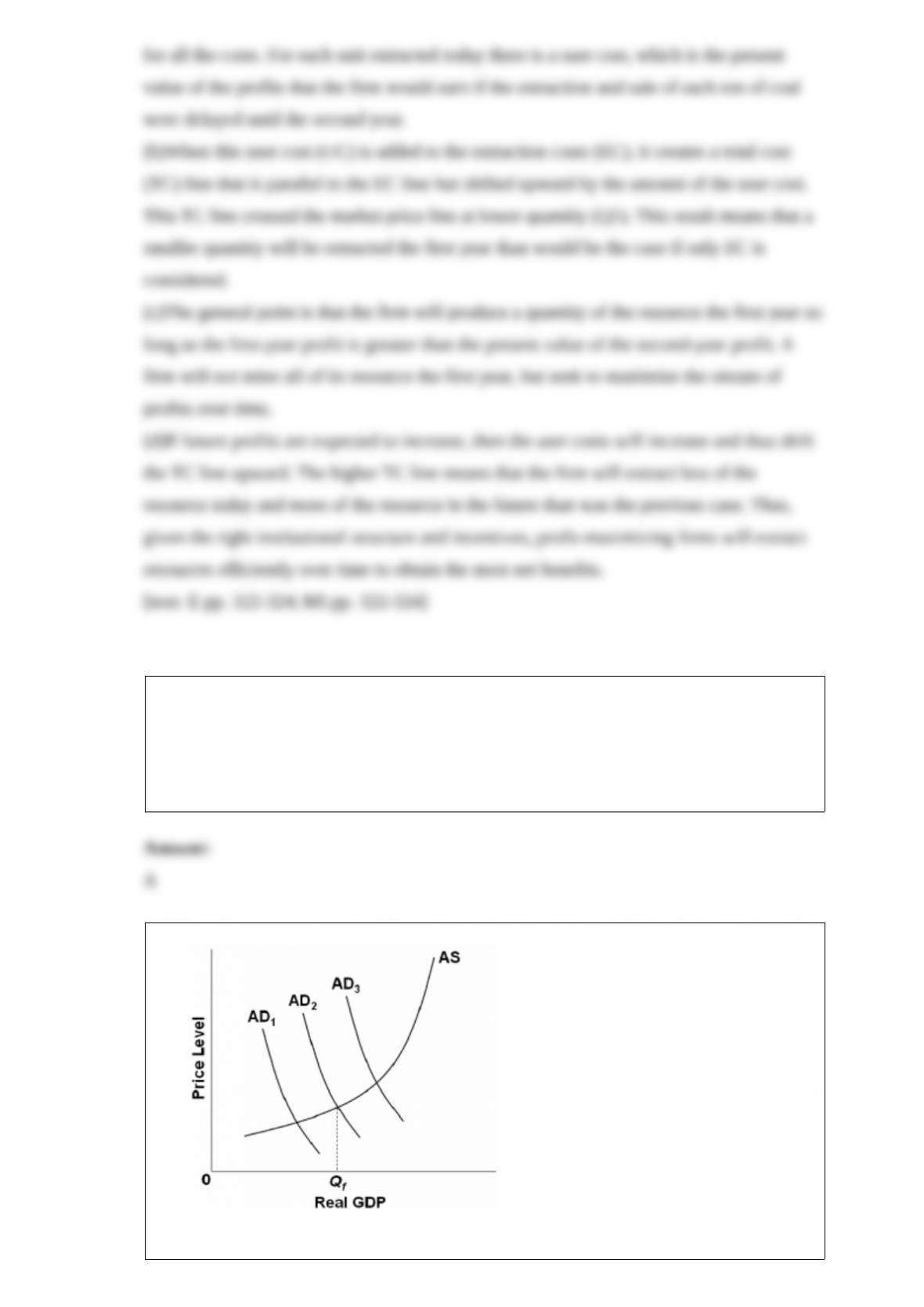
Refer to the above diagram, in which Qf is the full-employment output. If aggregate
demand curve AD1describes the current situation, appropriate fiscal policy would be to:
A.increase taxes and reduce government spending to shift the aggregate demand curve
rightward to AD2.
B.reduce taxes on businesses to shift the aggregate supply curve leftward.
C.reduce taxes and increase government spending to shift the aggregate demand curve
from AD1to AD2.
D.do nothing since the economy appears to be achieving full-employment real GDP.
6)
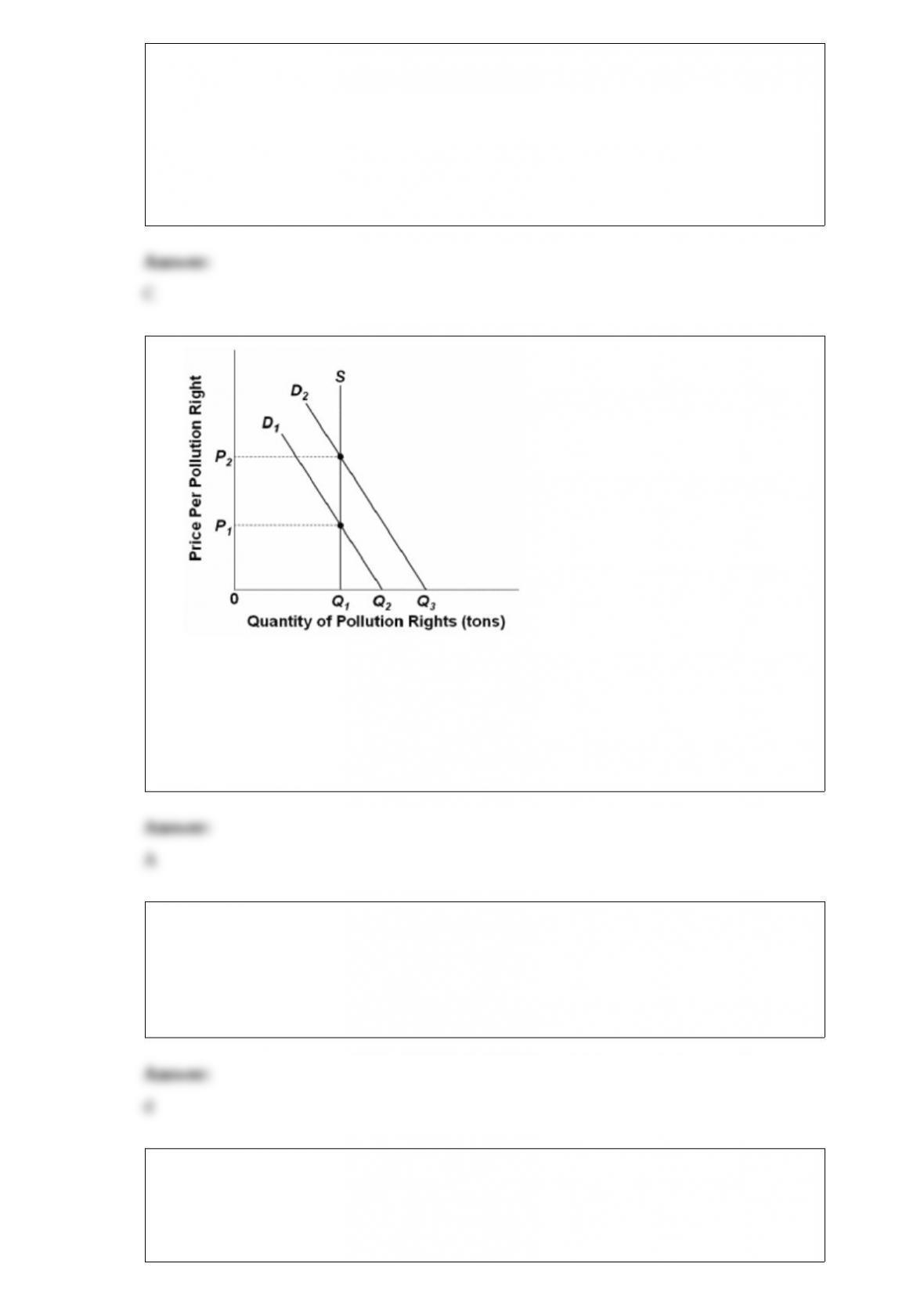
Refer to the above diagram of a market for pollution rights. Without this market for
pollution rights, the quantity (tons) of pollution would be:
A.Q3, if demand is D2.
B.Q1, if demand is D1.
C.Q2, if demand is D2.
D.Q1, if demand is D2.
7) which of the following is a land resource?
a.a farmer
b.an oil drilling rig
c.a machine for detecting earthquakes
d.natural gas
8) which of the following is a land resource?
a.a computer programmer
b.a computer
c.silicon (sand) used to make computer chips

d.a piece of software used by a firm
9) if personal income exceeds national income in a particular year, we can conclude
that:
a.transfer payments exceeded the sum of social security contributions, corporate income
taxes, and taxes on production and imports.
b.the sum of social security contributions, corporate income taxes, and undistributed
corporate profits exceeded transfer payments.
c.consumption of fixed capital and taxes on production and imports exceeded personal
taxes.
d.transfer payments exceeded the sum of social security contributions, corporate
income taxes, and undistributed corporate profits.
10) purposeful behavior suggests that:
a.everyone will make identical choices.
b.resource availability exceeds economic wants.
c.individuals will make different choices because of different desired outcomes.
d.an individual’s economic goals cannot involve tradeoffs.
11) gdp is:
a.the monetary value of all goods and services (final, intermediate, and non-market)
produced in a given year.
b.total resource income less taxes, saving, and spending on exports.
c.the economic value of all economic resources used in the production of a year’s
output.
d.the monetary value of all final goods and services produced within a nation in a
specific year.
12)
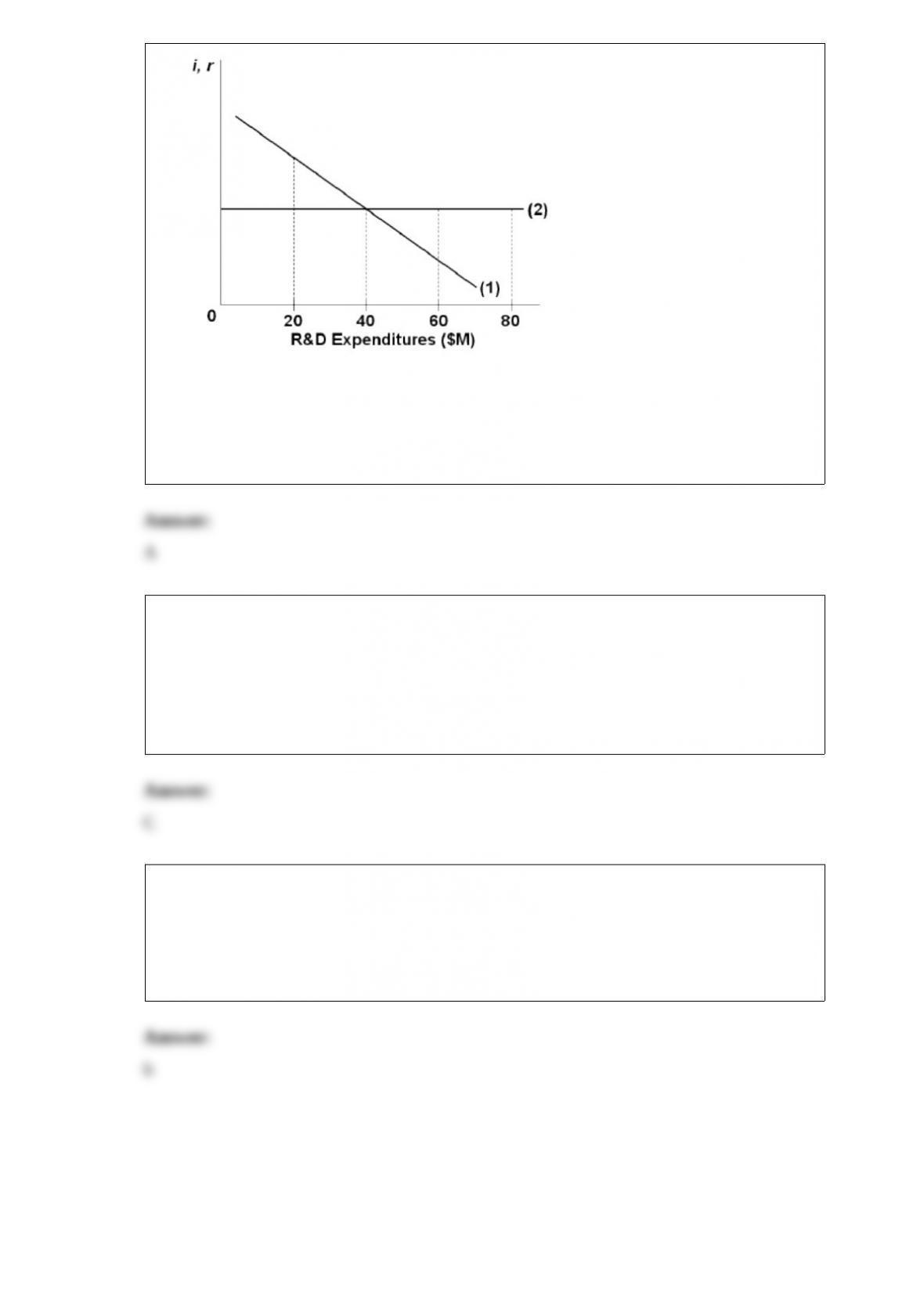
In the above diagram, at $10 million of R&D expenditure the:
A.expected rate of return exceeds the interest rate cost of funds.
B.firm is spending an optimal amount on R&D.
C.interest rate cost of funds exceeds the expected rate of return.
D.marginal benefit of R&D is less than the marginal cost of R&D.
13) Suppose that unintended increases in inventories are occurring in a mixed closed
economy. We can surmise that:
A.Ig + T > Sa + G.
B.T + G > Sa + Ig.
C.T + Sa > Ig + G.
D.T + Sa < Ig + G.
14) a purely monopolistic industry:
a.has no entry barriers.
b.has a downward sloping demand curve.
c.produces a product or service for which there are many close substitutes.
d.earns only a normal profit in the long run.
15)
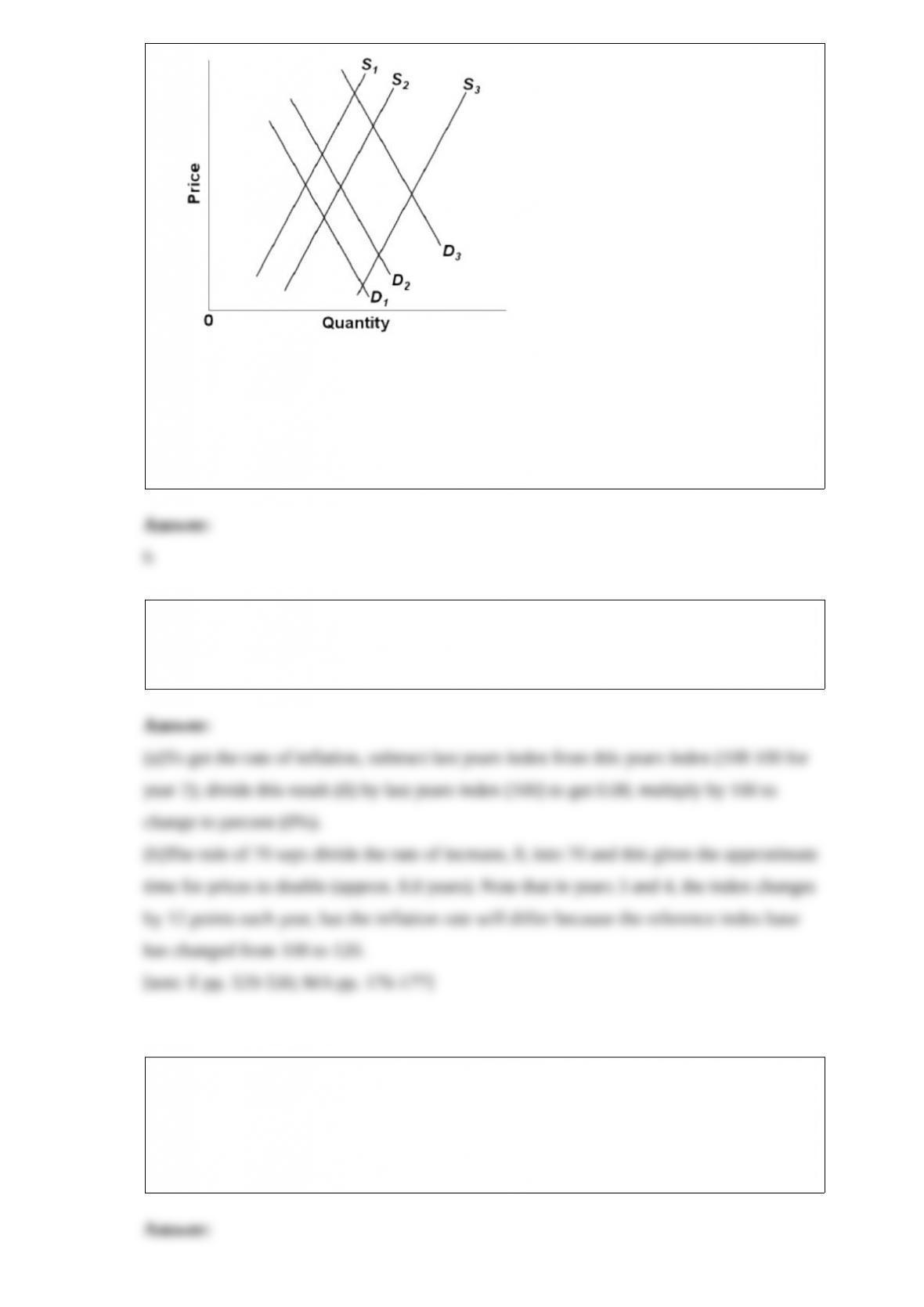
refer to the above figure that shows the market for u.s. health care. other things equal,
which of the following would shift the supply curve for medical care from s2 to s1?
a.an aging population.
b.cost-increasing medical technology.
c.expansion of the medicare program to include prescription drugs.
d.lower medical malpractice insurance premiums.
16) The table below shows the price index in the economy at the end of four different
years. (a) What is the rate of inflation in years 2, 3, and 4? (b) Using the rule of 70, how
many years would it take for the prices to double at each of these three inflation rates?
17) In terms of individual nations, the largest U.S. trade deficit is with:
A.Japan.
B.Mexico.
C.China.
D.Canada.
18) Describe the relationship between the size of the MPC and the multiplier. How does
it compare to the relationship between the size of the MPS and the multiplier?
19) What is the World Bank? Explain its primary purpose.
20) How would you describe the demand curve for the purely competitive firm? For the
industry?
21) Who are the poor in the United States? How many people and what groups are most
affected by poverty?
22) What conditions gave rise to the Temporary Assistance to Needy Families (TANF)
program?
23) Why is marginal revenue less than price for every level of output except the first?
24) What is the difference between the short run, long run and very long run?
25) State four factors that explain why investment spending tends to be unstable.
26) Why does price equal marginal revenue for the purely competitive firm? What is
the relationship to the demand curve for the firm?
27) What are the effects of a reciprocity strategy on game outcomes?