
Exhibit 34-2
The U.S. demand and supply for a good are shown. Under a policy of free trade, the
world price is PW. At this price, consumers’ surplus equals the area of
a. PW DE.
b. PW AB.
c. PW AC.
d. PW PNBD.
For a bank, more capital means more _____________, and it also means ___________
returns when asset values are rising.
a. risk; lower
b. risk; higher
c. safety; lower
d. safety; higher

All economists agree that the worldwide benefits of globalization are likely to be
greater than the worldwide costs.
a. True
b. False
The act of selling goods abroad at a price below their cost and below the price charged
in the domestic market is called
a. dumping.
b. slumping.
c. export manipulation.
d. constraining.
e. none of the above
If the (average) tax rate is cut by 10%, and as a result the tax base rises by 15%, tax
revenues will rise.

a. True
b. False
You turn to the bond market page of a newspaper and look under the column headed
“Net Chg” and see that it says, “-1/4” this indicates that
a. the closing price for the bond on this particular day was $2.50 lower than on the
previous day.
b. the closing price for the bond on this particular day is $0.25 lower than on the
previous day.
c. the yield for the bond has fallen by 0.25% compared to the previous day.
d. the yield for the bond has fallen by 0.25% compared to exactly one year ago.
Exhibit 9-4

When AD and SRAS cross at point (P1, Q3), the economy is in
a. a recessionary gap.
b. an inflationary gap.
c. long-run equilibrium.
d. a and c
e. b and c
The sale of __________ goods is omitted from current GDP because __________.
a. intermediate goods; these goods do not constitute production
b. used goods; these goods were counted in an earlier year
c. illegal; these goods do not constitute economic value
d. b and c
e. a, b, and c

All other things being equal among the banks below, which bank is the least likely to
become insolvent?
a. Bank A with assets of $100 million and liabilities of $80 million.
b. Bank B with assets of $100 million and liabilities of $70 million.
c. Bank C with assets of $200 million and liabilities of $120 million.
d. Bank D with assets of $400 million and liabilities of $310 million.
e. Bank E with assets of $100 million and liabilities of $60 million.
Which of the following statements best represents the law of supply?
a. Price and quantity supplied are inversely related.
b. Price and quantity supplied are directly related.
c. Price and quantity supplied are inversely related, ceteris paribus.
d. Price and quantity supplied are directly related, ceteris paribus.
e. Price and supply are directly related, ceteris paribus.

Which of the following statements is true?
a. There are more farms today than at the beginning of the 20th century.
b. An individual farmer prefers good weather to bad weather, but farmers as a group
may prefer bad weather to good weather, especially if the demand for their products is
inelastic.
c. Income elasticity of demand measures the responsiveness of a change in quantity
supplied to changes in income.
d. a and b
e. b and c
The number of unskilled workers employed before and after a change in the minimum
wage is found to be the same. This means
a. the minimum wage change did not affect the unskilled labor market.
b. nothing, unless we also know that the number of hours worked by each worker has
not changed.
c. the minimum wage could be below the equilibrium wage for unskilled labor.
d. either b or c
e. none of the above

For Adam, the opportunity cost of producing one unit of good A is ____________
unit(s) of good B.
a. 3.00
b. 0.33
c. 0.75
d. 1.33
Which of the following statements is false?
a. Government can remove individuals from a prisoner’s dilemma setting and make
them better off.
b. In a prisoner’s dilemma setting, it is impossible for the government to define and
enforce property rights that the individuals involved in the setting want to have defined
and enforced.

c. As long as government charges each individual in a prisoner’s dilemma setting a tax
that is less than the gain received by being removed from the setting, then government
has made the individuals better off.
d. Depending upon the amount of the tax charged to each individual in a prisoner’s
dilemma setting, the government can make both persons better off, both persons worse
off, or one person better off and the other person worse off.
If a theory can predict those things that you should observe if it is right and can also
predict those things that you should observe if it is wrong, it is said to have the virtue of
falsifiability.
a. True
b. False
Economist B thinks that it is important to identify the condition(s) under which the case
for government is strongest.With respect to the provision of nonexcludable public
goods, she says
a. people must pay taxes to pay for the nonexcludable public good.
b. firms must pay taxes to pay for the nonexcludable public good.
c. people must actually want the nonexcludable public good that the government
provides.
d. people must express their desire for the nonexcludable public good by voting for it.

e. none of the above
If, under a fixed exchange rate system, the dollar price of a Mexican peso is below its
equilibrium level, then the
a. dollar is overvalued.
b. peso is overvalued.
c. dollar has depreciated.
d. peso has appreciated.
Exhibit 17-3
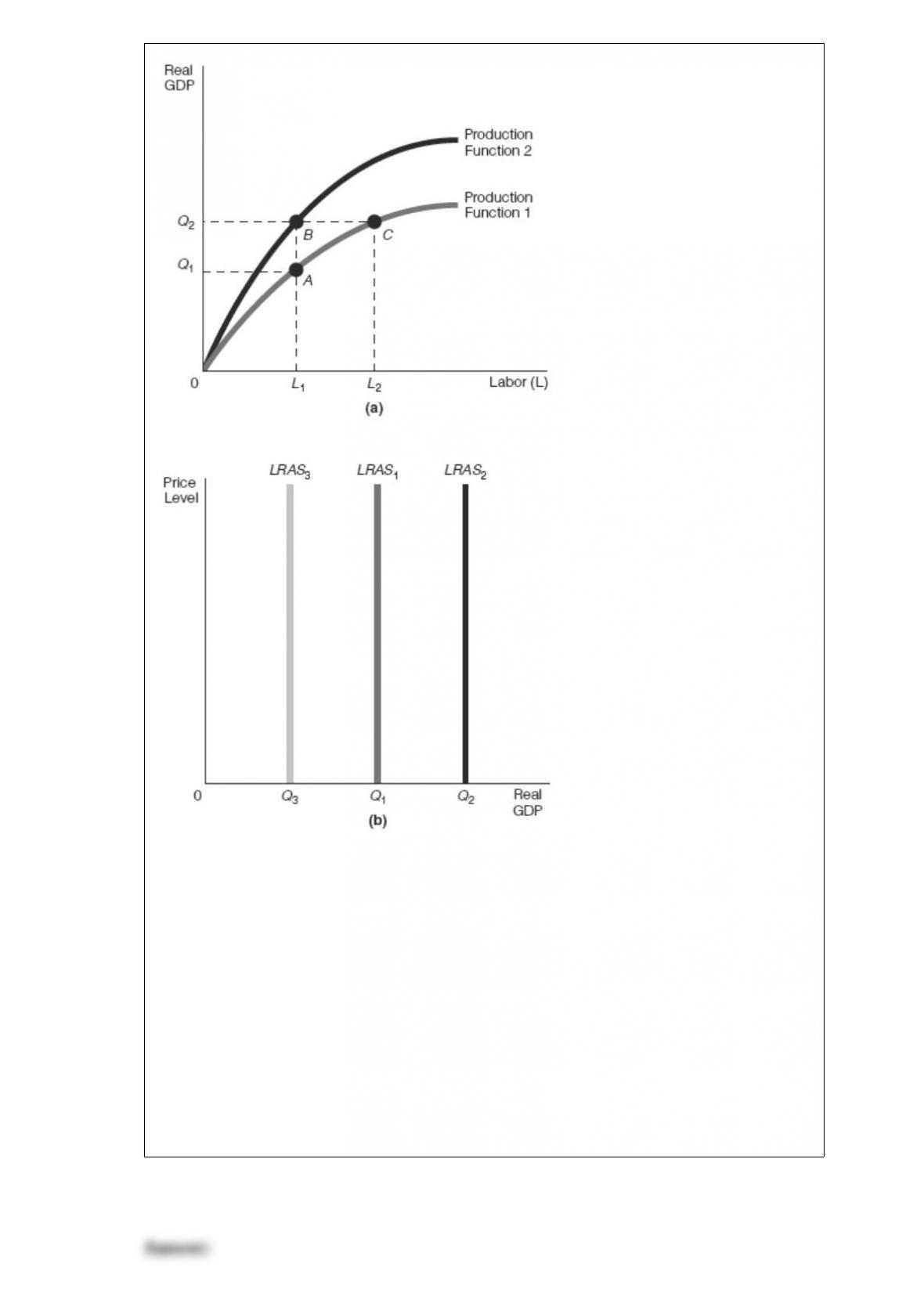
Assume that the starting point on the production function is point A.After an increase in
the quantity of labor, there would be a ______________________ which would shift
the LRAS curve from LRAS1 to _______________ resulting in _______________..
a. movement along the production function to point C; LRAS2; economic growth
b. shifting upward of the production function to point B; LRAS2; economic growth
c. movement along the production function to point C; LRAS3; a shrinking economy
d. shifting upward of the production function to point B; LRAS3; a shrinking economy