
1) The largest budgetary expense for the federal government in 2011 was
a.interest on the national debt.
b.health.
c.highways.
d.income security.
2) Which of the following is true of minimum-wage laws?
a.They affect skilled workers’ wages.
b.They create above-equilibrium wages for some unskilled workers.
c.They create a shortage of unskilled labor.
d.They negatively affect the employment of skilled workers.
3) The effects of borrowing by the federal government would be studied by a
microeconomist rather than a macroeconomist.
a.True
b.False
4) Suppose that a worker in Boatland can produce either 5 units of wheat or 25 units of
fish per year, and a worker in Farmland can produce either 25 units of wheat or 5 units
of fish per year. There are 30 workers in each country. No trade occurs between the two
countries. Boatland produces and consumes 75 units of wheat and 375 units of fish per
year while Farmland produces and consumes 375 units of wheat and 75 units of fish per
year. If trade were to occur, Boatland would trade 90 units of fish to Farmland in
exchange for 80 units of wheat. If Boatland now completely specializes in fish
production, how many units of fish could it now consume along with the 80 units of
imported wheat?
a.490 units
b.500 units
c.610 units
d.660 units

5) Discrimination is an emotionally charged issue that is impossible to study
objectively.
a.True
b.False
6) The line that relates the price of a good and the quantity supplied of that good is
called the supply
a.schedule, and it usually slopes upward.
b.schedule, and it usually slopes downward.
c.curve, and it usually slopes upward.
d.curve, and it usually slopes downward.
7) The practice of requiring someone to buy two or more items together, rather than
separately, is called
a.resale maintenance.
b.product fixing.
c.tying.
d.free-riding.
8) Callie has just graduated from Hairs-R-Us Beauty School with a license to cut hair.
She can earn $15 an hour styling hair at the local hair salon or $20 an hour styling hair
at the local funeral home. The higher wage offered by the funeral home is an example
of
a.a human capital differential.
b.a compensating differential.
c.signaling theory.
d.the superstar phenomenon.
9) Table 12-23
The dollar amounts in the last three columns are the taxes owed under the three
different tax systems.
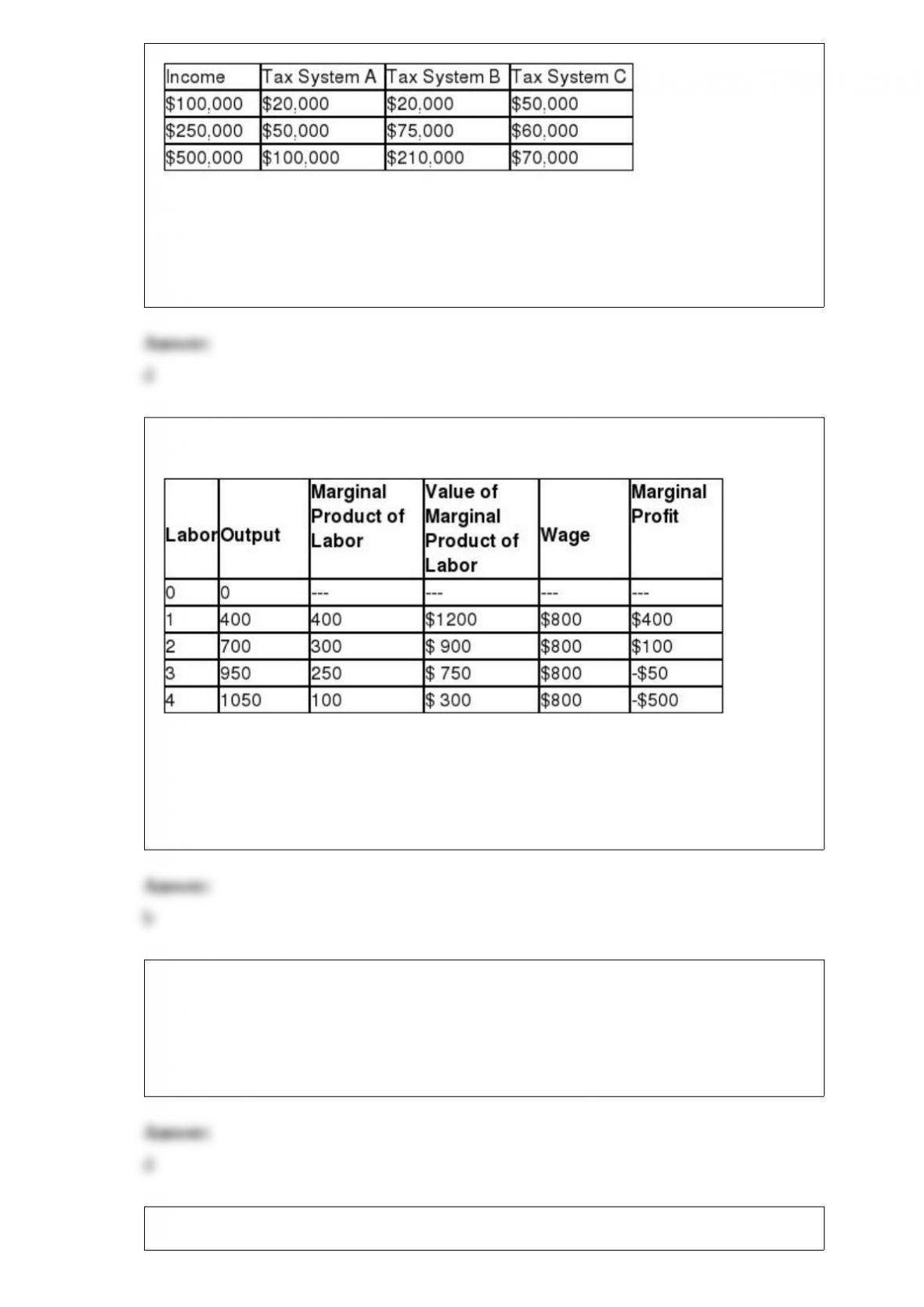
Which of the three tax systems exhibits vertical equity?
a.Tax System A
b.Tax System B
c.Tax System C
d.All of the systems exhibit vertical equity.
10) Table 18-4
Refer to Table 18-4. The price of output is
a.$400.
b.$3.
c.$2.
d.$1.
11) Free entry means that
a.the government pays any entry costs for individual firms.
b.government-funded research lowers the costs of patents and other barriers to entry.
c.a firm‘s marginal cost is zero.
d.no legal barriers prevent a firm from entering an industry.
12) Diana is a personal trainer whose client Charles pays $80 per hour-long session.

Charles values this service at $100 per hour, while the opportunity cost of Diana’s time
is $75 per hour. The government places a tax of $10 per hour on personal trainers.
Before the tax, what is the total surplus?
a.$25
b.$20
c.$5
d.$0
13) For private goods allocated in markets,
a.prices guide the decisions of buyers and sellers and these decisions lead to an efficient
allocation of resources.
b.prices guide the decisions of buyers and sellers and these decisions lead to an
inefficient allocation of resources.
c.the government guides the decisions of buyers and sellers and these decisions lead to
an efficient allocation of resources.
d.the government guides the decisions of buyers and sellers and these decisions lead to
an inefficient allocation of resources.