
A reason why there is more competition among restaurants than among large discount
department stores is that restaurants
A) have to cater to a variety of consumer tastes while department stores do not.
B) unlike department stores, have to abide by government sanitation rules.
C) unlike department stores, do not have significant economies of scale.
D) have more elastic demand for their product compared to department stores.
A firm’s total profit can be calculated as all of the following except
A) total revenue minus total cost.
B) average profit per unit times quantity sold.
C) (price minus average total cost) times quantity sold.
D) marginal profit times quantity sold.
Figure 13-15
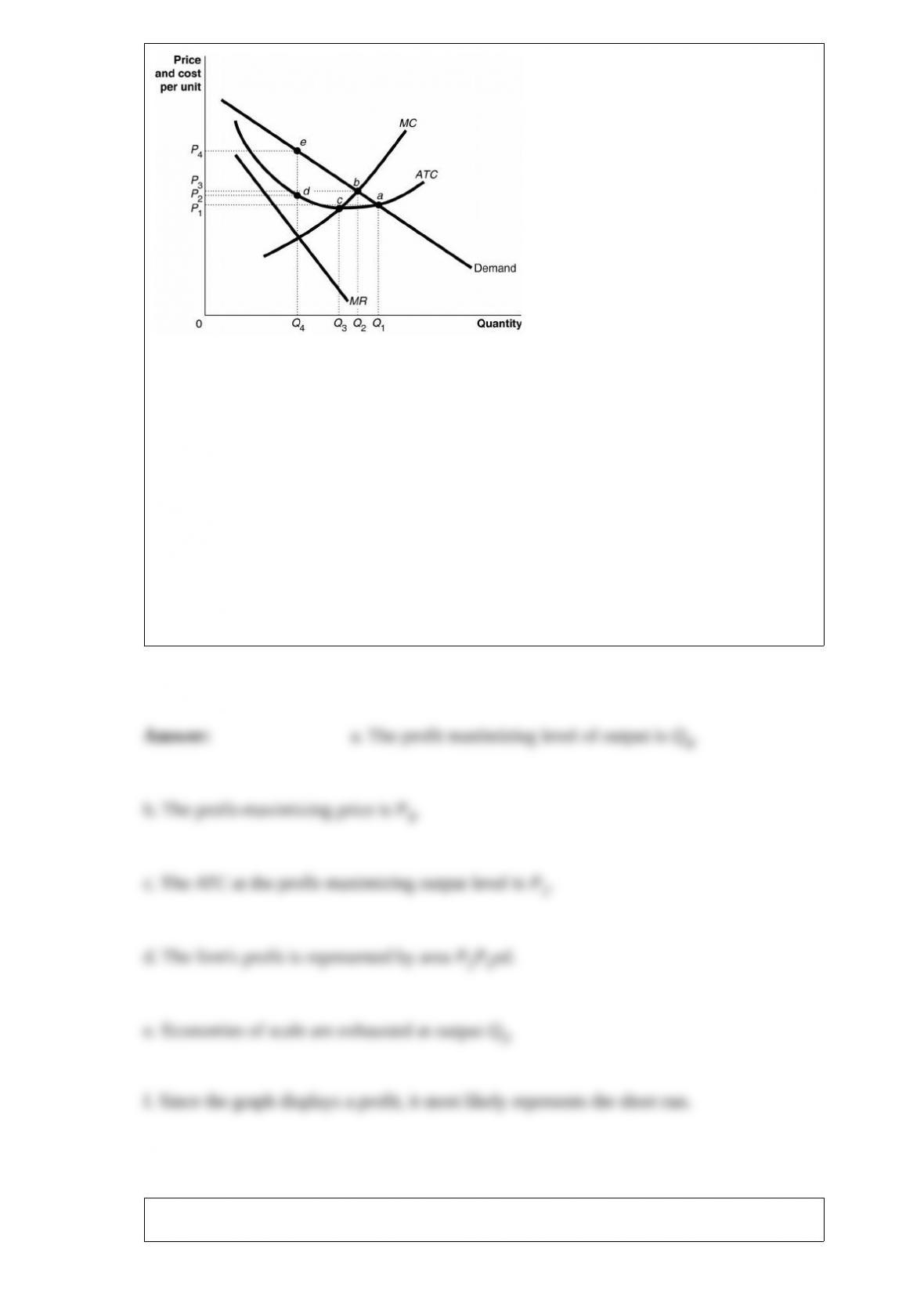
Answer the following questions.
a. What is the profit-maximizing output level?
b. What is the profit-maximizing price?
c. What is the average total cost at the profit-maximizing output level?
d. What area represents the firm’s profit?
e. At which output level are economies of scale exhausted?
f. Does this graph most likely represent the long run or the short run? Why?
Which of the following statements is true?

A) If the price of a good is lowered and total revenue decreases, demand is elastic.
B) If the price of a good is raised and total revenue does not change, demand is
perfectly elastic.
C) If the price of a good is raised and total revenue increases, demand is inelastic.
D) If the price of a good is lowered and total revenue increases, demand is inelastic.
China has developed a comparative advantage in the production of children’s toys. The
source of this comparative advantage is
A) superior process technology.
B) a large supply of unskilled workers and relatively little capital.
C) investment in capital used to produce toys.
D) a large supply of natural resources.
Which of the following is a true statement about the length of recessions and
expansions in the United States economy?
A) Prior to 1900, the length of expansions equaled the length of recessions.
B) Prior to 1900, the length of expansions were much less than the length of recessions.
C) Prior to 1900, the length of expansions were much longer than the length of
recessions.

D) Prior to 1900, the length of recessions were brief and almost nonexistent.
An example of a payroll tax in the United States is
A) Social Security taxes.
B) taxes on corporate profit.
C) excise taxes on gasoline.
D) property taxes on real estate.
All of the following contributed to the downfall of the Soviet Union in 1991 except
A) public dissatisfaction with low living standards and political repression.
B) an inability to produce low-cost consumer goods that households wanted.
C) lack of high-quality goods and services.
D) lack of a strong dictator who can coordinate economic activities.

For a given supply curve, how does the elasticity of demand affect the burden of a tax
imposed on a product?
A) The excess burden of the tax will be minimized when the demand is unit-elastic.
B) The excess burden of the tax will be greater when the elasticity of supply is greater
than the elasticity of demand.
C) The excess burden of the tax will be greater when the demand is less elastic than
when it is more elastic.
D) The excess burden of the tax will be greater when the demand is more elastic than
when it is less elastic.
What is the Congressional act, enacted in 1933 and repealed in 1999, which prevented
financial firms from being both commercial banks and investment banks?
A) the Sarbanes-Oxley Act
B) the Glass-Steagall Act
C) the Taft-Hartley Act
D) the Cellar-Kefauver Act
Consider a demand curve that has a constant elasticity value of 0. What happens to
quantity demanded and total revenue when price increases?

A) The quantity demanded and total revenue remain the same.
B) The quantity demanded does not change but total revenue increases.
C) The quantity demanded and total revenue fall to zero.
D) The quantity demanded does not change but total revenue decreases.
Which of the following takes place in the direct finance market?
A) Firms borrow funds from banks.
B) Deposits from savers are accumulated and loans made to borrowers.
C) Ownership in corporations is sold in the form of preferred stock.
D) Banks offer savings accounts to customers.
An individual’s labor supply curve shows
A) the maximum wage rates offered to that individual by various potential employers.
B) the relationship between wages and the quantity of labor that she is willing to
supply.
C) the relationship between wages and the quantity of labor that a firm is willing to
employ.
D) the relationship between the quantity of hours worked and total income earned by

that individual.