
1) The U.S. federal government collects taxes in a number of ways. Rank the following
sources of revenue from the largest to the smallest.
a.corporate income taxes, individual income taxes, social insurance taxes
b.social insurance taxes, individual income taxes, corporate income taxes
c.individual income taxes, social insurance taxes, corporate income taxes
d.individual income taxes, corporate income taxes, social insurance taxes
2) Suppose that the government taxes income in the following fashion: 30 percent of
the first $20,000, 50 percent of the next $30,000, and 60 percent of all income over
$50,000. Ted earns $40,000, and Robin earns $60,000. Which of the following
statements is correct?
a.Ted’s marginal tax rate is 60 percent, and his average tax rate is 50 percent.
b.Ted’s marginal tax rate is 50 percent, and his average tax rate is 40 percent.
c.Robin’s marginal tax rate is 50 percent, and her average tax rate is 45 percent.
d.Robin’s marginal tax rate is 60 percent, and her average tax rate is 40 percent.
3) Rick buys a 1966 Mustang for $3,000, planning to restore and sell the car. He goes
on to spend $9,000 restoring the car. At this point he can sell the car for $10,000. As an
alternative, he can spend an additional $3,000 replacing the engine. With a new engine
the car would sell for $13,000. Rick should
a.complete the repairs and sell the car for $13,000.
b.sell the car now for $10,000.
c.never try such an expensive project again.
d.be indifferent between (i) selling the car now and (ii) replacing the engine and then
selling it.
4) From society’s standpoint, cooperation among oligopolists is
a.desirable, because it leads to less conflict among firms and a wider variety of products
for consumers.
b.desirable, because it leads to an outcome closer to the competitive outcome than what
would be observed in the absence of cooperation.
c.undesirable, because it leads to output levels that are too low and prices that are too
high.
d.undesirable, because it leads to output levels that are too high and prices that are too
high.
5) Authors are allowed to be monopolists in the sale of their books in order to
a.encourage authors to write more and better books.
b.correct for the negative externalities that the Internet and television impose.
c.satisfy literary advocacy groups that exercise their lobbying power.
d.promote a society in which people think for themselves and learn from whichever
books they please.
6) The assumption of a fixed number of firms is appropriate for analysis of
a.the short run but not the long run.
b.the long run but not the short run.
c.both the short run and the long run.
d.neither the short run nor the long run.
7) Defenders of advertising argue that it is not rational for profit-maximizing firms to
spend money on advertising for products that have
a.superior quality.
b.inferior or mediocre quality.
c.low prices.
d.limited availability.
8) Suppose the point of tangency that characterizes long-run equilibrium for a
monopolistically competitive firm occurs at Q1units of output. This level of output, Q1,
a.exceeds the level of output at which marginal revenue equals marginal cost.
b.exceeds the level of output at which marginal cost equals average total cost.
c.falls short of the level of output at which price equals marginal cost.
d.exceeds the firm’s efficient scale of output.
9) When motorcycles are taxed and sellers of motorcycles are required to pay the tax to
the government,
a.the quantity of motorcycles bought and sold in the market is reduced.
b.the price paid by buyers of motorcycles decreases.
c.the demand for motorcycles decreases.
d.there is a movement downward and to the right along the demand curve for
motorcycles.
10) In 2011, the U.S. federal government collected approximately how much in total tax
receipts?
a.$800 million
b.$2.5 billion
c.$5.2 billion
d.$8.7 billion
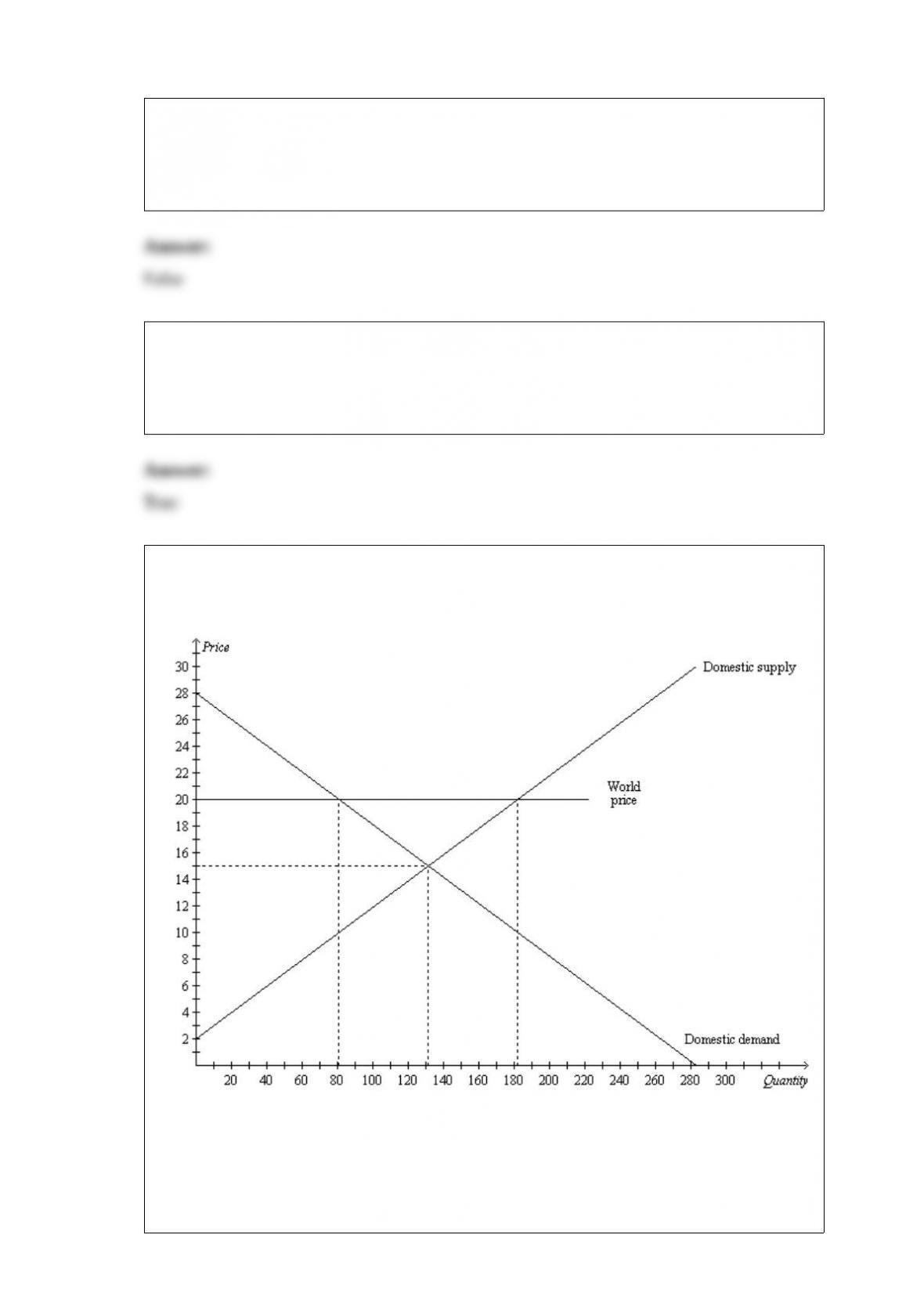
11) Figure 8-8
Suppose the government imposes a $10 per unit tax on a good.
The deadweight loss of the tax is the area
a.B+D.
b.C+F.
c.A+C+F+J.
d.B+C+D+F.
12) When a firm in a monopolistically competitive market earns zero economic profit,
its product price must equal marginal cost.
a.True
b.False
13) In order for a firm to maximize profits through price discrimination, the firm must
have some market power and be able to prevent arbitrage.
a.True
b.False
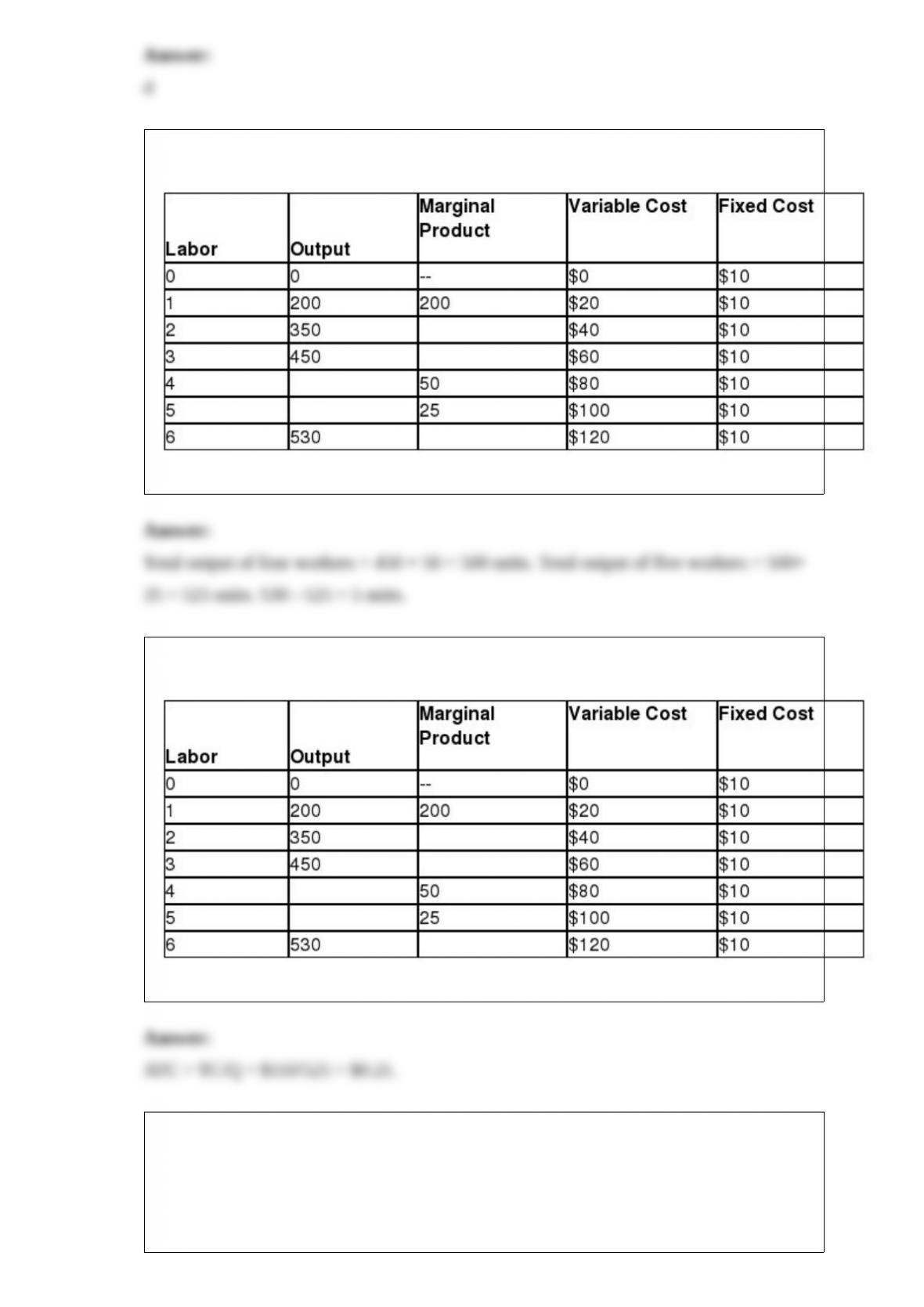
14) Figure 9-2
The figure illustrates the market for calculators in a country.
This country
a.has a comparative advantage in calculators.
b.should export calculators.
c.is a price taker in the world economy.
d.All of the above are correct.
15) Table 13-18
What is the marginal product of the sixth worker?
16) Table 13-18
What is the average total cost of producing 525 units of output?
17) Scenario 10-4
The demand curve for fire extinguishers slopes downward and the supply curve for fire
extinguishers slopes upward. The production of the 500th fire extinguisher entails the
following:
♦ a private cost of $10;
♦ an external cost of $0;
♦ a private value of $9;
♦ an external benefit of $3.
In order to maximize the total benefit of fire extinguishers to society as a whole, should
the number of fire extinguishers produced be less than, equal to, or greater than 500?
Explain.
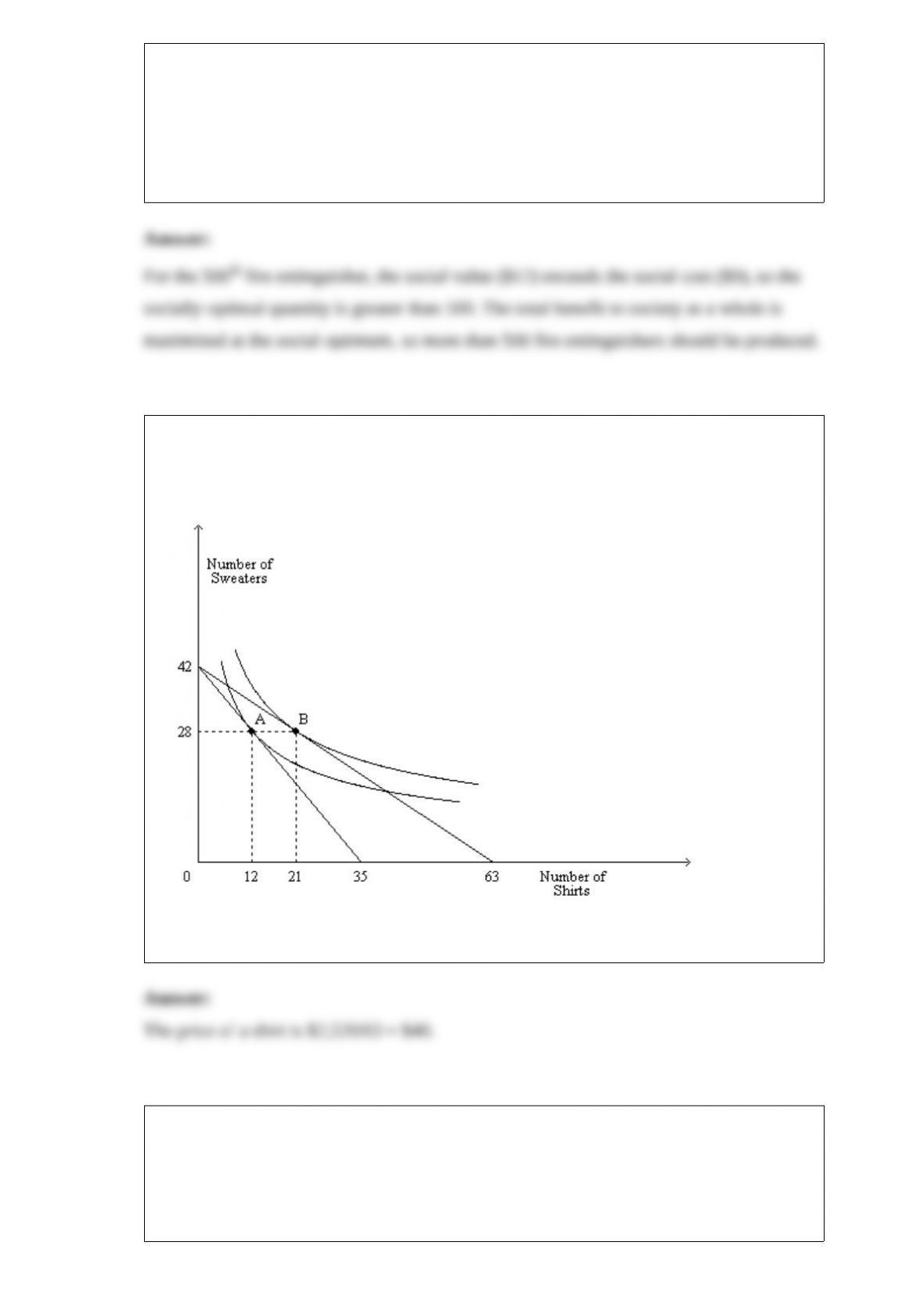
18) Figure 21-31
The figure shows two indifference curves and two budget constraints for a consumer
named Kevin.
Refer to Figure 21-31. If Kevin’s income is $2,520 and point B is his optimum, then
what is the price of a shirt?
19) Scenario 16-9
Dean goes to the grocery store to buy chips and soda for a party. He purchases brand
name products even though generic versions are available at lower prices. His friend
John says he was irrational to spend more for a nearly identical product. His friend
Martina agreed with Dean’s decision to spend more for the brand name products.
Martina offers two reasons for agreeing with Dean’s decision. What are they?
20) When asked to give a range for the height of the tallest mountain in North America
such that people were 90 percent confident the true number falls within it, most people
gave ranges that were