
The Wheeler-Lea Act of 1938 was designed to close the merger loophole that remained
in the Clayton Act.
a. True
b. False
Marginal revenue is defined as
a. the difference between costs and revenues.
b. the change in total revenue caused by selling one additional unit of output.
c. price times quantity.
d. total revenue divided by the level of output.
e. total revenue minus the level of output.
Generally, positive externalities result in
a. too much of a good being produced.
b. the socially optimal output of a good being produced.
c. too little of a good being produced.
d. either a or c
e. any of the above
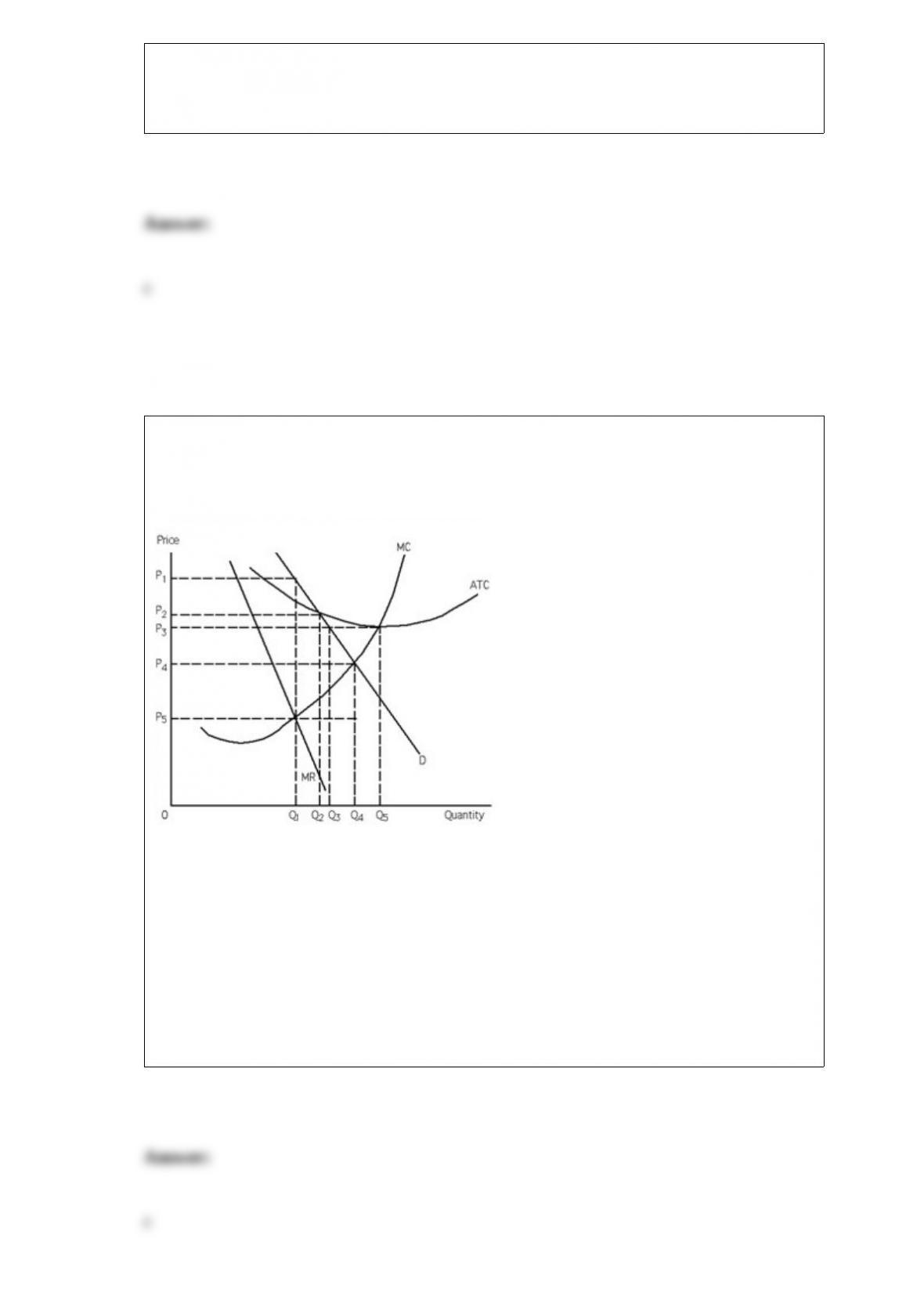
Refer to Exhibit 26-4. The problem with average-cost pricing regulation is that once it
is in place, there is a tendency for the
Exhibit 26-40
a. D curve to shift rightward.
b. D curve to shift leftward.
c. ATC curve to shift upward.
d. ATC curve to shift downward.
e. MR curve to shift leftward.
The difference between the highest amount a buyer would be willing to pay for a good
and the amount she actually pays for it is
a. producers’ surplus.
b. consumers’ surplus.
c. marginal revenue.
d. marginal utility.
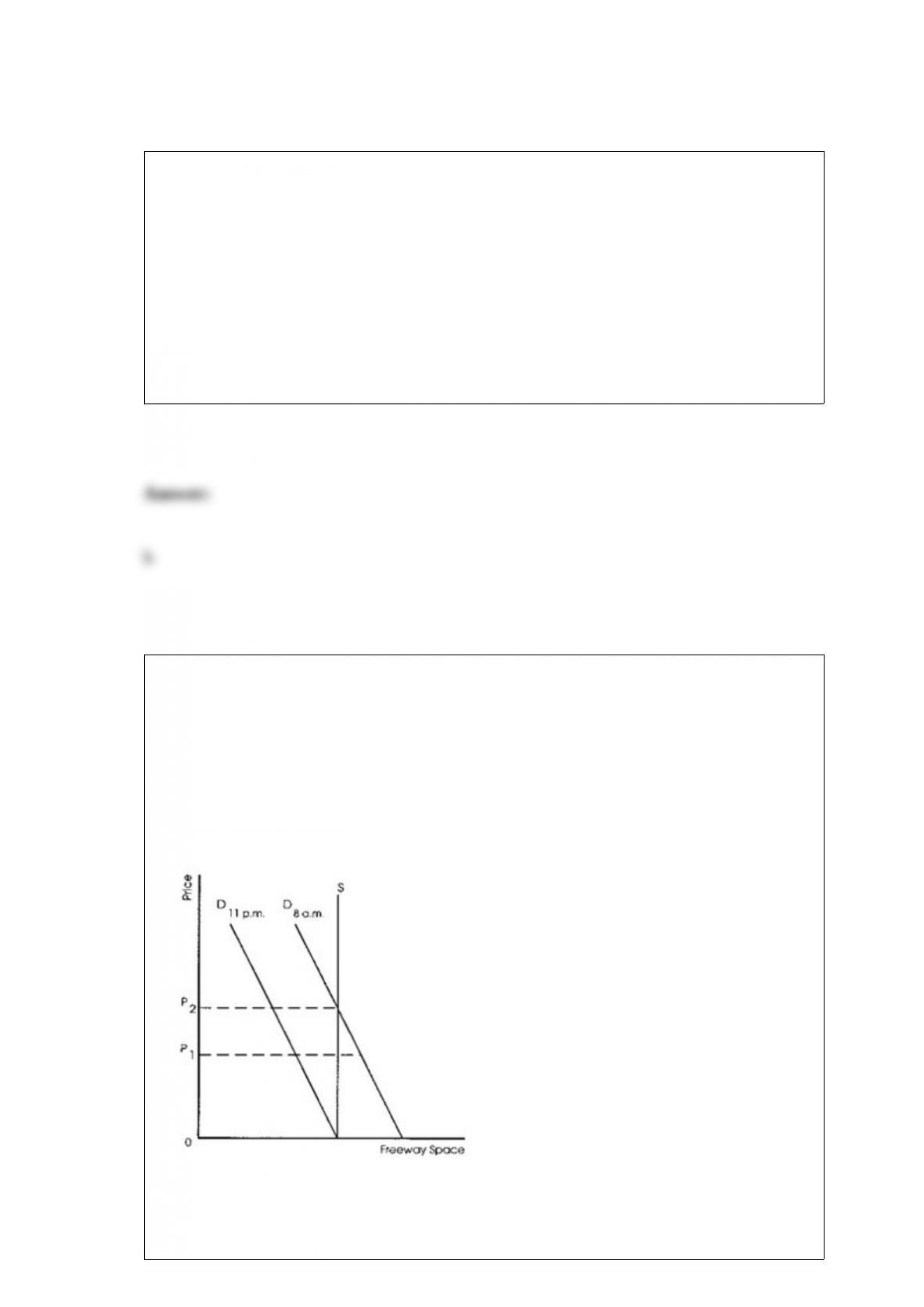
Refer to Exhibit 5-1, which shows supply and demand for freeway space at both 8 a.m.
and 11 p.m. Suppose that the government decides to set the money price of driving on
the freeway at zero, but creates programs that encourage drivers to carpool. If the
carpooling program is sufficiently successful to eliminate the shortage of freeway space
at 8 a.m., graphically the result of the increase in carpooling would be a
Exhibit 5-1
a. rightward shift of the supply of freeway
space curve.
b. leftward shift of the demand for freeway space curve from D8a.m. to D11p.m.

c. movement up along D8a.m. to the point where D8a.m. intersects the supply curve.
d. leftward shift of the supply of freeway space curve.
The answer is, “Because of the free rider problem.”The question is:
a. Why can’t the government produce nonexcludable public goods?
b. Why can’t the market produce nonexcludable public goods?
c. Why do negative externalities exist?
d. Why do positive externalities exist?
e. b and d
Which of the following statements is false?
a. One of the intended effects of the health-care reform bills passed in March 2010 was
for some people who had health insurance before the reform to choose to become
uninsured after health-care reform.
b. One of the provisions of the health-care reform bills passed in March 2010 is that
individuals will be fined for not buying insurance.
c. Among the provisions in the health-care reform bills passed in March 2010 is that
insurance companies are prohibited from turning down a person with a preexisting
disease.

d. One of the objectives of the health-care reform bills passed in March 2010 was to
bring more people into the pool of insured persons so that insurance policies would
become cheaper.
When countries engage in specialization and international trade, every individual
person in those countries will gain.
a. True
b. False
The factor demand curve shifts leftward as a result of
a. an increase in the price of the product the factor helps to produce.
b. an increase in the marginal physical product of the factor.
c. a decrease in the price of the product the factor helps to produce.
d. a and b
e. b and c

In an eight-hour day, Andy can produce either 24 loaves of bread or 8 pounds of butter.
In an eight-hour day, John can produce either 8 loaves of bread or 8 pounds of butter.
The opportunity cost of producing 1 pound of butter is
a. 1/3 hour for Andy and 1 hour for John.
b. 1 hour for Andy and 1 hour for John.
c. 3 loaves of bread for Andy and 1 loaf of bread for John.
d. 1/3 loaves of bread for Andy and 1 loaf of bread for John.
e. none of the above
The natural monopolist might have an incentive to go out of business under
a. price regulation.
b. profit regulation.
c. output regulation.
d. average-cost pricing.
e. b and d

Empirical research has shown that immediately upon deregulation of the airline
industry,
a. airlines spent less time and money on aircraft maintenance.
b. airline safety decreased.
c. airline fares decreased.
d. all of the above
We take one dollar from a millionaire and give it to a pauper. Assuming a diminishing
marginal utility of money,
a. total utility in the economy must rise.
b. total utility in the economy must fall.
c. total utility in the economy must remain the same.
d. we cannot say whether or not total utility changes.
Which of the following statements is false?
a. The quantity supplied of loanable funds and the interest rate are inversely related.
b. The supply curve of loanable funds is upward sloping.
c. One of the reasons the federal government demands loanable funds is that it needs to
finance budget deficits.
d. Savers are people who consume less than their current income.
Describe the circumstance under which profit maximization is the same as revenue
maximization.Use a hypothetical numerical example to help explain why this is so.
Describe the intended effects of the first-time home buyer tax credits granted by
Congress and many state governments in 2009 and 2010. In addition, describe in detail
the unintended effect of this type of legislation.
With respect to the supply and demand for a given product, describe the connection that
exists between equilibrium/disequilibrium and predictions.Cite your own unique
example in order to help support your answer.
Why is profit maximized at the level of output where marginal revenue equals marginal
cost?
Using proper economic terminology, describe why Mexican restaurants often provide
chips and salsa for free to their customers.
Suppose the governments of Mexico and the United States agree to a fixed exchange
rate.Describe some of the options available to the Mexican government if the peso was
persistently overvalued, creating a surplus of pesos on the foreign exchange market.Be
sure to explain how each of these options would be expected to impact the supply
and/or demand for Mexican pesos.
Using your own words, describe the law of increasing opportunity costs.Be sure to
explain why this phenomenon occurs and how it helps to contribute to the shape of the
production possibilities frontier.
Explain how the conditions for consumer equilibrium help to support the law of
demand. Give an example to support your answer.