
Scenario 1-1
Suppose a t-shirt manufacturer currently sells 5,000 t-shirts per week and makes a profit
of $10,000 per week. A manager at the plant observes, “Although the last 400 t-shirts
we produced and sold increased our revenue by $4,000 and our costs by $4,800, we are
still making an overall profit of $10,000 per week so I think we’re on the right track. We
are producing the optimal number of t-shirts.”
Refer to Scenario 1-1. Had the firm not produced and sold the last 400 t-shirts, would
its profit be higher or lower, and if so by how much?
A) Its profit will be $4,800 higher.
B) Its profit will be $800 higher.
C) Its profit will be $800 lower.
D) Its profit will be $4,000 lower.
Which of the following explains the ability of the U.S. economy to avoid diminishing
marginal returns and experience accelerating growth in the early to mid-20th century?
A) continuing technological change
B) immigration
C) additions of a greater amount of capital of the same quality
D) a decrease in the quality of labor
Lowering the discount rate will

A) decrease reserves, encourage banks to make fewer loans, and decrease the money
supply.
B) decrease reserves, encourage banks to make fewer loans, and increase the money
supply.
C) increase reserves, encourage banks to make more loans, and increase the money
supply.
D) increase reserves, encourage banks to make more loans, and decrease the money
supply.
The measure of production that values production using current prices is called
A) value-added GDP.
B) nominal GDP.
C) real GDP.
D) underground GDP.
Figure 12-3
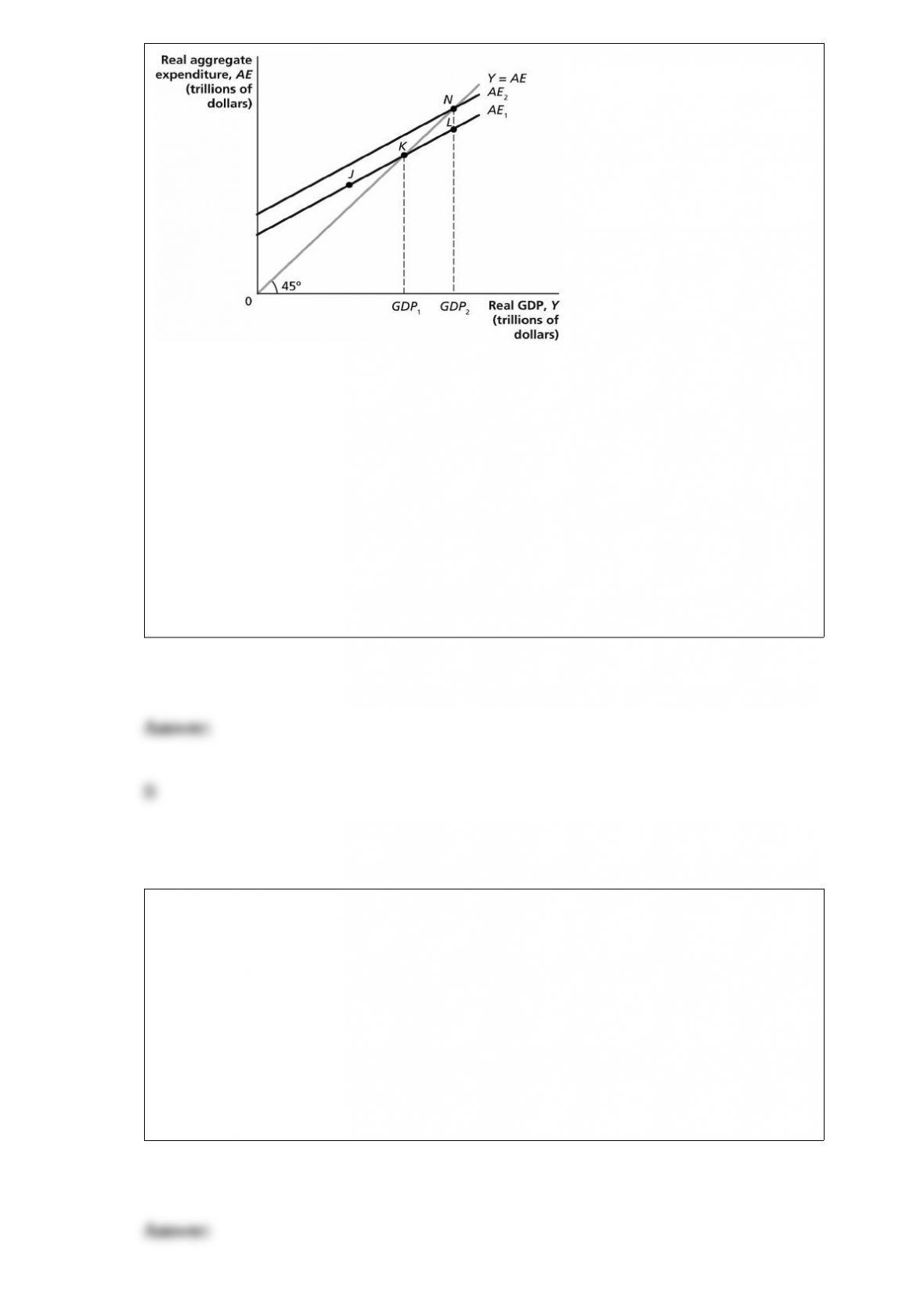
Refer to Figure 12-3. Suppose that government spending increases, shifting up the
aggregate expenditure line. GDP increases from GDP1 to GDP2, and this amount is
$200 billion. If the MPC is 0.8, then what is the distance between N and L or by how
much did government spending change?
A) $16 billion
B) $40 billion
C) $200 billion
D) $1,000 billion
Many economists ________ protectionism because it ________ consumers and
________ jobs in domestic industries that use protected products.
A) support; benefits; creates
B) criticize; causes losses to; eliminates
C) support; lowers prices for; raises wages for
D) criticize; unfairly rewards; relocates
Countries that abandoned the gold standard early in the Great Depression suffered an
average decline in production of 3 percent between 1929 and 1934. Countries that
stayed on the gold standard until 1933 or later suffered an average decline in production
of
A) 12 percent.
B) 18 percent.
C) 24 percent.
D) > 30 percent.
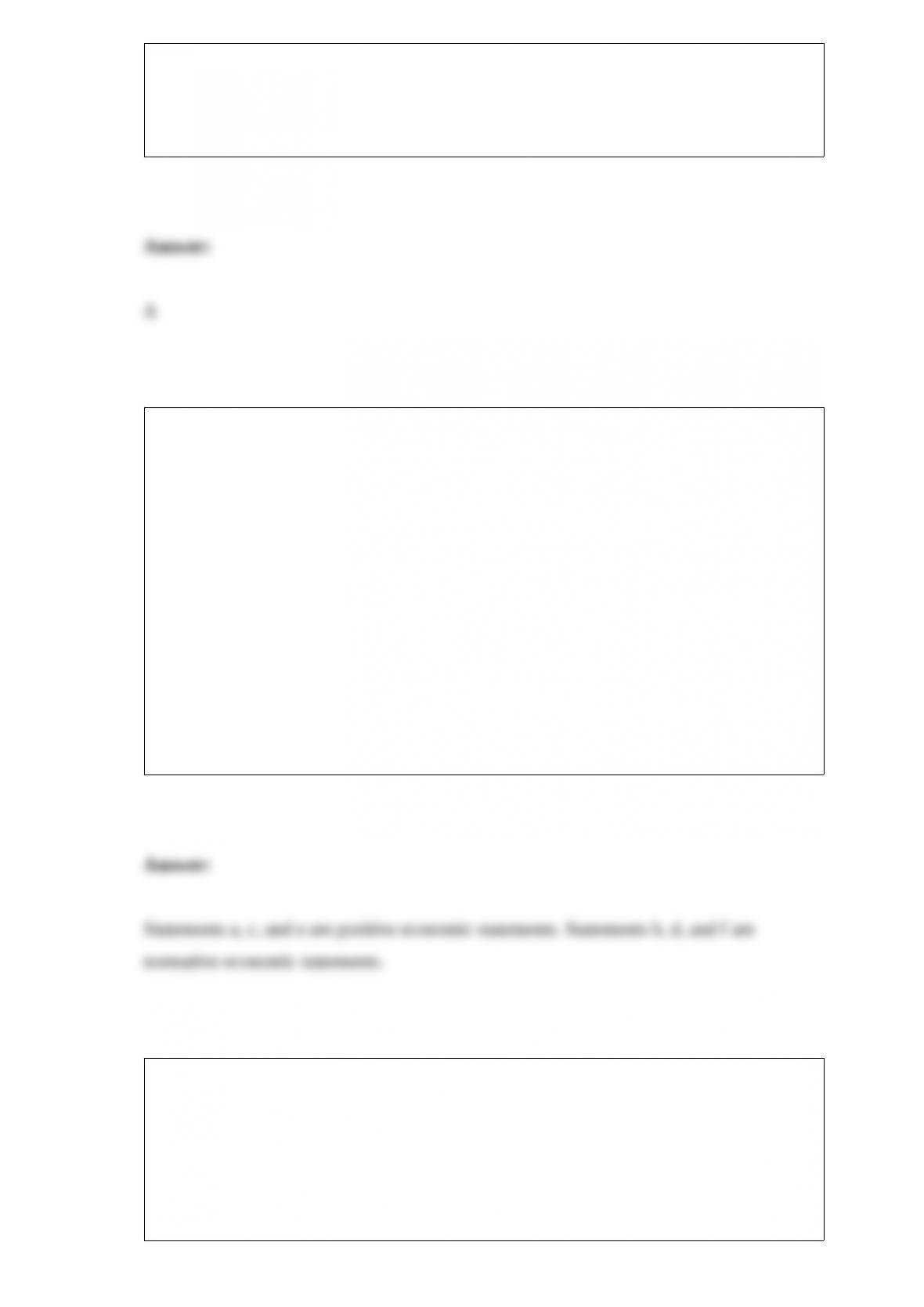
Figure 4-1
Figure 4-1 shows Kendra’s demand curve for ice-cream cones.
Refer to Figure 4-1. If the market price is $2.50, what is the consumer surplus on the
second ice cream cone?
A) $0.50
B) $1.50
C) $3.00
D) $10.50
Which of the following are positive economic statements and which are normative
economic statements?
a. An increase in the minimum wage causes unemployment.
b. The government should raise the minimum wage above $7.25 per hour.
c. The prolonged recession has caused the unemployment rate to reach a 30-year high.
d. Interest rates need to be lower for the economy to emerge from the recession.
e. Inflation has decreased since the onset of the recession.
f. Once the recession has ended, interest rates should increased to assure that inflation
does not go up.
Globalization is defined as the process of countries becoming ________ open to foreign
trade and ________ open to foreign investment.
A) more; less
B) more; more

C) less; more
D) less; less
Spending on the war in Afghanistan is essentially categorized as government purchases.
How do increases in spending on the war in Afghanistan affect the aggregate demand
curve?
A) They will move the economy up along a stationary aggregate demand curve.
B) They will move the economy down along a stationary aggregate demand curve.
C) They will shift the aggregate demand curve to the left.
D) They will shift the aggregate demand curve to the right.
The economy suffered a mild recession in 2001. Despite the recession, home sales and
durable goods sales remained high. Which of the following is a plausible explanation?
A) The Fed’s pursuit of contractionary policy stimulated these markets.
B) The Fed caused a reduction in the federal funds rate to its lowest level in 40 years.
C) Rising inflation encouraged many to invest in the real estate market.
D) Home building and consumer durable purchases are always high during a recession.

At the beginning of 2013, with the tariff on Chinese tires having expired, Goodyear’s
profits ________ compared to the previous year, and Chinese tire imports ________.
A) rose; increased
B) rose; decreased
C) fell; increased
D) fell; decreased
Disinflation refers to
A) a decrease in the price level.
B) a rapid increase in the price level.
C) a reduction in the rate of inflation.
D) an increase in the rate of inflation.
Assume that both the demand curve and the supply curve for DVD players shift to the
left but the supply curve shifts more than the demand curve. As a result

A) both the equilibrium price and quantity of DVD players will decrease.
B) the equilibrium price of DVD players will decrease; the equilibrium quantity may
increase or decrease.
C) the equilibrium price of DVD players may increase or decrease; the equilibrium
quantity will increase.
D) the equilibrium price of DVD players will increase; the equilibrium quantity will
decrease.
With the exception of during recessions, workers in Canada are eligible for
unemployment benefits for about twice as long a period of time as workers in the
United States. As a result,
A) the average duration of unemployment is longer in the United States than in Canada.
B) the unemployment rate in Canada is usually higher than in the United States.
C) the opportunity cost of job search in Canada is lower than in the United States.
D) frictional unemployment is higher, on average, in the United States than in Canada.
An increase in the value of the U.S. dollar will
A) reduce Canadian demand for winter homes in Florida.
B) increase Canadian demand for winter homes in Florida.
C) reduce the cost of homes in Florida for Canadian buyers.

D) increase the cost of homes in Florida for American buyers.