
Table 17-3
Hotspur Incorporated, a manufacturer of microwave ovens, is a price taker in its input
and output markets. The firm hires labor at a constant wage rate of $800 per week and
sells microwave ovens at a constant price of $80. Table 17-3 shows the relationship
between the quantity of labor it hires and the quantity of microwave ovens it produces.
Refer to Table 17-3. What is the amount of revenue added as a result of hiring the
fourth worker?
A) $1,200
B) $7,200
C) 15 microwaves
D) 90 microwaves
If a corporation goes bankrupt, bondholders have ________ on the firm’s assets.
A) no claim
B) third claim, after the IRS and stockholders,
C) second claim, after stockholders,
D) first claim

Firms do not have market power in which of the following market structures?
A) perfect competition only
B) perfect competition and monopolistic competition
C) oligopoly
D) monopoly
A firm’s demand for labor curve is also called its
A) marginal revenue product of labor curve.
B) marginal factor cost of labor curve.
C) marginal valuation curve.
D) marginal benefit of labor curve.

The price elasticity of supply is equal to
A) the value of the slope of the supply curve.
B) the change in quantity supplied divided by the change in price.
C) the percentage change in price divided by the percentage change in quantity
supplied.
D) the percentage change in quantity supplied divided by the percentage change in
price.
What is the endowment effect?
A) the phenomenon that economic agents are endowed with different qualities and
abilities so that trade among individuals increase efficiency
B) the tendency for economic agents with abundant resources to consume a
proportionately greater quantity of goods and services
C) the tendency of people to be unwilling to sell something they already own even if
they are offered a price that is greater than the price they would be willing to pay to buy
the good if they didn’t already own it.
D) the tendency of firms to use celebrities endowed with good looks to promote their
products
When firms analyze the relationship between their level of production and their costs
they separate the time period involved into
A) morning and evening.
B) 6 months or less; 6 months to 1 year; more than 1 year.
C) a fixed period and a variable period.
D) the short run and the long run.
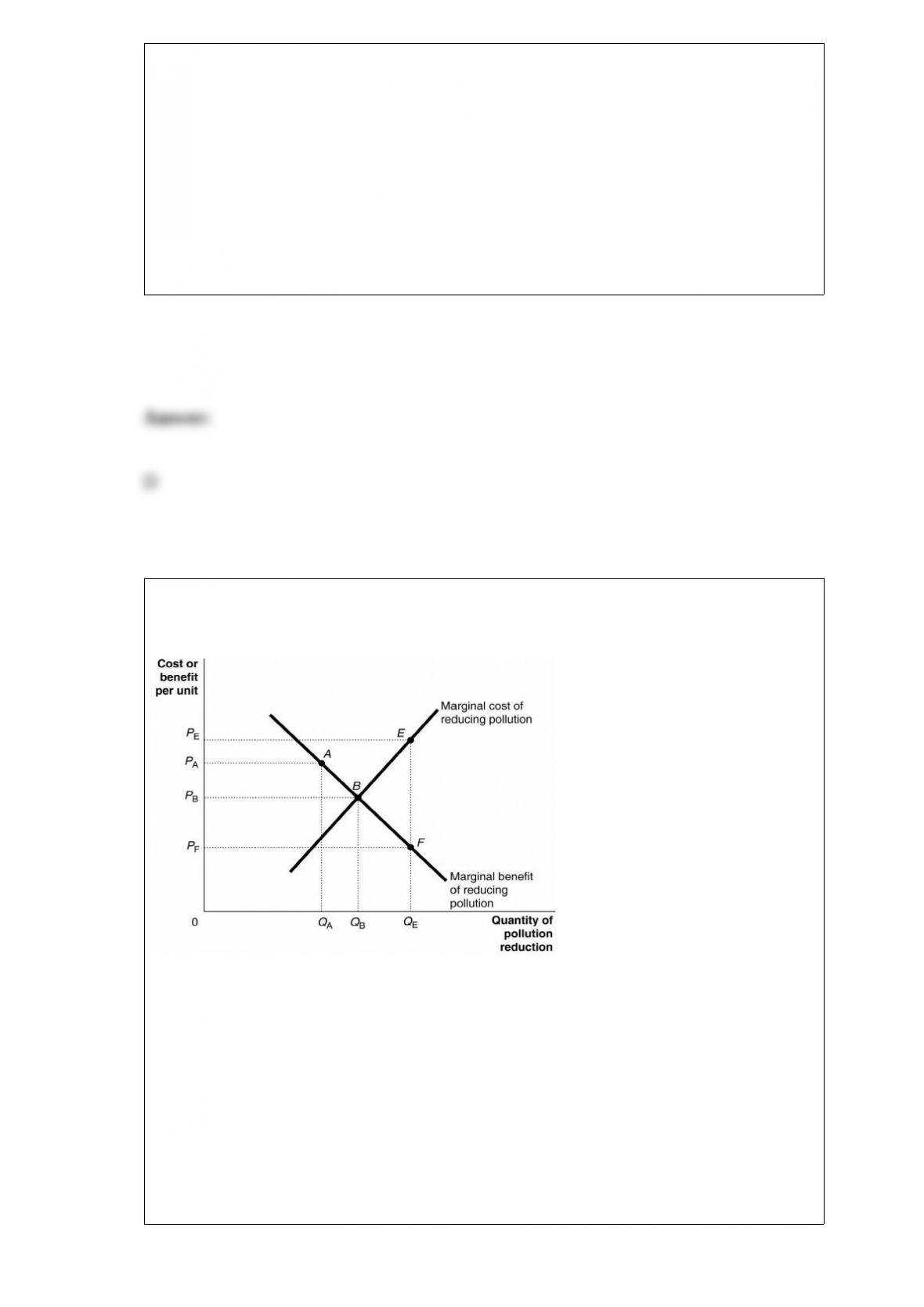
Figure 5-7
Refer to Figure 5-7. What is the incremental benefit of increasing the quantity of
pollution reduction from QBto QE units?
A) PF
B) PFQE
C) the value of the area BEF
D) the value of the area QBBFQE

If the price of muffins, a normal good you enjoy, rises
A) the income and substitution effects offset each other but the price effect leads you to
buy fewer muffins.
B) both the income and substitution effects lead you to buy fewer muffins.
C) the substitution effect which causes you to decrease your muffin consumption
outweighs the income effect which causes you to increase your muffin consumption,
resulting in fewer muffins purchased.
D) the income effect which causes you to decrease your muffin consumption outweighs
the substitution effect which causes you to increase your muffin consumption, resulting
in fewer muffins purchased.
Figure 2-2

Figure 2-2 above shows the production possibilities frontier for Mendonca, an agrarian
nation that produces two goods, meat and vegetables.
Refer to Figure 2-2. If Mendonca chooses to produce 160 pounds of vegetables, how
much meat can it produce to maximize production?
A) 0 pounds of meat
B) 30 pounds of meat
C) 60 pounds of meat
D) 120 pounds of meat
A typical consumer of health care in the United States
A) pays the full price of his or her health care.
B) pays more than the full price of his or her health care.
C) does not pay any of the price of his or her health care.
D) does not pay the full price of his or her health care.

Consider a downward-sloping demand curve. When the price of a normal good
decreases, the income and substitution effects
A) work in the same direction to increase quantity demanded.
B) work in the same direction to decrease quantity demanded.
C) work in opposite directions and quantity demanded increases.
D) work in opposite directions and quantity demanded decreases.
A firm has successfully adopted a positive technological change when
A) it can produce more output using the same inputs.
B) it produces less pollution in its production process.
C) can pay its workers less yet increase its output.
D) it sees an increase in worker productivity.

Suppose the California Nurses Union successfully secured a 12 percent increase in the
wages of registered nurses. If a hospital responds by reducing the quantity of registered
nurses hired and increasing the quantity of physician’s assistants hired, what conclusion
can you draw?
A) Physician’s assistants are more valuable in terms of their productivity.
B) The price elasticity of demand for registered nurses is negative while the price
elasticity of demand for physician’s assistants is positive.
C) The cross-price elasticity of demand between registered nurses and physician’s
assistants is positive.
D) The cross-price elasticity of demand between registered nurses and physician’s
assistants is negative.
If a firm shuts down in the short run it will
A) break even.
B) declare bankruptcy.
C) suffer a loss equal to its variable costs.
D) suffer a loss equal to its fixed costs.
In the United States, doctors and hospitals that provide most health care are

A) primarily private firms.
B) primarily employed by the government.
C) split evenly between private firms and employed by the government.
D) 100 percent employed by the government.
In economics, the optimal level of pollution is
A) zero.
B) the level for which the total benefit from reducing the pollution is the greatest.
C) the level for which the marginal benefit from reducing the pollution is the greatest.
D) the level for which the net benefit from reducing the pollution is the greatest.
Which of the following would cause the equilibrium price of white bread to decrease
and the equilibrium quantity of white bread to increase?
A) a decrease in the price of flour
B) an increase in the price of flour
C) an increase in the price of rye bread, a substitute for white bread

D) an increase in the price of butter, a complement for white bread
If a demand curve shifts to the left, then
A) demand has increased.
B) quantity demanded has increased.
C) demand has decreased.
D) quantity demanded has decreased.
If, at the firm’s projected sales level, the marginal cost is $40, the average cost is $50
and the markup is 30 percent, then its selling price is
A) $40.
B) $50.
C) $52.
D) $65.
During an economic expansion as consumer incomes rise, holding everything else
constant,
A) the demand for most goods, except luxuries, will rise.
B) the demand for luxuries will rise while the demand for inferior goods will fall.
C) the demand for luxuries and inferior goods will rise.
D) the prices of luxuries will fall while the prices of inferior goods will rise.
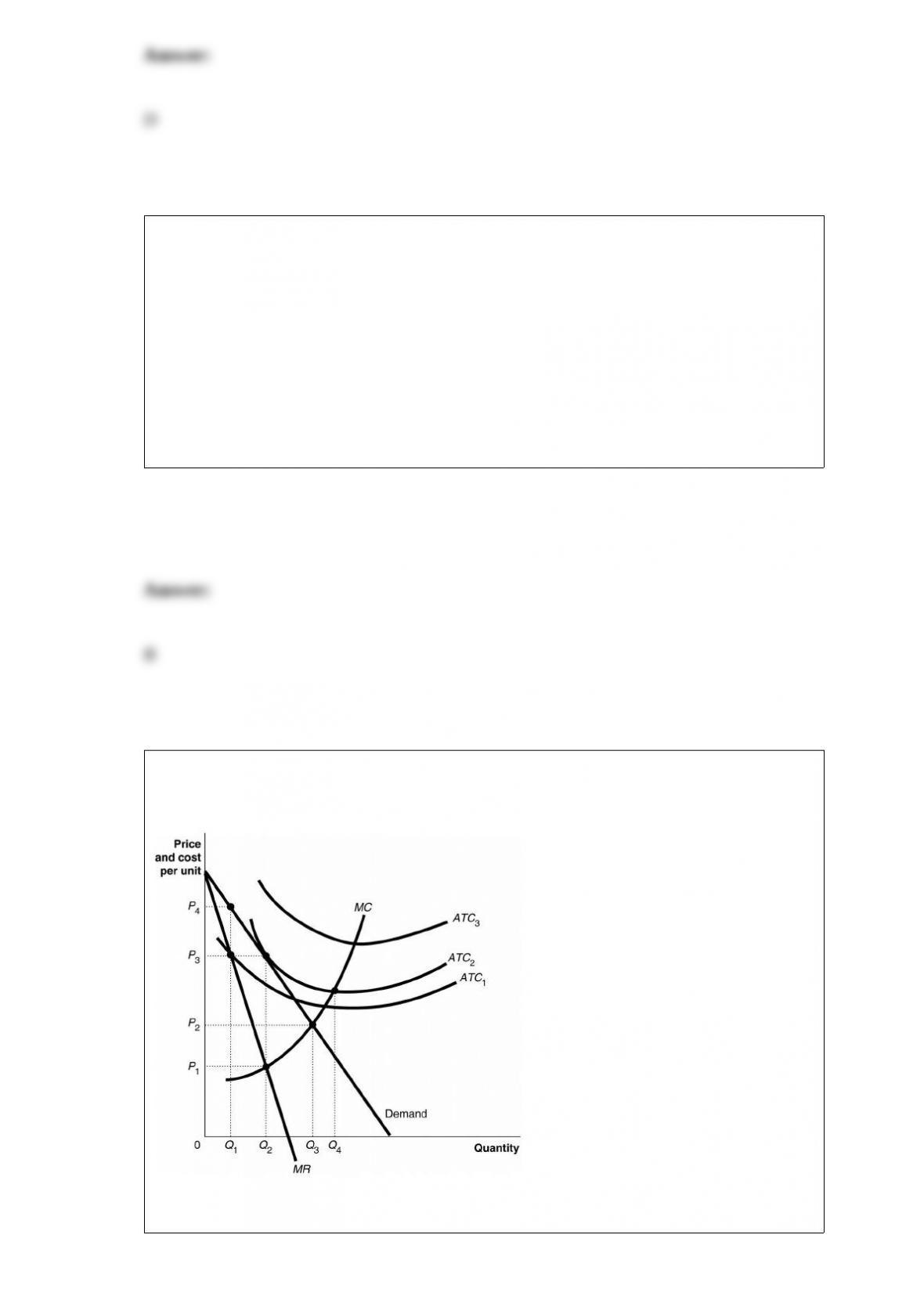
Figure 15-2
Figure 15-2 above shows the demand and cost curves facing a monopolist.

Refer to Figure 15-2. If the firm’s average total cost curve is ATC3, the firm will
A) suffer a loss.
B) break even.
C) make a profit.
D) face competition.
Which of the following is not a characteristic of a perfectly competitive market
structure?
A) There are a very large number of firms that are small compared to the market.
B) All firms sell identical products.
C) There are no restrictions to entry by new firms.
D) There are restrictions on exit of firms.
Figure 18-2

Figure 18-2 shows a demand curve and two sets of supply curves, one set more elastic
than the other.
Refer to Figure 18-2. If the government imposes an excise tax of $1.00 on every unit
sold, the consumer’s burden of the tax
A) is greater under the more elastic supply curve S0.
B) is greater under the less elastic supply curve S0.
C) is greater under the less elastic supply curve S1.
D) is the same under either supply curve because there is a single demand curve that
captures buyers’ market behavior.
If a corporation earns a profit, how do owners of the firm share in the profit?
A) through coupon payments on that firm’s bonds
B) through dividend payments on shares of that firm’s stock
C) by selling any bonds or stocks owned and realizing a capital gain
D) by raising the interest rate on bonds

Few firms in the United States are monopolies because
A) few firms experience economies of scale.
B) of antitrust laws.
C) when a firm earns profits, other firms will enter its market.
D) most products that firms produce have substitutes.
All else equal, if job turnover has people leaving jobs and finding new jobs in the same
industry, this will
A) increase the demand for labor and the supply of labor.
B) increase the demand for labor and decrease the supply of labor.
C) decrease the supply of labor, but not change the demand for labor.
D) not change demand or supply in the labor market.

The level of output at which all economies of scale have been exhausted is known as
A) constant returns to scale.
B) minimum efficient scale.
C) the economically efficient output level.
D) optimal economic size.
Firms use two marketing tools to differentiate their products. What are these two tools?
A) lobbying and word of mouth
B) market research and demand estimation
C) brand management and advertising
D) consumer surveys and market experiments
Figure 7-1

Figure 7-1 represents the market for vaccinations. Vaccinations are considered a benefit
to society, and the figure shows both the marginal private benefit and the marginal
social benefit from vaccinations.
Refer to Figure 7-1. At the market equilibrium, the deadweight loss is equal to
A) $0.
B) $250,000.
C) $500,000.
D) $1,000,000.
Identify whether each of the following transactions will take place in the factor market
or in the product market.
a. Graciela buys a Tesla Motors Model X.
b. Lashan works 60 hours a week at a law firm.
c. Tito sells his family’s farmland to a housing developer.
d. Tesla Motors increases employment at its Fremont, California plant.

A corporation is
A) the easiest type of business to set up.
B) the least expensive type of business to set up.
C) the most difficult type of business to set up.
D) the least profitable type of business to set up.
A supplier of an input is unlikely to have bargaining power if
A) the input supplied is specialized.
B) many firms can supply the input.
C) it is the sole supplier of the input.
D) it has a patent on the input.

Article Summary
In an attempt to discourage smoking, New York City Mayor Michael Bloomberg
proposed a bill which would set a $10.50 minimum price for a pack of cigarettes. The
bill would also prohibit retailers from offering any discounts such as 2-for-1 offers or
accepting discount coupons. New York City already has the highest cigarette tax in the
country, at $5.85 per pack, and the state of New York is one of many which already
require cigarettes be marked up by a specified percentage. This bill is a companion to
one which would require stores to keep tobacco products hidden from sight. Although
the bills are expected to be challenged in court, a precedent has been set in Rhode
Island, where a court upheld a ruling allowing the city of Providence to forbid retailers
from accepting coupons and offering discounts on cigarettes.
Source: Vivian Yee, “Bloomberg Seeks End to Cheap Cigarettes,” New York Times,
March 26, 2013.
Refer to the Article Summary. The minimum price of $10.50 per pack of cigarettes
being proposed by mayor Bloomberg would have which of the following effects on the
market for cigarettes?
A) Consumer surplus will increase.
B) Producer surplus will increase.
C) Deadweight loss will increase.
D) Market efficiency will increase.