
Monetary policy is conducted by the U.S. Treasury Department.
In the United States in 2011, over 90 percent of people without health insurance were
below the age of 34.
Positive analysis is concerned with “what ought to be,” while normative analysis is
concerned with “what is.”
Normative analysis is concerned with “what ought to be,” while positive analysis is
concerned with “what is.”

The excess burden of a tax is also a deadweight loss.
The Federal Home Loan Mortgage Corporation and the Federal National Mortgage
Association were established by Congress in order to regulate banks that buy and sell
mortgage-backed securities.
Physical capital refers to stocks and bonds.
The passage of the ________ in 1930 sparked a trade war that caused net exports to
decrease and real GDP to decrease.
A) Cellar-Kefauver Act
B) Sherman Antitrust Act
C) Clayton Act
D) Smoot-Hawley Tariff

By the 2000s, an important change in the mortgage market had occurred when
________ became significant participants in the secondary market for mortgages.
A) investment banks
B) Federal Reserve Banks
C) commercial banks
D) savings banks
Writing in the New York Times on the technology boom of the late 1990s, Michael
Lewis argues, “The sad truth, for investors, seems to be that most of the benefits of new
technologies are passed right through to consumers free of charge.” What does Lewis
means by the benefits of new technology being “passed right through to consumers free
of charge”?
A) Firms in perfect competition are price takers. Since they cannot influence price, they
cannot dictate who benefits from new technologies, even if the benefits of new
technology are being “passed right through to consumers free of charge.”
B) In perfect competition, price equals marginal cost of production. In this sense,
consumers receive the new technology “free of charge.”
C) In the long run, price equals the lowest possible average cost of production. In this
sense, consumers receive the new technology “free of charge.”
D) In perfect competition, consumers place a value on the good equal to its marginal
cost of production and since they are willing to pay the marginal valuation of the good,
they are essentially receiving the new technology “free of charge.”

Assume that Australia has a comparative advantage in producing surfboards and New
Zealand imports surfboards from Australia. We can conclude that
A) Australia also has an absolute advantage in producing surfboards relative to New
Zealand.
B) Australia has a lower opportunity cost of producing surfboards relative to New
Zealand.
C) New Zealand has an absolute disadvantage in producing surfboards relative to
Australia.
D) Labor costs are higher for surfboard producers in New Zealand than in Australia.
All of the following are examples of explicit cost a firm might incur except
A) the out-of-pocket expense to hire employees.
B) taxes owed to the state government.
C) the rental value of the warehouse space the company owns and uses for itself.
D) the revenue a firm generates in using its resources.

When the value of a currency is determined ________, the exchange rate system is
defined as a floating exchange rate system.
A) only by supply and demand
B) by its issuing government
C) mostly by supply and demand, but with occasional government intervention
D) by its issuing government, with occasional readjustments in value
Which of the following is counted as a liability for a bank?
A) customer deposits
B) bank reserves
C) securities
D) bank loans
Consider a firm that uses two inputs, labor and capital, to produce its output. Assume
labor is measured on the horizontal axis and capital on the vertical axis. Which of the
following best explains why the marginal rate of technical substitution decreases in
absolute value as we move down an isoquant?
A) The law of diminishing returns: for a given decline in capital, decreasing amounts of

labor are required to produce the same level of output.
B) The law of increasing marginal opportunity cost: if a firm uses less and less capital it
must use more and more labor, which drives up the cost of labor.
C) The law of diminishing returns: for a given decline in capital, increasing amounts of
labor are required to produce the same level of output.
D) The law of imperfect substitutability: labor and capital are not perfect substitutes;
therefore, a firm must replace decreases in capital with increases in labor.
If a monopolist’s price is $50 at 63 units of output, and marginal revenue equals
marginal cost and average total cost equals $43, then the firm’s total profit is
A) $3,150.
B) $2,709.
C) $441.
D) $7.
Which of the following must be present to reach a private solution to an externality
problem?
A) A majority of the parties affected by the externality must agree to a solution.
B) The transaction costs to negotiate a solution must be relatively low.
C) The total number of people, creators of the problem and those affected, must be

relatively large to justify negotiating a solution.
D) The government must approve the solution for it to be a legal solution.
Consider a downward-sloping demand curve. When the price of an inferior good
decreases, the income and substitution effects
A) work in the same direction to increase quantity demanded.
B) work in the same direction to decrease quantity demanded.
C) work in opposite directions and quantity demanded increases.
D) work in opposite directions and quantity demanded decreases.
Why does a monopoly cause a deadweight loss?
A) because it does not produce some output for which marginal benefit exceeds
marginal cost
B) because it appropriates a portion of consumer surplus for itself
C) because it increases producer surplus at the expense of consumer surplus
D) because it does not produce some output for which demand exceeds supply

Assume a hypothetical case where an industry begins as perfectly competitive and then
becomes a monopoly. Which of the following statements regarding economic surplus in
each market structure is true?
A) Under perfectly competitive conditions, economic surplus in this industry equals
consumer surplus plus producer surplus. Under monopoly conditions, some consumer
surplus is transferred to producer surplus, but economic surplus is the same as it was
under perfectly competitive conditions.
B) Under perfectly competitive conditions, economic surplus in this industry is
maximized. Under monopoly conditions economic surplus is minimized.
C) Under perfectly competitive conditions, economic surplus is equal to consumer
surplus; there is no producer surplus because firms are price-takers. Under monopoly
conditions, economic surplus is equal to producer surplus.
D) Under perfectly competitive conditions, economic surplus is maximized. Under
monopoly conditions economic surplus is less than under perfect competition and there
is a deadweight loss.
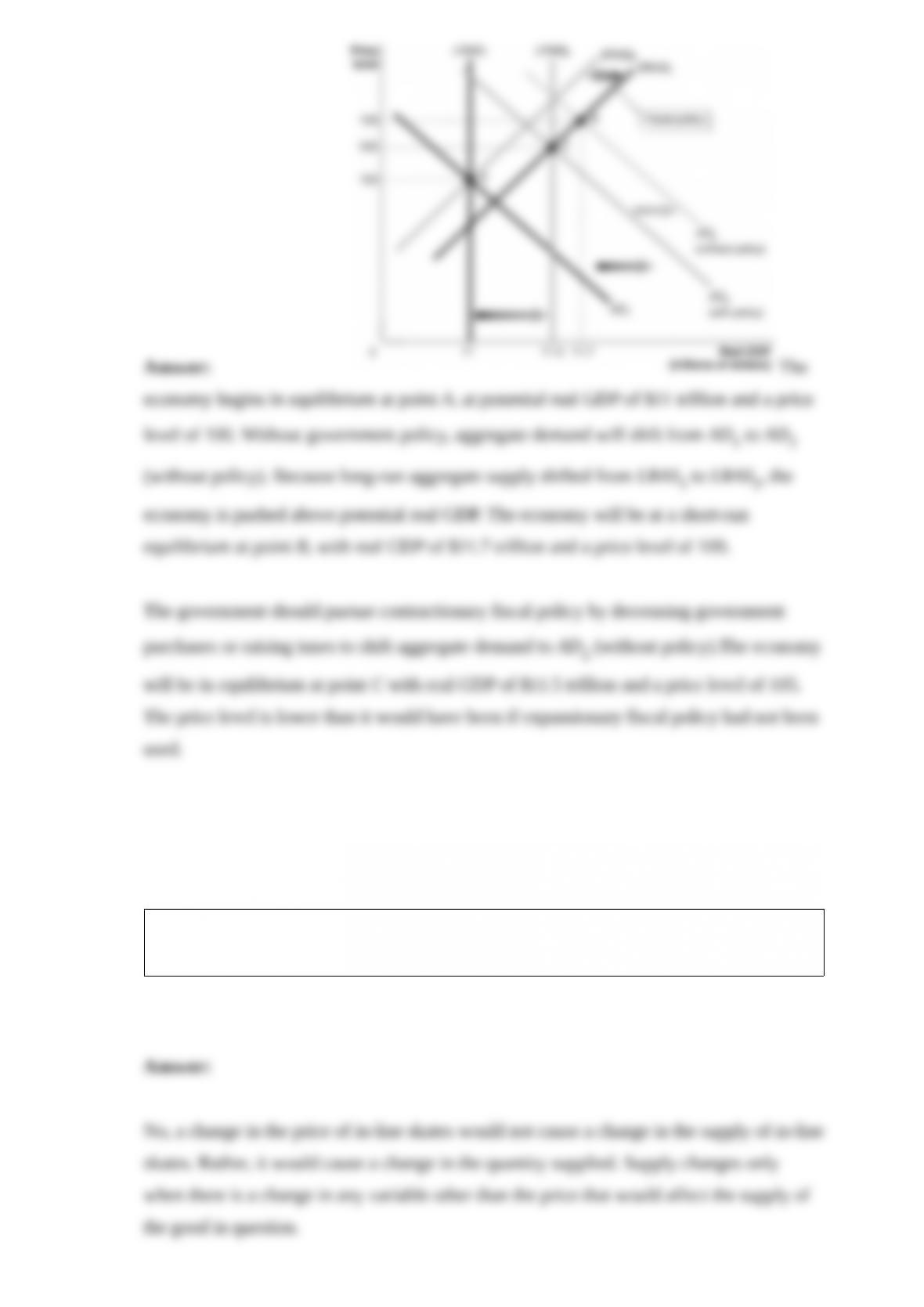
When potential GDP increases, is it necessarily the case that real GDP increases as
well? Explain.

Would the invention of money, as opposed to barter, increase the growth rate of real
GDP in a country over time? Why or why not?
If the labor supply curve shifts to the left and the labor demand curve remains
unchanged, what will happen to the equilibrium wage and the equilibrium level of
employment? Illustrate your answer with a graph.
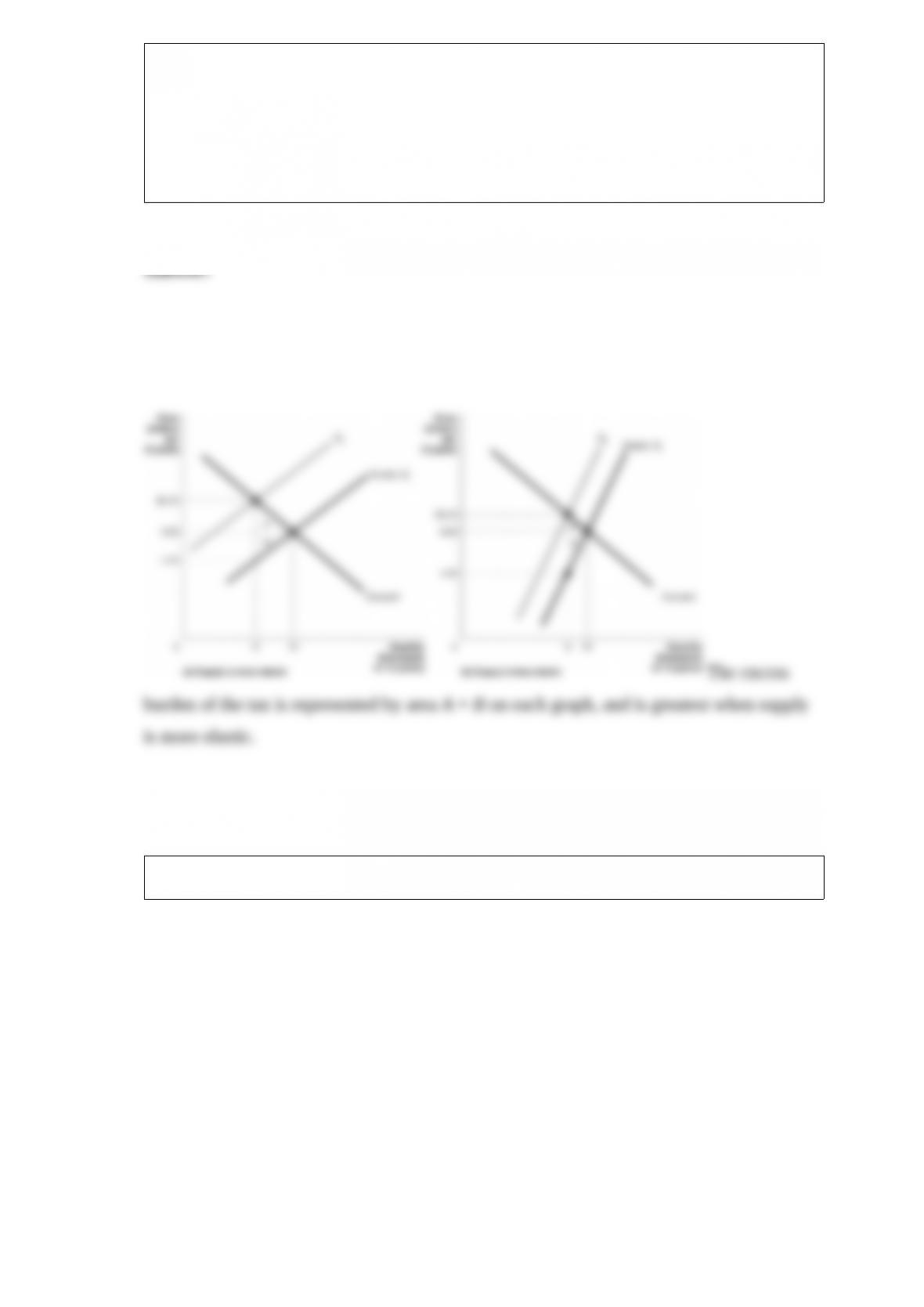
Suppose the equilibrium price and quantity of a 12-pack of Dr. Pepper are $5.00 and
10,000 12-packs, respectively, and the government decides to impose a $1.00 tax on
every 12-pack of carbonated soft drinks. Draw two supply and demand graphs, one
showing the excess burden of the tax when supply is less elastic and the other showing
the excess burden of the tax when supply is more elastic. Identify the excess burden of
the tax on each graph. On which graph is the excess burden the greatest?
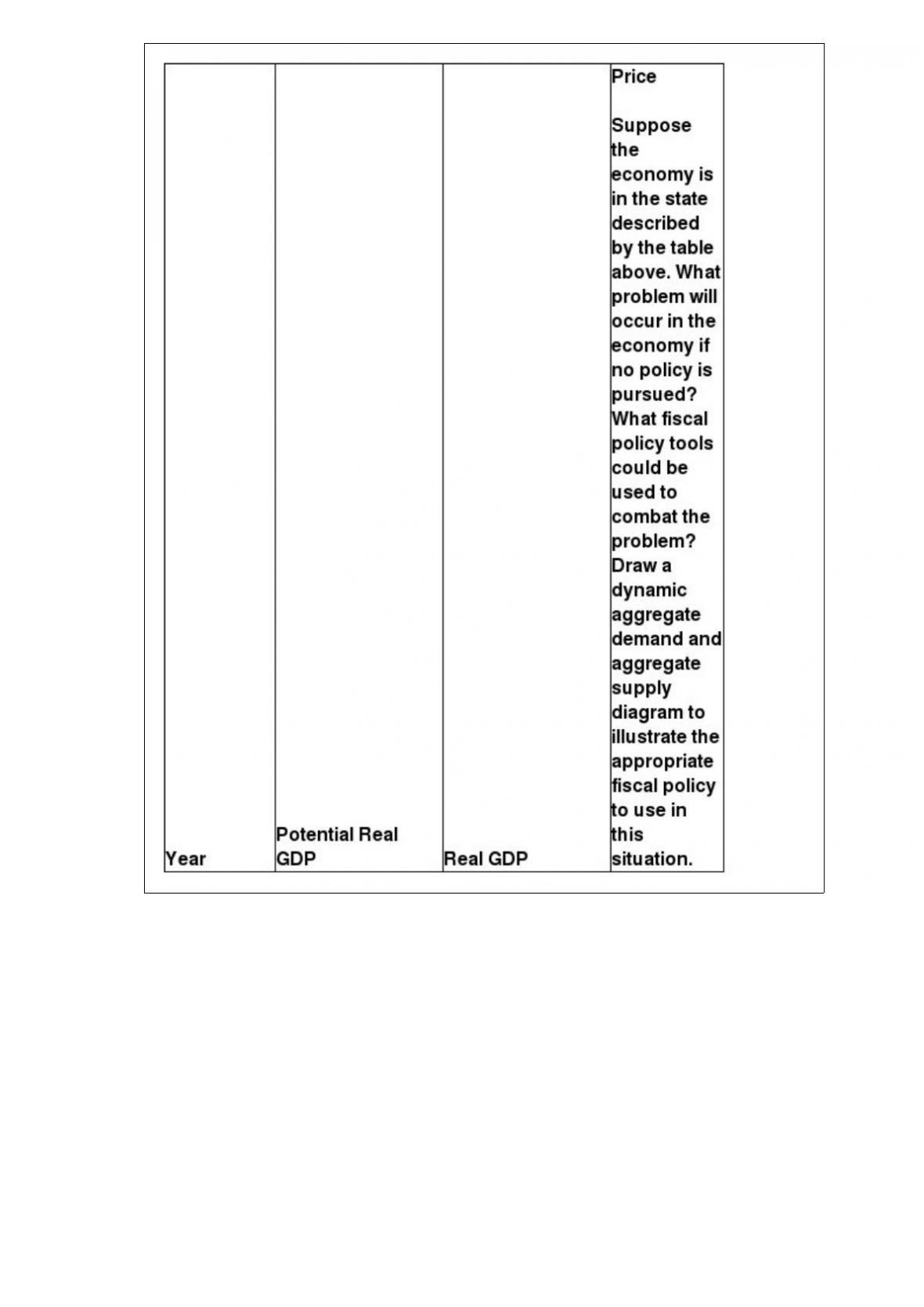
Table 16-6
Would a change in the price of in-line skates cause a change in the supply of in-line
skates? Why or why not?
What are the advantages of setting up a corporation as opposed to a proprietorship or
partnership?
Use the information below to explain adjustments that move the economy to a long-run
equilibrium. Assume that firms and workers have adaptive expectations. The current
unemployment rate = 4%.
The natural rate of unemployment = 6%.
Last year’s inflation rate = 3%.
This year’s inflation rate = 4%.
U.S. antitrust laws are designed to prohibit monopolization and encourage competition.
Why, then, does the government erect barriers to entry and create monopoly power by
granting firms patents?
Dalton, Georgia, a town with a population less than 35,000, has developed into a
leading producer of carpets, despite its small size. Some government officials argue that
the success achieved by firms in Dalton in developing a comparative advantage in
carpet making because of external economies can be used to justify trade barriers as a
means to protect an “infant industry.” After an infant industry gains experience it can
compete in international markets and the trade barriers can be removed. What
objections do economists make to this argument in favor of trade barriers?