The classical model does a good job of explaining short-run fluctuations in the level of
economic activity.
Suppose that a perfectly competitive market is in equilibrium. Then,
A firm’s total cost of production
The equilibrium interest rate will change if
a. the money demand curve shifts
b. there is a movement along the money demand curve
c. crowding out becomes so serious that the dollar loses value
d. the federal funds rate fluctuates rapidly
e. Congress threatens to put a cap on interest rates
The formula for determining a real variable is real variable =
a. (nominal variable /100) x CPI
b. (nominal variable x CPI) /100
c. (nominal variable /price index) x 100
d. (nominal variable /price index) + 100
e. (nominal variable /price index) /100
The specialization of labor
What would be the effect of a reduction in the corporate profits tax?

a. Investment would decrease, the production function would shift downward,
productivity would decrease, and so would output.
b. Investment would increase, the production function would shift upward, productivity
would increase and output would decrease.
c. Investment would increase, the production function would shift upward, and both
productivity and output would increase.
d. Investment would decrease, the production function would shift downward, and both
productivity and output would increase.
e. Investment would increase, the production function would shift upward, productivity
would decrease and output would increase.
An industry’s typical percentage markup
a. should be expected to fluctuate wildly from year to year
b. equals 1 – (average cost per unit/average revenue per unit)
c. is determined by collusion
d. is of price concern for the macroeconomy
e. is relatively low if there is fierce competition among firms.
Which of the following will shift the aggregate supply curve upward?
a. A decrease in world oil prices
b. Bad weather, which increases farmers’ costs per unit of output
c. Increases in consumer spending
d. An increase in the price level
e. Technological changes that improve worker productivity
Diminishing marginal returns means that aggregate production function is
a. linear
b. downward sloping
c. upward sloping
d. concave
e. convex
Monopolies are characterized by all of the following, except one. Which is the
exception?
The committee of the National Bureau of Economic Research that determines when a
recession in the U.S begins and ends looks at
a. employment, industrial production, sales, and personal income.
b. real GDP.
c. employment and sales.
d. employment.
e. sales and industrial production.
If 50 units of resources can produce either 1 ton of sugar beets or 100 lb. of ham in
Germany, while 90 units of resources can produce either 2 tons of sugar beets or 300 lb.
of ham in Poland,
a. Poland has a comparative advantage in producing both goods
b. Germany has a comparative advantage in producing sugar beets
c. neither country has an absolute advantage in producing sugar beets, but Poland has
an absolute advantage in producing ham
d. Germany can produce more ham than Poland can
e. mutually beneficial international trade is not possible
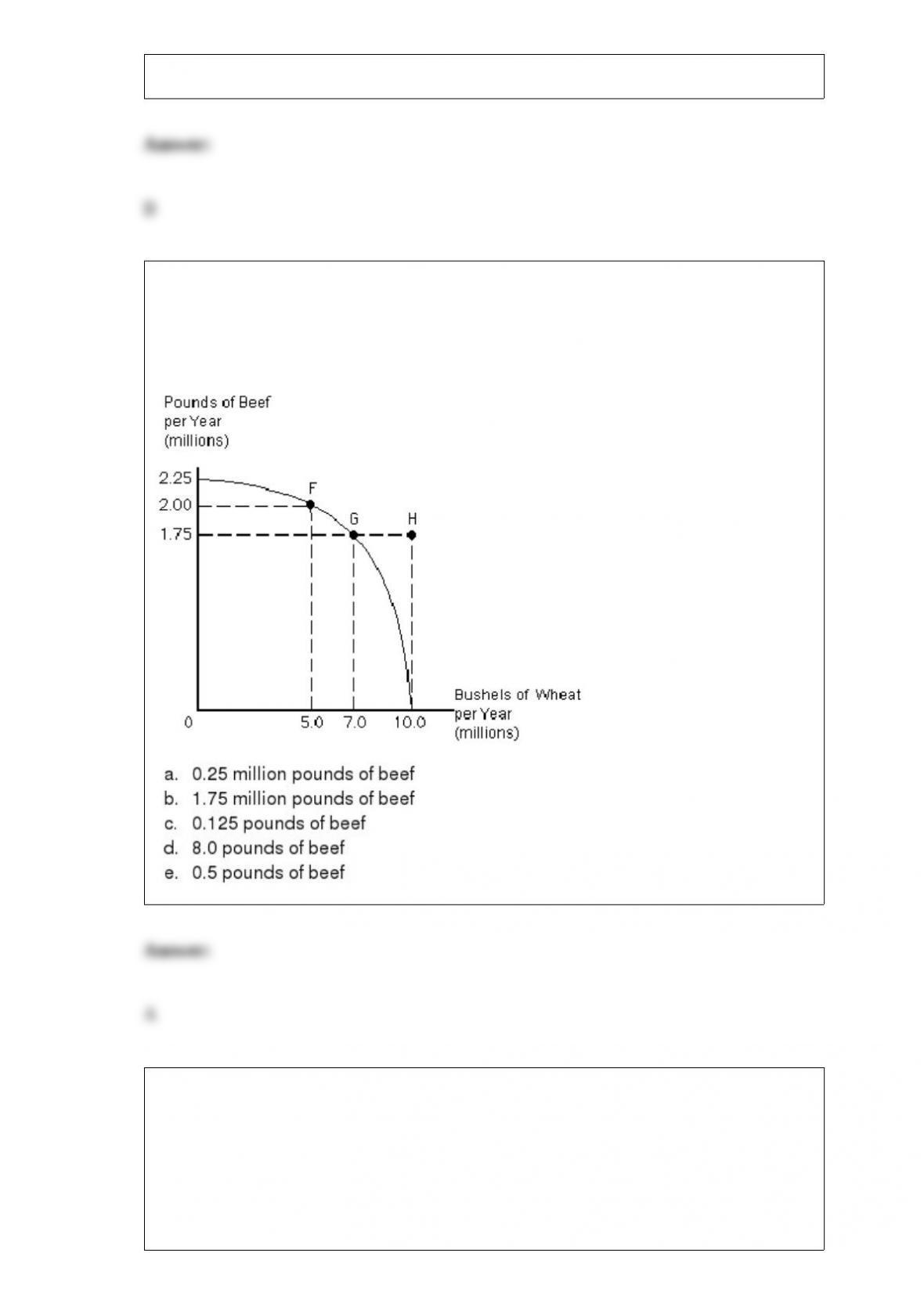
Assume that U.S. agricultural land is used either to raise cattle for beef or to grow
wheat. Figure 2-2 represents the production possibility frontier for beef and wheat.
Between points F and G, the opportunity cost increasing wheat by two bushels equals
Figure 2-2
Suppose the economy includes two distinct groups of people: wage earners and goods
sellers. If the price level increases by 50 percent and nominal wages remain unchanged,
a. there will be no redistribution of purchasing power because all private wage earners
in the U.S. economy receive indexed wages
b. real wages will remain the same because nominal wages do not change
c. there will be no redistribution of purchasing power because only changes in real
income can change the distribution of income

d. income will be redistributed from wage earners to goods sellers
e. income will be redistributed from goods sellers to wage earners
The largest component of aggregate expenditure is
a. consumption spending
b. government purchases
c. net exports
d. capital expenditures
e. investment spending
If the marginal propensity to consume is 0.5 and disposable income increases by
$10,000, by how much will consumption spending increase?
a. $10,000
b. $500
c. $50
d. $5,000
e. $9,524
Reserves that the Fed injects into the banking system are ultimately
a. converted into loans that banks make to other banks
b. distributed among different banks in the system as required reserves
c. end up in just two or three banks
d. ineffective at increasing money supply
e. important to banks that want more customers

The Consumer Price Index (CPI)
a. measures the prices of all goods produced in the economy
b. includes prices of raw materials
c. is found by averaging the prices of all goods consumed in the economy
d. includes only the prices of domestically produced consumer goods
e. includes the prices of some used consumer goods
Increases in inventories are subtracted from GDP because they reflect output that is
produced but not sold.