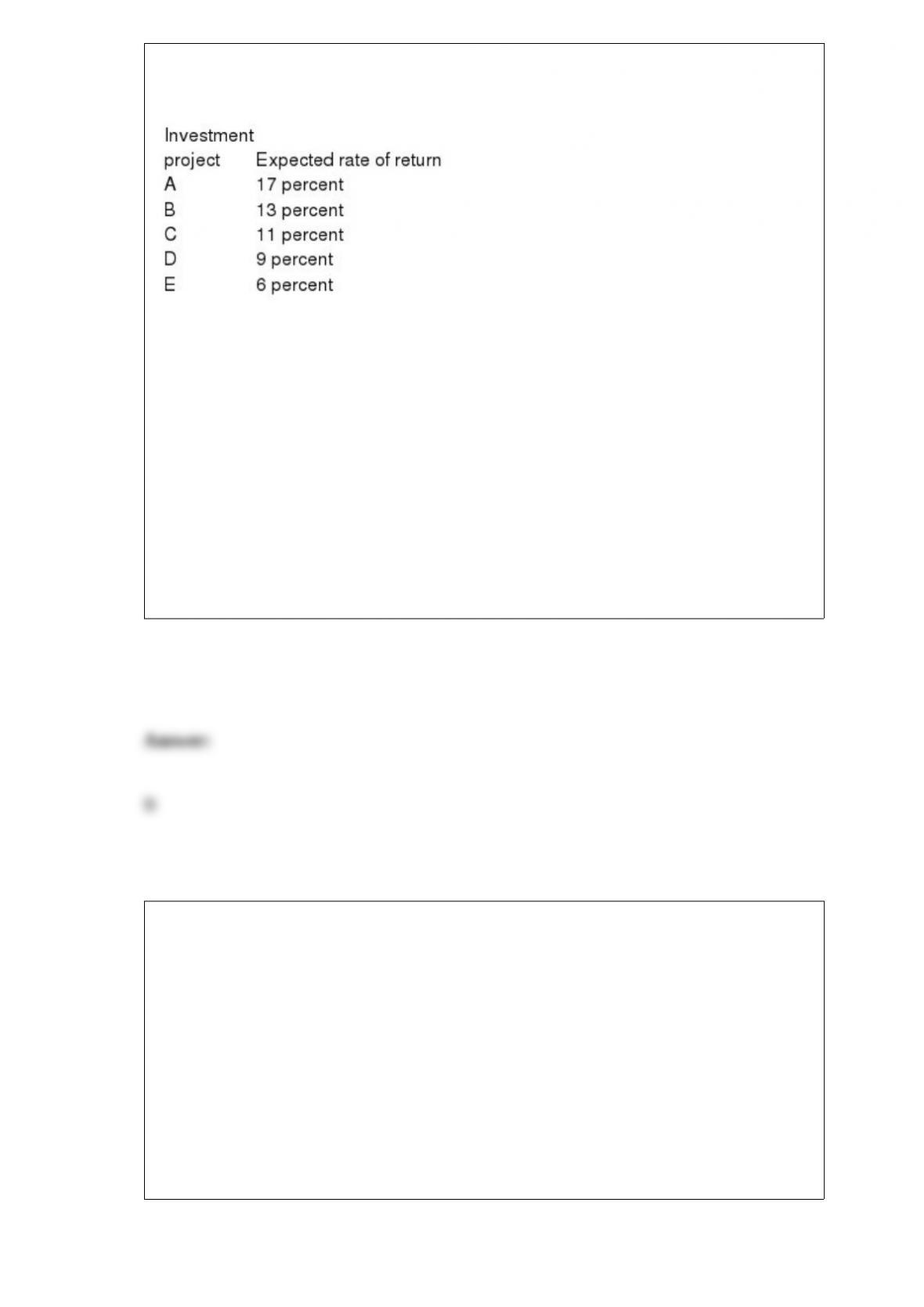
The following questions are based on the following rates of return for five independent
investment projects:
A 2 percent increase in the interest rate might result in canceling the decision to
undertake project
a. A.
b. B.
c. C.
d. D.
e. E.
If one pictures the Federal Reserve System as a pyramid, the apex (top peak) of the
pyramid represents
a. the president.
b. Congress.
c. the Federal Reserve Board.
d. the Federal Open Market Committee.
e. the presidents of large commercial banks.
Small loans carry higher interest rates than large loans because they are
a. less risky.
b. pure loans.
c. more productive.
d. more expensive to administer.
e. very liquid.
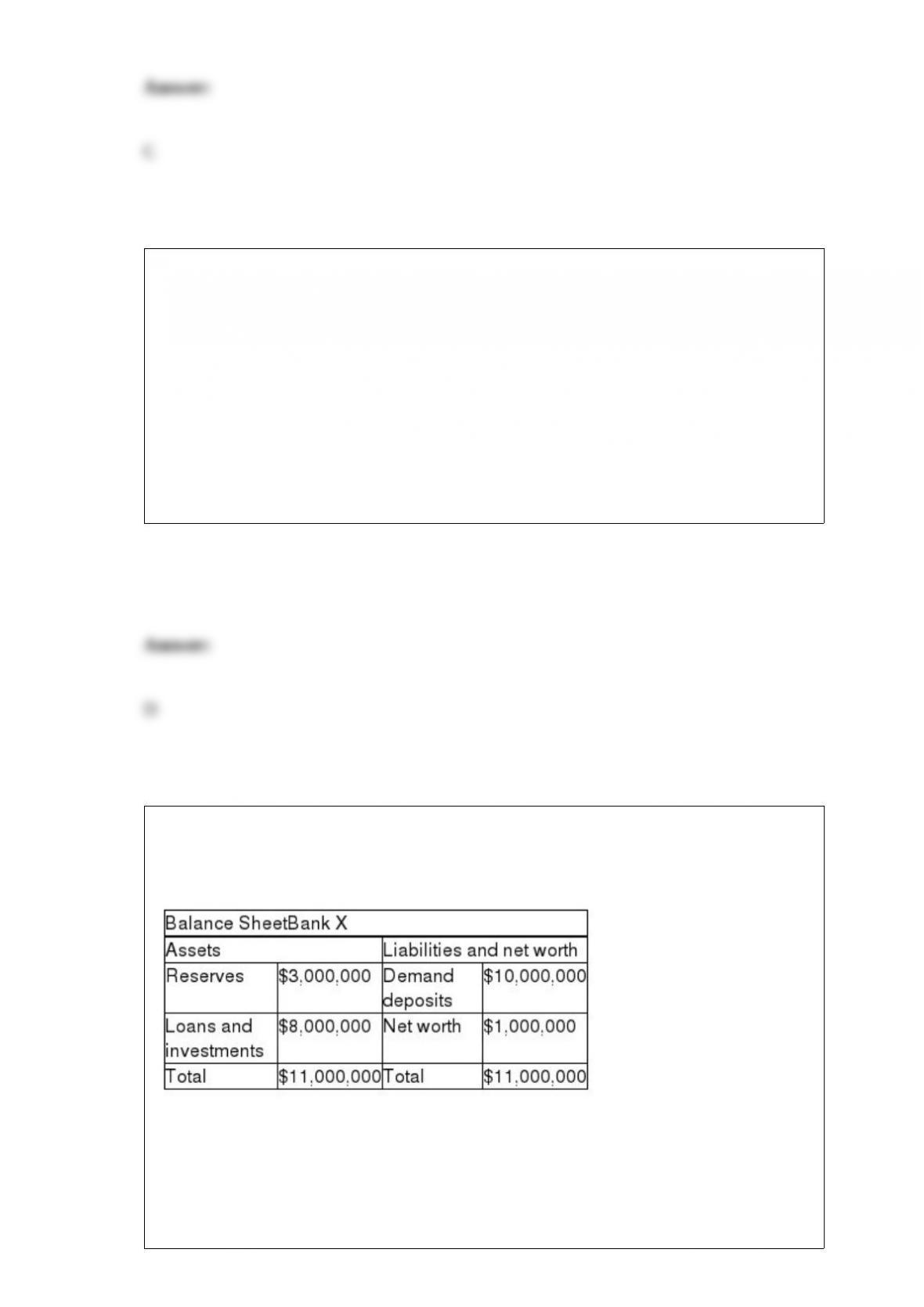
The following questions refer to the table that follows. Assume that there is a
fractional-reserve banking system, that the legal reserve requirements are 10 percent,
and that the balance sheet for Bank X is as follows:
Bank X can safely increase its loans and investment by the amount of
a. $5,000,000.
b. $3,000,000.

c. $2,000,000.
d. $1,667,000.
e. $1,000,000.
In a Keynesian model, an increase in the money supply will increase GDP by
a. increasing the rate of interest, thereby increasing savings.
b. lowering the rate of interest and shifting the investment function upward.
c. causing prices to rise and thereby trading off inflation against unemployment.
d. causing an increase in government expenditures.
e. shifting the transactions demand for money.
The argument that total consumer enjoyment from income increases if income is
redistributed from the rich to the poor is based in part on the idea that an additional
dollar given to a poor person provides him or her with more
a. purchasing power than it provides a rich person.
b. wants than it provides a rich person.
c. employment than it provides a rich person.
d. money than it provides a rich person.
e. extra satisfaction than it provides a rich person.
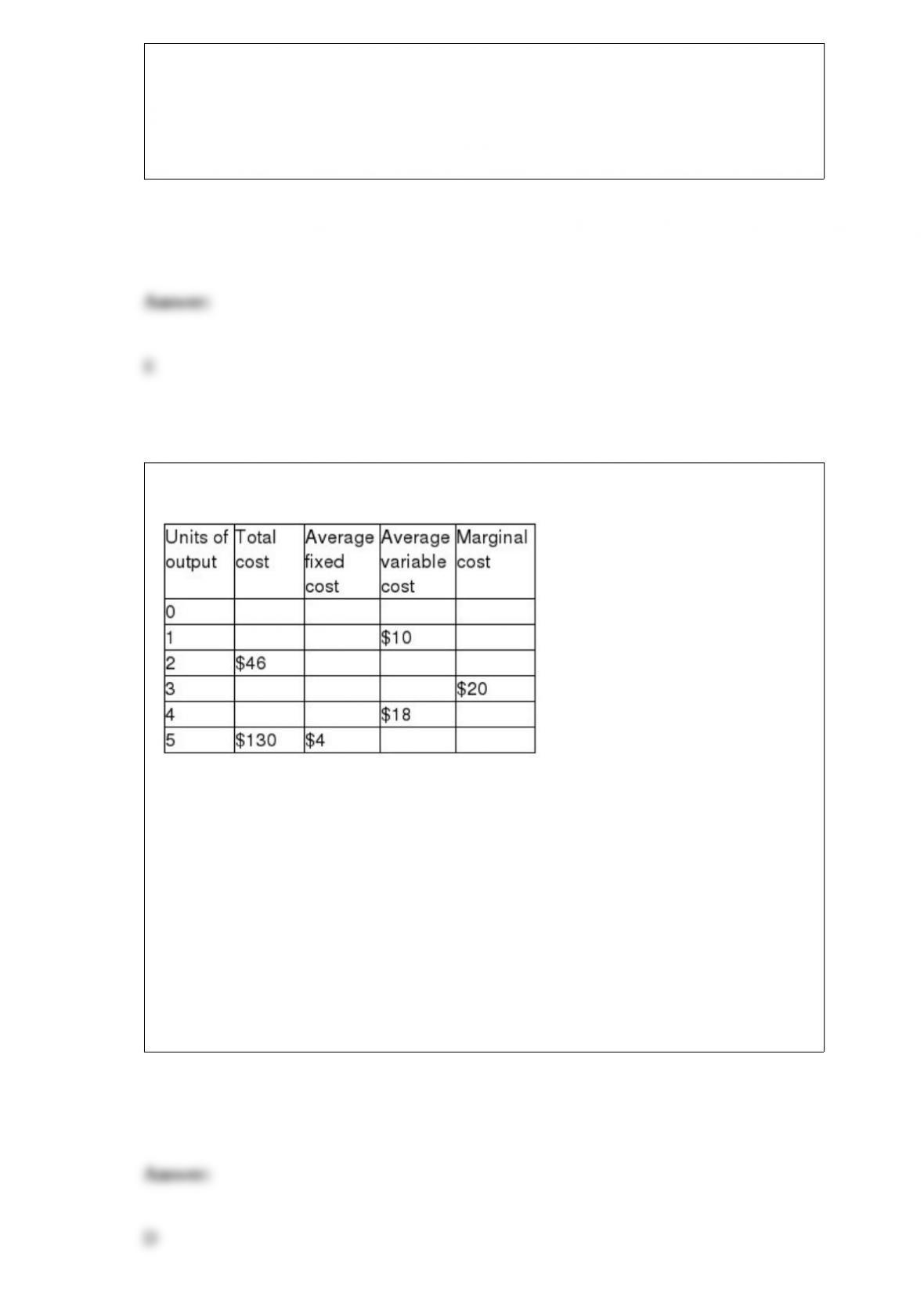
The following questions are based on the following table:
The total cost of producing three units is
a. $20.
b. $22.
c. $26.
d. $66.
e. $92.

The value of the marginal product is the same as the change in
a. output from hiring one more unit of input.
b. revenue from selling one more unit of output.
c. cost from hiring one more unit of input.
d. revenue from one additional dollar of cost.
e. revenue from hiring one more unit of input.
Real business cycle theorists maintain that business fluctuations are due to
a. changes in the real money supply.
b. inflexible wages and prices.
c. increases and decreases in government spending.
d. shifts in the aggregate supply curve.
e. variability in household spending decisions on durable goods.
According to economist Richard Gill, the gold standard

a. would never lead to a balance between imports and exports under normal conditions.
b. was doomed to failure because there was not enough gold in the world.
c. in effect gave the world a single common currency.
d. may be appropriate for a single country but was too complex for use in a world of
many different currencies.
e. leads inevitably to international inflation.
The president submits his budget for the next fiscal year to Congress in
a. January.
b. March.
c. June.
d. September.
e. December.
Economists who favor the use of interest rates as an indicator of monetary tightness
argue that an increase in the demand curve for money

a. is difficult to accommodate unless banks are willing to hold excess reserves.
b. signals an impending recession unless interest rates are allowed to rise.
c. leads to a recession unless the quantity of money is increased.
d. results in increased inflationary pressures unless interest rates are allowed to rise.
e. results in a recession unless the quantity of money is reduced.
The commitment of the government to ensure maximum employment, production, and
purchasing power is provided for in the
a. Automatic Stabilizer Act of 1953.
b. Taft-Hartley Act of 1947.
c. Employment Act of 1946.
d. Consumer Price Index.
e. Truman Doctrine.
The largest component of the U.S. money supply, narrowly defined, is
a. coins.

b. currency.
c. demand and other checkable deposits.
d. savings deposits.
e. credit cards.
In 1975 Congress passed a resolution that the Fed must publish its targets for growth in
the money supply. The general effect of that resolution has been to
a. noticeably restrict the Fed’s power.
b. curb the Fed’s power over monetary policy but enhance its power over fiscal policy.
c. give the Fed the right to set a ceiling on commercial banks’ interest rates for the first
time.
d. force the Fed to rely more heavily on changes in the reserve ratio.
e. have some impact; however, it has been difficult to measure just how much or at
what cost.
The following questions are based on the following graphs for men’s shirts in South
Korea and the United States. The exchange rate is 1,200 won equals $1.00.
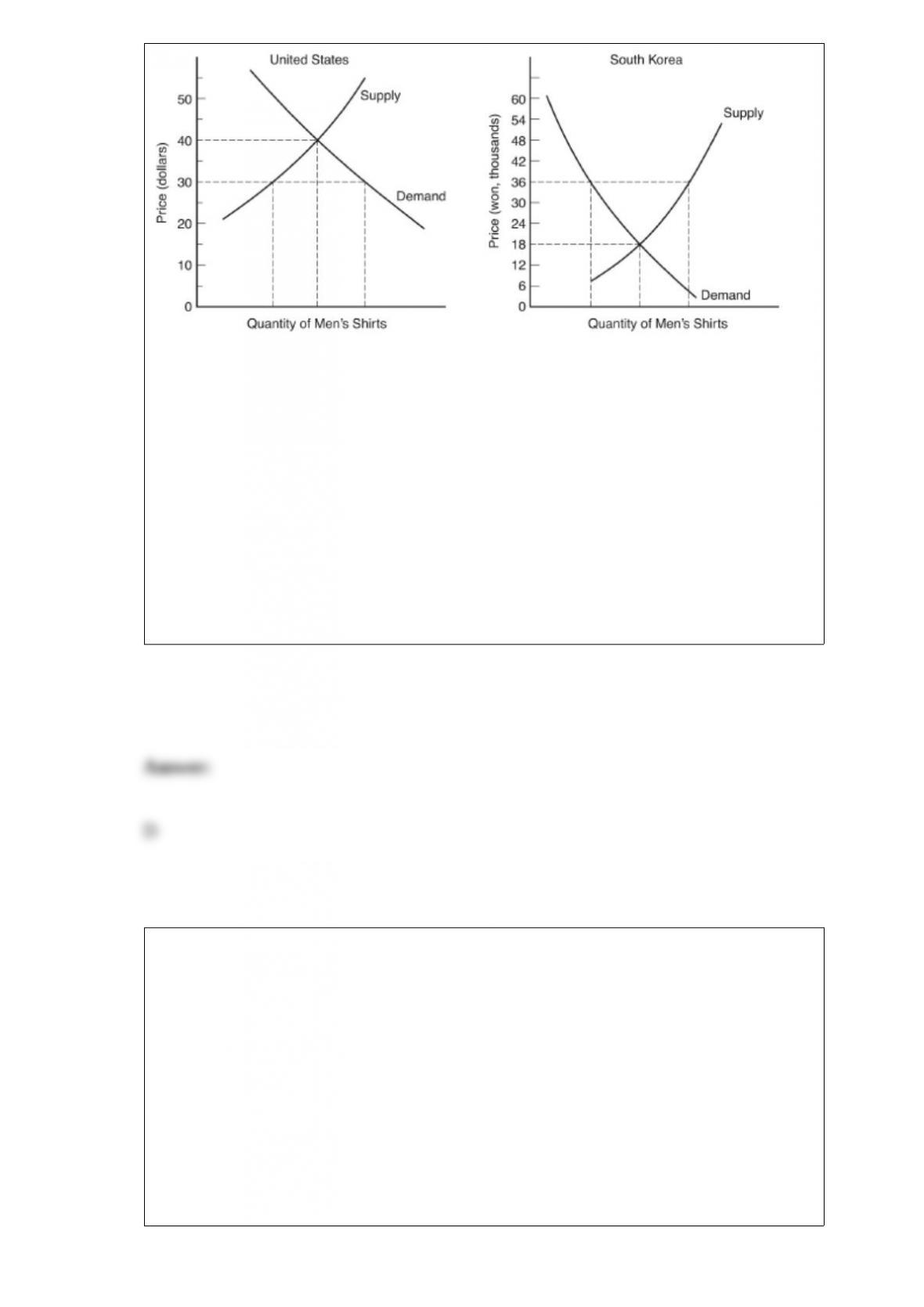
If the United States imposes a prohibitive tariff on men’s shirts, the price of a man’s
shirt in the United States probably is
a. below $30.
b. $30.
c. between $30 and $40.
d. $40.
e. over $40.
Excluded from the four key trends that account for the high Asian growth rates in the
1980s and early 1990s are
a. rising female labor force participation rates.
b. rapid rises in educational attainment.
c. rapid increases in the rate of innovation and a growth in Asian consumer demand.
d. high and rising investment rates.
e. shifts of workers from agriculture to manufacturing.

In labor-management relationships, what are implicit contracts?
a. contracts imposed by outside arbitration panels
b. informal unwritten understandings between labor and management
c. agreements between management and union leaders that are kept secret from the rank
and file members
d. contracts that do not specify a wage rate but ensure that workers get the current going
rate
e. documents that spell out in detail the intent and meaning of the provisions in the
formal contract
Gold certificates held by the Federal Reserve are
a. legal tender.
b. warehouse receipts issued by the Treasury for gold bullion.
c. the assets for backing our paper money.
d. deposits used by the Treasury to pay its bills.
e. I.O.U.s that reflect the gold we owe those countries that export more to us than we
export to them.

Environmental pollution is an economic problem because
a. levels of pollution decline as the rate of economic growth increases.
b. firms that maximize profits rarely pollute.
c. capitalist market economies normally minimize pollution-causing activities.
d. firms and individuals that pollute pay less than the true social cost of disposing of
their wastes.
e. it is a sign that the price system is functioning in an optimal way.
Each Federal Reserve Bank is a corporation owned by
a. the Board of Governors.
b. state governments.
c. the U.S. Treasury.
d. central banks.
e. commercial banks.

A leftward shift in the aggregate supply curve produces
a. demand-side inflation.
b. increases in the price level.
c. falling interest rates.
d. a higher standard of living.
e. a horizontal Phillips curve.
If the demand curve is vertical and the supply curve slopes upward, the imposition of a
sales tax will
a. shift entirely to the buyer.
b. fall more heavily on the buyer.
c. be equally shared by the buyer and seller.
d. fall more heavily on the seller.
e. shift entirely to the seller.
A more rapid rate of growth of productivity can be achieved if
a. the rate of investment in equipment increases.
b. a country’s population growth rate rises rapidly, increasing demand.
c. high rates of inflation are maintained.
d. government involvement is eliminated.
e. private saving is discouraged.
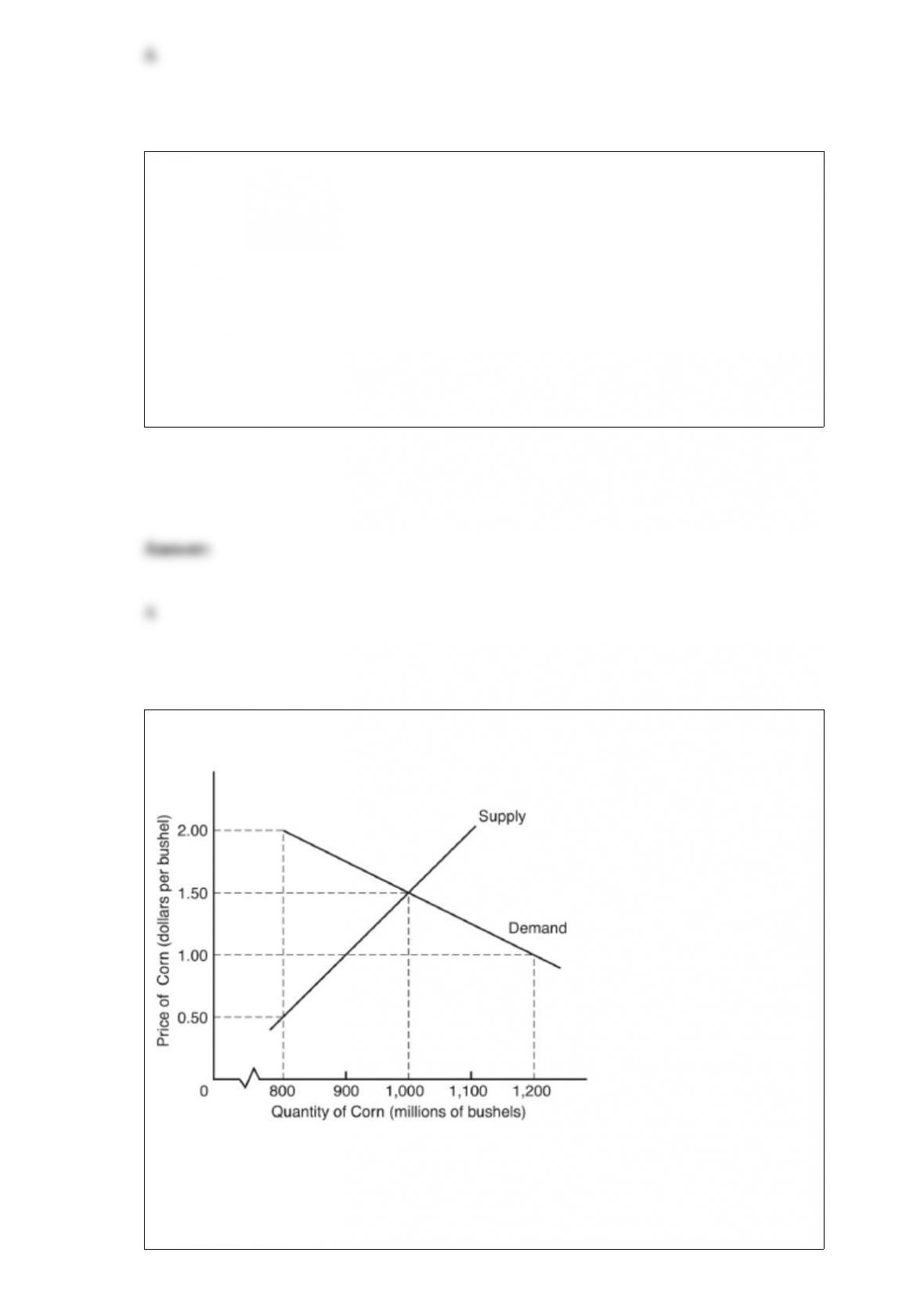
The following questions are based on the following graph showing the market for corn:
If the quantity supplied were less than the quantity demanded at a particular price, the
equilibrium price would be achieved by
a. rationing.
b. a decrease in supply.
c. an increase in the price that increases the quantity supplied and decreases the quantity
demanded.
d. the piling up of inventories until firms were forced to lower the price.
e. an increase in demand that would induce firms to step up production.
To maximize its profit for a particular quantity of output, a firm should equate the
a. total amount spent on each of its inputs.
b. marginal product of each of its inputs.

c. average product of each of its inputs.
d. marginal product with the average product of each of its inputs.
e. marginal product of a dollar’s worth of each input.
In what way was the Employment Act of 1946 signed into law by President Truman
significantly different from the original bill introduced into the U.S. Senate in January
1945?
a. The final act guaranteed the right to employment; the original bill did not.
b. The final act marked a commitment by government to high employment but not the
guaranteed employment written into the original.
c. The final act limited the government’s power to tax in a way that the original had not.
d. The original bill was far less supportive of workers’ rights than the final version.
e. The final act mandated deficit spending; the original bill required the government to
balance its budget.
To monetarists, the monetary base is important because
a. it is unaffected by policy actions of the Fed.
b. unlike the money supply, interest rates are not affected by changes in the monetary

base.
c. it is based on the gold certificate holdings of the Fed.
d. the total money supply is dependent on as well as made from it.
e. it constitutes the broadest possible definition of the money supply.
If $1,000 received a year from today is equivalent to $926 received today, the rate of
interest is ________ percent.
a. 10
b. 9.3
c. 8
d. 4
e. 6
________ stressed the importance of innovation in the process of economic growth.
a. Joseph Schumpeter
b. Karl Marx

c. Thomas Malthus
d. David Ricardo
e. Adam Smith
The main reason the government relied on a restrictive monetary policy to fight
inflation during the late 1970s was that
a. such a policy was strongly urged during the 1974 economic summit conference called
by President Ford.
b. such a policy is the only proven method for fighting inflation and unemployment at
the same time.
c. unemployment was then viewed as a more serious problem than inflation, and such a
policy could boost employment.
d. most observers during that time felt that inflation was due to excessive demand, not
shortages.
e. the resulting increase in interest rates would stimulate investment and expanded
output.