
Would a profit-maximizing firm sell where demand is inelastic?
a. No, this would not follow the rule of MC = MR.
b. No, the firm could not profitably raise price.
c. Yes, the firm could profitably lower price to attract sales.
d. Yes, in this case there are few substitutes for the good.
The current exchange rate system for most currencies is described most accurately as
one of
a. fixed exchange rates.
b. freely flexible exchange rates.
c. gold standard rates.
d. dirty or managed floating.
Which factor of production receives the greatest share of the U.S. national income?
a. land
b. labor

c. capital
d. entrepreneurship
When computing gross domestic product, government services are valued at the
a. price consumers pay for them.
b. value of the resources used to produce them.
c. value of comparable outputs from the private sector.
d. value of taxes collected from consumers.
An increase in fixed cost will, in the short run, alter the industry’s output of
a. both a monopolist and a competitive industry.
b. only a monopolist.
c. only a competitive industry.
d. neither a monopolist nor a competitive industry.

The amount by which equilibrium real GDP exceeds full-employment GDP is known as
a. stagflation.
b. employment.
c. a recessionary gap.
d. an inflationary gap.
The price elasticity of demand for widgets at any particular price is determined by
a. whether widgets are luxuries or necessities.
b. how much of their budgets consumers spend on widgets.
c. whether there are any good substitutes for widgets.
d. All of the above are correct.

In The General Theory of Employment, Interest, and Money, Keynes rejected the idea
that
a. a capitalist economy always gravitates toward high levels of employment.
b. budget deficits necessarily cause recessions and inflation.
c. the ultimate breakdown of the capitalist system is inevitable.
d. international trade always helps to achieve economic stability.
As hourly wages have risen in the United States in the twentieth century, the number of
hours of labor supplied by most wage workers has
a. fallen.
b. stayed roughly constant.
c. risen.
d. generally risen, but has fallen during periods of recession.
Debt grew faster than GDP during and after the recent Great Recession, when the
government had to spend more (as for unemployment benefits), while its tax revenue
shrank.
a. True

b. False
The equilibrium level of GDP is always accompanied by full employment and stable
prices.
a. True
b. False
The selection of particular products’ production processes
a. determines the output of other products made with those inputs at the same time.
b. is part of the distribution problem in an economy.
c. is accomplished without regard to profit in a laissez-faire economy.
d. depends upon plans for distribution of the products.

Total physical product shows what happens to the quantity of an output when the firm
changes the quantity of an input.
a. True
b. False
In the circular flow diagram saving
a. is a leakage and investment is an injection.
b. and investment are both injections.
c. is an injection and investment is a leakage.
d. and investment are both leakages.
If the Fed reduces the required reserve ratio, how will this affect excess reserves and the
money supply?
a. Both will increase.
b. Excess reserves increase and the money supply decreases.
c. Both will decrease.

d. Excess reserves decrease and the money supply increases.
Colombia produces coffee with less labor and land than any other country; it therefore
surely has
a. an absolute advantage in coffee production.
b. a comparative advantage in coffee production.
c. absolute efficiency in coffee production.
d. a comparatively absolute advantage in coffee production.
Table 11-1
Y = C + I + G
C = 500 + .8(Y − T)
I = 300
G = 700
T = .25Y

Refer to Table 11-1. What is the level of consumption in this model?
a. 2,950
b. 2,750
c. 2,550
d. 2,350
e. 2,150
Although a balanced budget may be appropriate under one monetary policy, a deficit or
surplus may be appropriate under a different monetary policy.
a. True
b. False
In both the 1970s and the 1990s, extreme economic events caused unemployment to
move in the same direction as inflation.
a. True
b. False

In the equation of exchange, velocity of money increases when
a. Y increases without any changes in P and M.
b. Y falls without any changes in P.
c. M increases without any changes in P and Y.
d. P falls without any changes in Y and M.
It can be shown that average revenue and price are always equal.
a. True
b. False
Both parties gain in a voluntary exchange.
a. True
b. False
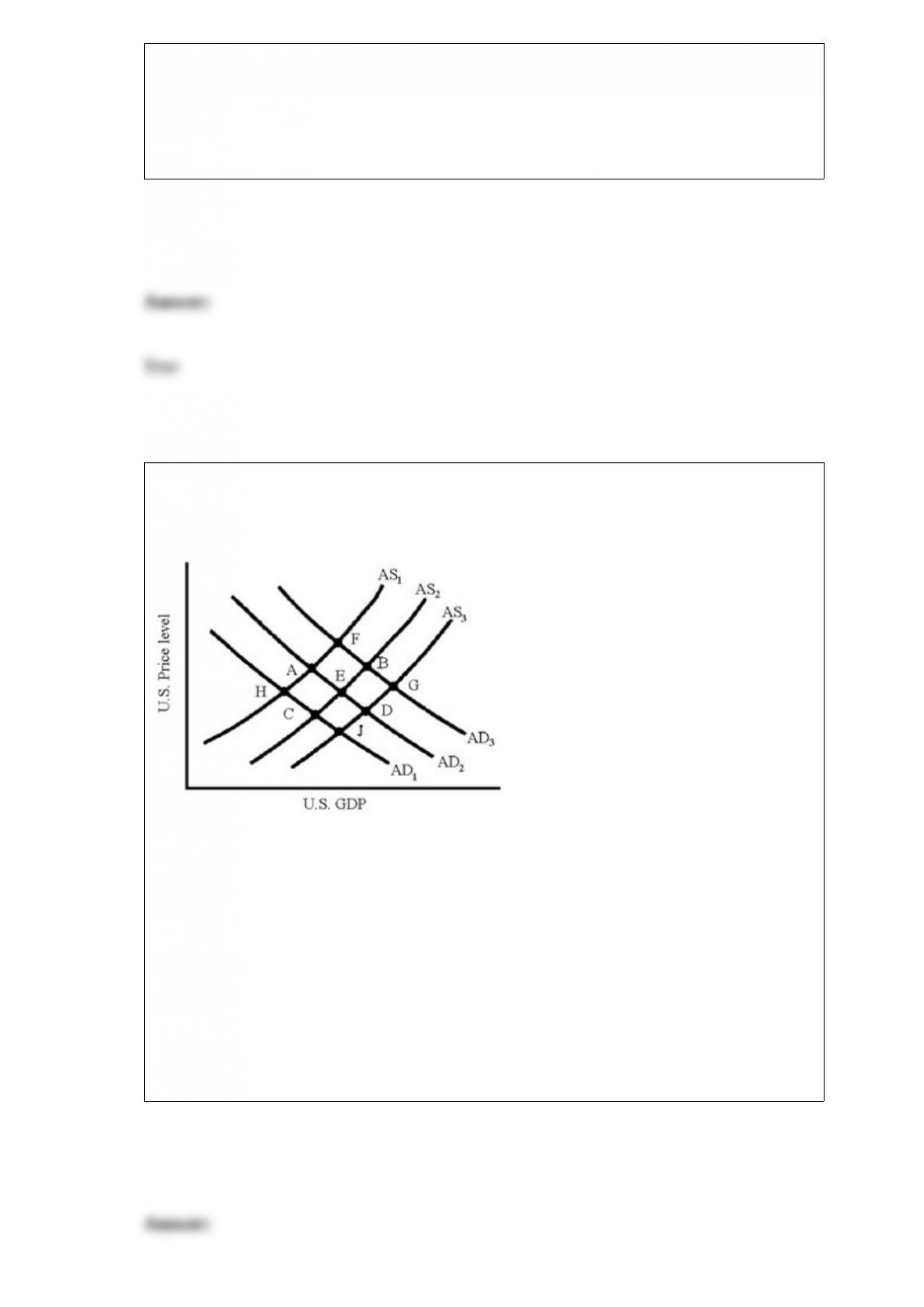
Figure 20-6
In Figure 20-6, an expansive monetary policy in a closed economy results in an
equilibrium at point E. In our open economy, allowing for the induced change in the
currency exchange rate, the final equilibrium will be at a point like
a. B.
b. F.
c. J.
d. H.

It is efficient to increase the output of computers if
a. society considers the extra computers more valuable than other goods foregone to
produce the computers.
b. the opportunity cost of more computers is greater than their marginal utility.
c. computer production can be increased only if production of other goods is decreased.
d. the price of the computers is equal to their average cost.
Since World War II, the share of corporate income tax collections in total federal
revenue has been:
a. increasing rapidly.
b. declining rapidly.
c. increasing slowly.
d. declining generally.

A corporate bond sold in 2000 with a face value of $10,000, a $100 coupon, and a
maturity date in 2010
a. will pay the bondholder $100 a year every year from 2000 to 2010 and will also pay
him $9,000 in 2010.
b. will pay the bondholder $100 a year every year from 2000 to 2010 and will also pay
him $10,000 in 2010.
c. requires the bondholder to pay $100 a year every year from 2000 to 2010 and will
pay him $10,000 in 2010.
d. requires the bondholder to pay $100 in 2000 only and will pay him $10,000 in 2010.
Improvements in human capital and education played a major role in the productivity
improvements of the U.S. economy from 1995 to 2009.
a. True
b. False
A college education is a(n)
a. investment in human capital.
b. form of innovation.
c. public good.
d. mediated settlement.
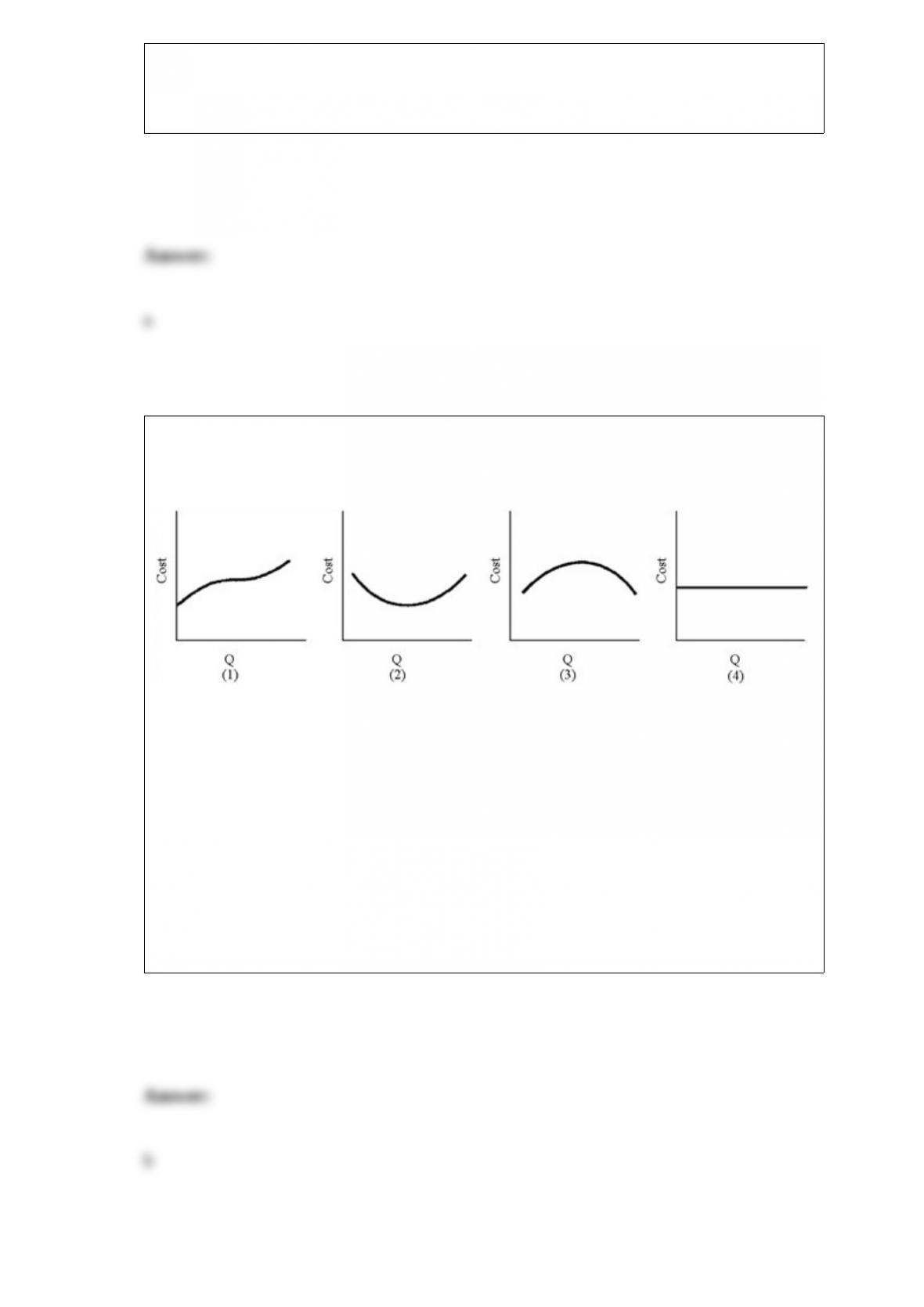
Figure 7-8
“Overfishing” impairs the ability of fish stock to replenish itself, so the stock of fish
declines. Fishermen then attempt to increase output by adding more boats and fishing
longer. Which average cost curve in Figure 7-8 depicts the “overfishing” situation?
a. 1
b. 2
c. 3
d. 4
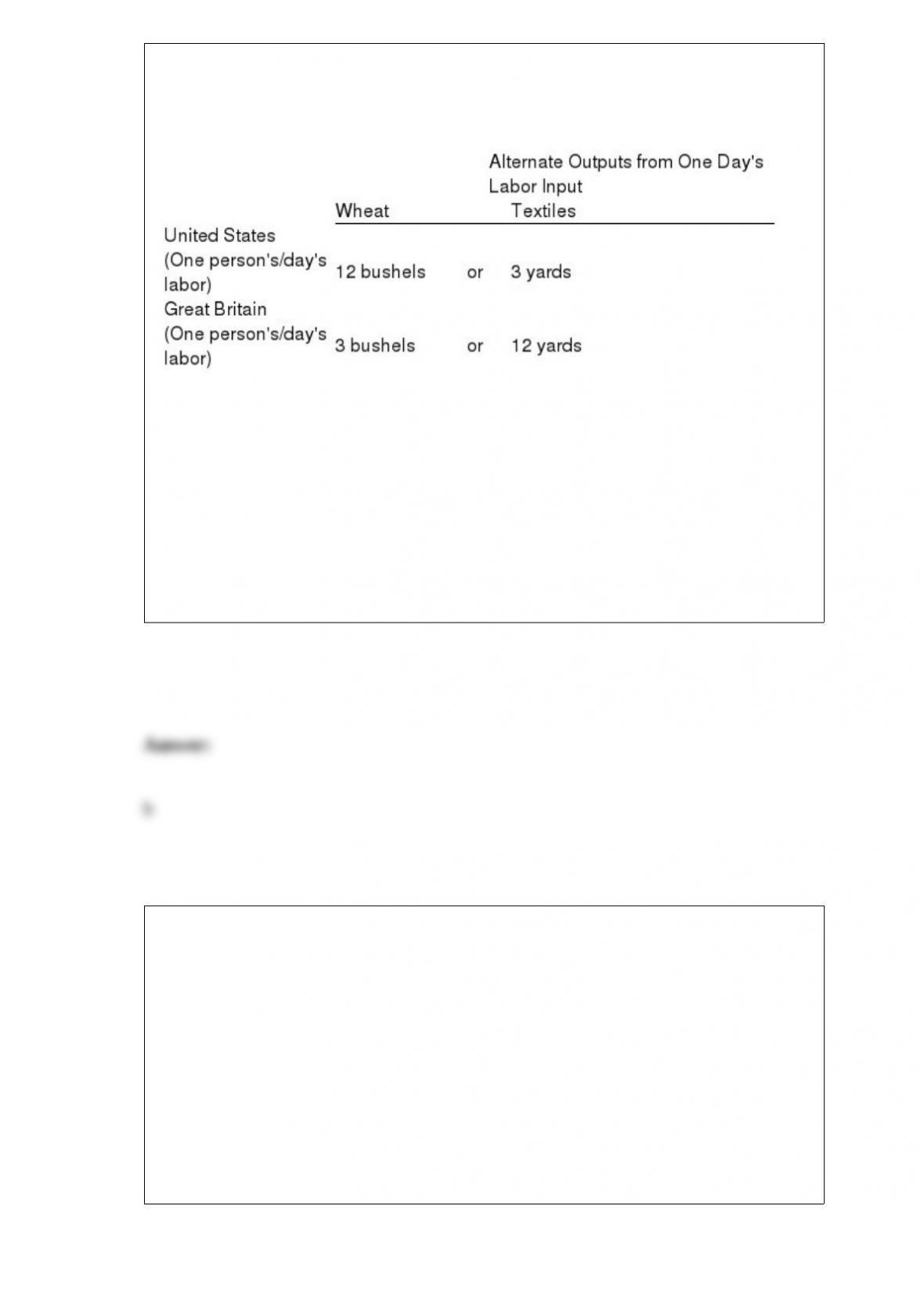
Table 22-1
From Table 22-1, the United States
a. has an absolute advantage over Great Britain in the production of textiles.
b. has an absolute advantage over Great Britain in the production of wheat.
c. has a comparative advantage in the production of textiles.
d. should export textiles to Great Britain.
The Wall Street Journal reports that “hard times aid poultry companies as people eat
cheaper fowl.” In the language of economists, this means
a. chicken is an inferior good.
b. chicken has a negative substitution effect.
c. chicken has a positive substitution effect.
d. people’s tastes change during recessions.
e. chicken has a positive income effect.

From a purely economic point of view, discrimination exists when
a. black teenagers earn more than white teenagers.
b. all factors are earning average products.
c. women earn less than men.
d. equivalent factors earn different payments for equal contributions to output.
A country has a comparative advantage over another in the production of gadgets if it
can produce
a. more gadgets than can the other country.
b. more gadgets than can any other country.
c. gadgets more efficiently than it can produce any other good.
d. gadgets at lower opportunity cost than can the other country.
If borrowers and lenders expect a higher rate of inflation,
a. nominal interest rates should decrease.
b. nominal interest rates should remain constant.
c. nominal interest rates should increase.
d. real interest rates should increase.
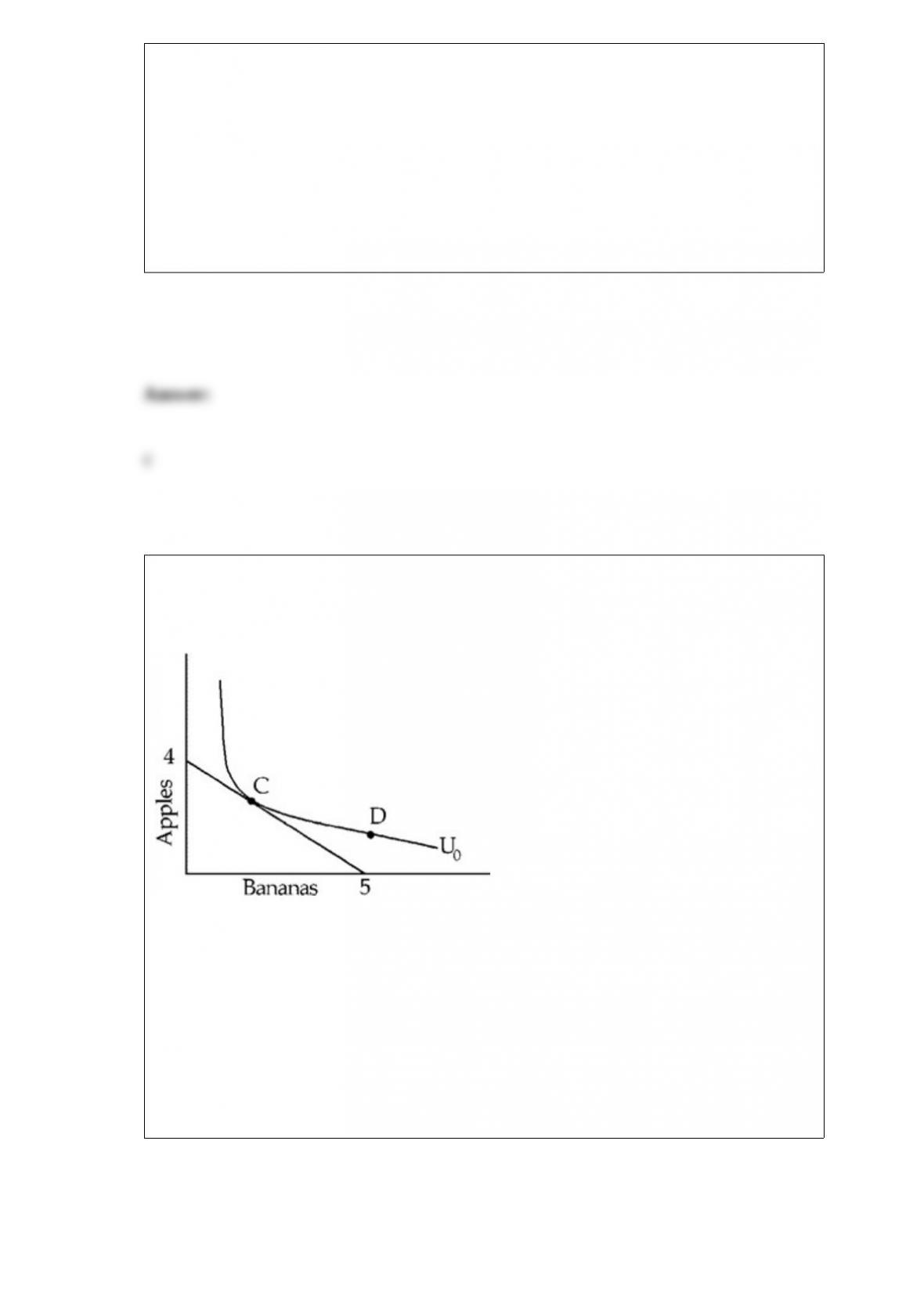
Figure 5-16
In Figure 5-16, Adam is
a. better off at C than at D and able to afford either C or D.
b. better off at D than at C but only able to afford C.
c. equally well off at C and D and able to afford either C or D.
d. equally well off at C and D but only able to afford C.