
Which of the following would be the most likely long-run effect if the United States
increased its tariff rates and adopted stricter import quotas?
a. a decrease in both U.S. imports and exports
b. an increase in both U.S. imports and exports
c. a decrease in U.S. imports and an increase in U.S. exports
d. an increase in U.S. imports and a decrease in U.S. exports
A professor of economics gets a $100 a month raise. She figures that even with her new
monthly salary she will be unable to buy as many goods and services as she could 12
months ago.
a. Her real and nominal salary have risen.
b. Her real and nominal salary have fallen.
c. Her real salary has risen and her nominal salary has fallen.
d. Her real salary has fallen and her nominal salary has risen.
If the Fed wanted to shift to a restrictive monetary policy and reduce the money supply,
it could
a. increase the interest rate paid on excess reserves encouraging banks to extend more
loans.
b. decrease the interest rate paid on excess reserves encouraging banks to extend more
loans.
c. decrease the interest rate paid on excess reserves encouraging banks to hold excess

reserves rather than extend more loans.
d. increase the interest rate paid on excess reserves encouraging banks to hold excess
reserves rather than extend more loans.
When information about potential jobs is costly to acquire and individuals must spend
time searching for jobs, which type of unemployment will result?
a. frictional
b. seasonal
c. structural
d. cyclical
Other things constant, a decrease in the demand for hair dryers will
a. increase the price of hair dryers.
b. increase the quantity supplied of hair dryers.
c. increase the demand for hair dryer manufacturing workers.
d. decrease the demand for hair dryer manufacturing workers.

Compared to the 1910-1960 period, economic fluctuations during the past 50 years
have been less severe. Most economists believe that this increased stability is primarily
the result of
a. more stable monetary policy.
b. the smaller budget deficits of recent decades.
c. regulations that promoted more affordable housing.
d. greater stability of stock prices as measured by the Dow Jones Industrial Average.
The major advantage of automatic stabilizers is that they
a. guarantee the federal budget will be balanced in a relatively short amount of time.
b. institute countercyclical fiscal policy without the delays associated with legislative
action.
c. automatically produce surpluses during recessions and deficits during expansions.
d. require discretionary actions on the part of Congress before they exert an impact on
output and employment.

Terrell, an auto repair mechanic who remains unemployed because he refuses to work
for less than $1,000 an hour, is
a. counted as part of the labor force.
b. considered frictionally unemployed.
c. an underemployed worker.
d. not counted as part of the labor force.
e. considered as productively active.
If the actual price level is lower than the expected price level reflected in long-term
contracts,
a. many firms will find production more profitable than they had expected and will
increase the quantity of output supplied
b. many firms will find production less profitable than they had expected and will
decrease the quantity of output supplied
c. many firms will find production more profitable than they had expected and will
decrease the quantity of output supplied
d. many firms will find production less profitable than they had expected and will
increase the quantity of output supplied

Which of the following is a term that is sometimes used to describe markets with low
entry barriers and firms that are price searchers?
a. pure competition
b. monopoly
c. monopolistic competition
d. oligopoly
Which of the following is true?
a. To remain in office, a politician must try to enact policies that gain him votes for his
reelection and increase the support coming from contributors.
b. A politician always attempts to pursue policies that are good for society even if they
are strongly opposed by many of her constituents or contributors.
c. Politicians generally place more weight on how their decisions affect future costs and
benefits than on how they affect present costs and benefits.
d. The value of being in office is so low that most political candidates spend very little
on campaigns to try to win (or keep) elected office.
Which of the following would increase U.S. GDP?

a. Ford Motor Company begins to produce and sell cars in China.
b. Mercedes-Benz begins to produce and sell cars in Mississippi.
c. An American investor buys 100 shares of Ford stock.
d. An American investor purchases 100 shares of Mercedes-Benz stock.
When production of a good generates external costs, the
a. demand curve for the good will overstate the true social benefits from consumption
of the good.
b. demand curve for the good will understate the true social benefits from consumption
of the good.
c. supply curve for the good will overstate the true social cost of producing the good.
d. supply curve for the good will understate the true social cost of producing the good.
Since the end of World War II, the U.S. has almost always had rising prices and an
upward trend in real GDP. To explain this
a. it is only necessary that long-run aggregate supply shifts right over time.
b. it is only necessary that aggregate demand shifts right over time.

c. both aggregate demand and long-run aggregate supply must be shifting right and
aggregate demand must shift farther.
d. None of the above cases would produce rising prices and growing real GDP over
time.
Both price floors and price ceilings lead to
a. shortages.
b. surpluses.
c. reductions in quality.
d. a reduction in the quantity traded.
When demand is price inelastic,
a. price and total revenue move in the same direction.
b. price and total revenue move in the opposite direction.
c. total revenue increases whether price goes up or down.
d. total revenue decreases whether price goes up or down.
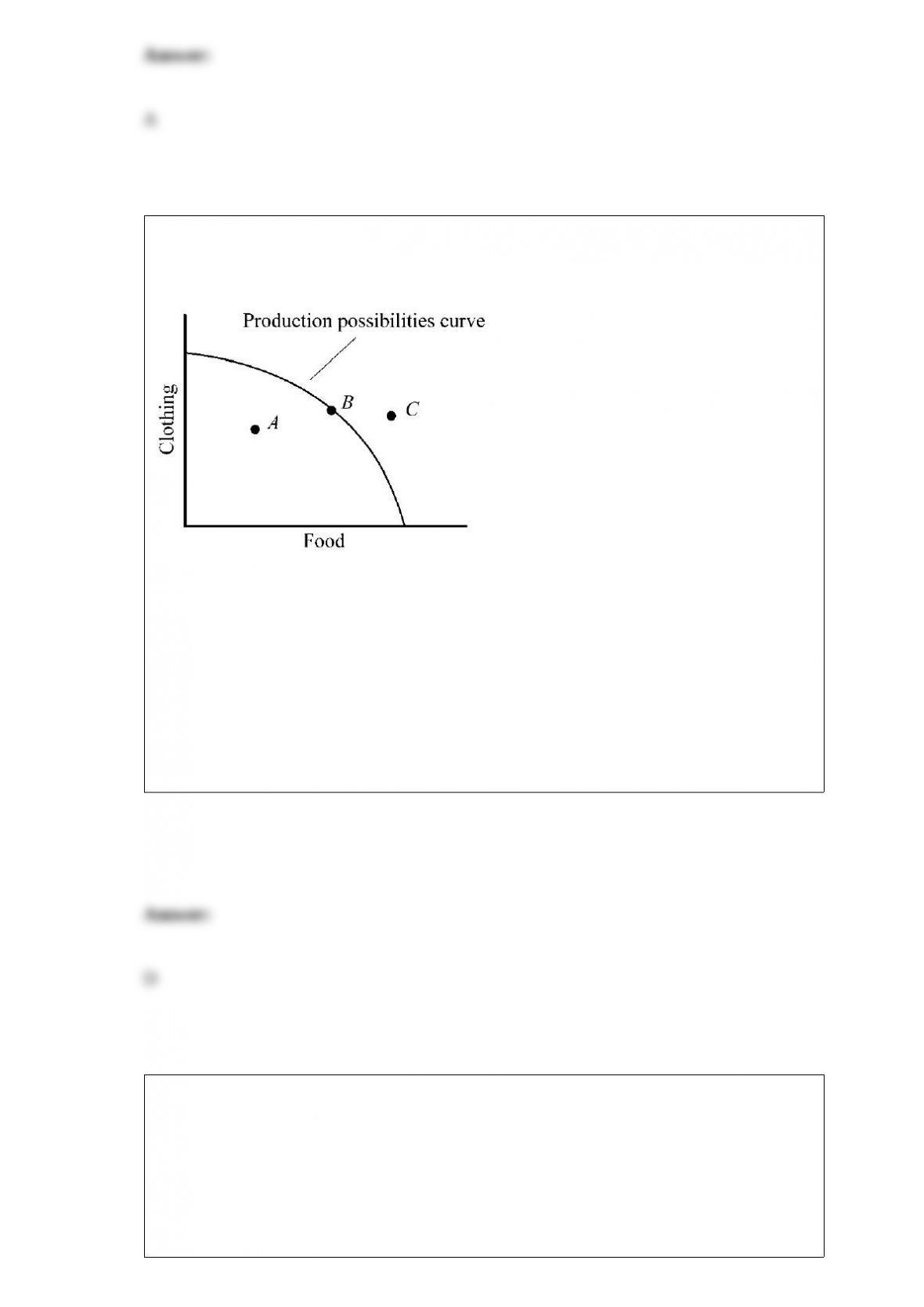
Figure 2-5
In Figure 2-5, which of the following is true?
a. Point A is inefficient.
b. Point B is efficient.
c. Point C is unattainable.
d. All of the above are true.
In a price-taker market, the short-run market supply curve is the
a. vertical sum of the marginal cost curves of all firms in the market.
b. vertical sum of the average variable cost curves of all firms.
c. horizontal sum of the marginal cost curves of all firms so long as price exceeds
average variable cost.
d. horizontal sum of the average total cost curves of all the firms in the market so long

as average total cost exceeds the market price.
A tax for which the average tax rate rises with income is defined as a
a. regressive tax.
b. proportional tax.
c. neutral tax.
d. progressive tax.
Use the table below to answer the following question(s).
Table 7-5
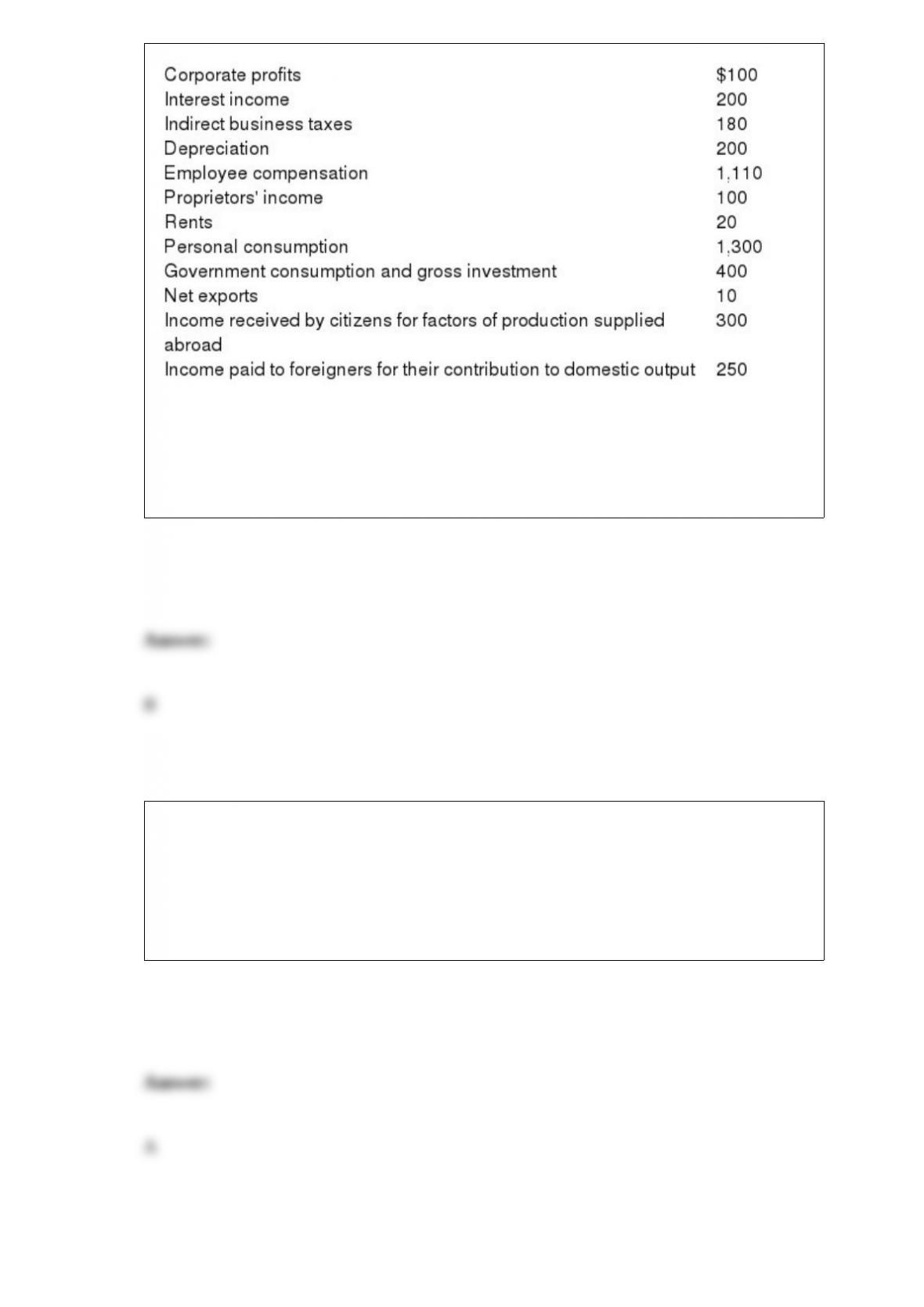
Refer to Table 7-5. National income equals
a. $1,380.
b. $1,530.
c. $1,860.
d. $4,170.
The primary source of purchasing power used to buy imported goods is the
a. revenue received from exports.
b. monetary sector.
c. balance of payments deficit.
d. domestic currency of a nation.
The infant-industry argument about tariffs implies that
a. it is unfair to levy tariffs on items intended for use by infants.
b. tariffs should be levied on foreign products that compete with new domestic
industries only in the short run.
c. if a newly established domestic industry can survive in the short run, a tariff should
be levied to protect it from foreign competition in the long run.
d. permanent tariffs should be levied on foreign products that compete with those
produced by newly established domestic industries.