The productivity speed-up in the United States could be explained by
a. improvements in labor force quality.
b. falling energy prices.
c. rising rates of domestic saving.
d. advances in information technology.
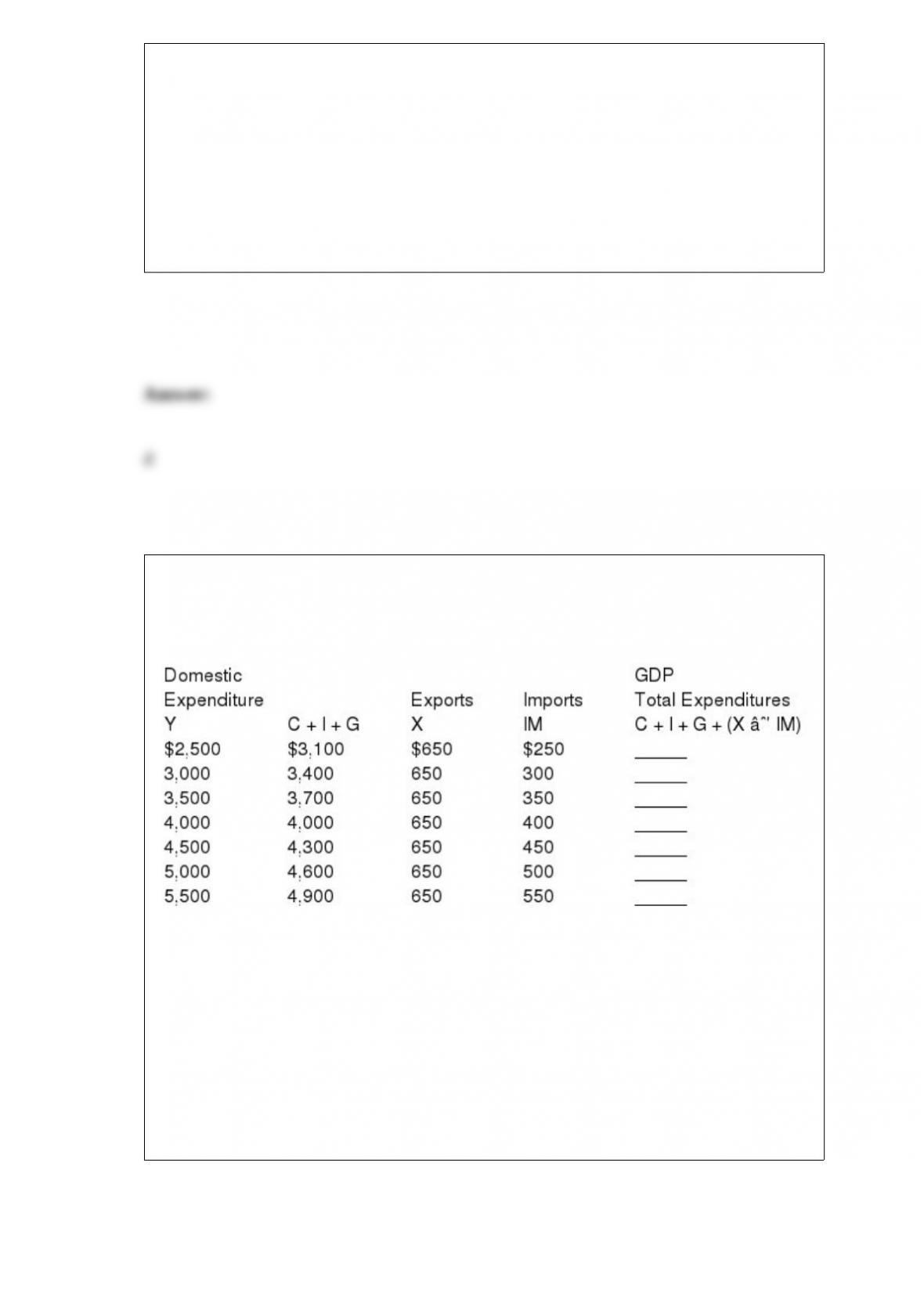
Table 20-2
In Table 20-2, assume that exports rise to $900. How large is the multiplier?
a. 5
b. 4
c. 2.5
d. 2

The steam engine was first invented by
a. Heron of Alexandria
b. James Wyatt
c. Robert Fulton
d. Denis Papin
In general, as productivity levels increase, the potential for productivity growth
a. decreases.
b. increases.
c. remains the same.
d. increases if GDP increases.

Whether or not a production process shows economies of scale depends on
a. the number of inputs used.
b. technology.
c. technology and input prices.
d. technology and output prices.
An economy eliminates a recessionary gap by reducing wages and prices.
a. True
b. False
Economists can evaluate the desirability of the distribution of income.
a. True
b. False

Economic rent is the amount of money above and beyond that necessary to keep the
factor of production employed where it is.
a. True
b. False
The increasing share of women in the labor force may have contributed to the decrease
in unionization.
a. True
b. False
A surplus occurs when price is higher than the market equilibrium.
a. True
b. False

One of the principal ways in which Congress intended the Fed to provide insurance
against financial panics was to act as a “lender of first resort.”
a. True
b. False
One conceptual problem in assigning assets to M1, M2, etc. is
a. distinguishing money from “near monies.”
b. the problem of measuring asset size.
c. the need to agree on a unit of account.
d. the different size of financial assets.
Equilibrium is the point where total spending equals total output, or GDP.

a. True
b. False
The main policy tool for manipulating consumer spending is personal income tax, but
this tool takes time to have an effect.
a. True
b. False
The purchase of stocks and bonds is included in which component of GDP?
a. saving
b. investment
c. consumer spending
d. They are not included in GDP.

Which of the following will occur if a natural monopoly is broken into two smaller
firms?
a. The price will drop.
b. Industry output will increase.
c. Production costs will increase.
d. Industry output will decrease.
According to the theory of rational expectations, errors in predicting inflation will
a. be biased upward more often than not.
b. be purely random.
c. tend to be biased downward when inflation is rising, and tend to be biased upward
when inflation is falling.
d. tend to be biased upward when inflation is rising, and tend to be biased downward
when inflation is falling.

A perfectly competitive firm can maximize profits by producing the quantity at which
MR exceeds MC by the greatest amount.
a. True
b. False
The U.S. spends more on education, and achieves far worse results. The underling
cause of this disparity may have to do with:
a. the cost per student spent
b. the high degree of inequality in the U.S.
c. the difference in property tax rates
d. both the high degree of inequality in the U.S. and the difference in property tax rates
Figure 11-1
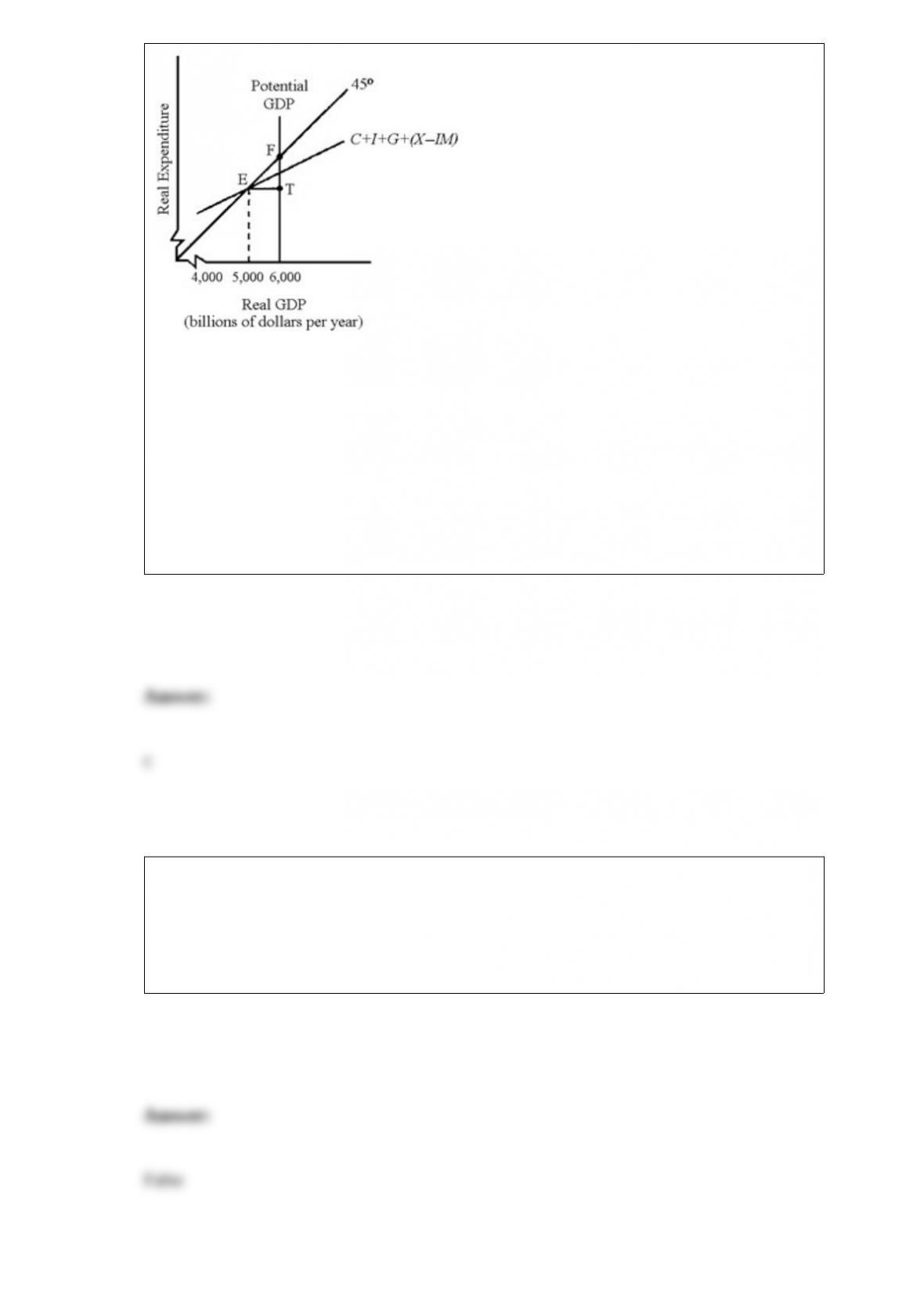
In Figure 11-1, the economy is experiencing a(n)
a. inflationary gap equal to EF.
b. inflationary gap equal to ET.
c. recessionary gap equal to ET.
d. recessionary gap equal to FT.
Expansionary fiscal policy normally lowers interest rates.
a. True
b. False

The term “laissez faire” was given to a system of free markets by
a. twentieth-century American economists.
b. a seventeenth-century Scottish economist.
c. eighteenth-century French economists.
d. nineteenth-century Italian economists.
If the Fed sells a U.S. Treasury bill to a member of the public, the banking system has
a. less reserves and the money supply tends to fall.
b. more reserves and the money supply tends to fall.
c. less reserves and the money supply tends to grow.
d. more reserves and the money supply tends to grow.
The sales of the 50 largest corporations in the U.S. economy amount to nearly 37
percent of GDP.
a. True
b. False

Air quality in most U.S. cities has ____ since World War II.
a. worsened
b. improved
c. remained unchanged
d. improved slightly before a recent deterioration
Perfect competition is the term used to describe
a. an industry in which all businessmen are honest and accommodating.
b. an industry in which numerous firms produce identical products.
c. an industry untouched by government regulation.
d. the kind of industry any American would support.

A monopolist is best described as a price
a. taker.
b. searcher.
c. maker.
d. follower.
Expansionary fiscal policy in an open economy has a
a. greater effect than in a closed economy.
b. similar effect in a closed economy.
c. smaller effect than in a closed economy.
d. greater effect than monetary policy.
If two goods are complements, their cross elasticity of demand will normally be
a. zero.
b. a negative number.

c. a positive number.
d. infinity.
In the collective bargaining process
a. supply and demand analysis is used to determine the wage.
b. the contract can legally cover only the wage or salary determined.
c. there is often heated discussion with threats of strikes and counterthreats of lockout.
d. the negotiation period is limited to thirty days.
Which of the following questions are not answered by the process of demand side GDP
determination?
a. How large is equilibrium GDP?
b. Does the economy have unemployment?
c. Is demand side equilibrium consistent with supply side equilibrium?
d. Does the economy have inflation?
e. All of the above are not answered.