
A firm’s total output divided by the amount of input used to produce it is the ________
of the input.
a. cost
b. supply
c. average product
d. marginal product
e. combined product
When a price decrease produces a decline in the total amount spent on a commodity,
demand is said to be
a. of absolute elasticity.
b. income inelastic.
c. of unitary elasticity.
d. price inelastic.
e. price elastic.
The two basic conditions for long-run equilibrium in monopolistically competitive

markets are that
a. all firms maximize profits and that economic profits are zero.
b. price exceeds average cost for all firms and that they have no additional production
capacity.
c. firms constantly enter and leave the market because of the existence of economic
profits.
d. all firms cover their average variable costs and that marginal revenue equals total
revenue.
e. all firms maximize output while minimizing unit costs.
The most important function of a central bank is to
a. set interest rates.
b. make loans to the Federal Reserve System.
c. hold time and demand deposits.
d. control the quantity of money.
e. lend out money to large corporations.

In addition to annually and cyclically balanced budget policies, a third approach argues
that the government’s budget should be
a. set to promote the preferred combination of unemployment and inflation.
b. balanced over the course of the business cycle.
c. measured in current rather than constant dollars to accurately reflect the magnitude of
fiscal stimulus.
d. designed to ensure persistent surpluses to reduce unemployment.
e. using the tax laws to stimulate investment.
Excluded from a list of reasons often cited as responsible for the slowdown in U.S.
productivity during the 1970s is the
a. increase in the proportion of youths and women in the labor force.
b. reduction in the rate of growth of the capital-labor ratio.
c. presence of increased amounts of government regulation.
d. reduction in the proportion of GDP devoted to research and development.
e. price stability and stable interest rates over that period, which reduced profit
opportunities.
The new classical macroeconomists conclude that
a. monetary and fiscal stabilization policies are most effective at countering supply-side
shocks.
b. the short-run aggregate supply curve is unaffected by expected changes in the price
level.
c. if firms and individuals formulate expectations rationally, they will frustrate activist
government stabilization policy.
d. real output will increase as long as wage increases exceed price increases, thus
stimulating aggregate demand.
e. firms and individuals can be counted on to make systematic errors in forecasting the
future.
To say that all U.S. currency is presently fiat money means that
a. it is money by government decree.
b. its metallic value exceeds its face value.
c. the government will redeem that money with gold.
d. money serves as a store of value.
e. currency is the only asset that can serve as money.

Large capital accumulation is facilitated in a corporate form of business because of
a. the separation of ownership and control.
b. the low tax rate on corporate profits.
c. the political power inherent in a large firm.
d. limited liability.
e. the high monopoly profits accruing to corporations.
The average propensity to consume equals the
a. change in personal consumption expenditures divided by the current level of
consumption expenditures.
b. amount spent on consumption divided by the amount of disposable income.
c. change in personal consumption expenditures divided by the change in disposable
income.
d. personal consumption expenditures divided by personal saving.
e. sum of personal consumption expenditures and disposable income divided by 2.
In which of the following countries has the central bank NOT adopted the policy
framework known as inflation targeting?
a. Australia
b. Canada
c. Sweden
d. the United Kingdom
e. the United States
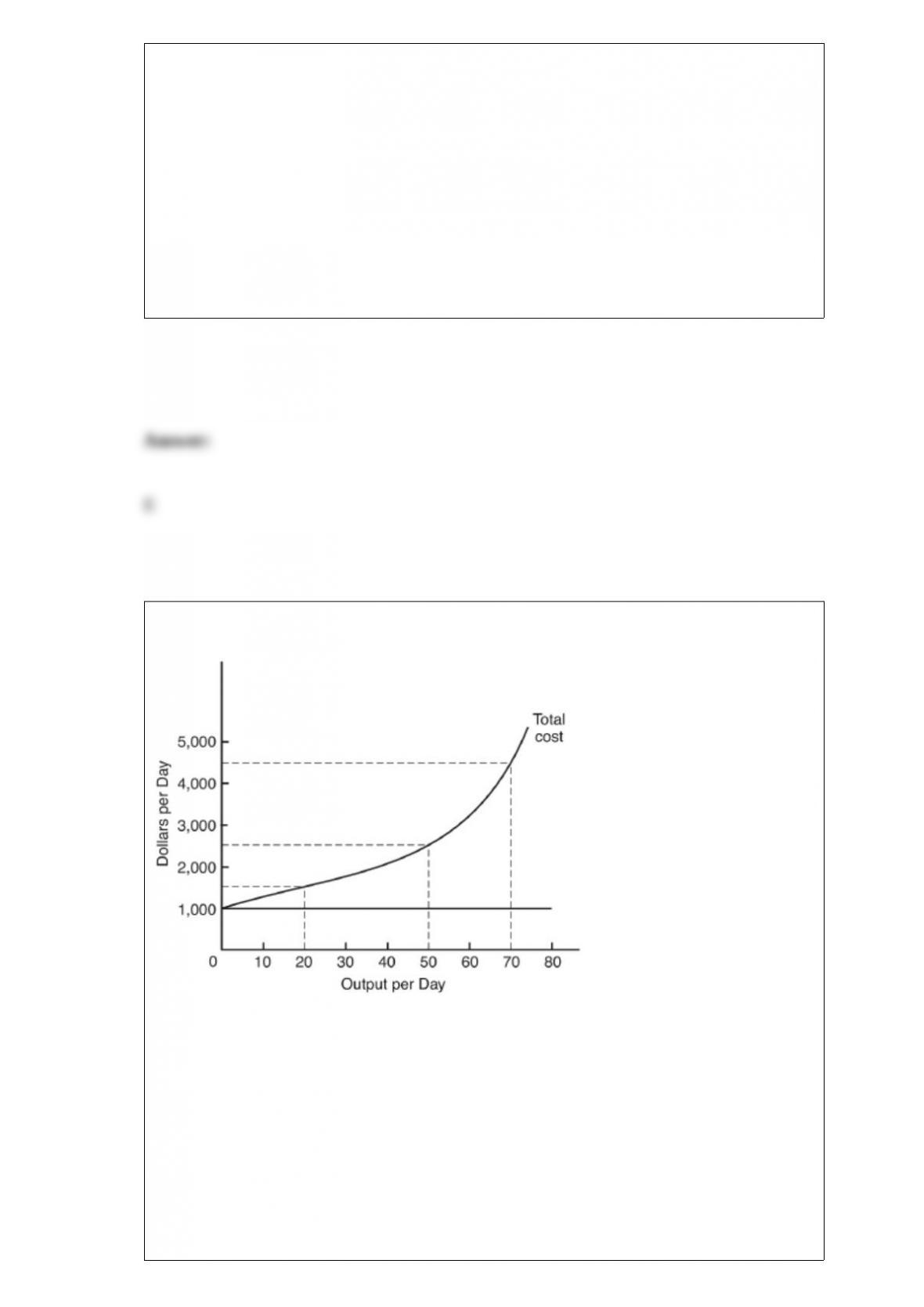
The following questions are based on the following graph:
In the previous question, if marginal cost for the 101st unit is $0.70, average variable
cost must be
a. rising.
b. falling.
c. remaining the same.
d. equal to average total cost.

e. undeterminable from the information given.
Which set of characteristics best identifies a monopolistically competitive market?
a. many firms, homogeneous product, significant barriers to entry, significant nonprice
competition, and considerable power over price
b. few firms, differentiated product, no barriers to entry, the absence of nonprice
competition, and considerable advertising
c. one firm producing a product with no close substitutes, significant barriers to entry,
and considerable power over price
d. many firms, differentiated product, few barriers to entry, and nonprice competition
e. few firms, differentiated product, significant barriers to entry, and significant
amounts of nonprice competition
The negative income tax is a
a. principle that argues that most income taxes reduce incentives to produce in a market
system.
b. system whereby families below a certain break-even level receive a government
income tax payment.

c. proposal to allow the automatic setting of income tax rates to negate the effects of a
business cycle.
d. form of unequal taxation that disproportionately hurts low-income families.
e. tax on unearned income primarily designed to affect high-income families.
Between 1929 and 1931, about 2,000 banks failed across the United States. A major
reason for this was probably that the Fed
a. had little power since it was not created until mid-1931.
b. had no power to lend money to commercial banks.
c. felt its main obligation was to assist only those banks that were solvent.
d. was under the direction of the president and Congress and could act only at their
specific request.
e. pursued a restrictive monetary policy to prevent the loss of gold reserves from the
banking system.
Supply-side inflation
a. is caused by rapidly increasing labor productivity.
b. results from an increase in aggregate demand.

c. leads to falling price levels.
d. is a manifestation of the wage-price spiral.
e. can occur only at full-employment levels of real GDP.
The demand curve for loanable funds slopes downward to the right because
a. there are more projects that are profitable at low than at high rates of interest.
b. firms borrow money only when interest rates are low.
c. an increase in the supply of loanable funds generally raises interest rates.
d. the lower the asset’s rate of return, the higher the interest rate.
e. money is not as profitable when its price is high.
Excluded from among the important bases for specialization is the existence of
a. perfect resource homogeneity and mobility.
b. differences in the quality of resources.
c. relative differences in the quantities of human and nonhuman resources.

d. comparative advantage.
e. differences in technology.
High rates of unemployment generally mean that
a. the aggregate demand curve is rising.
b. the aggregate demand curve is horizontal.
c. the equilibrium output is above potential output.
d. policies to increase spending are appropriate.
e. the price level is rising.
Schumpeter and Galbraith argue that, in a dynamic sense, innovation is less likely in
a. monopoly.
b. pure oligopoly.
c. monopolistic competition.
d. perfect competition.
e. differentiated oligopoly.

The aggregate supply curve becomes vertical
a. when there is significant excess capacity.
b. as the prices of raw materials and labor fall.
c. at full employment.
d. because demand falls as prices rise.
e. for reasons that are a mystery to most economists.
The federal agency established in 1970 to establish air and water quality standards and
devise rules to achieve these standards is the
a. Sierra Club.
b. Council on Environmental Quality.
c. Council of Economic Advisers.
d. DDT.
e. EPA.

U.S. gross domestic product measured in current dollars is
a. growing more slowly than GDP measured in constant dollars.
b. measured in terms of 1996 dollars.
c. the same in the base year as GDP measured in constant dollars.
d. not affected by changes in the price level.
e. also known as real GDP.
In the video, Nariman Behravesh argued that the supply-side impact of the Reagan tax
cuts was
a. very large, leading to increased government tax revenues.
b. about equal in magnitude to the demand-side impact of those cuts.
c. enough to ensure that the size of the federal budget deficit would decrease.
d. small at first but likely to grow as time went on.
e. virtually nonexistent, although they did boost investment and lead to higher
productivity.

A country is said to have a comparative advantage in the production of a good when
a. it can produce more of that good with a unit of its resources than another country.
b. specialization in the production of the good and trade enables it to consume more of
all goods.
c. production of the good requires a greater sacrifice of other goods than in another
country.
d. it enables the country to be self-sufficient and eliminates the need for trade.
e. production of the good requires complete specialization.
The Federal Reserve Bank’s exercising control over the quantity of money and interest
rates is called
a. fiscal policy.
b. commercial banking.
c. monetary policy.
d. functional finance.
e. incomes policy.

The interest rate earned on an investment in an asset is called
a. the capital output ratio.
b. depreciation.
c. the risk quotient.
d. capitalization.
e. the rate of return.
The reciprocal of the marginal propensity to save is called the
a. multiplier.
b. propensity to consume.
c. saving function.
d. 45-degree line.
e. interest rate.
If a country maintains its level of exports to another country under free trade, even after
its world price is equalized and there are no international shortages or surpluses, it must
have a

a. comparative advantage in that good.
b. comparative disadvantage in that good.
c. lower domestic price for the good than would be the case if trade were not permitted.
d. higher rate of domestic consumption of the good than would be the case if trade were
not permitted.
e. persistent domestic shortage of the good that necessitates a tariff on it.
The number of dollars of investment required to produce an extra dollar of goods or
services is called the
a. multiplier.
b. rate of innovation.
c. marginal efficiency of investment.
d. capital-output ratio.
e. rate of return.
The security holdings of a commercial bank are considered part of the bank’s

a. assets.
b. liabilities.
c. net exposure.
d. ordinary ratio.
e. fractional multiplier.