
Other things the same, a higher real interest rate raises the quantity of
a. domestic investment.
b. net capital outflow.
c. loanable funds demanded.
d. loanable funds supplied.
The Earned Income Tax Credit is an example of a
a. minimum-wage law.
b. price ceiling.
c. wage subsidy.
d. rent subsidy.
Most spells of unemployment are
a. long, and most unemployment observed at any given time is long term.
b. long, but most unemployment observed at any given time is short term.
c. short, but most unemployment observed at any given time is long term.

d. short, and most unemployment observed at any given time is short term.
The law of supply states that, other things equal, an increase in
a. price causes quantity supplied to increase.
b. price causes quantity supplied to decrease.
c. quantity supplied causes price to increase.
d. quantity supplied causes price to decrease.
Which of the following events must cause equilibrium quantity to rise?
a. demand increases and supply decreases
b. demand and supply both decrease
c. demand decreases and supply increases
d. demand and supply both increase

Which of the following observations was made famous by Adam Smith in his book The
Wealth of Nations?
a. There is no such thing as a free lunch.
b. People buy more when prices are low than when prices are high.
c. No matter how much people earn, they tend to spend more than they earn.
d. Households and firms interacting in markets are guided by an “invisible hand” that
leads them to desirable market outcomes.
Which of the following ideas is the most plausible?
a. Tax revenue is more likely to increase when a low tax rate is increased than when a
high tax rate is increased.
b. Tax revenue is less likely to increase when a low tax rate is increased than when a
high tax rate is increased.
c. Tax revenue is likely to increase by the same amount when a low tax rate is increased
and when a high tax rate is increased.
d. Decreasing a tax rate can never increase tax revenue.

If American cheese and cheddar cheese are substitutes, then which of the following
would increase the demand for cheddar cheese?
a. a decrease in the price of cheddar cheese
b. an increase in the price of American cheese
c. a decrease in the price of American cheese
d. Both a) and b) are correct.
In the open-economy macroeconomic model, if there is a surplus in the market for
foreign-currency exchange, which of the following will move the market to
equilibrium?
a. the real exchange rate depreciates and net exports fall.
b. the real exchange rate depreciates and net exports rise.
c. the real exchange rate appreciates and net exports fall.
d. the real exchange rate appreciates and net exports rise.

A person who is risk averse might accept a 50% chance of losing $100 today in
exchange for a 50% chance of winning $125 in two years if the interest rate was
a. 9% but not 10%
b. 10% but not 11%
c. 11% but not 12%
d. None of the above is correct; a risk averse person would not accept any of the above
bets.
Other things the same, if the exchange rate changes from 30 Thai bhat per dollar to 25
Thai bhat per dollar, then the dollar has
a. appreciated and so buys more Thai goods.
b. appreciated and so buys fewer Thai goods.
c. depreciated and so buys more Thai goods.
d. depreciated and so buys fewer Thai goods.
Other things the same, an increase in the price level induces people to hold
a. less money, so they lend less, and the interest rate rises.

b. less money, so they lend more, and the interest rate falls.
c. more money, so they lend more, and the interest rate falls.
d. more money, so they lend less, and the interest rate rises.
If Shawn can produce donuts at a lower opportunity cost than Sue, then
a. Shawn has a comparative advantage in the production of donuts.
b. Sue has a comparative advantage in the production of donuts.
c. Shawn should not produce donuts.
d. Shawn is capable of producing more donuts than Sue in a given amount of time.
Figure 3-10
Alice and Betty’s Production Possibilities in one 8-hour day.
Alice’s Production Possibilities Frontier Betty’s Production Possibilities Frontier
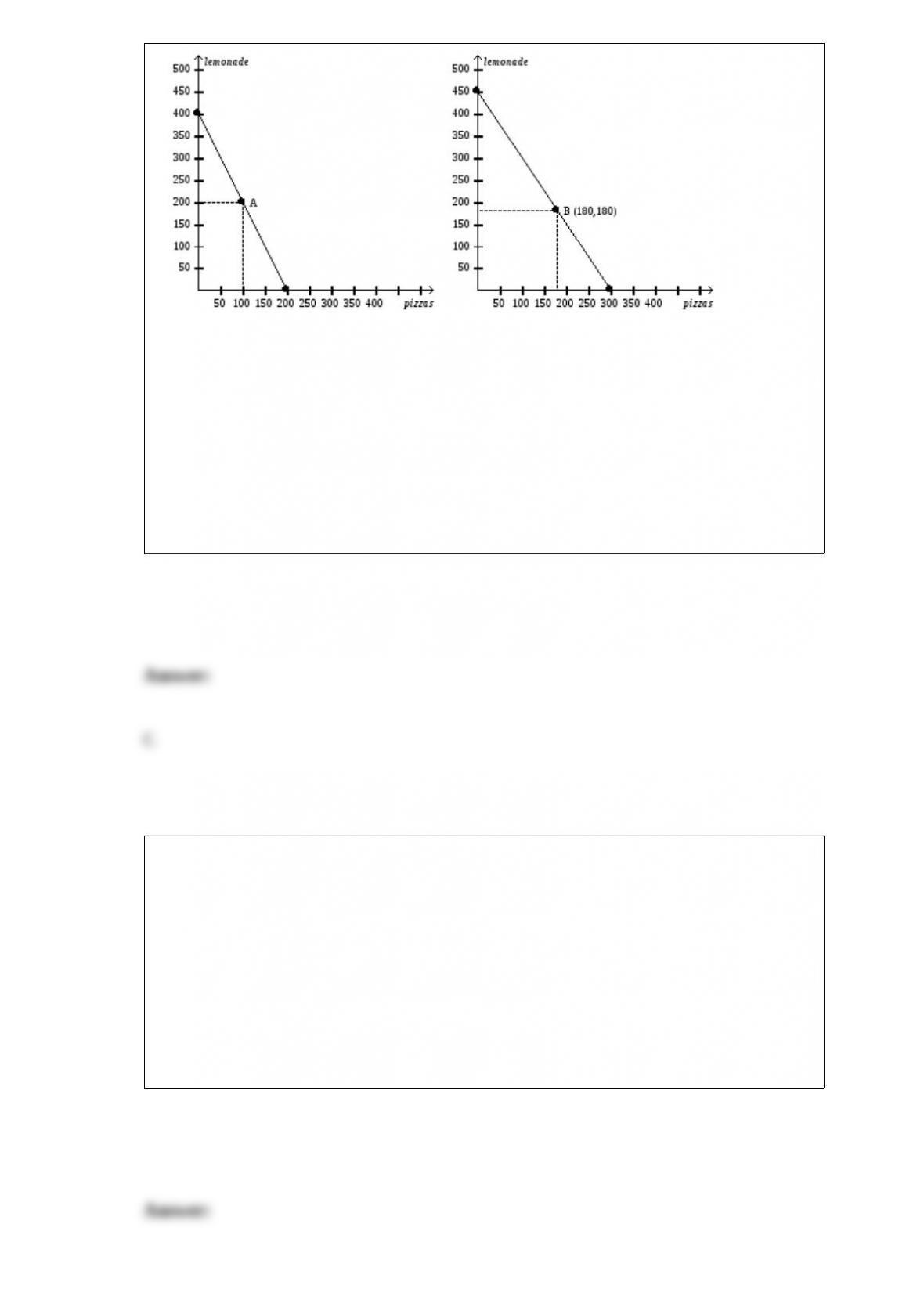
Refer to Figure 3-10. If Alice produces only lemonade, she can produce
a. 200 pitchers per day.
b. 300 pitchers per day.
c. 400 pitchers per day.
d. 450 pitchers per day.
What is the present value of a payment of $100 one year from today if the interest rate
is 5 percent?
a. $95.50
b. $95.24
c. $95.00
d. None of the above are correct to the nearest cent.

Which of the following statements is not correct?
a. If GDP is rising faster than debt, the government is, in some sense, living within its
means.
b. The ratio of debt to GDP in the United States has always been less than one.
c. Debts during wars may distribute the burden of fighting the war more evenly across
generations.
d. During times of peace in the United States, the ratio of debt to GDP sometimes rose.
In an imaginary economy, consumers buy only sandwiches and magazines. The fixed
basket consists of 20 sandwiches and 30 magazines. In 2006, a sandwich cost $4 and a
magazine cost $2. In 2007, a sandwich cost $5. The base year is If the consumer price
index in 2007 was 125, then how much did a magazine cost in 2007?
a. $0.83
b. $2.25
c. $2.50
d. $3.00
If the real exchange rate is greater than 1, then the
a. nominal exchange rate x U.S. price > foreign price. The dollars required to purchase
a good in the U.S. would buy more then enough foreign currency to buy the same good
overseas.
b. nominal exchange rate x U.S. price > foreign price. The dollars required to purchase
a good in the U.S. would not buy enough foregoing currency to buy the same good
overseas.
c. nominal exchange rate x U.S. price < foreign price. The dollars required to purchase
a good in the U.S. would buy more then enough foreign currency to buy the same good
overseas.
d. nominal exchange rate x U.S. price < foreign price. The dollars required to purchase
a good in the U.S. would not buy enough foreign currency to buy the same good
overseas.
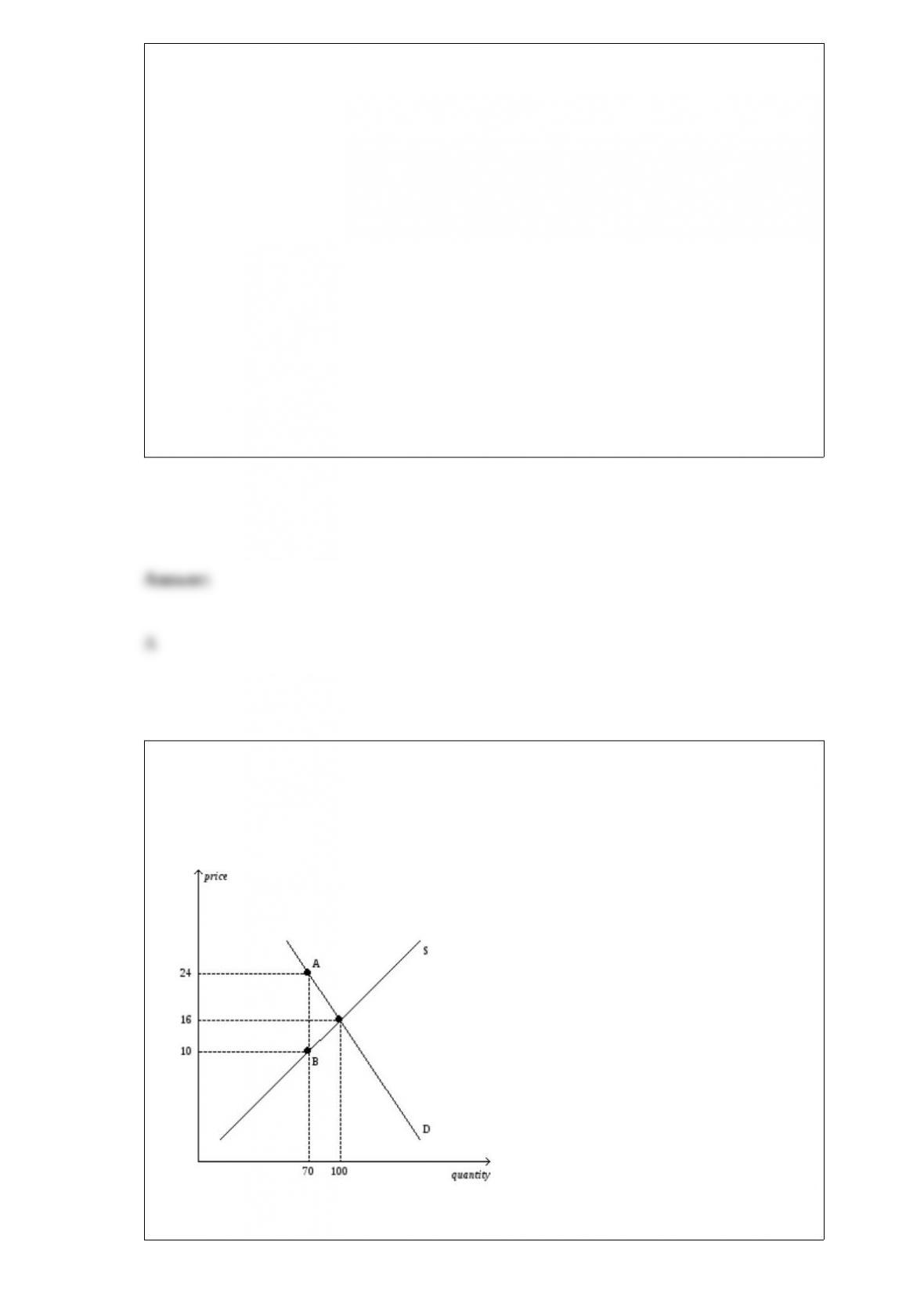
Figure 6-14
The vertical distance between points A and B represents the tax in the market.
Refer to Figure 6-14. The per-unit burden of the tax on buyers is

a. $6.
b. $8.
c. $14.
d. $24.
In the early 1960s, the Kennedy administration made considerable use of
a. fiscal policy to stimulate the economy.
b. fiscal policy to slow down the economy.
c. monetary policy to stimulate the economy.
d. monetary policy to slow down the economy.
Suppose Country A has a high average wage level and a high level of output per person,
while Country B has a low average wage level and a low level of output per person.
Which country can benefit from trade?
a. Only Country A can benefit.
b. Only Country B can benefit.

c. Both Country A and Country B can benefit.
d. Neither Country A nor Country B can benefit.
If policymakers increase aggregate demand, then in the short run the price level
a. falls and unemployment rises.
b. and unemployment fall.
c. and unemployment rise.
d. rises and unemployment falls.
The bond market
a. is a financial market, whereas the stock market is a financial intermediary.
b. is a financial intermediary, whereas the stock market is a financial market.
c. is a financial market, as is the stock market.
d. is a financial intermediary, as is the stock market.
Normative conclusions
a. come from positive analysis alone.
b. are based on ignorance of positive analysis.
c. involve value judgments.
d. reflect the economist’s role as scientist.
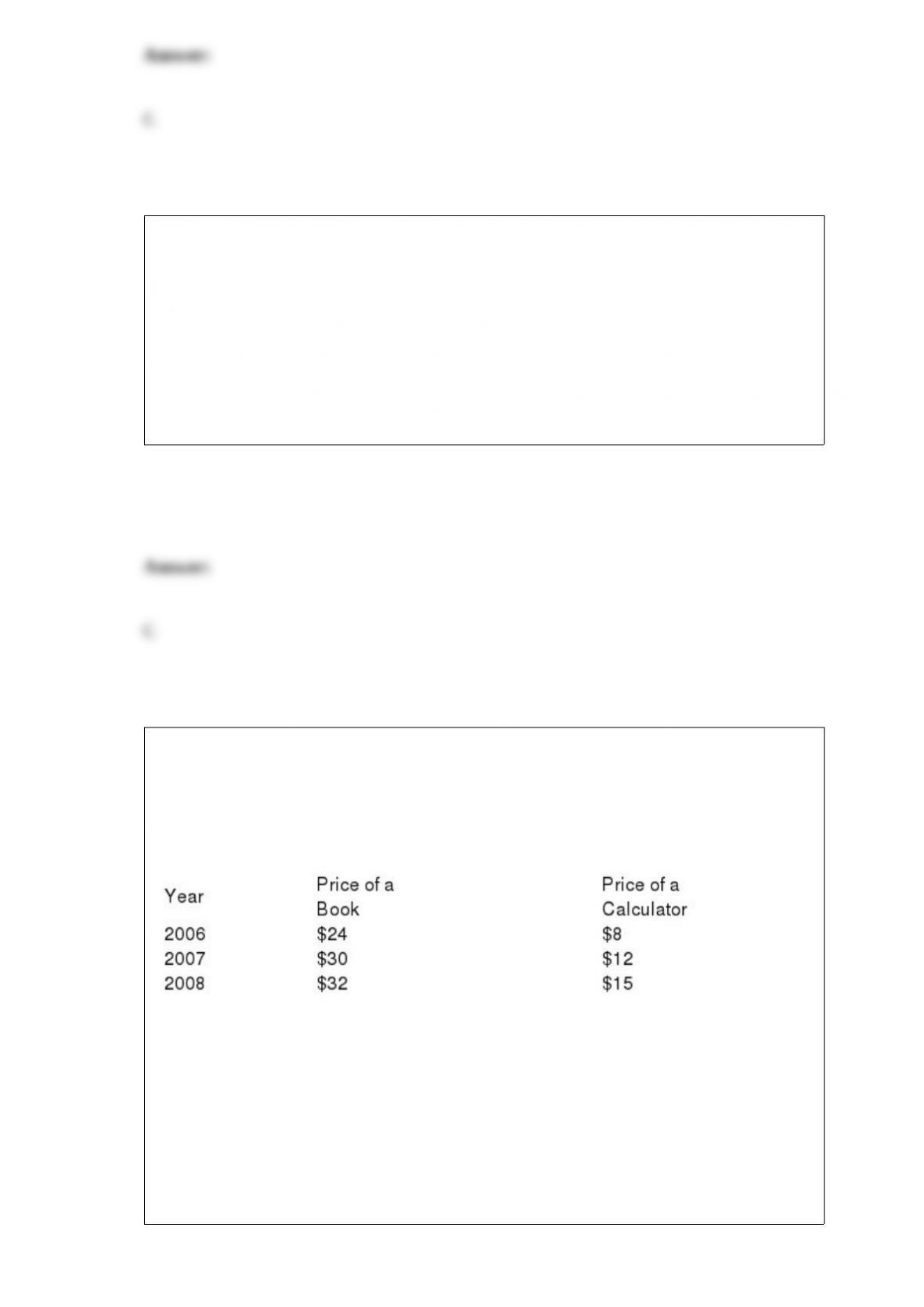
Table 11-3
The table below pertains to Studious, an economy in which the typical consumer’s
basket consists of 5 books and 10 calculators.
Refer to Table 11-3. The cost of the basket
a. increased from 2006 to 2007 and increased from 2007 to 2008.
b. increased from 2006 to 2007 and decreased from 2007 to 2008.
c. decreased from 2006 to 2007 and increased from 2007 to 2008.
d. decreased from 2006 to 2007 and decreased from 2007 to 2008.
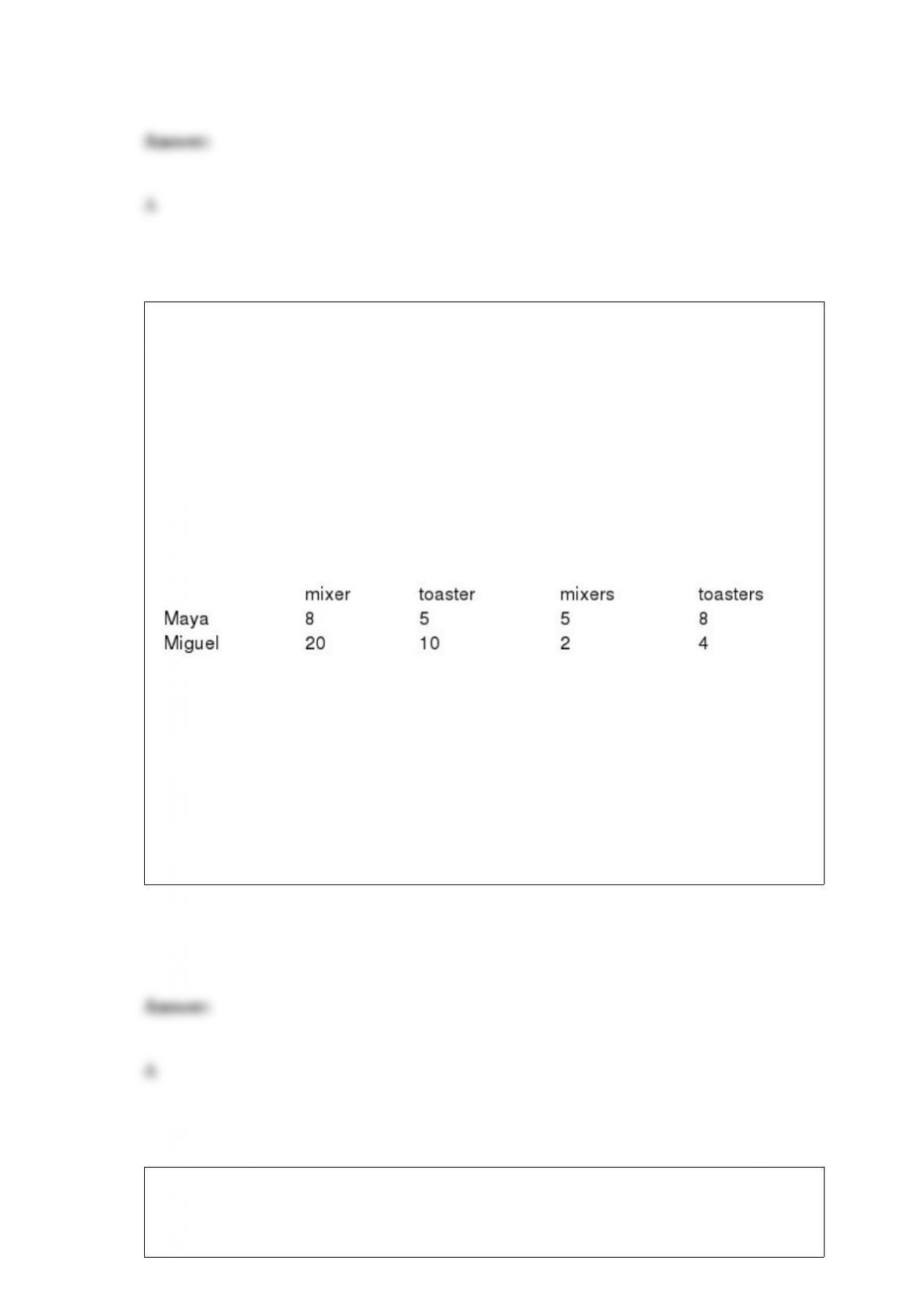
Table 3-6
Assume that Maya and Miguel can switch between producing mixers and producing
toasters at a constant rate.
Hours Needed
To Make 1 Amount Produced
in 40 Hours
Refer to Table 3-6. Maya has an absolute advantage in the production of
a. both goods and a comparative advantage in the production of mixers.
b. both goods and a comparative advantage in the production of toasters.
c. neither good and a comparative advantage in the production of mixers.
d. neither good and a comparative advantage in the production of toasters.
The average income in a rich country
a. is about 5 times that in a poor country. Further, people in rich countries have longer

life expectancy.
b. is about 5 times that in a poor country. However, people in rich countries have about
the same life expectancy as those in poor countries.
c. is more than ten times that in a poor country. Further, people in rich countries have
longer life expectancy.
d. is more than ten times that in poor country. However, people in rich countries have
about the same life expectancy as those in poor countries.
Demand is said to be inelastic if the
a. quantity demanded changes proportionately more than price.
b. price changes proportionately more than income.
c. quantity demanded changes proportionately less than price.
d. quantity demanded changes proportionately the same as price.
There is evidence that the rate at which money changed hands rose during the German
hyperinflation. This means that
a. velocity rose. If monetary neutrality holds the rise in velocity increased the ratio M/P.
b. velocity rose. If monetary neutrality holds the rise in velocity decreased the ratio

M/P.
c. velocity fell. If monetary neutrality holds the fall in velocity increased the ratio M/P.
d. velocity fell. If monetary neutrality holds the fall in velocity decreased the ratio M/P.
When they are confronted with an adverse shock to aggregate supply, policymakers
face a difficult choice in that
a. if they contract aggregate demand, the unemployment rate will increase further.
b. if they expand aggregate demand, the inflation rate will increase further.
c. they face a less favorable trade-off between inflation and unemployment than they
did before the shock.
d. All of the above are correct.
Which of the following statements is correct?
a. Stocks, bonds, and deposits are all similar in that each provides a common medium
of exchange.
b. Most buyers of stocks and bonds prefer those issued by large and familiar companies.
c. Banks charge borrowers a slightly lower interest rate than they pay to depositors.
d. None of the above is correct.
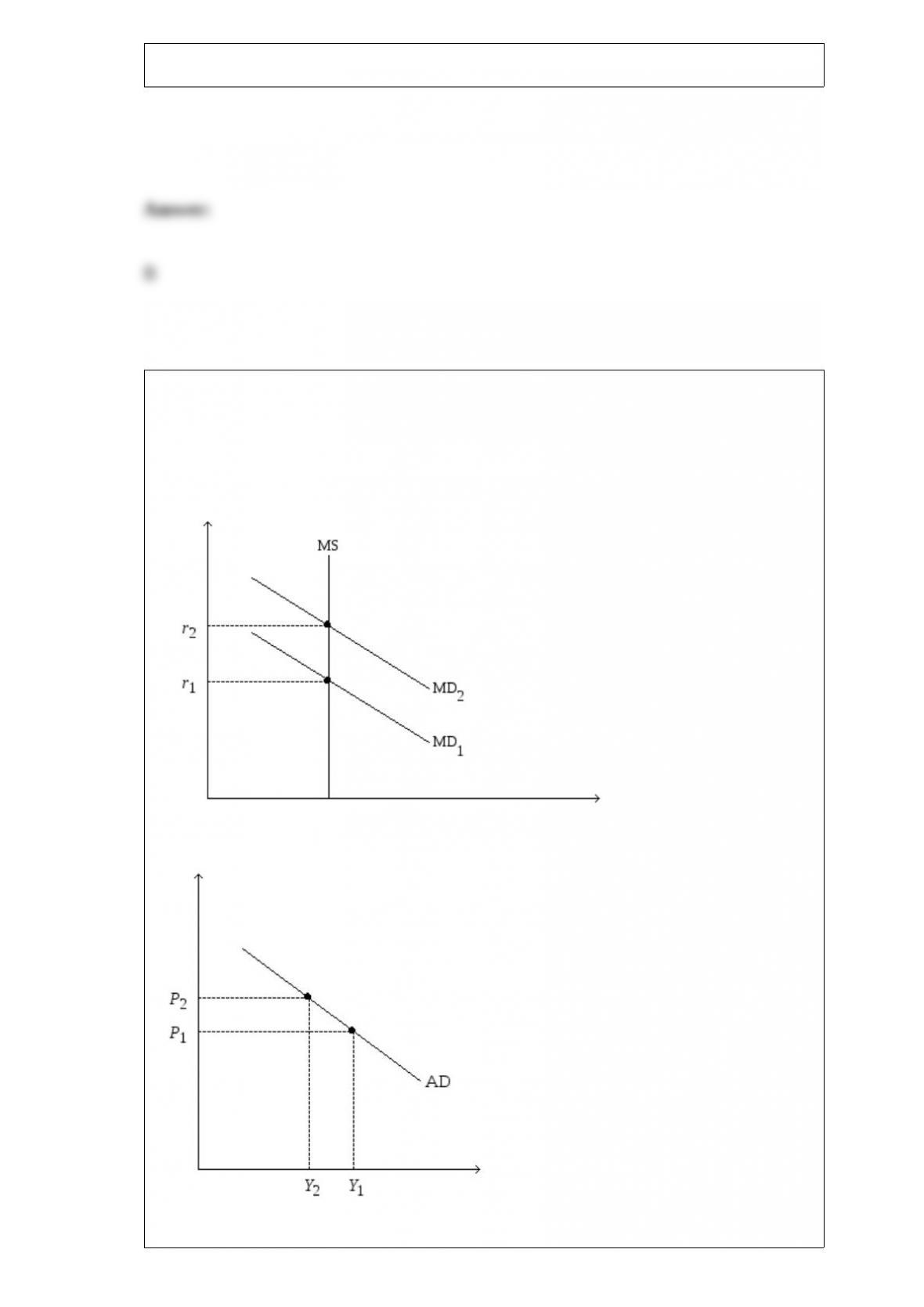
Figure 21-2. On the left-hand graph, MS represents the supply of money and MD
represents the demand for money; on the right-hand graph, AD represents aggregate
demand. The usual quantities are measured along the axes of both graphs.
.
Refer to Figure 21-2. If the graphs apply to an economy such as the U.S. economy,

then the slope of the AD curve is primarily attributable to the
a. wealth effect.
b. interest-rate effect.
c. exchange-rate effect.
d. Fisher effect.
When the government attempts to improve equality in an economy the result is often
a. an increase in overall output in the economy.
b. additional government revenue since overall income will increase.
c. a reduction in equality.
d. a reduction in efficiency.
Figure 14-2. The figure shows a utility function for Mary Ann.
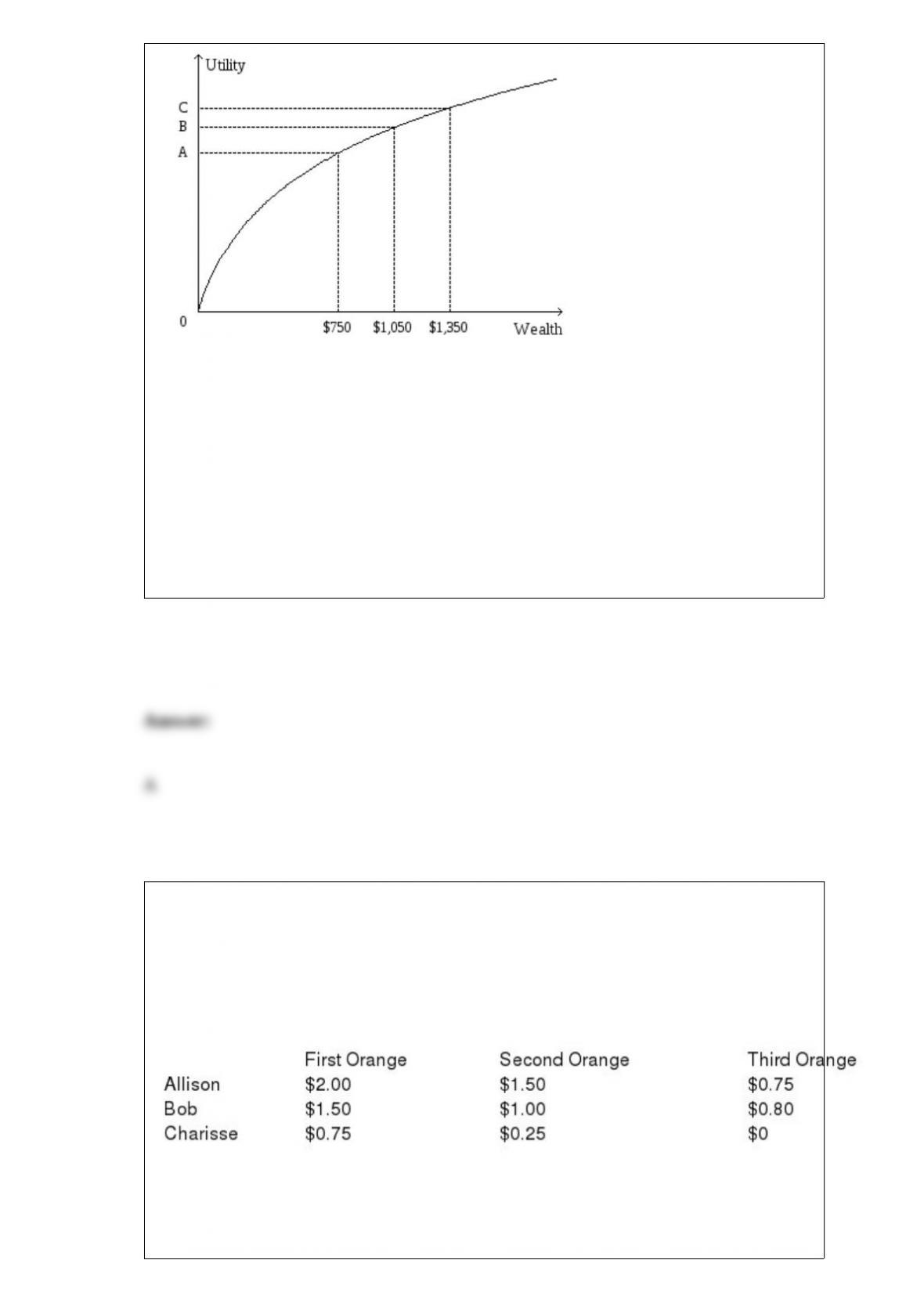
Refer to Figure 14-2. From the appearance of the utility function, we know that
a. Mary Ann is risk averse.
b. Mary Ann gains more satisfaction when her wealth increases by X dollars than she
loses in satisfaction when her wealth decreases by X dollars.
c. the property of increasing marginal utility applies to Mary Ann.
d. All of the above are correct.
Table 7-5
For each of three potential buyers of oranges, the table displays the willingness to pay
for the first three oranges of the day. Assume Alex, Barb, and Carlos are the only three
buyers of oranges, and only three oranges can be supplied per day.
Refer to Table 7-5. If the market price of an orange increases from $0.60 to $1.05, then
consumer surplus
a. increases by $2.90.

b. decreases by $2.25.
c. decreases by $2.70.
d. decreases by $3.85.