
The sticky-price theory of the short-run aggregate supply curve says that when the price
level is higher than expected, some firms will have
a. higher than desired prices, which leads to an increase in the aggregate quantity of
goods and services supplied.
b. higher than desired prices, which leads to a decrease in the aggregate quantity of
goods and service supplied.
c. lower than desired prices, which leads to an increase in the aggregate quantity of
goods and services supplied.
d. lower than desired prices, which leads to a decrease in the aggregate quantity of
goods and services supplied
Ken and Traci are two woodworkers who both make tables and chairs. In one month,
Ken can make 3 tables or 18 chairs, whereas Traci can make 8 tables or 24 chairs.
Given this, we know that the opportunity cost of 1 chair is
a. 1/6 table for Ken and 1/3 table for Traci.
b. 1/6 table for Ken and 3 tables for Traci.
c. 6 tables for Ken and 1/3 table for Traci.
d. 6 tables for Ken and 3 tables for Traci.

Other things the same, an increase in the budget deficit
a. shifts the demand for loanable funds right, so the interest rate rises.
b. shifts the demand for loanable funds left, so the interest rate falls.
c. shifts the supply of loanable funds right, so the interest rate falls.
d. shifts the supply of loanable funds left, so the interest rate rises.
The Congressional Budget Office, which is staffed by economists, provides Congress
with independent evaluations of policy proposals.
a. True
b. False
GDP is used as the basic measure of a society’s economic well-being. A better measure
of the economic well-being of individuals in society is
a. saving per person.
b. GDP per person.
c. government expenditures per person.
d. investment per business firm.

To promote good economic outcomes, policymakers should strive to enact policies that
a. enhance productivity.
b. enhance individuals’ market power.
c. result in a rapidly-growing quantity of money.
d. All of the above are correct.
Real GDP measures output of final goods and services in physical units.
a. True
b. False

The classical dichotomy and monetary neutrality are represented graphically by
a. an upward-sloping long-run aggregate-supply curve.
b. a vertical long-run aggregate-supply curve.
c. an upward-sloping short-run aggregate-curve.
d. a downward-sloping aggregate-demand curve.
In which case(s) does(do) a country’s supply of loanable funds shift right?
a. both an increase in the budget deficit and capital flight
b. an increase in the budget deficit, but not capital flight
c. capital flight, but not an increase in the budget deficit
d. neither an increase in the budget deficit nor capital flight
A situation in which the Fed’s target interest rate has fallen as far as it can fall is
sometimes described as a
a. liquidity preference.
b. liquidity trap.

c. open-market trap.
d. interest-rate contraction.
An assumption of the production possibilities frontier model is that technology is fixed.
a. True
b. False
A movement upward and to the left along a demand curve is called a(n)
a. increase in demand.
b. decrease in demand.
c. decrease in quantity demanded.
d. increase in quantity demanded.

Which of the following, other things the same, would make the price level decrease and
real GDP increase?
a. long-run aggregate supply shifts right
b. long-run aggregate supply shifts left
c. aggregate demand shifts right
d. aggregate demand shifts left
Which of the following would shift the long-run aggregate supply curve right?
a. both an increase in the capital stock and an increase in the price level
b. an increase in the capital stock, but not an increase in the price level
c. an increase in the money supply, but not an increase in the capital stock
d. neither an increase in the money supply nor an increase in the capital stock
Economists believe that production possibilities frontiers rarely have a bowed shape.
a. True

b. False
Data from the Bureau of Labor Statistics show that consumer spending on medical care
is about equal to consumer spending on recreation and consumer spending on education
and communication.
a. True
b. False
Economists at the U.S. Department of Justice help enforce the nation’s antitrust laws.
a. True
b. False
Which of the following terms is used to refer to the ability of people to exercise
authority over the resources they own?
a. natural rights
b. property rights
c. input control
d. collective control
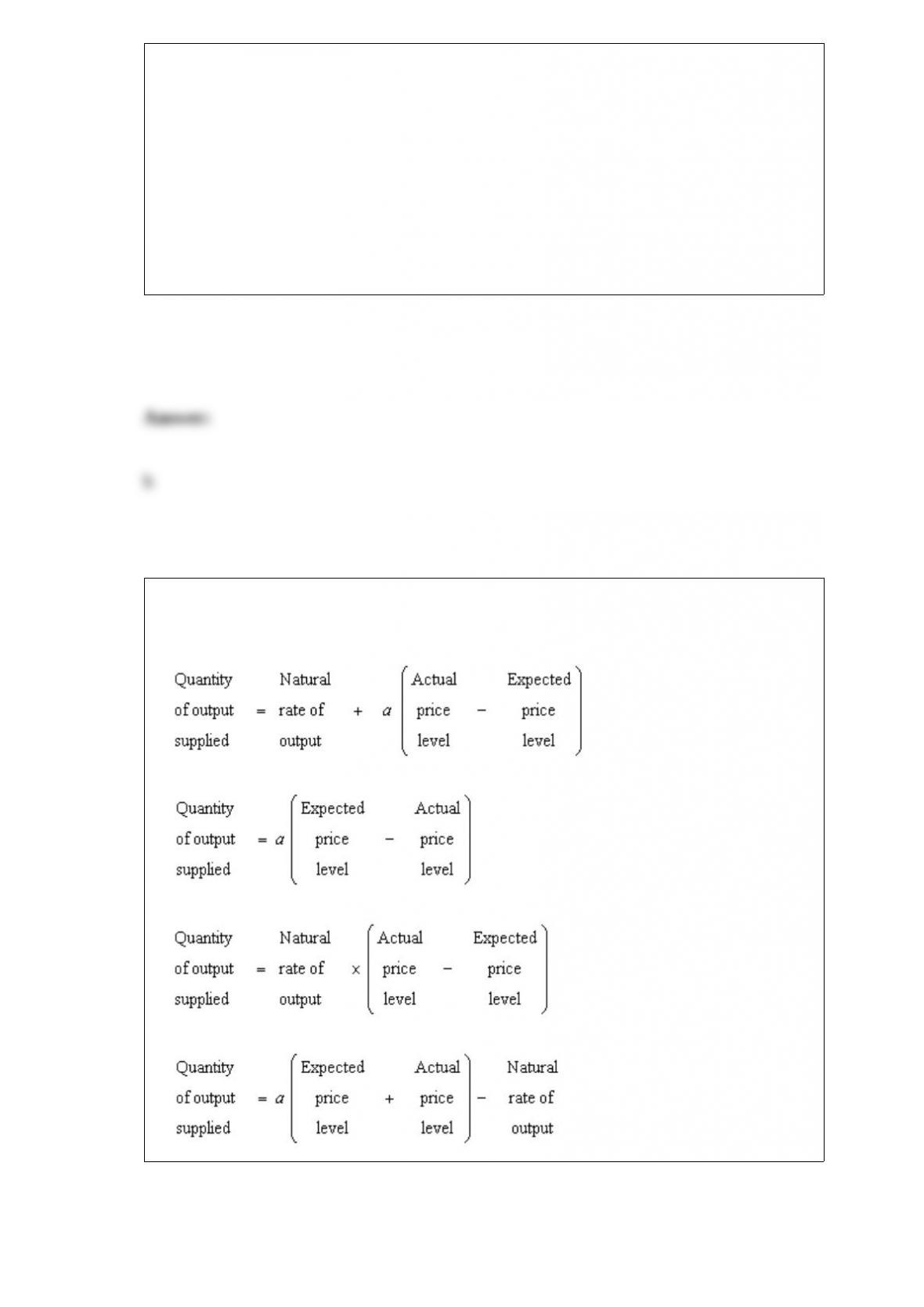
Which of the following correctly expresses why the short-run aggregate-supply curve
slopes upward?
a.
b.
c.
d.

Which of the following is correct?
a. In unionized industries, wages are below the level that would prevail in competitive
markets.
b. The introduction of a union in an industry increases the quantity of labor demanded
in that industry, causes some workers in that industry to be unemployed, and increases
wages in the rest of the economy.
c. Critics argue that the allocation of labor resulting from unions is both inefficient and
inequitable.
d. All of the above are correct.
Other things the same, the real exchange rate between American and Chinese goods
would be higher if
a. prices of Chinese goods were higher, or the number of yuan a dollar purchased was
higher.
b. prices of Chinese goods were higher, or the number of yuan a dollar purchased was
lower.
c. prices of Chinese goods were lower, or the number of yuan a dollar purchased was
higher.
d. prices of Chinese goods were lower, or the number of yuan a dollar purchased was
lower.

According to 2012 data on the U.S. population, which of the following was correct for
the adult population of prime working age, ages 25-54?
a. Black females had higher labor-force participation rates and lower unemployment
rates compared to white females.
b. Black females had similar labor-force participation rates and higher unemployment
rates compared to white females.
c. Black females had both lower labor-force participation rates and lower
unemployment rates compared to white females.
d. Black females had lower labor-force participation rates and higher unemployment
rates compared to white females.
If Saudi Arabia had negative net exports last year, then it
a. sold more abroad than it purchased abroad and had a trade surplus.
b. sold more abroad than it purchased abroad and had a trade deficit.
c. bought more abroad than it sold abroad and had a trade surplus.
d. bought more abroad than it sold abroad and had a trade deficit.
If the MPC is 5/6 then the multiplier is
a. 6/5, so a $200 increase in government spending increases aggregate demand by $240.
b. 5, so a $200 increase in government spending increases aggregate supply by $1000.
c. 6, so a $200 increase in government spending increases aggregate demand by $1200.
d. 6/5, so a $200 increase in government spending increases aggregate supply by $1200.
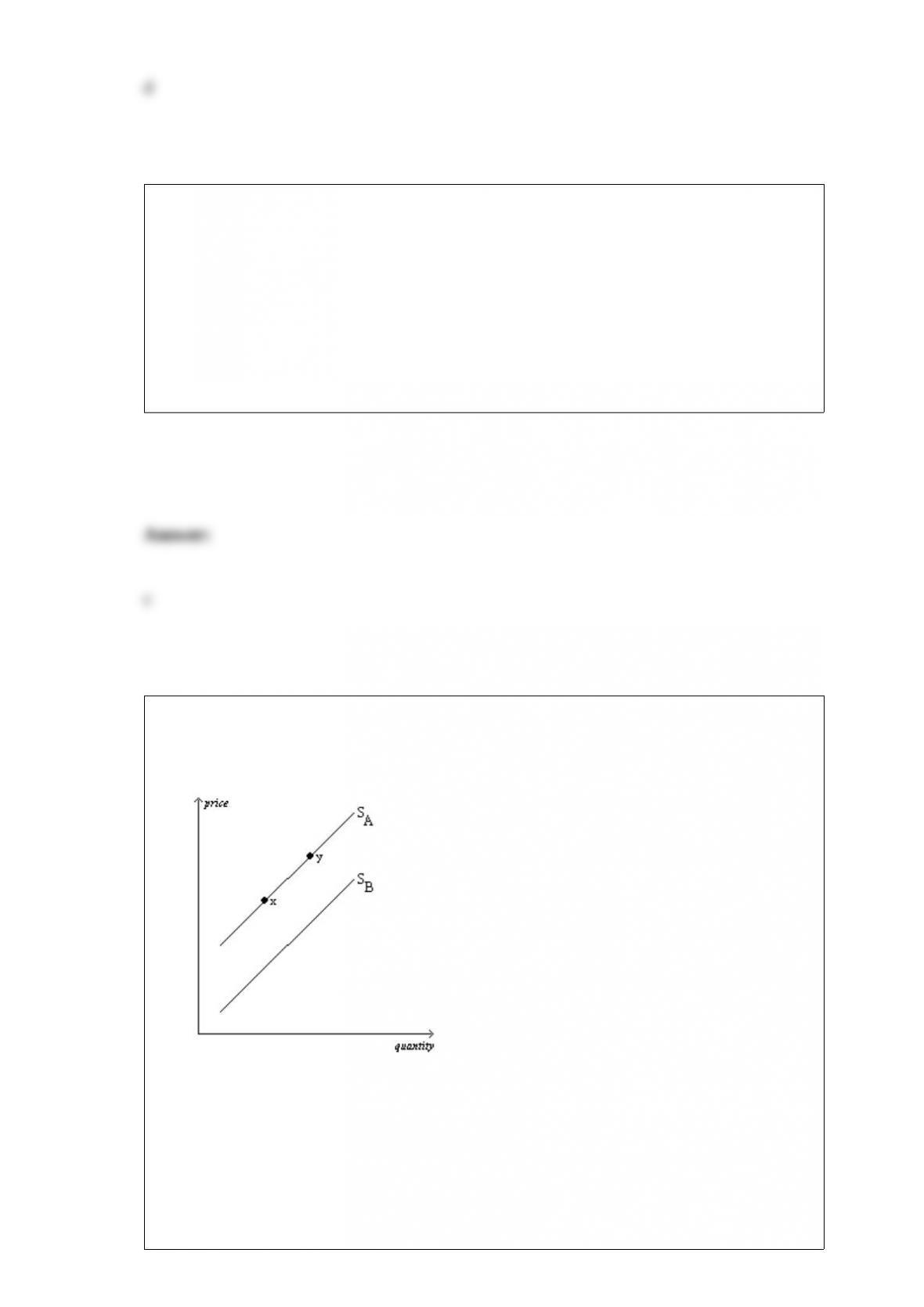
Figure 4-25
The graph below pertains to the supply of paper to colleges and universities.
RefertoFigure4-25.All else equal, the return of college students to campus in the fall
would cause a move from
a. x to y.
b. y to x.

c. SAto SB.
d. SBto SA.
The classical notion of monetary neutrality is consistent both with a vertical long-run
aggregate-supply curve and with a vertical long-run Phillips curve.
a. True
b. False
Which of the following will notchange the U.S. real interest rate?
a. capital flight from the United States
b. the government budget deficit increases
c. the U.S. imposes import quotas
d. None of the above is correct.

Assume Leo buys coffee beans in a competitive market. It follows that
a. Leo has a limited number of sellers from which to buy coffee beans.
b. Leo will negotiate with sellers whenever he buys coffee beans.
c. Leo can influence the price of coffee beans if he buys a large quantity of them.
d. None of the above is correct.
If Joanna is risk averse, then
a. her utility function exhibits the property of decreasing utility.
b. her utility function exhibits the property of increasing marginal utility.
c. she dislikes bad things more than she likes comparable good things.
d. she is unlike most people, because most people are notrisk averse.
Amy discovers a way to produce water heaters so they are less expensive and use less

natural gas. Amy’s discovery is
a. physical capital. If Amy’s discovery leads to lower natural gas prices, it has made
natural gas less scarce.
b. physical capital. If Amy’s discovery leads to lower natural gas prices, it has made
natural gas scarcer.
c. technological knowledge. If Amy’s discovery leads to lower natural gas prices, it has
made natural gas less scarce.
d. technological knowledge. If Amy’s discovery leads to lower natural gas prices, it has
made natural gas scarcer.
The Karmic Deed Restaurant uses all of the following to produce vegetarian meals.
Which of them is an example of physical capital?
a. the owner’s knowledge of how to prepare vegetarian entrees
b. the money in the owner’s account at the bank from which she borrowed money
c. the tables and chairs in the restaurant
d. the fresh fruits, vegetables, and grains the restaurant uses to prepare its meals
One way to characterize the difference between compoundingand discountingis to say
that

a. compounding involves the assumption that the interest rate is zero, whereas
discounting does not involve that assumption.
b. discounting involves the assumption that the interest rate is zero, whereas
compounding does not involve that assumption.
c. the process of compounding produces a future value, whereas the process of
discounting produces a present value.
d. the process of compounding produces a present value, whereas the process of
discounting produces a future value.
In a system of 100-percent-reserve banking,
a. banks do not make loans.
b. currency is the only form of money.
c. deposits are banks’ only assets.
d. All of the above are correct.
Gary’s wealth is $1 million. Economists would say that Gary has $1 million worth of
money.
a. True

b. False
Suppose the U.S. and Japan both produce airplanes and televisions and the U.S. has a
comparative advantage in the production of airplanes while Japan has a comparative
advantage in the production of televisions. If the U.S. exports airplanes to Japan and
imports televisions from Japan,
a. both countries, as a whole, will be better off.
b. all individuals in both countries will be better off.
c. both countries, as a whole, will be worse off.
d. all individuals in both countries will be worse off.