
At a given level of labor employment, knowing the difference between the average
product of labor and the marginal product of labor tells you
A) whether increasing labor use raises output.
B) whether increasing labor use changes the marginal product of labor.
C) whether economies of scale exist.
D) whether the law of diminishing returns applies.
E) how increasing labor use alters the average product of labor.
When a company introduces new audio products, it often initially sets the price high
and lowers the price about a year later. This is an example of
A) a two-part tariff.
B) second-degree price discrimination.
C) intertemporal price discrimination.
D) first-degree price discrimination.
In 1970s the federal government imposed price controls on natural gas. Which of the
following statements is true?

A) These price controls caused a chronic excess supply of natural gas.
B) Consumers gained from the price controls, because consumer surplus was larger
than it would have been under free market equilibrium.
C) Producers gained from the price controls because producer surplus was larger than it
would have been under free market equilibrium.
D) This episode of price controls was unusual, because it resulted in no deadweight loss
to society.
It can be rational to play tit-for-tat in a repeated Prisoners’ Dilemma game
A) only if the game is played an infinite number of times.
B) if the game is played an infinite number of times, or if it is uncertain how many
times it will be played.
C) only if the game is played a finite number of times, and that number is known by all
the players in advance.
D) for n-1 of the n periods it will be played, if n is known in advance.
E) at no time; tit-for-tat is an irrational strategy in this situation.
Scenario 4.4:

The demand curve for the new computer game, Rock and Roll Trivia, is given as
follows:
Q = 200 – 5P – .1Pc – .5Pd + .2A – I
where P is the price of the game
Pc is the price of a computer
Pd is the price of a diskette
A is the level of advertising
Q is the level of incomeSee the information in Scenario 4.4. From this demand curve,
one can infer that:
A) an increase in advertising will cause an increase in the demand for Rock and Roll
Trivia.
B) Rock and Roll Trivia and computers are substitutes.
C) Rock and Roll Trivia and diskettes are substitutes.
D) all of the above
E) none of the above
Halifax & Smyth (H&S) is a clothier that specializes in expensive men’s suits, and the
firm makes the suits from wool fabrics that are woven by one of the firm’s divisions.
This division is the only source for this material, and H&S uses the optimal transfer
price to determine the value of the wool fabric. What happens if the marginal cost of
assembling the men’s suits increases?
A) The net marginal revenue (NMR) curve for wool fabric shifts upward, and wool
(suit) production increases.
B) The net marginal revenue (NMR) curve for wool fabric shifts upward, and wool
(suit) production decreases.

C) The net marginal revenue (NMR) curve for wool fabric shifts downward, and wool
(suit) production increases.
D) The net marginal revenue (NMR) curve for wool fabric shifts downward, and wool
(suit) production decreases.
Which of the following events will cause a leftward shift in the supply curve of
gasoline?
A) A decrease in the price of gasoline
B) An increase in the wage rate of refinery workers
C) Decrease in the price of crude oil
D) An improvement in oil refining technology
E) all of the above
The curve in the diagram below is called:
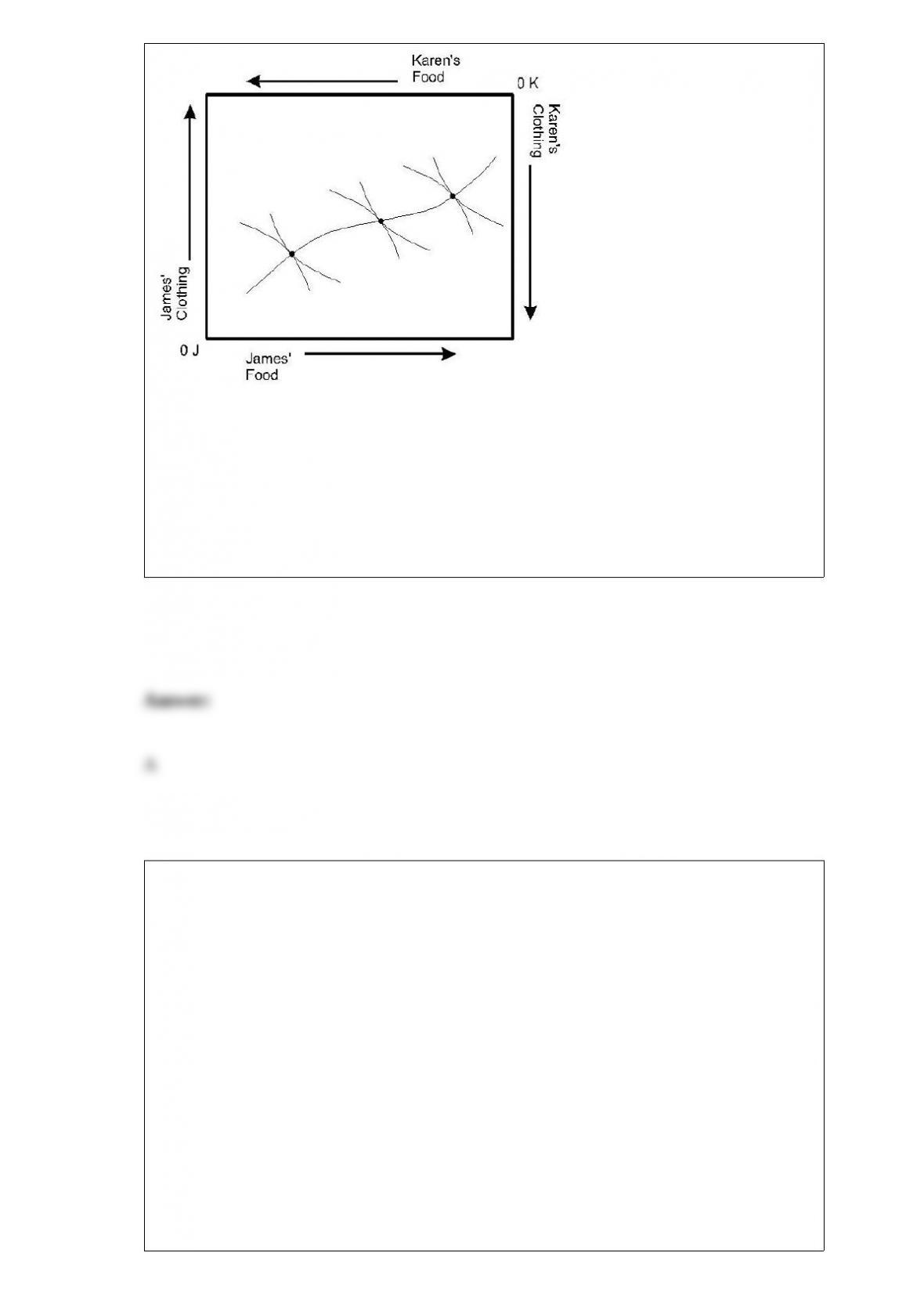
A) the contract curve.
B) the utility possibilities frontier.
C) the production possibilities frontier.
D) the production contract curve.
Two soft-drink firms, Fizzle & Sizzle, operate on a river. Fizzle is farther upstream, and
gets cleaner water, so its cost of purifying water for use in the soft drinks is lower than
Sizzle’s by $500,000 yearly.
If Fizzle and Sizzle sell the same output at the same price and are otherwise identical,
Fizzle’s profit will be
A) higher than Sizzle’s by $500,000 yearly.
B) higher than Sizzle’s by just less than $500,000 yearly.
C) zero in the long run, and Sizzle will be out of business.
D) the same as Sizzle’s, because Fizzle must be assigned an implicit cost of $500,000
yearly for economic rent.

E) the same as Sizzle’s, because Sizzle will move to a more advantageous location in
order to compete.
An investment opportunity has two possible outcomes, and the value of the investment
opportunity is $250. One outcome yields a $100 payoff and has a probability of 0.25.
What is the probability of the other outcome?
A) 0
B) 0.25
C) 0.5
D) 0.75
E) 1.0
Scenario 5.6:
Consider the information in the table below, describing choices for a new doctor. The
outcomes represent different macroeconomic environments, which the individual
cannot predict.
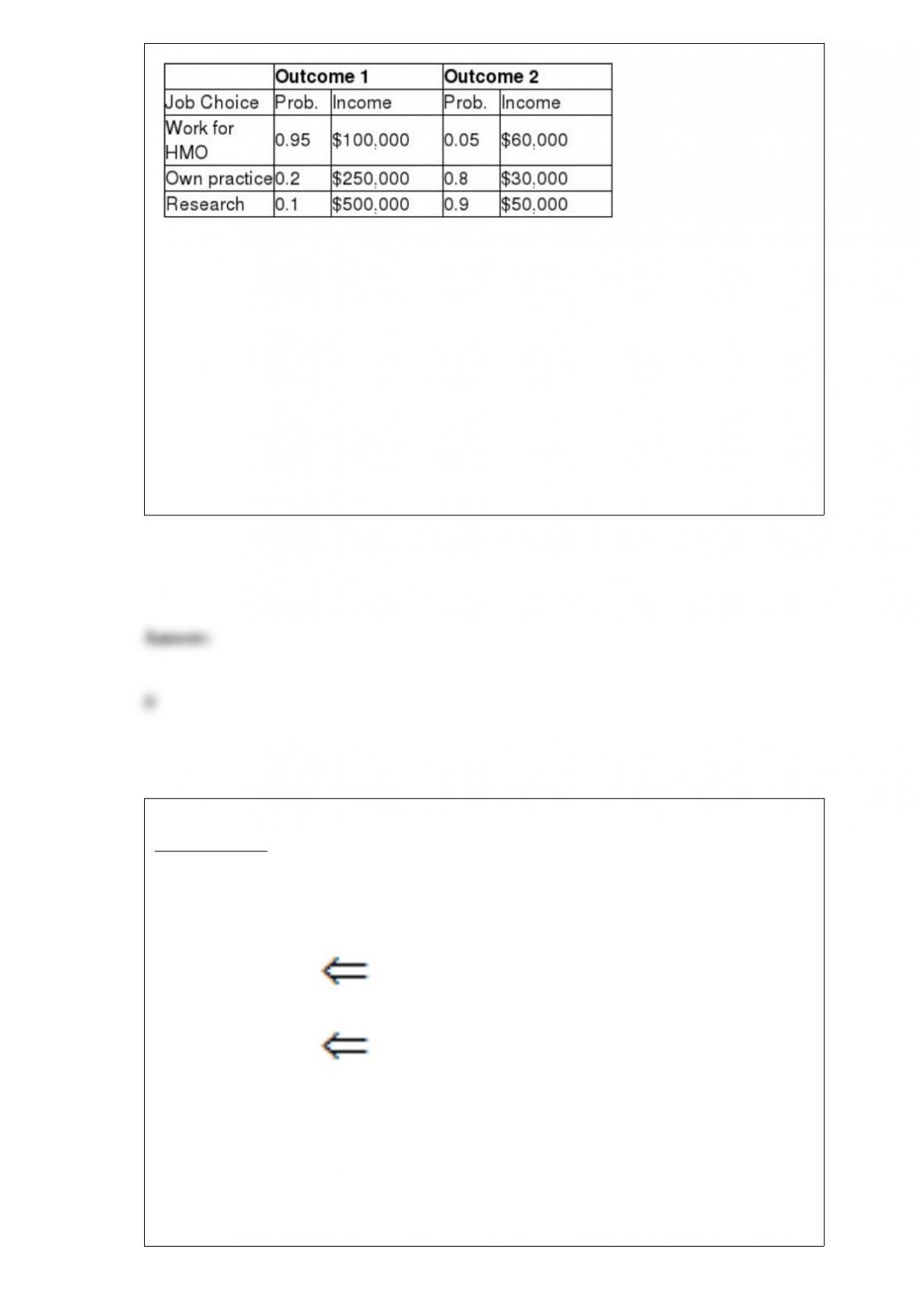
Refer to Scenario 5.6. The utility of expected income from research is
A) U($275,000).
B) U($95,000).
C) [U($500,000) + U($50,000)]/2.
D) .1U($500,000) + .9U($50,000).
E) dependent on which outcome actually occurs.
Scenario 12.2:
You are studying a market for which the kinked demand curve model applies. The
kinked demand curve is as follows:
Q = 1200 – 5P for 0 Q < 150
Q = 360 – P for 150 Q
The marginal cost is given as:
MC = Q
Refer to Scenario 12.2. What is the profit maximizing price?

A) 72
B) 240
C) 210
D) all of the above
E) none of the above
MNO Limited publishes a magazine targeted at urban professionals who live on the east
and west coasts of the U.S., and all of the magazines are printed at a marginal cost of
$0.50 per copy at a publishing plant in Kansas. If the East Coast elasticity of demand
for the magazine is -1.25 and the West Coast elasticity of demand is -1.50, what prices
should MNO Limited charge for the magazines in these two markets in order to
maximize profits?
A) Price should be $0.50 in both markets
B) Price should be $2.50 on the West Coast and $1.50 on the East Coast
C) Price should be $1.50 on the West Coast and $2.50 on the East Coast
D) Price should be $0.40 on the West Coast and $0.33 on the East Coast
This year a new oil field with substantial reserves has been discovered. Such
discoveries are not made every year. Therefore an increase in the demand for oil will:

A) increase the long-run price of oil more than the short-run price of oil.
B) increase the long-run price of oil less than the short-run price of oil.
C) ensure the long-run price of oil and short-run price of oil increase by the same
amount.
D) ensure that the short-run price of oil falls.
E) ensure that the short-run price of oil remains unchanged.
A new toll road was built in Southern California between San Juan Capistrano and
Costa Mesa. On average, drivers save 10 minutes taking this road as opposed to the old
road. The toll is $2; the fine for not paying the toll is $76. The probability of catching
and fining someone who does not pay the toll is 90%. Individuals who take the road and
pay the toll must therefore value 10 minutes at a minimum
A) between $1.80 and $68.40.
B) between $2 and $68.40.
C) $1.80.
D) between $1.80 and $76.
E) more than $76.

The authors explain that the marginal cost of production does not have to be constant in
order to maximize profits under intemporal price discrimination. Which of the
following is NOT an example of changing marginal costs under profit-maximizing
intertemporal price discrimination?
A) Marginal cost increases sharply after the initial marketing stages when the product is
sold to the broader market of consumers.
B) Marginal costs decline over time due to learning-by-doing.
C) Marginal costs decline over time because the producer sells less expensive versions
of the product in later stages of marketing (e.g., hard-cover versus paper-cover books).
D) Marginal costs decline over time due to economies of scale.
Answer both parts of the following question.
a. The San Francisco Chronicle reported that the toll on the Golden Gate Bridge was
raised from $2 to $3. Following the toll increase, traffic fell by 5 percent. Based on this
information, calculate the point price elasticity of demand. Is demand elastic or
inelastic? Explain.
b. Stephen Leonoudakis, chairman of the bridge’s finance auditing committee, warned
that the toll increase could cause toll revenues to decrease by $2.8 million per year. Is
this statement consistent with economic theory? Explain.

The amount of output that a firm decides to sell has no effect on the market price in a
competitive industry because
A) the market price is determined (through regulation) by the government
B) the firm supplies a different good than its rivals
C) the firm’s output is a small fraction of the entire industry’s output
D) the short run market price is determined solely by the firm’s technology
E) the demand curve for the industry’s output is downward sloping
In general, does the demand for labor become more or less elastic as we increase the
number of other variable inputs used in a production process?
A) More elastic
B) No change in elasticity
C) Less elastic
D) We cannot answer this question without more information about the other inputs

A firm maximizes profit by operating at the level of output where
A) average revenue equals average cost.
B) average revenue equals average variable cost.
C) total costs are minimized.
D) marginal revenue equals marginal cost.
E) marginal revenue exceeds marginal cost by the greatest amount.
The law of large numbers:
A) can be used to explain why some people are risk averse and others are risk neutral or
risk loving.
B) can be used to explain why some people choose to self-insure against random, single
and largely unpredictable events.
C) states that large amounts of information are often preferred to small amounts of
information.
D) states that the average outcome of a large number of similar events can often be
predicted.

A firm setting a two-part tariff with only one customer should set the entry fee equal to
A) marginal cost.
B) consumer surplus.
C) marginal revenue.
D) price.
Let P be the price of a good and let I represent consumer income. Which of the
following demand functions represents a luxury good with inelastic price response?
A) log(Q) = 4 ” 2 log(P) + 2 log(I)
B) log(Q) = 4 – 0.5 log(P) + 0.25 log(I)
C) log(Q) = 4 – 0.25 log(P) + 2 log(I)
D) log(Q) = 4 + 2 log(P) + 0.2 log(I)
The perfectly competitive firm’s marginal revenue curve is

A) exactly the same as the marginal cost curve.
B) downward-sloping, at twice the (negative) slope of the market demand curve.
C) vertical.
D) horizontal.
E) upward-sloping.
For automobile demand in the U.S., the income response tends to be larger in the:
A) short run.
B) long run.
C) The income response is the same in the long run and the short run.
D) We do not have enough information to answer this question.
To demonstrate the anchoring phenomenon, Kahneman and Tversky would ask research
subjects very difficult questions that should be answered with a number between zero
and 100. Before asking for the respondent’s answer, they would also spin a large wheel
that generated random number outcomes from zero to 100. If the respondents were
subject to the anchoring effect, then we should expect that:

A) their responses are uncorrelated with the numbers generated by the wheel.
B) their responses are correlated with the numbers generated by the wheel.
C) their responses are wrong most of the time.
D) none of the above
Which of these is NOT an exercise in general equilibrium analysis?
A) A discussion of factors within the wheat market that influence wheat prices
B) An analysis of the effects of changes in oil prices upon the natural gas market
C) An evaluation of relationships between the markets for tires and automobiles
D) none of the above
You using a Laspeyres (fixed-weight )price index to compare price changes over time,
and the index is based on consumption bundles from 2005 when energy costs were
lower and housing costs were higher. Your results are likely to:
A) Overstate changes in the cost of living because the weight assigned to energy is too
small.
B) Overstate changes in the cost of living because the weight assigned to energy is too
large.

C) Understate changes in the cost of living because the weight assigned to housing is
too small.
D) Understate changes in the cost of living because the weigh assigned to housing is too
large.
Which of the following statements about markets and industries is TRUE?
A) A market includes buyers but not sellers.
B) A market includes sellers but not buyers.
C) An industry includes buyers but not sellers.
D) An industry includes sellers but not buyers.
The bandwagon effect corresponds best to which of the following?
A) Snob effect
B) External economy
C) Negative network externality
D) Positive network externality

If the firms in an industry could take advantage of a reduced wage, how would one best
describe the firms’ demand for labor? The MRPL
A) schedule would remain unchanged, and the firms would hire more labor at the lower
wage.
B) schedule would shift to the left and the firms would move down the new schedule.
C) schedule would shift to the right and the firms would move down the new schedule.
D) none of the above
A dominant strategy can best be described as
A) a strategy taken by a dominant firm.
B) the strategy taken by a firm in order to dominate its rivals.
C) a strategy that is optimal for a player no matter what an opponent does.
D) a strategy that leaves every player in a game better off.
E) all of the above
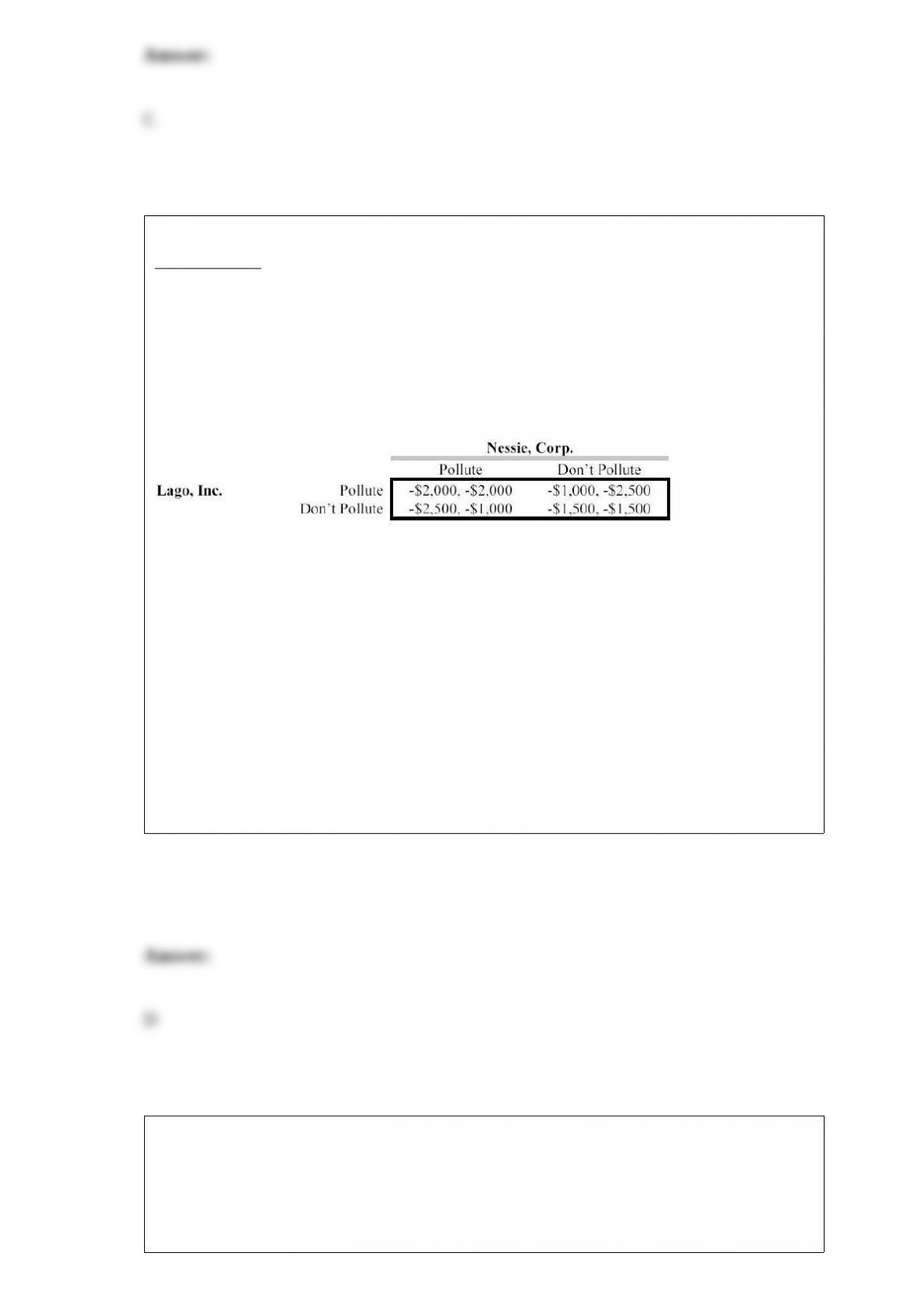
Scenario 13.9
Consider the following game:
Two firms are situated next to a lake, and it costs each firm $1,500 per period to use
filters that avoid polluting the lake. However, each firm must use the lake’s water in
production, so it is also costly to have a polluted lake. The cost to each firm of dealing
with water from a polluted lake is $1,000 times the number of polluting firms.
Refer to Scenario 13.9. If this game is repeated over an infinite or uncertain horizon, the
most likely observed behavior will be that
A) both firms pollute.
B) only Lago pollutes.
C) only Nessie pollutes.
D) neither firm pollutes.
E) the firms alternate polluting in different periods.
Joe owns a coffee house and produces coffee drinks under the production function q =
5KL where q is the number of cups generated per hour, K is the number of coffee
machines (capital), and L is the number of employees hired per hour (labor). What is
the marginal product of labor?

A) MP = 5
B) MP = 5K
C) MP = 5L
D) MP = 5K/L
When a per unit tax is imposed on the sale of a product of a monopolist, the resulting
price increase will
A) always be less than the tax.
B) always be more than the tax.
C) always be less than if a similar tax were imposed on firms in a competitive market.
D) not always be less than the tax.