Recall the Application about low-price guarantees and the prices of tires to answer
the following question(s).
Recall the Application. A study of the retail tire market suggests that prices are
________ in markets where firms offer low-price guarantees.
A) generally higher
B) generally lower
C) always lower
D) generally unchanged
Table 3.1 illustrates Willy and Blythe’s hourly production for apples and carrots. From
the table, we can conclude that:
Table 3.1
A) Willy should specialize in carrots and trade for apples.
B) Willy should specialize in apples and trade for carrots.
C) Blithe should specialize in both goods.
D) Willy should specialize in both goods.

If supply is perfectly elastic, the price elasticity of supply is equal to:
A) 1.
B) 0.
C) infinity.
D) a positive number between 0 and infinity.
Which of the following is NOT an example of the adverse selection problem?
A) Buyers in a market for used cars must choose from an undesirable selection of used
cars.
B) An insurance company must choose one price for its coverage for both high-cost and
low-cost people.
C) Commercial banks would rather use credit rationing than raising interest rates in the
presence of excess demand for loans.
D) An insured motorist drives more recklessly.
Table 10.2 contains price, demand, and cost data for the Capri Theater, the only first-run
movie theater in a small town. Should the firm adopt the single price policy or the
student discount policy?
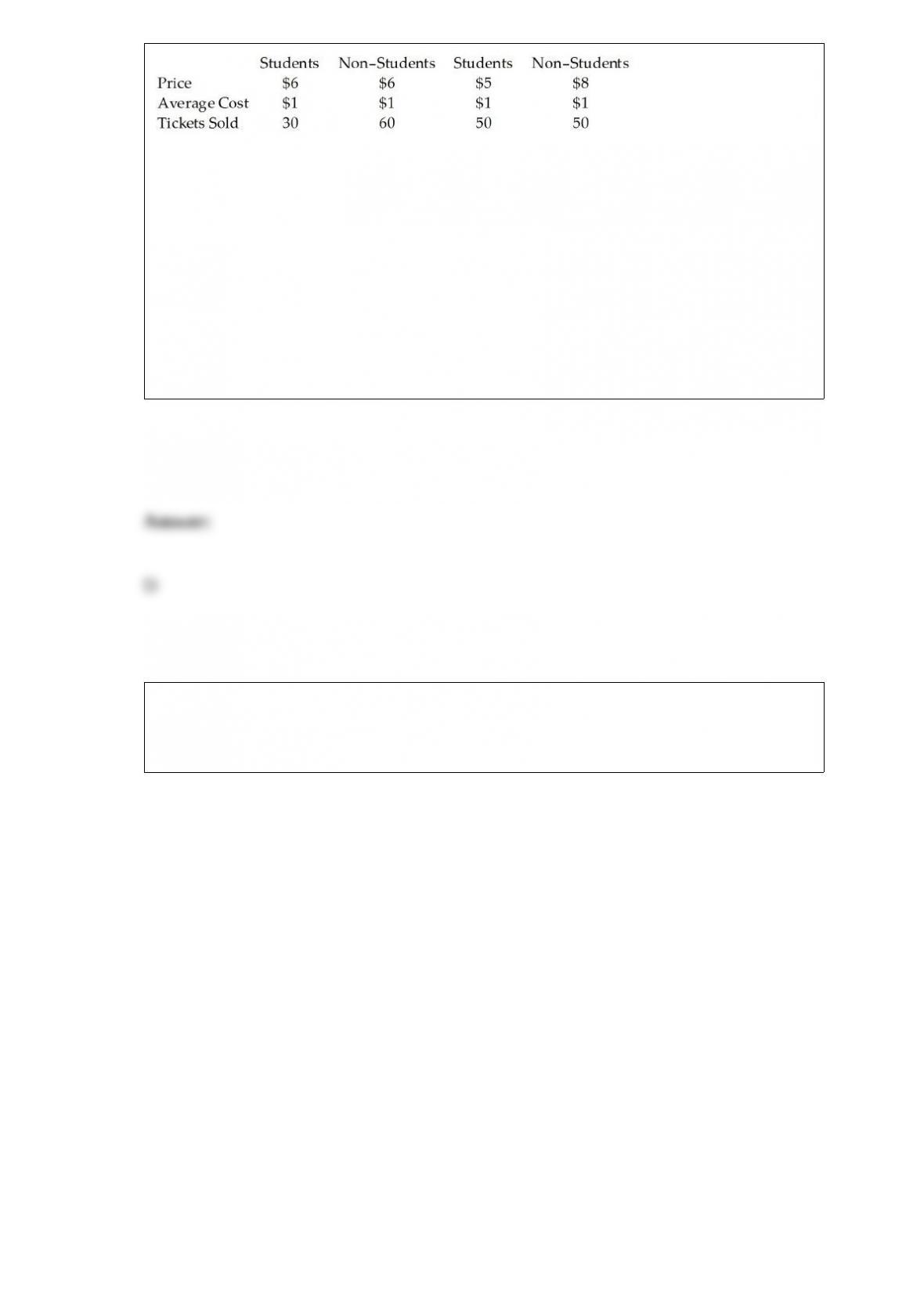
Table 10.2
A) the single price policy because the firm does not meet the three conditions necessary
to engage in price discrimination
B) the single price policy because price discrimination would not be legal for this firm
C) the single price policy because it is more profitable than price discrimination for this
firm
D) the student discount policy because it is more profitable than the single price policy
Figure 2.2 presents a production possibilities curve for a country that can either produce
highways or provide people with medical care in a given year. The opportunity cost of
the third new highway built in a year is:
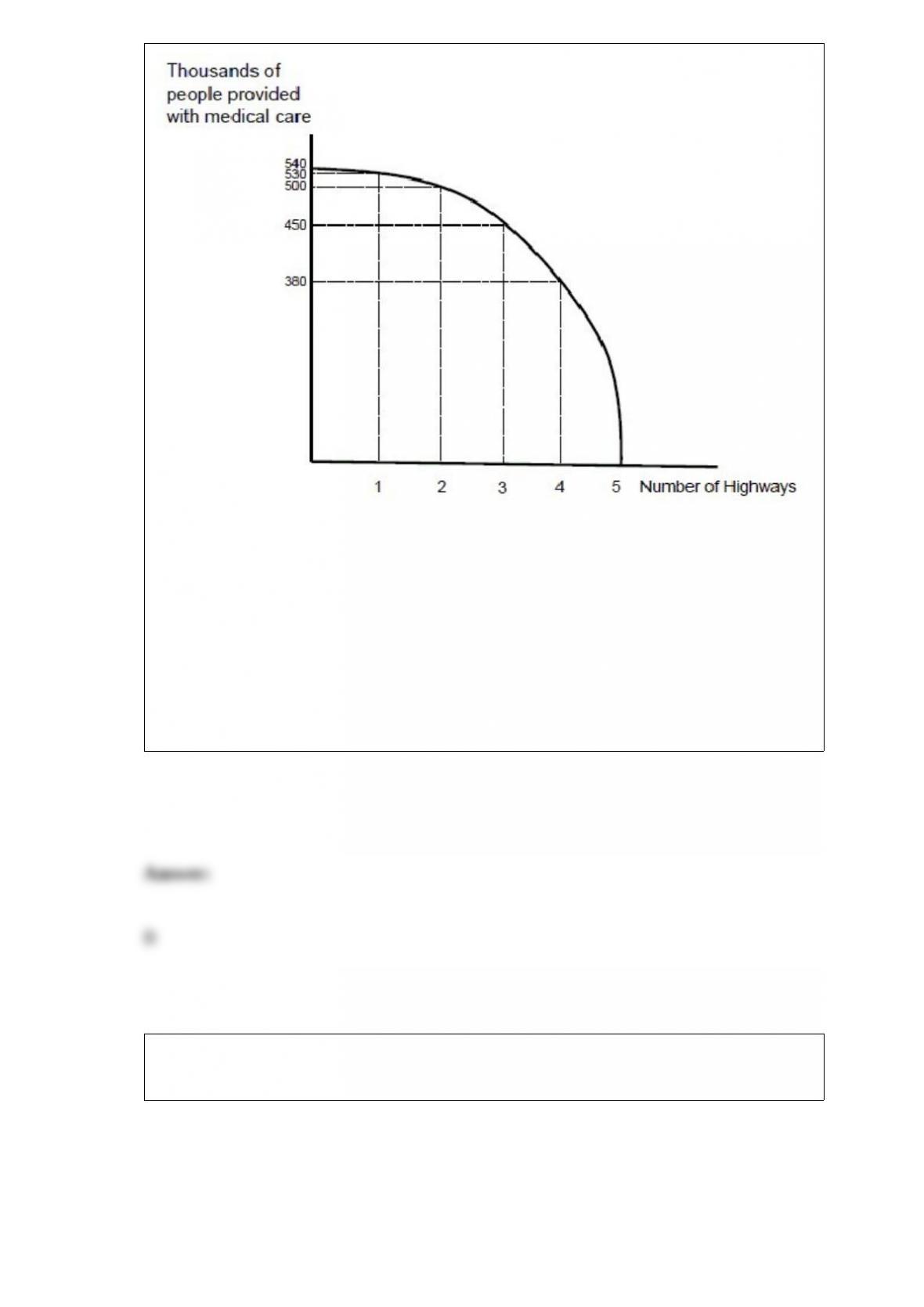
Figure 2.2
A) 10,000 people provided with medical care.
B) 50,000 people provided with medical care.
C) 90,000 people provided with medical care.
D) 450,000 people provided with medical care.
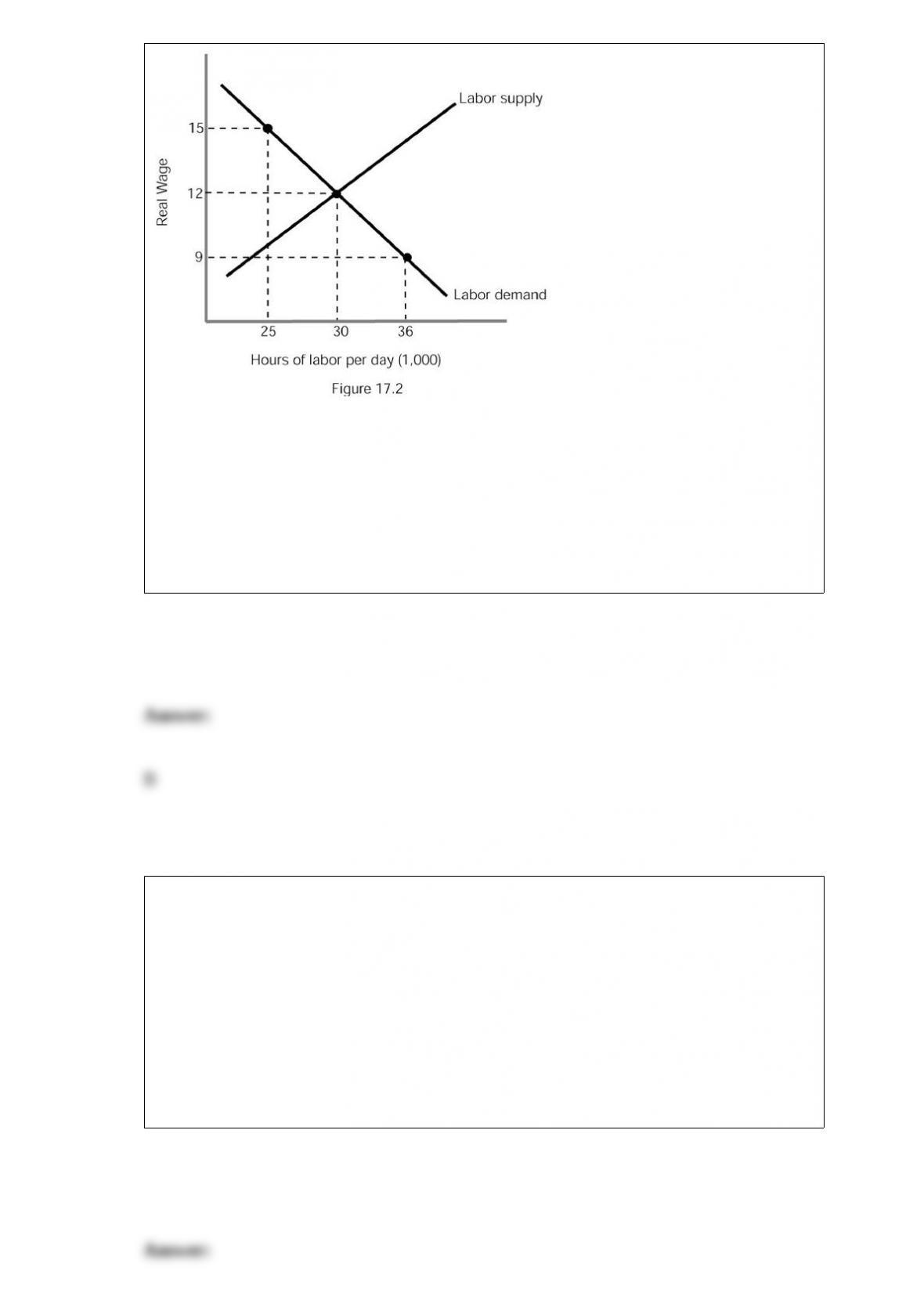
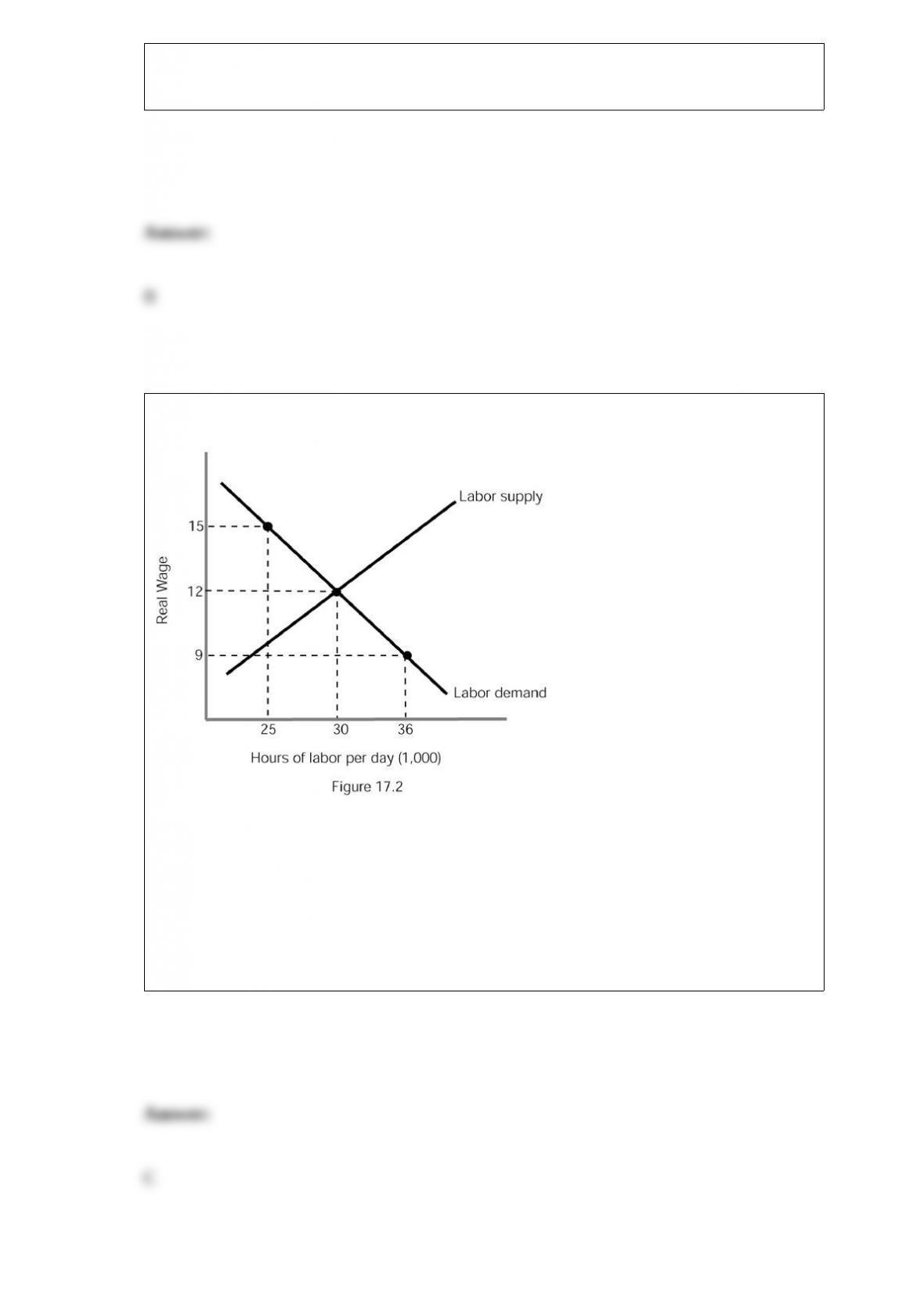
Refer to Figure 17.2. If the equilibrium wage $12 and a new minimum wage is set at
$15, then ________ hours of labor will be employed.
A) 36,000
B) 25,000
C) 30,000
D) none of these
A trust is:
A) a cartel.
B) legal under the Sherman Act.
C) an arrangement in which the owners of several companies transfer their
decision-making powers to a group of trustees.
D) all of the above
If a monopolist is maximizing its profits, we know that it has:
A) maximized total revenue.
B) maximized marginal revenue.
C) minimized total cost.
D) equated marginal cost and marginal revenue.
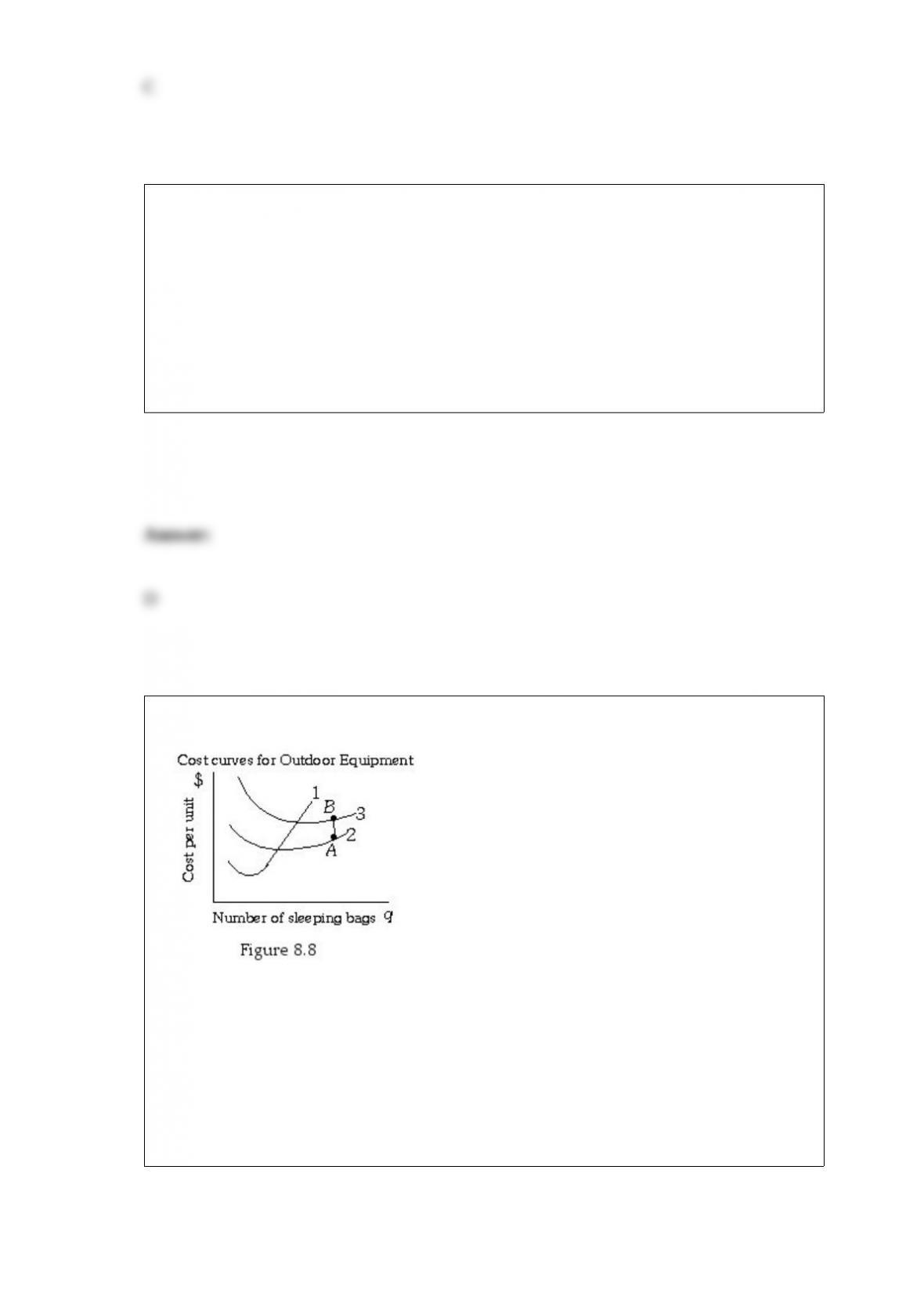
Refer to Figure 8.8. Curve 2 is Outdoor Equipment’s:
A) marginal cost curve.
B) average variable cost curve.
C) average total cost curve.
D) average fixed cost curve.

The budget line will shift parallel to the right if:
A) income increases.
B) income decreases.
C) the price of the good on the vertical axis increases.
D) the price of the good on the vertical axis decreases.
A fixed cost can be thought of as:
A) a cost that changes as output increases.
B) a cost that must be paid even if output equals zero.
C) a cost that is paid only when output equals zero.
D) total costs ignoring opportunity costs.

The minimum efficient scale is:
A) the quantity after which it makes no sense for a firm to produce.
B) the minimum quantity where a firm would be able to produce profitably.
C) the output level beyond which the firm will not experience scale economies.
D) the output level beyond which the firm will experience scale economies.
Which of the following situations would be examples of price discrimination?
A) United Airlines charges customers who book 14 days ahead a lower price than those
who don’t.
B) Chevron gas stations charges customers 20 cents more per gallon if they choose the
premium grade over the regular unleaded.
C) The local carwash charges drivers of minivans and large SUVs a $2.00 “large
vehicle” surcharge.
D) GEICO, an insurance company, charges higher rates to those who received more
than one speeding ticket in the last 6 months.
Education generates external benefits. A free market with no government intervention
will produce:

A) an efficient level of education.
B) more than the efficient level of education.
C) less than the efficient level of education.
D) zero units of education.
When a firm has decreasing average costs over the entire range of market demand it is:
A) a natural monopoly.
B) an oligopoly.
C) rent seeking.
D) in a contestable market.
Recall the application about how a private good, LoJack, generates external benefits as
well as private benefits. Which of the following is NOT a benefit from the LoJack
system?
A) more stolen cars recovered
B) more police being hired
C) lower insurance costs
D) fewer automobile thefts
Refer to Figure 17.2. If the hourly wage increases from $9 to $12, then:
A) quantity demanded for labor will rise.
B) demand for labor will decrease.
C) quantity supplied of labor will increase.
D) supply of labor will fall.
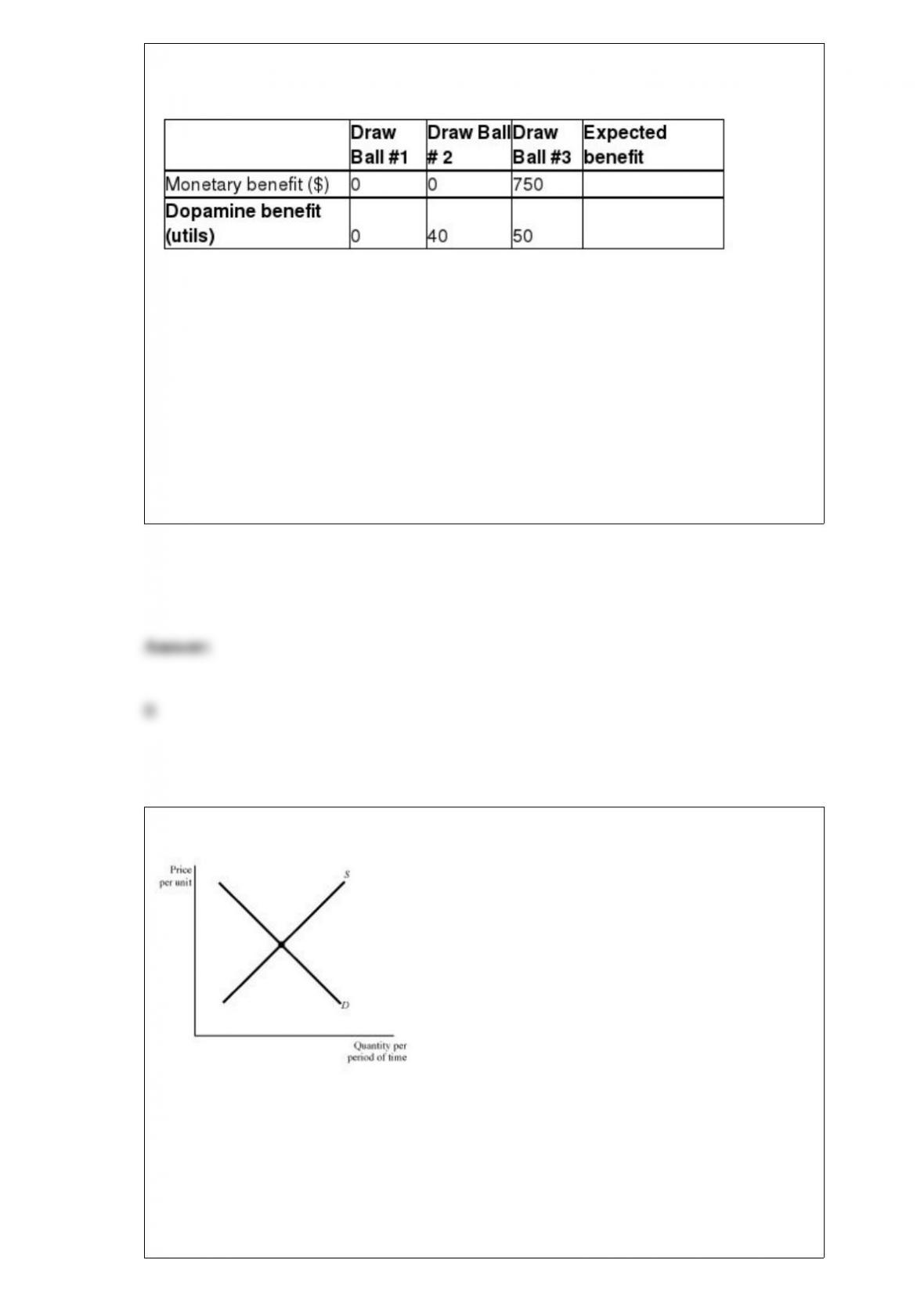
Refer to Table 7.1. For this game, the expected monetary benefit is:
Table 7.1
The Table represents the payoffs for a gambling game. The player blindly draws
one of three balls, marked 1, 2, and 3, from an urn. The cost to play the game is
$375 per draw.
A) $0.
B) $250.
C) $375.
D) $750.
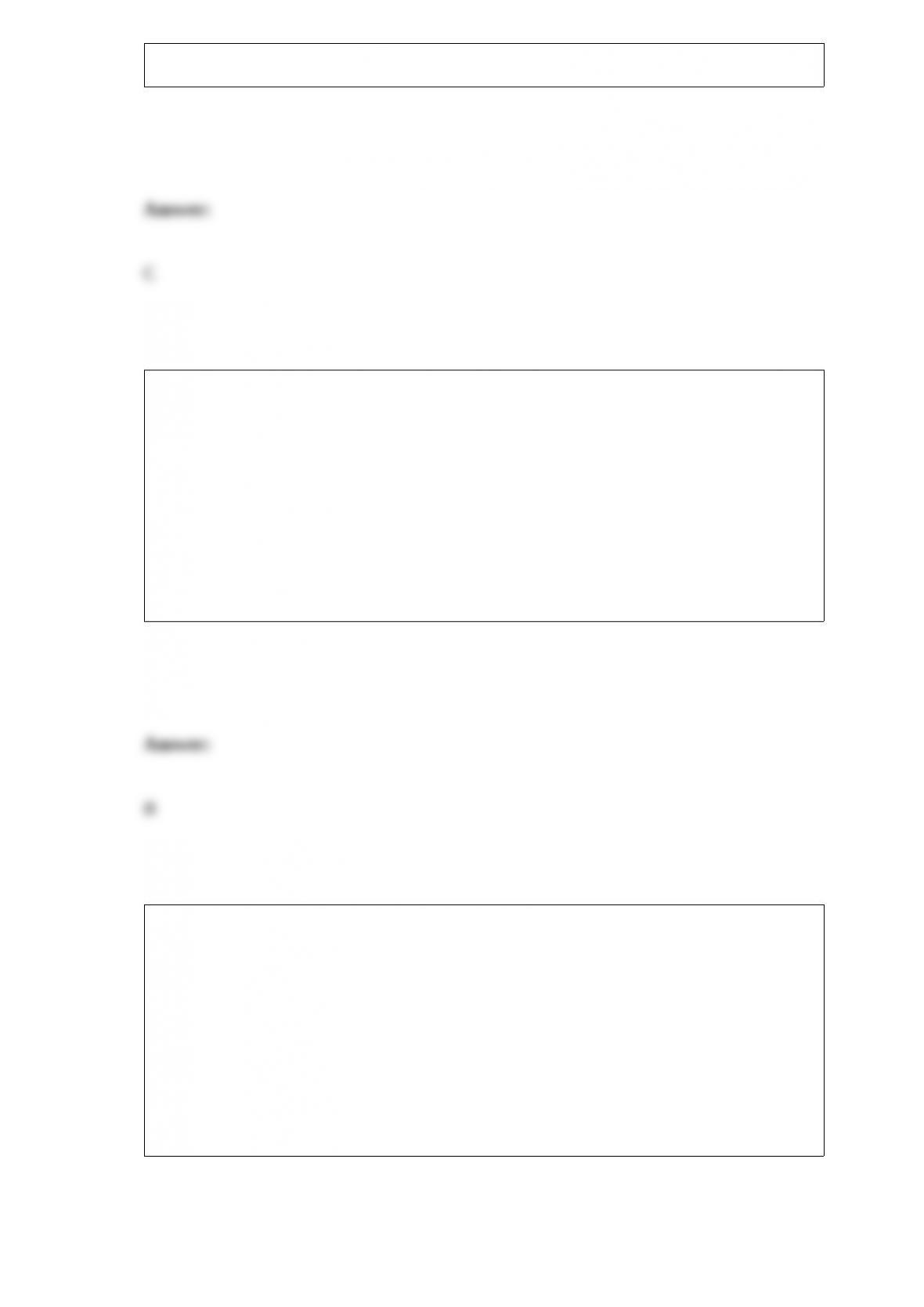
If demand increases and supply decreases in Figure 4.7, then the equilibrium:
Figure 4.7
A) price rises.
B) price falls.

C) quantity rises.
D) quantity falls.
Suppose that the price elasticities of demand for pharmaceutical products differ across
several customer groups. If senior citizens have the most elastic demand for
pharmaceutical products, they will receive:
A) the greatest quantity of pharmaceutical products.
B) the highest price for pharmaceutical products.
C) the lowest price for pharmaceutical products.
D) the smallest quantity of pharmaceutical products.
You are a student at a university. You pay $8,000 per year in tuition, $5,000 per year in
living expenses, and $1,000 per year for books. Were you not in school, you could earn
$15,000 per year and you would not live with your parents. What is your economic cost
of a year in college?
A) $9,000
B) $15,000
C) $24,000
D) $29,000
In which of the following ways is a monopolistically competitive firm like a perfectly
competitive firm?
A) Short-run economic profits are always positive.
B) Short-run economic profits may be positive, negative, or zero.
C) Long-run economic profits are negative.
D) Long-run economic profits are positive.
Suppose there are two firms maintaining a cartel agreement. If one firm suddenly drops
its price, the other firm could interpret this as signaling:
A) under-pricing.
B) limit pricing.
C) cartel pricing.
D) cooperative pricing.

The difference in wages between college graduates and high school graduates:
A) has increased in recent years.
B) is smaller than in the past.
C) is nonexistent when labor markets are in equilibrium.
D) has been stable for several decades.
Consider Figure 12.5. If B’s sentence were 3 years in the case where B confesses but A
does not then:
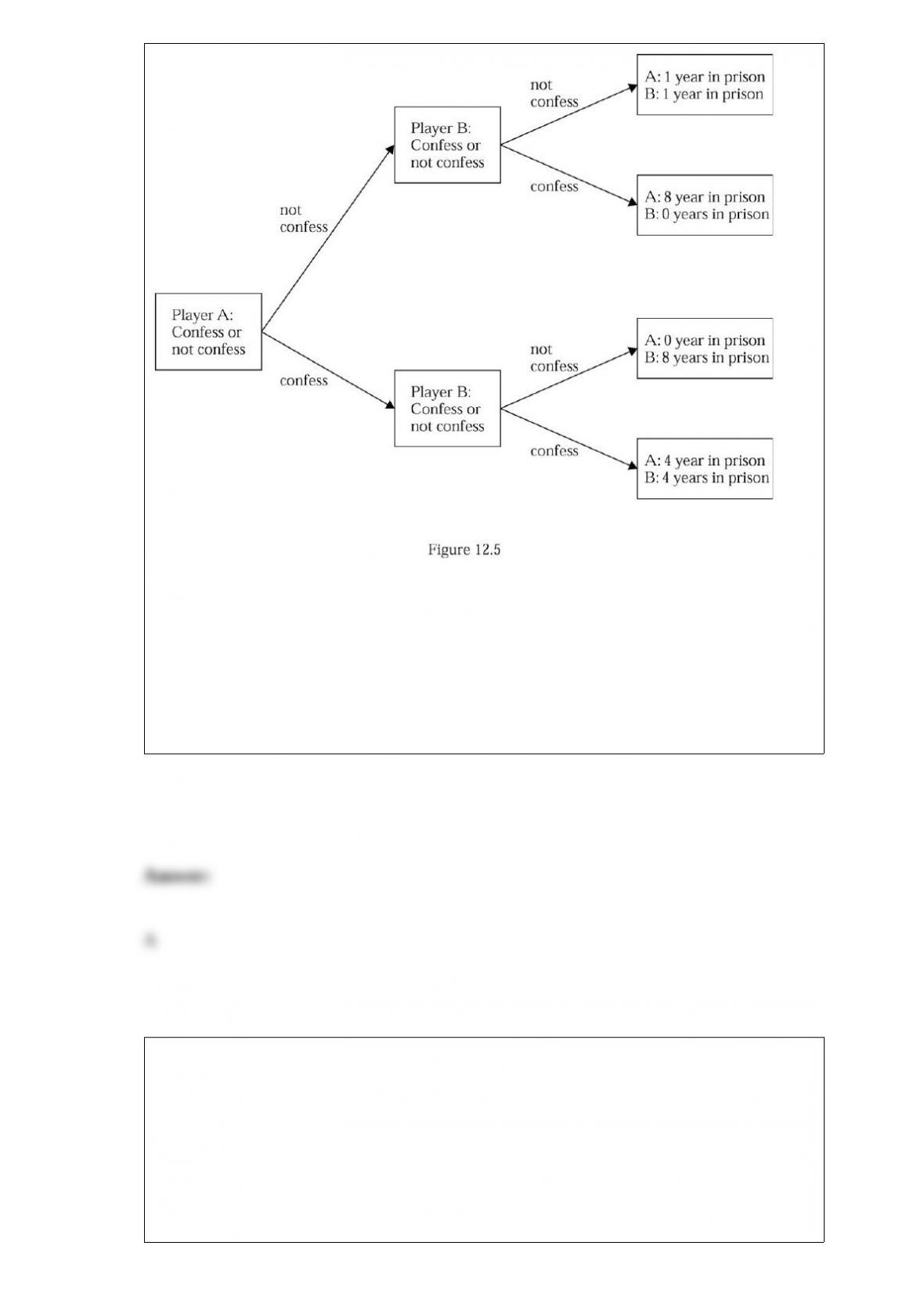
A) confessing is no longer a dominant strategy for B.
B) the dominant strategy does not change.
C) confessing is no longer a dominant strategy for A.
D) A would not confess.
Recall the application about straddling the zinc cost curve, what is the shutdown price
for the zinc mines?
A) The cost of mining zinc varies from one mine to another, the shutdown price varies
too.
B) The shutdown price is $1900 per ton for all zinc mines.

C) The shutdown price is $1500 per ton for all zinc mines.
D) none of the above
When the Motor Carrier Act of 1980 was made into law, new firms entered into the
trucking industry. This action by new trucking firms confirm that:
A) the trucking industry was earning profits in the long run prior to the entry of the new
firms.
B) the trucking industry was earning losses in the long run prior to the entry of the new
firms.
C) the trucking industry was earning profits as a result of the entry of the new firms.
D) the trucking industry was earning losses before and after the entry of the new firms.
Which of the following statements about a perfectly competitive market is
INCORRECT?
A) There are many sellers, each supplying a small quantity.
B) There are many buyers, each purchasing a small quantity.
C) The market sell homogeneous products.
D) Buyers and sellers cannot enter exit the market freely.

The principle of diminishing returns implies that when one input increases while the
other inputs are held fixed, output: beyond some point will exhibit:
A) increases at an increasing rate.
B) increases at a decreasing rate.
C) decreases at a decreasing rate.
D) decreases at an increasing rate.
Figure 4.3 illustrates the demand for tacos. If people expect the price of tacos to
decrease in the near future, this would most likely bring about a movement from:
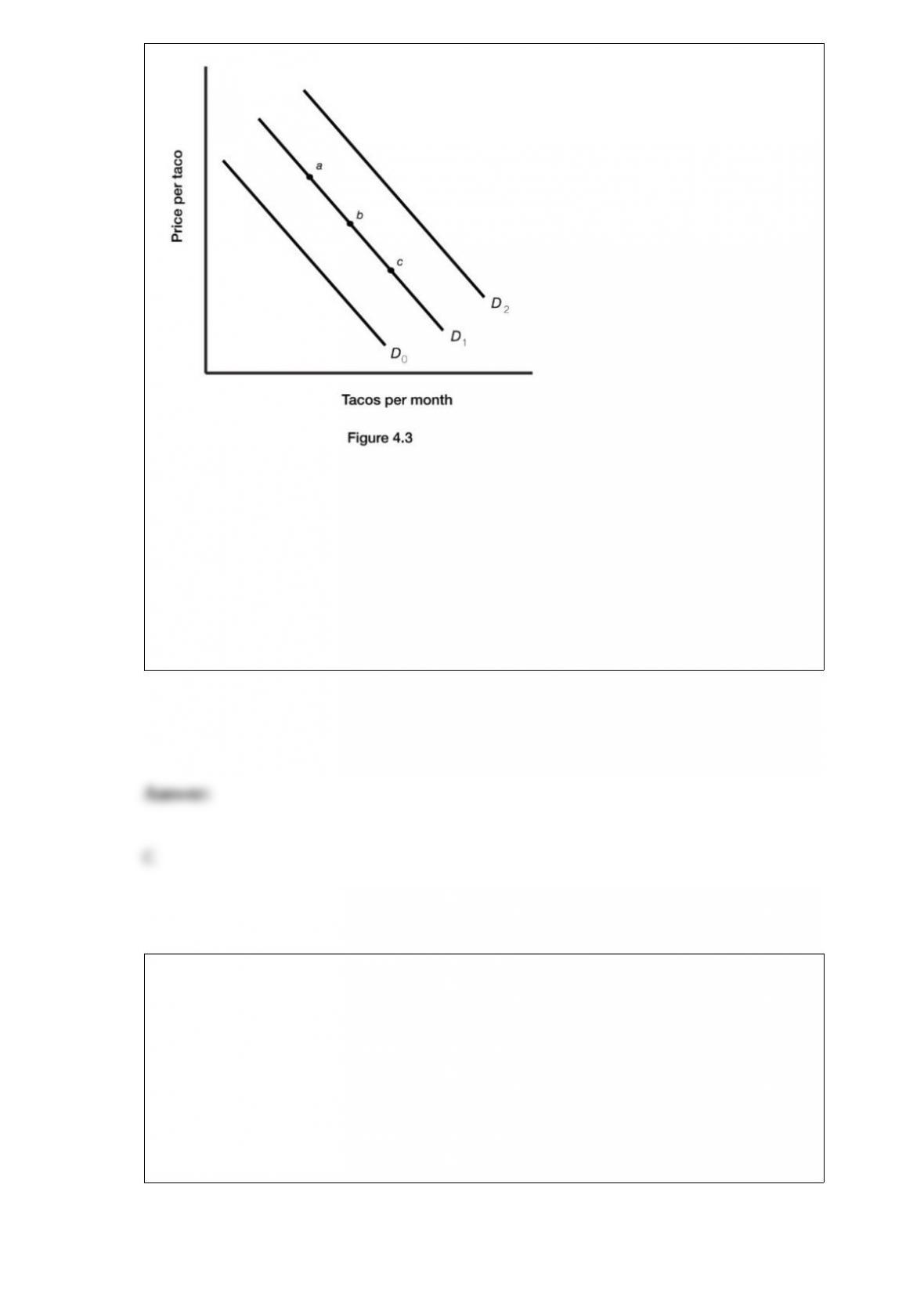
A) point a to point b.
B) point c to point a.
C) D2 to D0.
D) D0 to D1.
The government imposes taxes on firms which generate external costs in an effort to:
A) make it easier for economists to measure external costs.
B) lead to a zero level of output.
C) force decision makers to consider the full costs of their actions.
D) lower the firms’ costs of production.

A good that is available for everyone to consume, regardless of who pays and who
doesn’t, is called a:
A) private good.
B) external good.
C) public good.
D) spillover good.