The price level is:
A. the rate of inflation.
B. a measure of overall prices at a particular point in time.
C. the percentage change in a price index such as the CPI.
D. the price of a specific good in comparison to the prices of other goods and services.
A fiscal policy action to close an expansionary gap is to:
A. increase taxes.
B. increase transfer payments.
C. increase government purchases.
D. increase the marginal propensity to consume.
If the nominal interest rate is 8% and the real interest rate is 3%, then the inflation rate
equals:
A. 3%
B. 5%
C. 8%
D. 11%
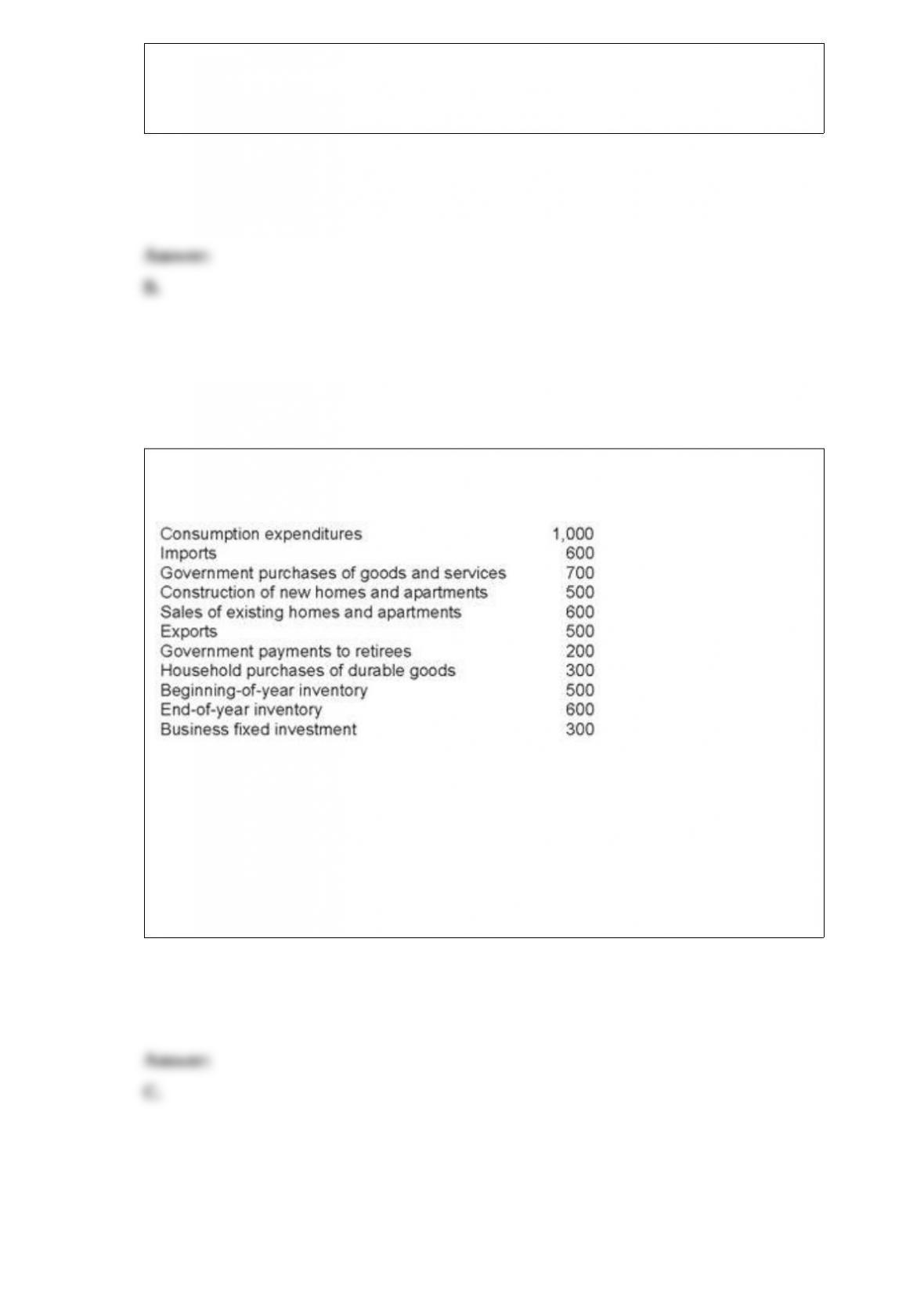
The following table provides data for an economy in a certain year._
Given the data in the table, compute the government purchases component of GDP.
A. 200
B. 500
C. 700
D. 900
Suppose you learn that in 1900, households spent about 40 percent of their budget on
food, and today, they spend about 10 percent of their budget of food. All else equal, this
suggests that the price elasticity of demand for food:
A. is probably negative.
B. has always been very high.
C. is probably lower now than it was in 1900.
D. is probably higher now than it was in 1900.
Suppose the natural rate of unemployment is 6 percent. What is the actual rate of
unemployment if actual output is 2 percent below potential output?
A. 4 percent
B. 7 percent
C. 8 percent
D. 10 percent
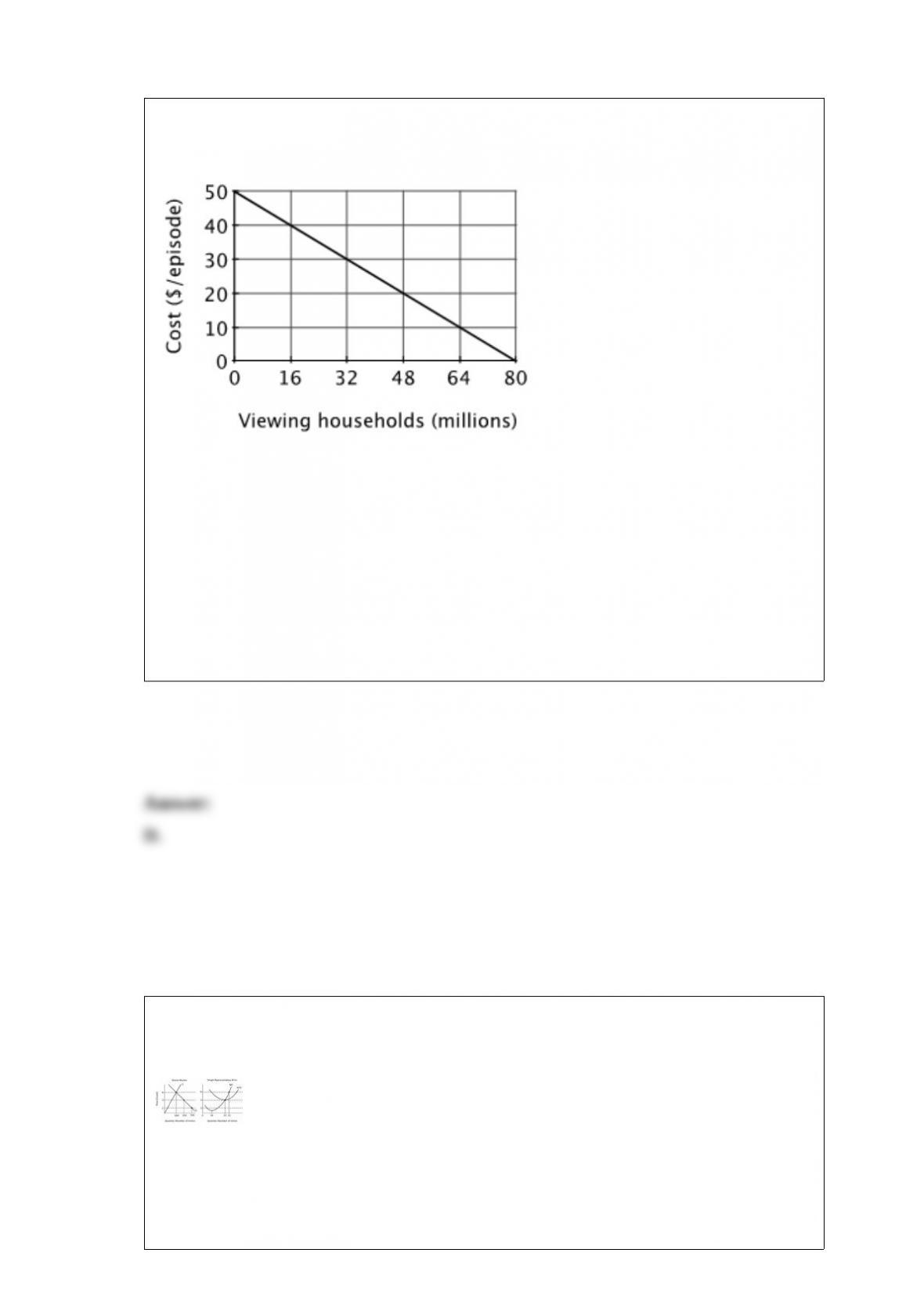
If the popular television show The Bachelor is shown on pay-per-view television every
Monday at 9pm, then the demand curve for each episode is given below.
If the regulated pay-per-view charge were $30 per household, what would be the loss in
total economic surplus relative to when there is no charge to watch an episode?
A. $4000 million
B. $2000 million
C. $1280 million
D. $720 million
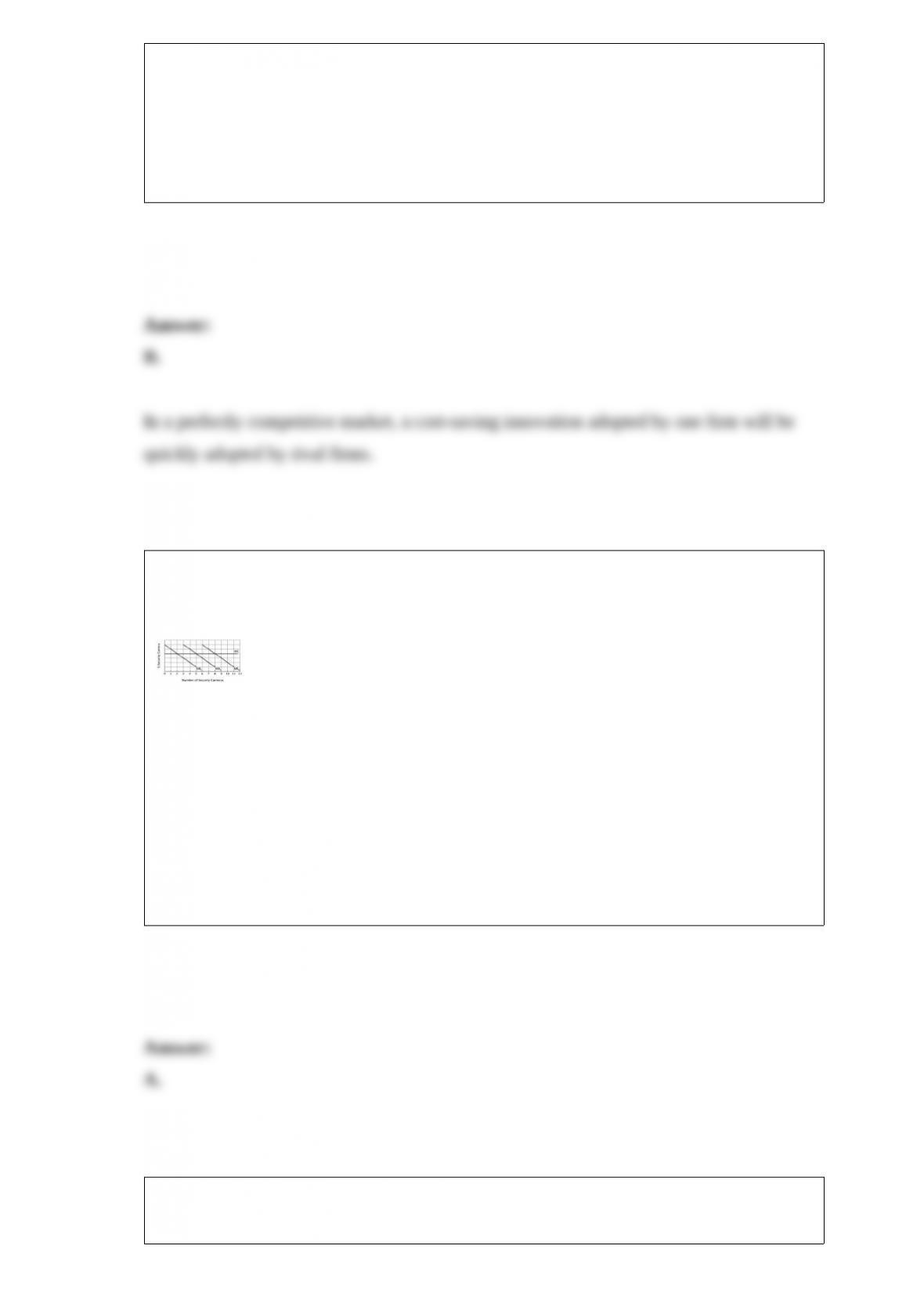
The figure below depicts the short-run market equilibrium in a perfectly competitive
market and the cost curves for a representative firm in that market. Assume that all
firms in this market have identical cost curves.
A starting assumption about this industry was that all of the firms in the market had
identical cost curves. This assumption is:
A. unrealistic because each firms is unique.
B. realistic because any cost-saving innovation adopted by one firm will be quickly
adopted by others.
C. unrealistic because firms closely guard the details of their production processes.
D. realistic because firms rarely seek out cost-saving innovations.
The figure below shows the marginal benefit of having a security camera at the library
(MBL), the supermarket (MBS), and the museum (MBM). The marginal cost of hiring a
security guard is the same at all three places and is given by MC.
If each location installs the socially optimal number of security cameras, then the
marginal benefit of the last security camera installed at each location will be:
A. the same at all three locations.
B. highest at the museum.
C. highest at the grocery store.
D. highest at the library.
Assume the price of gasoline doubles tonight and remains at that price for the next two
years. Compared with the long-run price elasticity of demand for gasoline, the short-run
price elasticity of demand for gasoline will be ______.
A. higher
B. more variable
C. the same
D. lower
The time between when Federal Reserve policymakers decide to close an output gap
and when they act to change the fed funds rate is an example of:
A. the outside lag of macroeconomic policy.
B. a structural policy change.
C. anchoring inflationary expectations.
D. the inside lag of macroeconomic policy.
Suppose Cathy and Lewis work in a bakery making pies and cakes. Suppose it takes

Cathy 1.5 hours to make a pie and 1 hour to make a cake, and suppose it takes Lewis 2
hours to make a pie and 1.5 hours to make a cake. Which of the following statements is
correct?
A. Cathy has a comparative advantage in pies, and Lewis has an absolute advantage in
pies.
B. Cathy has a comparative and absolute advantage in pies.
C. Lewis has a comparative and absolute advantage in pies.
D. Lewis has a comparative advantage in pies, and Cathy has an absolute advantage in
pies.
Refer to the figure below. What is the Nash equilibrium of this game?
A. A chooses Up, B chooses Right
B. A chooses Up, B chooses Left
C. A chooses Down, B chooses Right
D. A chooses Down, B chooses Left
Inflation ______ the signals sent by price changes to demanders and suppliers of goods
and services.
A. amplifies
B. obscures
C. enhances
D. has no impact on
Comparisons of economic activity over time should be made using:
A. nominal GDP adjusted for unemployment.
B. nominal GDP per capita.
C. current-dollar GDP.
D. real GDP.
Ingrid has been waiting for the show “Mamma Mia!” to come to town. When it finally
does come, tickets cost $60. Ingrid’s reservation price is $75. But when Ingrid tries to
buy a ticket, they are sold out. Suppose Steven was able to purchase a ticket at the box
office for $60. Steven’s reservation price for the ticket is $65. If Steven attends
“Mamma Mia!” and Ingrid does not, then this situation is:
A. inefficient because Steven and Ingrid could have made a mutually beneficial trade.
B. efficient because Steven paid less for the ticket than his reservation price.
C. efficient because Steven arrived at the ticket counter before the show was sold out.
D. inefficient because Ingrid would have enjoyed the show too.
Prior to World War II most consumers in the United States:
A. owned medical insurance for catastrophic illness but paid for routine medical care
out of their own pockets.
B. paid for catastrophic illness out of their own pockets but owned medical insurance
for routine medical care.
C. had no medical insurance of any type.
D. owned medical insurance covering both catastrophic illness and routine medical
care.
Janie must choose to either mow the lawn or wash clothes. If she mows the lawn, she
will earn $30, and if she washes clothes, she will earn $45. She dislikes both tasks
equally and they both take the same amount of time. Janie will therefore choose to
______ because it generates a ______ economic surplus.
A. mow the lawn; bigger
B. wash clothes; bigger
C. mow the law; smaller
D. wash clothes; smaller
Based on the information in the table, what quantity of reserves would the Federal
Reserve have had to inject into the economy in 1932 to prevent the money supply from
falling, given that the public increased the amount of currency it held and that banks
increased the reserve-deposit ratio?
A. $0.30 billion
B. $0.66 billion
C. $0.89 billion
D. $3.54 billion
If short-run equilibrium output equals 20,000 and potential output (Y*) equals 25,000,
then this economy has a(n) ______ gap that can be closed by _________.
A. recessionary; increasing taxes
B. expansionary; increasing transfer payments
C. expansionary; increasing government purchases
D. recessionary; increasing government purchases
Suppose Erie Textiles can dispose of its waste “for free” by dumping it into a nearby
river. While the firm benefits from dumping waste into the river, the waste reduces fish
and bird reproduction. This causes damage to local fishermen and bird watchers. At a
cost, Erie Textiles can filter out the toxins, in which case local fishermen and bird
watchers will not suffer any damage. The relevant gains and losses (in thousands of
dollars) for the three parties are listed below.
Suppose you observe that Erie has not added a filter. You could conclude that the Coase
Theorem failed to solve the externality problem because:
A. Erie’s benefits to operating without a filter are greater than the benefits of a filter to
the fishermen and bird watchers.
B. negotiation with many individual fishermen and bird watchers was too costly.
C. Erie has a property right to the river.
D. regulators prevent application of the Coase Theorem when the environment is at
stake.

Which of the following is a nominal quantity?
A. The number of people unemployed
B. The current price of a barrel of oil
C. The number of cars produced in 2005
D. The amount of coal mined in one month
The economy of Alpha operates according to Okun’s law. In Alpha, potential GDP
equals $500 billion, actual GDP equals $520 billion, and the natural rate of
unemployment is 5 percent. What is the actual rate of unemployment in Alpha?
A. 1 percent
B. 3 percent
C. 4 percent
D. 7 percent
If the demand curve for open-heart surgery is vertical for people with serious heart
conditions, then the demand for open-heart surgery is ______ with respect to price.
A. unit elastic
B. inelastic
C. perfectly elastic
D. perfectly inelastic
The AD curve can be shifted by:
A. both fiscal and monetary policy.
B. neither fiscal nor monetary policy.
C. fiscal policy only.
D. monetary policy only.
Long-term increases in productivity that have increased the demand for labor, and
raised real wages, have resulted primarily from ______ and _____.
A. technological progress; a modernized capital stock
B. technological progress; an increased labor supply
C. a modernized capital stock; skill-biased technological change
D. a modernized capital stock; an increased labor supply
Refer to the figure below. The law of diminishing marginal returns becomes evident
after ______ units of output are produced.
A. 33
B. 66
C. 99
D. 132
The opportunity cost of money is:
A. the time spent going to the bank to withdraw funds.
B. the fees charged by banks to provide checking services.

C. the nominal interest rate.
D. the price level.
Refer to the figure below. What is the equilibrium quantity of bananas in this market?
A. 0 pounds/day
B. 3 pounds/day
C. 4 pounds/day
D. 5 pounds/day
Suppose Acme and Mega produce and sell identical products and face zero marginal
and average cost. Below is the market demand curve for their product.
For a monopolist facing this demand curve, the profit-maximizing quantity is ______
and the profit-maximizing price is ______.
A. 50; $2
B. 100; $2
C. 50; $3
D. 100; $1
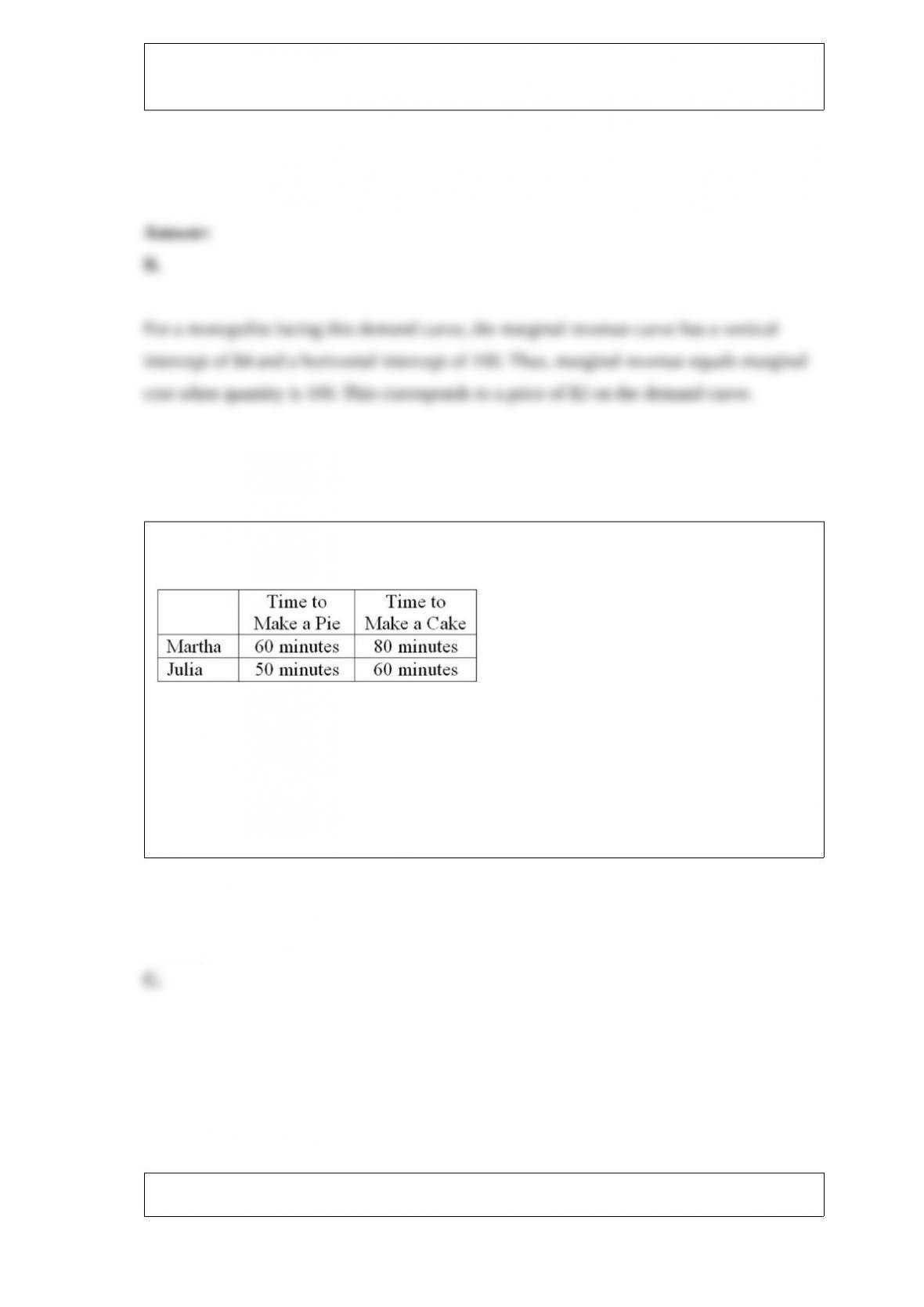
Refer to the table above. ______ has the comparative advantage in making pies and
______ the comparative advantage in making cakes.
A. Martha; Martha
B. Julia; Julia
C. Martha; Julia
D. Julia; Martha
The following graph depicts demand.
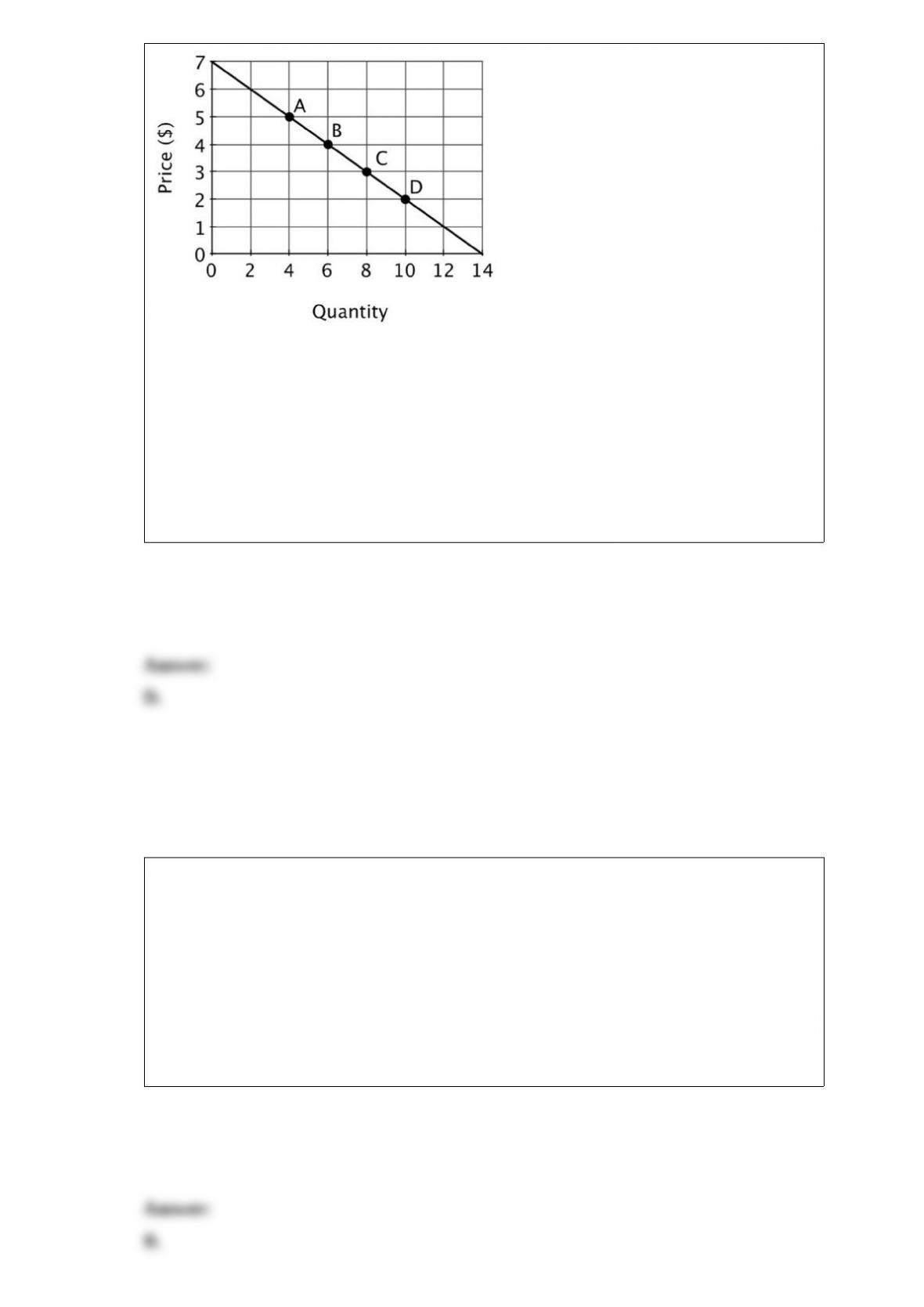
The slope of the demand curve (ignoring the negative sign) is:
A. 2.
B. 1.5.
C. 1.
D. 0.5.
To increase future living standards by pursuing higher current rates of investment
spending, an economy must:
A. allow higher rates of current consumption.
B. reduce current rates of consumption spending.
C. reduce the current capital stock.
D. decrease the amount of future research and development spending.