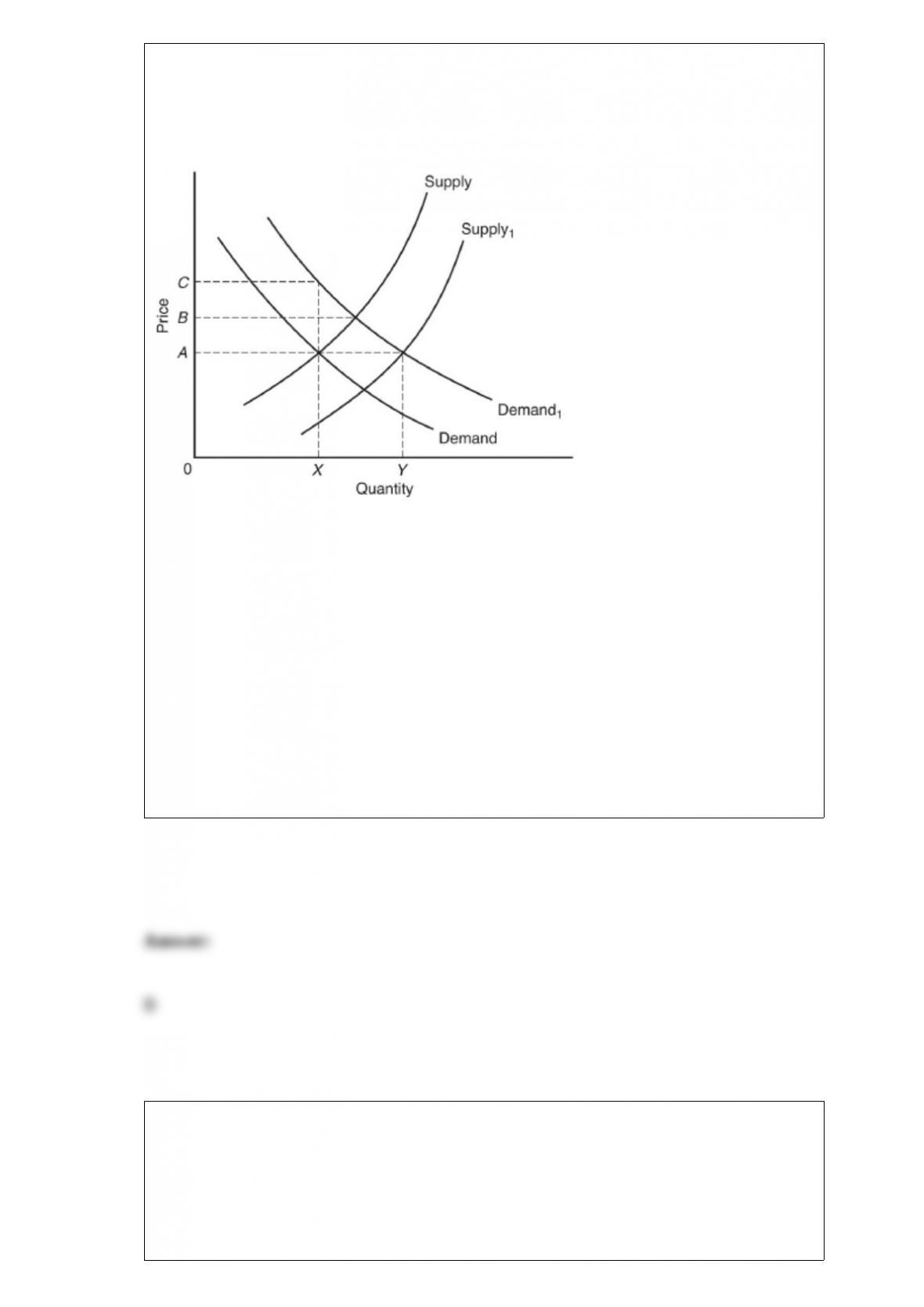
The following questions are based on the following graph, showing short-run supply
and demand curves for a perfectly competitive market. The initial supply curve is
labeled “Supply” and the initial demand curve is labeled “Demand.” Price 0A and
output rate 0X represent the initial equilibrium price and output.
If demand for the product increases to Demand1, the market achieves its short-run
equilibrium position where the
a. market price is 0A.
b. market price is 0B.
c. market price is 0C.
d. industry output rate is 0X.
e. industry output rate is 0Y.
Which of the following must decline for demand-side inflation to slow?
a. productivity
b. spending
c. taxes
d. population
e. unemployment
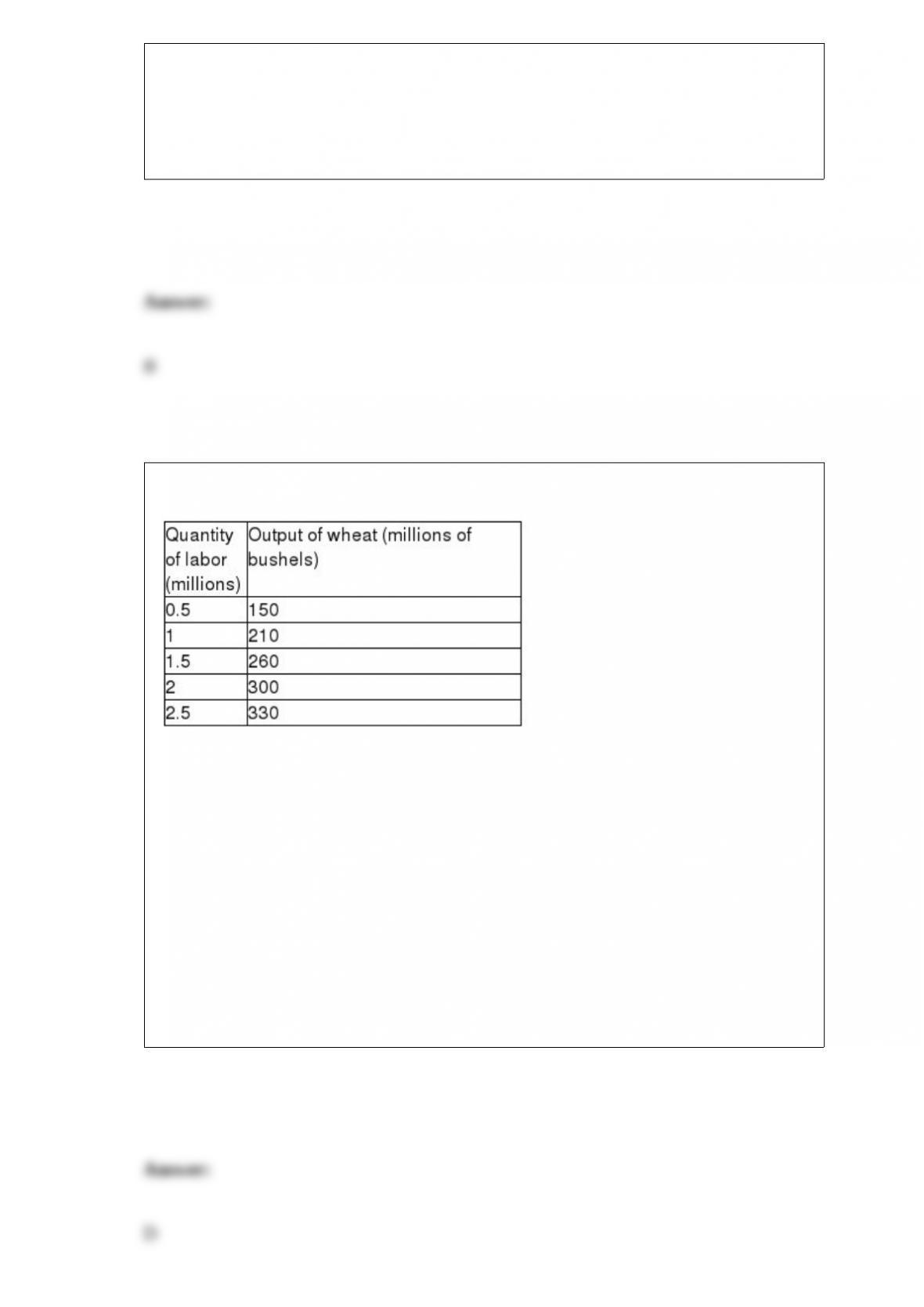
The next question is based on the following table:
According to Malthus, if subsistence is 150 bushels of wheat per worker, the
equilibrium labor force would be ________ million.
a. 0.5
b. 1.0
c. 1.5
d. 2.0
e. 2.5

In addition to preferences, a consumer’s choice is further constrained by
a. nothing.
b. a rising marginal utility curve.
c. income and commodity prices.
d. an equilibrium market where utility is minimized.
e. the fact that the optimal market basket is rarely the equilibrium market basket.
A leftward shift in the demand curve for a commodity may
a. mean consumers are willing to buy more of the good at each price than previously.
b. decrease the equilibrium price of the commodity.
c. mean that supply decreased.
d. mean that the price of a complement has fallen.
e. follow from a rise in the price of the product.
The quantity of domestic goods that a country must give up to get a unit of imported
goods is called
a. absolute advantage.
b. comparative advantage.
c. export subsidies.
d. terms of trade.
e. a quota.
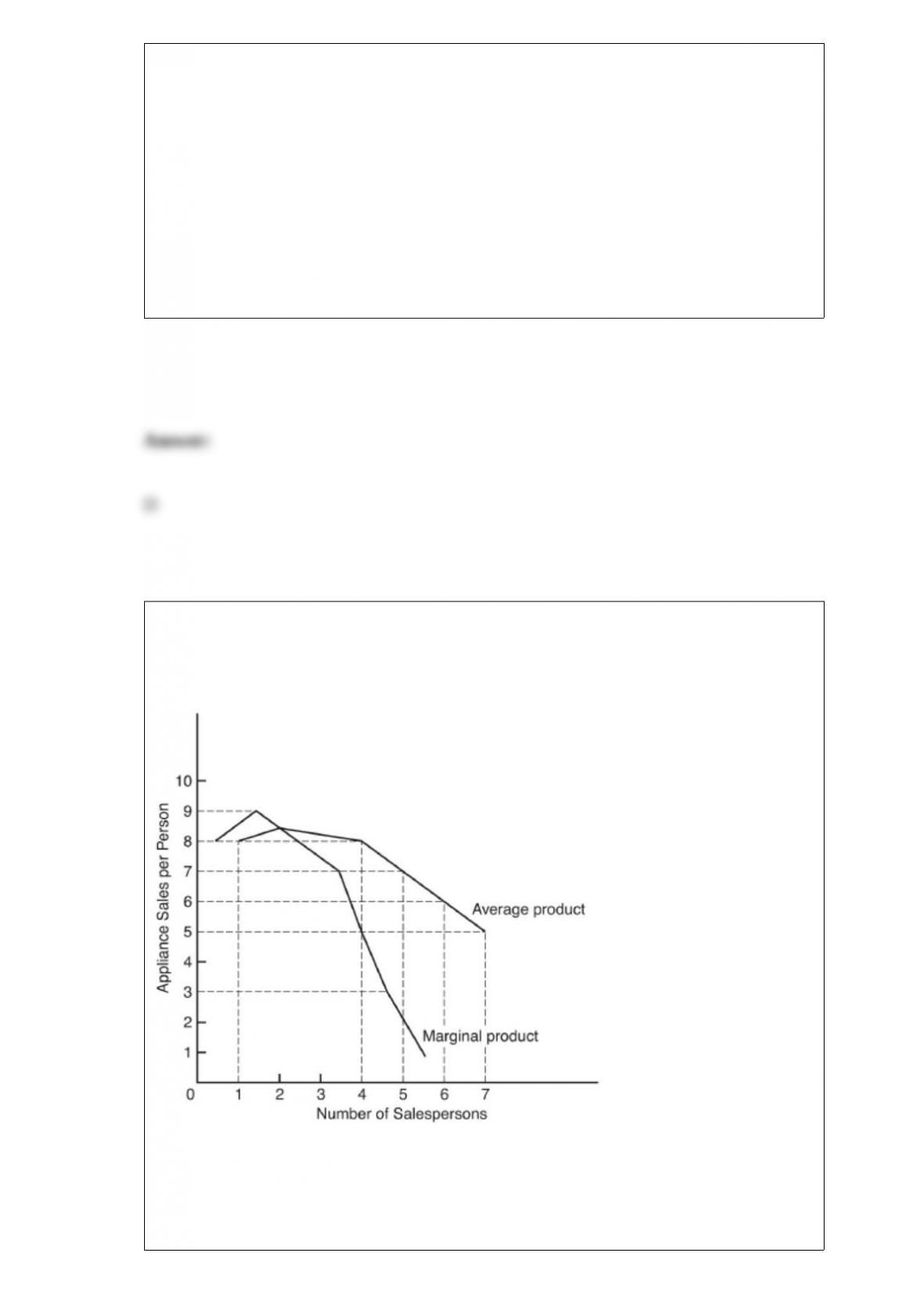
The following questions are based on the following diagram illustrating the weekly
average and marginal products for salespersons in the appliance department of a large
department store:
The additional number of appliances sold by adding the fifth person is
a. 1.

b. 3.
c. 7.
d. 8.
e. 15.
A firm that realizes minimum average costs at an output rate sufficient to satisfy the
entire market is an example of
a. monopolistic competition.
b. natural monopoly.
c. nonprice competition.
d. the crowding-out effect.
e. supply-side economics.
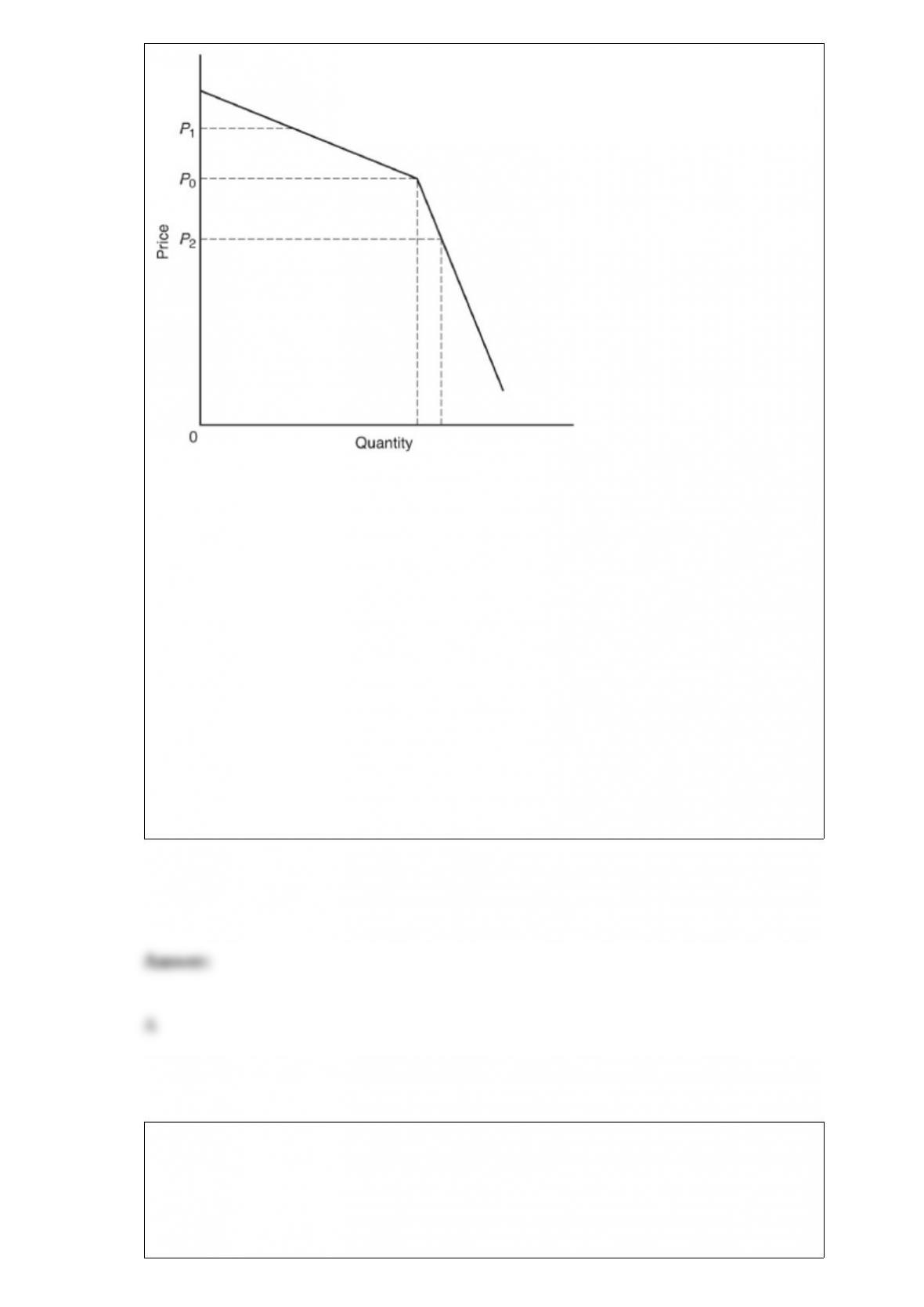
This diagram is used to illustrate
a. why an oligopoly firm is unwilling to raise its price above P0 to P1 or lower it from
P0 to P2.
b. the “phases of the moon” pricing process used by the electrical industry.
c. the difference between dominant firm price leadership raising the price from P0 to P1
and barometric firm price leadership reducing the price from P0 to P2.
d. long-run equilibrium in a perfectly competitive market.
e. the process by which a cartel sets prices and divides up the market among its
members.
According to the Stabilization Policy video, one problem with discretionary fiscal
stimulus is that
a. as you expand the economy, spending on foreign goods increases, thus reducing its
impact on domestic output and employment.

b. consumers and businesses do not expect the policies to work, so they are unprepared
to take advantage of the opportunities created.
c. it works only when monetary authorities reduce the money supply to counter
inflation.
d. the employment created is primarily in government agencies and not in the private
sector.
e. it leads to stabilization in the long run while allowing existing economic hardship to
persist indefinitely.
The notion that discretionary fiscal and monetary policies are subject to strong
incentives to change them in an attempt to achieve short-term gains is called
a. the separation of powers.
b. policy transitivity.
c. systematic inefficiency.
d. rational expectancy.
e. time inconsistency.
A major advantage of a sales tax is that it

a. tends to place a relatively greater burden on high-income individuals who have more
money to spend.
b. cannot be shifted.
c. provides a high yield with relatively low collection costs.
d. has little or no effect on the final prices consumers pay.
e. does not affect the overall level of retail sales.
For a monopolist the Golden Rule of Output Determination is to set the output rate at
the point where marginal revenue equals
a. price.
b. marginal cost.
c. profits.
d. output.
e. zero.
The following questions are based on the following diagram of a monopolist:
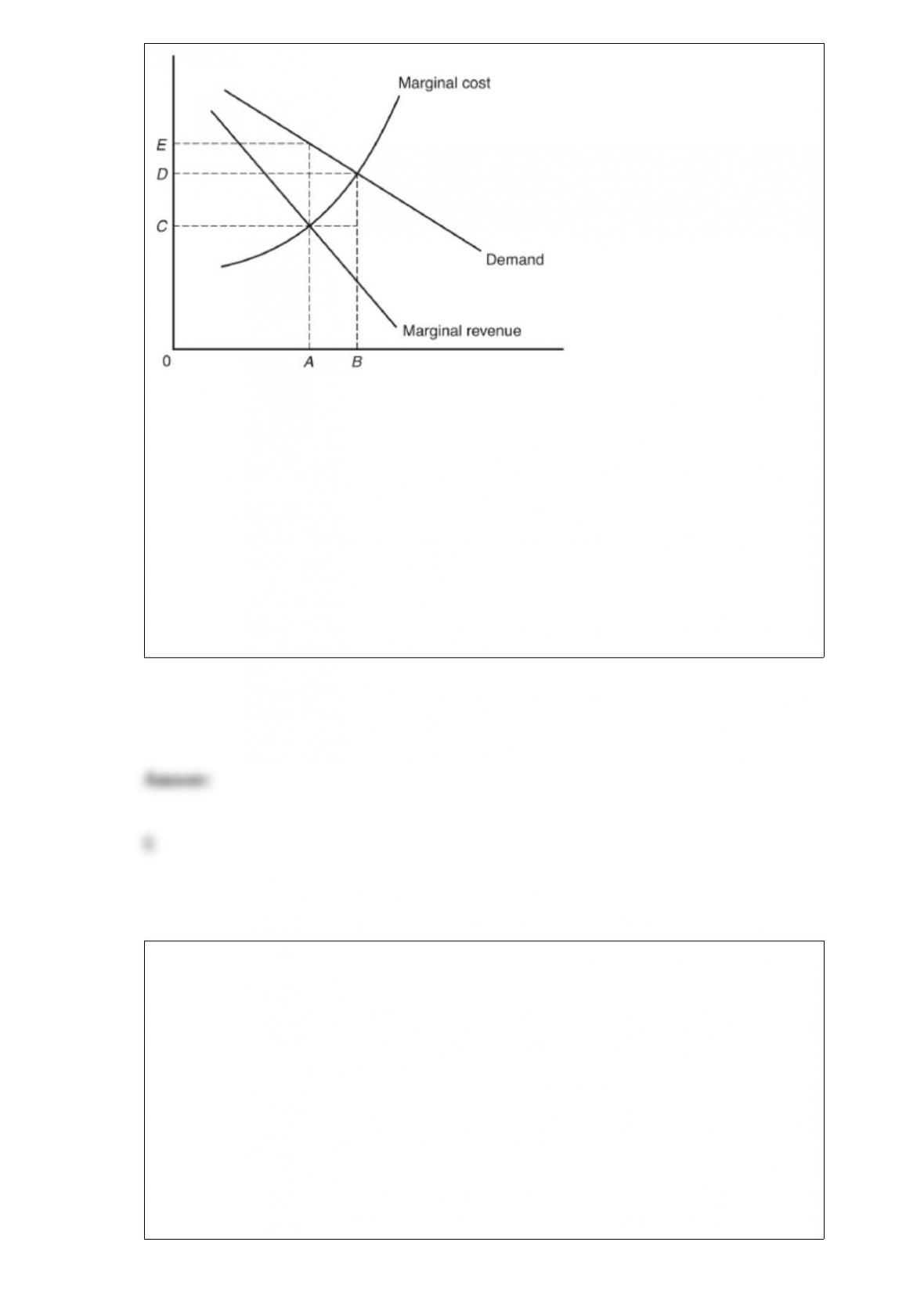
To maximize profits, the firm will charge a price of
a. 0A.
b. 0B.
c. 0C.
d. 0D.
e. 0E.
If a society attempts to increase output by increasing the amount of labor used, holding
land and capital fixed, it will experience diminishing marginal
a. cost.
b. utility.
c. propensity.
d. employment.
e. returns.

Significant government involvement in stimulating economic growth became more
common
a. before the Civil War.
b. between the Civil War and World War I.
c. during the 1920s.
d. during the 1930s.
e. after World War II.
If the marginal propensity to consume is 0.6, a $1.2 billion increase in intended
investment will increase equilibrium GDP by ________ billion.
a. $0.4
b. $0.6
c. $1.2
d. $2.5
e. $3

A leftward shift in the short-run aggregate supply curve causes
a. price levels to fall.
b. real output to rise.
c. demand-pull inflation.
d. simultaneous inflation and a decrease in total real output.
e. unemployment to fall.
If the Federal Reserve pursues a policy of easy money, the supply of loanable funds will
a. shift to the right, causing the interest rate to fall.
b. shift to the right, causing the interest rate to rise.
c. be unaffected, but the demand for loanable funds will shift to the right.
d. shift to the left, causing the interest rate to rise.
e. shift to the left, causing the interest rate to fall.

Bank investments in short-term government securities that can readily be turned into
cash are often referred to as ________ reserves.
a. federal
b. fractional
c. legal
d. open
e. secondary
One person’s (or firm’s) use of a resource that damages other people who cannot obtain
proper compensation is called a(n)
a. private cost.
b. positive externality.
c. external diseconomy.
d. effluent fee.
e. compensated social cost.
The short-run relationship between the rate of change in the wage level and the level of

unemployment is generally
a. positive.
b. inverse.
c. nonexistent.
d. reflexive.
e. inert.
Gross domestic product (GDP)
a. equals the total wages paid in a year.
b. is a measure of government output.
c. equals the total value of final goods and services produced in a year.
d. is the sum of all goods, both final and intermediate.
e. is an obsolete economic indicator of inflation.
Increases in demand are caused by
a. decreases in price.

b. increases in costs of production.
c. decreases in the prices of substitute goods.
d. increases in income.
e. decreases in the number of consumers in the market.
Average fixed cost equals
a. total cost divided by output.
b. total cost minus total variable cost.
c. average total cost plus average variable cost.
d. total fixed cost minus total variable cost.
e. total fixed cost divided by output.
The Kennedy-Johnson guidelines broke down in the late 1960s because of
a. strong demand-side inflation.
b. the symptoms of deflation.

c. increases in aggregate supply.
d. price decreases by big firms.
e. labor union wage restraints.
The ________ Act was designed to prevent undesirable and unfair competitive practices
and was later used to outlaw deceptive advertising.
a. Sherman
b. Federal Trade Commission
c. Clayton
d. Webb-Pomerene
e. Celler-Kefauver
Philosophically, the monetarists are most closely aligned with the views of
a. Karl Marx.
b. Keynes.
c. classical economists.

d. the Federal Reserve System.
e. Walter Heller.
The concept of value added
a. is not applicable to intermediate goods.
b. represents a firm’s or industry’s contribution to production.
c. is the same as a firm’s profits.
d. refers to the nonmarketed goods and services not included in GDP.
e. helps distinguish between current dollar GDP and real GDP.
The following questions are based on the following diagram:
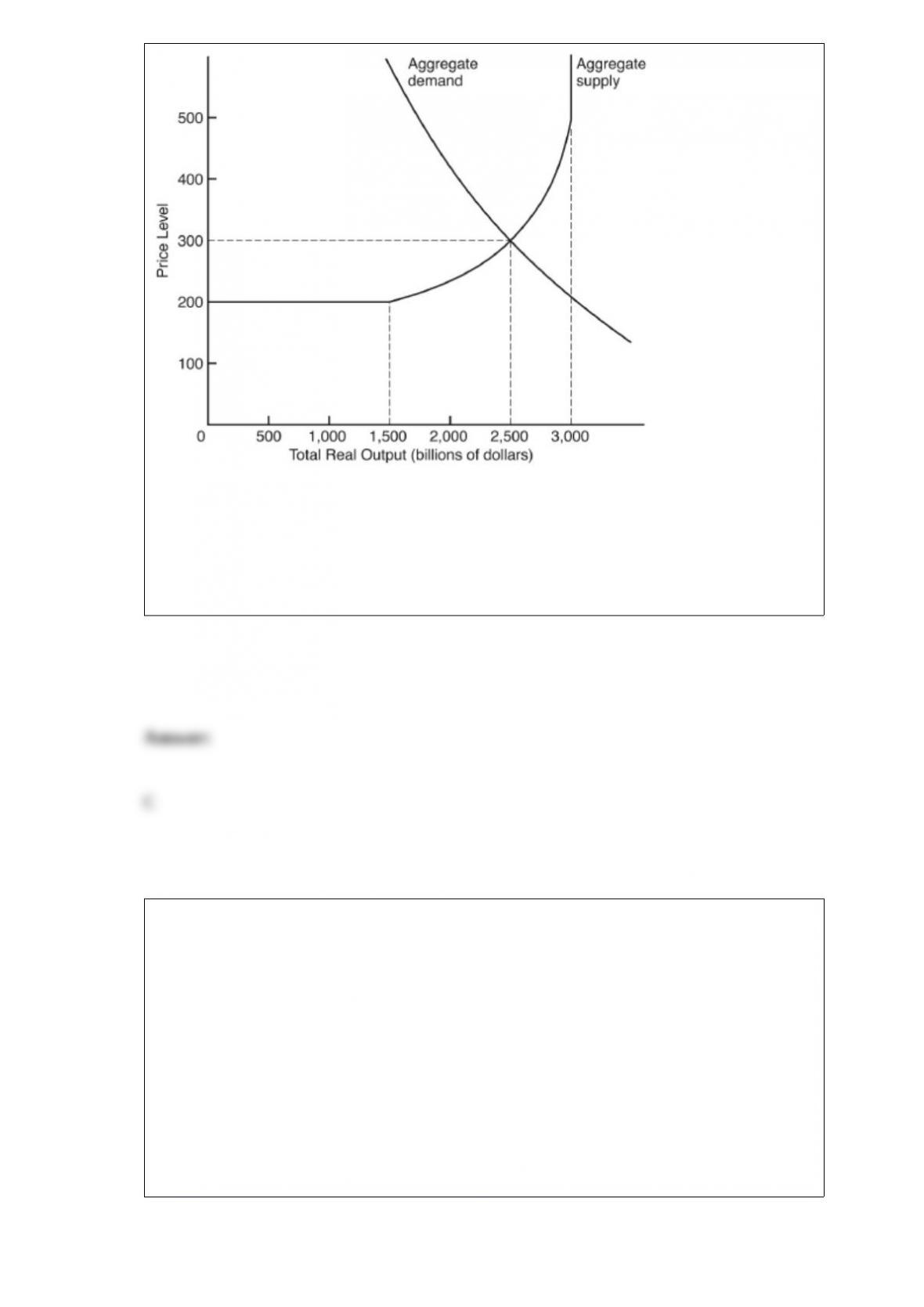
If aggregate demand shifts to the right
a. unemployment increases.
b. price levels fall.
c. real output rises.
d. both the demand for money and interest rates fall.
e. consumers or investors must have decided to decrease their spending.
Under diminishing marginal returns, as the amount of a variable input is reduced, the
marginal product of a dollar’s worth of the input will
a. exceed total product.
b. exceed average cost.
c. rise.
d. fall.
e. remain the same, but total input cost will rise.

The largest national union in the United States is the
a. Teamsters.
b. National Education Association.
c. United Auto Workers.
d. AFL-CIO.
e. American Association of Federal, County, and Municipal Employees.