
One of the elegant beauties of international equity markets is that over the last 100 or so
years, the average market risk premium is almost identical across major industrial
countries.
A country with a managed float that wishes to WEAKEN its currency may choose to
raise domestic interest rates to attract additional capital from abroad.
Since the global financial crisis of 2008-2009, the Chinese renminbi (yuan) has become
the most widely traded currency with the U.S. dollar surpassing the euro, yen, and
pound as dollar trading pairs.
Comparative advantage shifts over time as less developed countries become more
developed and realize their latent opportunities.

The authors describe a process for development of a MNE that begins with a purely
domestic phase, followed by the multinational phase, and topping out with the
international trade phase.
International debt security purchases and sales are defined as portfolio investments for
financial account purposes because by definition debt securities do not provide the
buyer with ownership or control.
It is important that firms adopt a common standard for the capital budgeting process for
choosing among foreign and domestic projects.
When dealing with international capital budgeting projects, the value of the project is
NOT sensitive to the firm’s cost of capital.

If the addition of a foreign security to the portfolio of the investor decreases the
expected return for a given level of risk, then the security adds value to the portfolio.
Multinational firms should invest only if they can earn a risk-adjusted return greater
than locally based competitors can earn on the same project.
The smaller and less liquid markets and currency markets frequently demonstrate
behaviors that follow the principles outlined by the different schools of thought on
exchange rate determination (parity conditions, balance of payments approach, and
asset approach) relatively well in the medium to long term.
It is possible to use different exchange rates for different line items on a financial
statement.

Tax treaties typically result in reduced withholding tax rates between the two signatory
countries.
Swap agreements are treated as off-balance sheet transactions via U.S. accounting
methods.
The transition to floating exchange rate regimes in the 1970s (described in Chapter 3)
changed the focus from the total BOP to its various subaccount like the current and
financial account balances.
If an American-style option possesses time value on any day up to expiration date, the
option holder would get more by selling it than exercising it.
Under U.S. accounting and translation practices, use of the current rate method is

termed “translation” while use of the temporal method is termed “remeasurement.”
A significant advantage of borrowing foreign currency-denominated bonds is that the
borrower need not worry about relative changes in the value of the home currency.
Dealers in foreign exchange departments at large international banks act as market
makers and maintain inventories of the securities in which they specialize.
Typically, a “greenfield” investment abroad is considered an investment having a
greater foreign presence than a joint venture with a foreign firm.
Regarding comparative corporate governance regimes: Bank-based regimes
characterized by government influence in bank lending and a lack of transparency is
often found in countries such as Korea and Germany.

Tax haven subsidiaries of MNEs are categorically referred to as international offshore
financial centers.
One of the benefits of investing in Global Registered Shares (GRS) is that GRS allow to
invest in foreign companies without foreign exchange risk.
The objective of currency hedging is to eliminate the change in the value of the exposed
asset or cash flow from a change in exchange rates.
Between 2006 – 2012, global corporate tax rates have trended upward.

ADRs cannot be exchanged for the underlying shares of the foreign stock, therefore,
arbitrage cannot keep the prices in line with the foreign price of the stock.
Real option analysis is a particularly powerful device when addressing potential
investment projects with extremely long life spans or investments that do not
commence until future dates.
Because the market for foreign exchange is worldwide, the volume of foreign exchange
currency transactions is level throughout the 24-hour day.
Interest rate calculations differ by the number of days used in the period’s calculation
and in the definition of how many days there are in a year (for financial purposes). One
of the practices is to use 260 business days in a year.

It is safe to say that most determinants of the spot exchange rate are also affected by
changes in the spot rate. i.e., they are linked AND mutually determined.
Real option analysis treats cash flows in terms of future value in a positive sense,
whereas DCF treats future cash flows negatively.
As a general rule, the decision about where to invest abroad for the first time is the
same as the decision about where to reinvest abroad.
Because countries have different financial regulations and customs, it is common for
MNEs to apply their domestic rules and regulations when doing financial business in a
foreign country.

Changes in the BOP may predict the imposition or removal of foreign exchange
controls.
Today, international trade is dominated by transactions between unaffiliated parties
(known or unknown).
The ideal tax should not only raise revenue efficiently but also have as few negative
effects on economic behavior as possible.
Managers CAN outguess the market. If and when markets are in equilibrium with
respect to parity conditions, the expected net present value of hedging should be
POSITIVE.
Jasper Pernik is a currency speculator who enjoys “betting” on changes in the foreign

currency exchange market. Currently the spot price for the Japanese yen is ¥129.87/$
and the 6-month forward rate is ¥128.53/$. Jasper would earn a higher rate of return by
buying yen and selling a forward contract than if he had invested her money in 6-month
US Treasury securities at an annual rate of 2.50%.
An advantage of trading with an affiliated party for an MNE, compared to an
unaffiliated party, could be reduced contracting costs and less to even no need to protect
against nonpayment.
Management must be able to predict disequilibria in international markets to take
advantage of diversification strategies.
A put option on yen is written with a strike price of ¥105.00/$. Which spot price
maximizes your profit if you choose to exercise the option before maturity?
A) ¥100/$
B) ¥105/$
C) ¥110/$
D) ¥115/$

Financial derivatives are powerful tools that can be used by management for purposes
of:
A) speculation.
B) hedging.
C) human resource management.
D) A and B above
________ exposure measures the change in the present value of the firm resulting from
unexpected changes in exchange rates.
A) Operating
B) Transaction
C) Translation
D) Accounting
Examples of a business motivation for long-run exchange rate forecasts include all but
which of the following?
A) a major capital investment in a foreign country
B) the desire to hedge a 90-day security
C) a portfolio manager considering investing in foreign securities
D) All of the above are examples of a business motivation for long-run exchange rate
forecast.

Assuming no transaction costs (i.e., hedging is “free”), hedging currency exposures
should ________ the variability of expected cash flows to a firm and at the same time,
the expected value of the cash flows should ________.
A) increase; not change
B) decrease; not change
C) not change; increase
D) not change; not change
A letter of credit that is confirmed in the ________ country has the additional advantage
of eliminating the problem of ________.
A) exporter’s; portfolio risk
B) importer’s; blocked foreign exchange
C) exporter’s; blocked foreign exchange
D) none of the above
Which of the following is the typical order of sourcing capital abroad?
A) an international bond issue, then cross listing the outstanding issues on other
exchanges, then an international bond issue in the target market
B) an international bond issue in the target market, then cross listing the outstanding
issues on other exchanges, then an international bond issue
C) an international bond issue in less prestigious markets, then an international bond
issue in the target market, and ultimately a eurobond issue
D) cross listing the outstanding issues on other exchanges, then an international bond
issue, then an international bond issue in the target market
Which of the following is NOT a typical pitfall of cross-border acquisitions?
A) paying too much
B) excessive financing costs
C) melding corporate cultures
D) all of the above are pitfalls
If a financial manager with an interest liability on a future date were to sell Futures and
interest rates end up going up, the position outcome would be:
A) Futures price falls; short earns a profit.
B) Futures price rises; short earns a loss.
C) Future price falls; long earns a loss.
D) Futures price rises; long earns a profit.
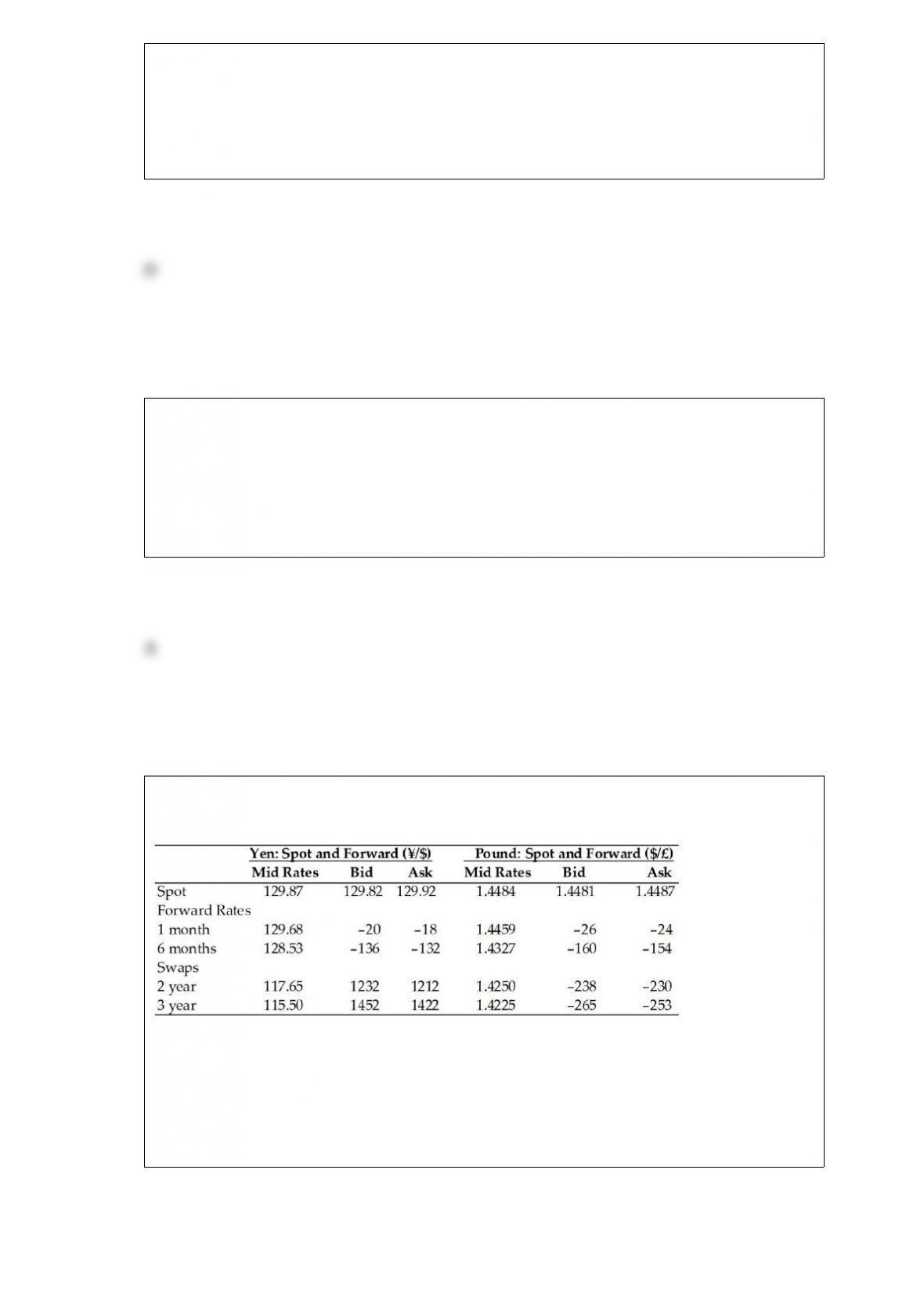
TABLE 5.1
Use the table to answer following question(s).
Refer to Table 5.1. The one-month forward bid price for dollars as denominated in
Japanese yen is:
A) –¥20.
B) –¥18.
C) ¥129.74/$.
D) ¥129.62/$.

Assume a nominal interest rate on one-year U.S. Treasury Bills of 2.60% and a real rate
of interest of 1.00%. Using the Fisher Effect Equation, what is the approximate
expected rate of inflation in the U.S. over the next year?
A) 2.10%
B) 2.05%
C) 1.60%
D) 1.00%
Jaguar has full manufacturing costs of their S-type sedan of £22,803. They sell the
S-type in the UK with a 20% margin for a price of £27,363. Today these cars are
available in the US for $55,000 which is the UK price multiplied by the current
exchange rate of $2.01/£. Jaguar has committed to keeping the US price at $55,000 for
the next six months. If the UK pound appreciates against the USD to an exchange rate
of $2.15/£, and Jaguar has not hedged against currency changes, what is the percentage
margin the company will realize given the new exchange rate?
A) 20.0%
B) 15.3%
C) 12.2%
D) 7.2%
Which of the following is NOT cited as a good reason for hedging currency exposures?
A) Reduced risk of future cash flows is a good planning tool.
B) Reduced risk of future cash flows reduces the probability that the firm may not meet
required cash flows.
C) Currency risk management increases the expected cash flows to the firm.
D) Management is in a better position to assess firm currency risk than individual

investors.
An option whose exercise price is equal to the spot rate is said to be:
A) in-the-money.
B) at-the-money.
C) out-of-the-money.
D) on-the-spot.
________ are transactions for which there are, at present, no contracts or agreements
between parties.
A) Backlog exposure
B) Quotation exposure
C) Anticipated exposure
D) none of the above
________ is the risk that a foreign government will place restrictions such as limiting
the amount of funds that can be remitted to the parent firm, or even expropriation of
cash flows earned in that country.
A) Exchange risk
B) Foreign risk
C) Political risk
D) Unnecessary risk

A ________ resembles a back-to-back loan except that it does not appear on a firm’s
balance sheet.
A) forward loan
B) currency hedge
C) counterparty
D) currency swap
A firm in the International Trade Phase of Globalization:
A) makes all foreign payments in foreign currency units and all foreign receipts in
domestic currency units.
B) receives all foreign receipts in foreign currency units and makes all foreign
payments in domestic currency units.
C) bears direct foreign exchange risk.
D) none of the above
Instruction 18.1:
Use the information to answer the following question(s).
The Velo Rapid Revolutions Inc., a company that produces bicycles, elliptical trainers,
scooters and other wheeled non-motorized recreational equipment is considering an
expansion of their product line to Europe. The expansion would require a purchase of
equipment with a price of euro 1,200,000 and additional installation of euro 300,000
(assume that the installation costs cannot be expensed, but rather, must be depreciated
over the life of the asset). Because this would be a new product, they will not be
replacing existing equipment. The new product line is expected to increase revenues by

euro 600,000 per year over current levels for the next 5 years, however; expenses will
also increase by euro 200,000 per year. (Note: Assume the after-tax operating cash
flows in years 1-5 are equal, and that the terminal value of the project in year 5 may
change total after-tax cash flows for that year.) The equipment is multipurpose and the
firm anticipates that they will sell it at the end of the five years for euro 500,000. The
firm’s required rate of return is 12% and they are in the 40% tax bracket. Depreciation is
straight-line to a value of euro 0 over the 5-year life of the equipment, and the initial
investment (at year 0) also requires an increase in NWC of euro 100,000 (to be
recovered at the sale of the equipment at the end of five years). The current spot rate is
$0.95/euro , and the expected inflation rate in the U.S. is 4% per year and 3% per year
in Europe.
Refer to Instruction 18.1. In euros, what is the NPV of the Velo Rapid Revolutions
expansion?
A) €1,524,690
B) $1,611,317
C) -€75,310
D) -€111,317
In September 2009 a U.S. investor chooses to invest $500,000 in German equity
securities at a then current spot rate of $1.30/euro. At the end of one year the spot rate is
$1.35/euro.
Refer to Instruction 13.1. At the end of the year the investor sells his stock that now has
an average price per share of €57. What is the investor’s average rate of return after
converting the stock back into dollars?
A) -1.35%
B) 5.0%
C) -5.0%
D) -7.24%
In its approximate form the Fisher effect may be written as ________. Where: i = the
nominal rate of interest, r = the real rate of return and π = the expected rate of inflation.
A) i = (r)(π)
B) i = r + π + (r)(π)

C) i = r + π
D) i = r + 2π
A British firm has a subsidiary in the U.S., and a U.S. firm, known to the British firm,
has a subsidiary in Britain. Define and then provide an example for each of the
following management techniques for reducing the firm’s operating cash flows. The
following are techniques to consider:
a) matching currency cash flows
b) risk-sharing agreements
c) back-to-back or parallel loans
________ is the restriction of access to foreign currency by government.
A) Indirect Intervention

B) Direct Intervention
C) Foreign Direct Investment
D) Capital Controls
Instruction 15.1:
Use the information to answer the following question(s).
Green Valley Exporters USA has $100,000 of before tax foreign income. The host
country has a corporate income tax rate of 25% and the U.S. has a corporate income tax
rate of 35%.
Refer to Instruction 15.1. If the U.S. has a bilateral trade agreement with the host
country that calls for the total tax paid to be equal to the maximum amount that could
be paid in the highest taxing country, what is the total amount of income taxes Green
Valley Exporters will pay to the host country, and how much will they pay in U.S
income taxes on the foreign earned income?
A) $25,000; $10,000
B) $25,000; $26,250
C) $35,000; $0
D) none of the above
Which of the following is NOT commonly associated with a government affiliated form
of corporate governance regime?
A) no minority influence
B) lack of transparency
C) state ownership of enterprise
D) All are associated with this type of corporate governance regime.

________ is a specialized technique to eliminate the risk of nonpayment by importers in
instances where the importing firm and/or its government is perceived by the exporter
to be too risky for open account credit.
A) Forfeiting
B) Marketable Bank Shares
C) Forfaiting
D) Banker’s Acceptances
Under the U.S. method of translation procedures, if the financial statements of the
foreign subsidiary of a U.S. company are maintained in the local currency, and the local
currency is the functional currency, then:
A) the translation method to be used is not obvious.
B) translation is accomplished through the temporal method.
C) translation is not required.
D) translation is accomplished through the current rate method.
A ________ occurs when two business firms in separate countries arrange to borrow
each other’s currency for a specified period of time.
A) natural hedge loan
B) forward loan
C) currency switch loan
D) back-to-back loan

Central Valley Transit Inc. (CVT) has just signed a contract to purchase light rail cars
from a manufacturer in Germany for euro 3,000,000. The purchase was made in June
with payment due six months later in December. Because this is a sizable contract for
the firm and because the contract is in euros rather than dollars, CVT is considering
several hedging alternatives to reduce the exchange rate risk arising from the sale. To
help the firm make a hedging decision you have gathered the following information.
∙ The spot exchange rate is $1.250/euro
∙ The six month forward rate is $1.22/euro
∙ CVT’s cost of capital is 11%
∙ The Euro zone 6-month borrowing rate is 9% (or 4.5% for 6 months)
∙ The Euro zone 6-month lending rate is 7% (or 3.5% for 6 months)
∙ The U.S. 6-month borrowing rate is 8% (or 4% for 6 months)
∙ The U.S. 6-month lending rate is 6% (or 3% for 6 months)
∙ December call options for euro 750,000; strike price $1.28, premium price is 1.5%
∙ CVT’s forecast for 6-month spot rates is $1.27/euro
∙ The budget rate, or the highest acceptable purchase price for this project, is $3,900,000
or $1.30/euro
Refer to Instruction 10.1. If CVT chooses to hedge its transaction exposure in the
forward market, it will ________ euro 3,000,000 forward at a rate of ________.
A) buy; $1.22
B) buy; $1.25
C) sell; $1.22
D) sell; €1.25
Which of the following is NOT a basic step in the capital budgeting process?
A) Identify the initial capital invested.
B) Estimate the cash flows to be derived from the project over time.
C) Identify the appropriate interest rate at which to discount future cash flows.
D) All of the above are steps in the capital budgeting process.
Daily trading volume in the foreign exchange market was about ________ per
________ in 2013.
A) $5,300 billion; month

B) $3,300 billion; month
C) $5,300 billion; day
D) $3,300 billion; day
Foreign stock markets are frequently characterized by controlling shareholders for the
individual publicly traded firms. Which of the following is NOT identified by the
authors as typical controlling shareholders?
A) the government (for example, privatized utilities)
B) institutions (such as banks in Germany)
C) family (such as in France)
D) All of the above were identified by the authors as controlling shareholders.
A balance sheet hedge requires that the amount of exposed foreign currency assets and
liabilities:
A) have a 2:1 ratio of assets to liabilities.
B) have a 2:1 ratio of liabilities to assets.
C) have a 2:1 ratio of liabilities to equity.
D) be equal.
Which one of the following management techniques is likely to best offset the risk of
long-run exposure to receivables denominated in a particular foreign currency?
A) Borrow money in the foreign currency in question.
B) Lend money in the foreign currency in question.

C) Increase sales to that country.
D) Increase sales in this country.
Most observers believe that for better or for worse, we have achieved a global market
for securities. Discuss the major changes in the international markets of securities:
during the 1980s, during the 1990s and the current conditions.
For a corporate borrower, it is especially important to distinguish between credit risk
and repricing risk. Explain both types of risks.

Diversification is possibly the best technique for reducing the problems associated with
international transactions. Provide one example each of international financial
diversification and international operational diversification and explain how the action
reduces risk.
The measurement of all international economic transactions that take place between the
residents of a country and foreign residents is called the balance of payments (BOP).
List and explain three reasons why host-country BOP data is important to managers and
investors.

Many MNEs have established rigid transaction exposure risk management policies
which mandate proportional hedging (a percentage of existing transaction exposures).
Explain the pros and cons of proportional hedging.
The Euro-medium-term-note (EMTN) has filled a substantial niche market in global
financing. What are the distinguishing characteristics of the EMTN and why is it such a
popular form of financing for MNEs?

How does counterparty risk influence a firm’s decision to trade exchange-traded
derivatives rather than over-the-counter derivatives?
What is meant by the term “governance risk”? What is the most important type of
governance risk?
List and describe three differences and advantages of Global Registered Shares (GRS)
over American Depositary Receipts (ADRs).

For what reason might an exporter use standard international trade documentation
(letter of credit, draft, order bill of lading) on an intrafirm export to its parent or sister
subsidiary?

The foreign exchange market provides the physical and institutional structure through
which three typical functions are accomplish. List and explain three functions of the
foreign exchange market.
Although there are many different cultural and legal approaches used in corporate
governance worldwide, there is a growing consensus on what constitutes good
corporate governance. List and explain at least three standardized common principles of
good corporate governance.

What are the most important distinctions that make state owned enterprises (SOEs)
different from other forms of government organizations?
Some forecasters believe that foreign exchange markets for the major floating
currencies are “efficient” and forward exchange rates are unbiased predictors of future
spot exchange rates. Explain the rationale of this statement including the assumptions
made, the meaning of “efficient” and “unbiased”, and the empirical evidence.

The authors highlight a strong theoretical argument in favor of analyzing any foreign
project from the viewpoint of the parent. Provide at least three reasons why the parent’s
viewpoint is superior to the local viewpoint and give an example of when the local
viewpoint fails to maximize the value of the firm.
Capital market segmentation is a financial market imperfection caused mainly by
government constraints, institutional practices, and investor perceptions. List and
explain three imperfections.
Define patient and impatient capitalism and discuss how each may lead to different
decision-making in the shareholder wealth maximization model.

The Fisher Effect is a familiar economic theory in the domestic market. In words,
define the Fisher Effect and explain why you think it is also appropriately applied to
international markets.
List and explain three benefits the euro would generate for the states participating in the
European Economic and Monetary Union.

Explain what a letter of credit (L/C) is, who the principle parties are, what the principle
advantage is, and how the L/C facilitates international trade.