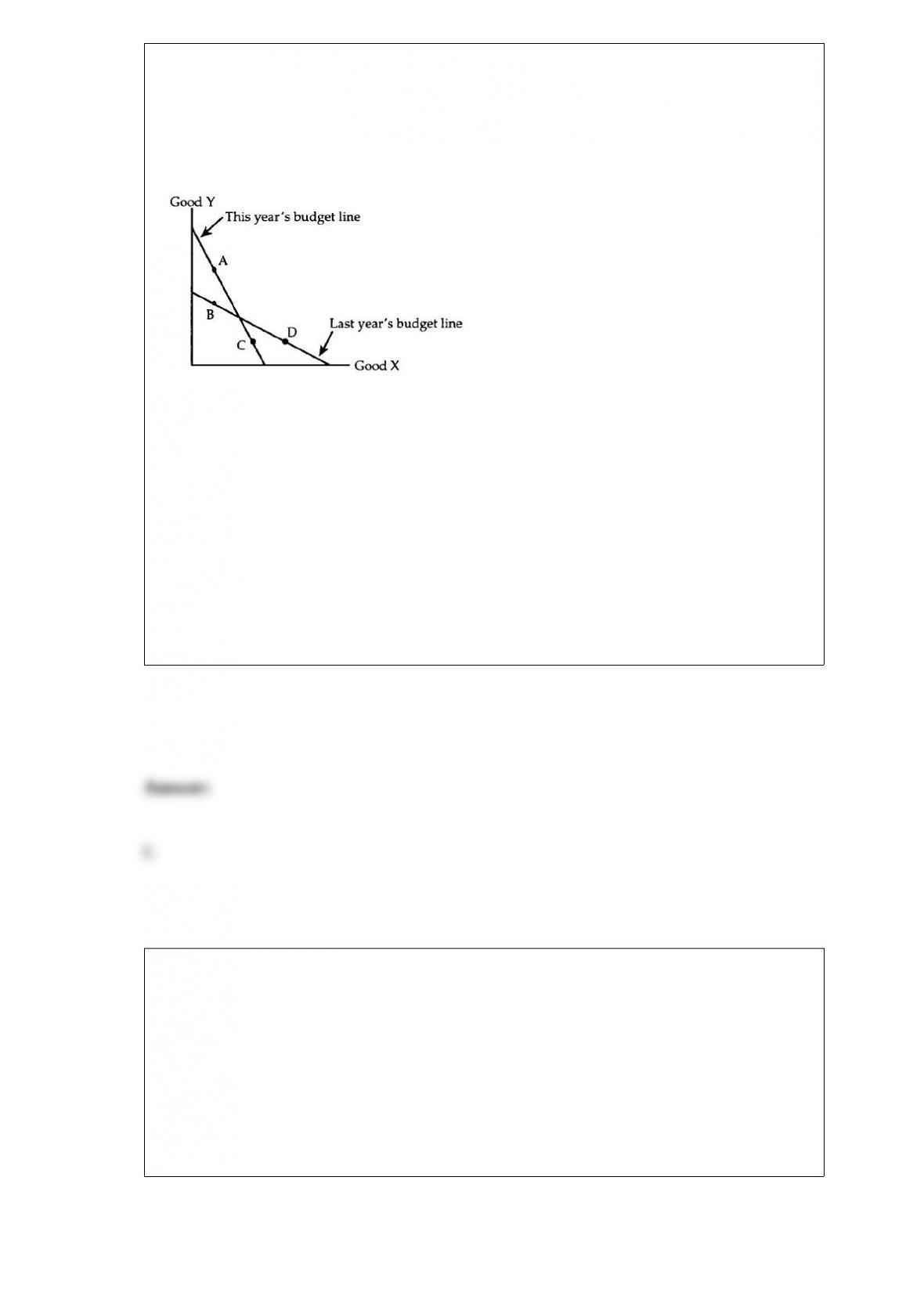
Budget Lines
The following questions refer to the following diagram, which shows the budget lines
faced by a consumer last year and this year.
The only situation where we can conclude that this consumer’s tastes must have
changed is when we observe him
a. buying B last year and buying A this year.
b. buying D last year and buying A this year.
c. buying B last year and buying C this year.
d. buying D last year and buying C this year.
An increase in nonlabor income leads to
a. a fall in the quantity of labor supplied and in consumption.
b. a fall in the quantity of labor supplied but an increase in consumption.
c. an increase in the productivity of labor.
d. a fall in the wage rate.

According to the Strong Coase Theorem, when will the assignment of property rights
have no effect on the allocation of resources?
a. Always.
b. When there are no transactions costs.
c. When there are no transactions costs and changes in the distribution of income do not
have significant effects on market demand curves.
d. When liability is assigned to the party with the least-cost method of dealing with an
externality problem.
Which of the following results in the greatest present value if the interest rate is 10%?
a. A perpetuity that pays $10 per year.
b. One hundred dollars tomorrow.
c. A payment of $111 at the end of this year.
d. One hundred dollars today.

Redding Railroad is held liable by the courts for damages to crops growing along its
lines caused by sparks flying off when trains pass. The court ordered damage
assessment is $100 per adjoining acre though profits per acre are less than this.
Currently, about half of the line has adjoining planted farmlands, the other half is not
yet developed. As a result
a. farmers are likely to reduce the number of acres they plant.
b. farmers are likely to increase the number of acres they plant in order to collect the
payment.
c. the railroad will increase the number of trains running.
d. farmers will accept payments from the railroad equal to lost profits not to plant.
Which of the following could cause an industry to be an increasing-cost industry?
a. The development of subindustries in response to industry growth.
b. The factor-price effect.
c. Identical break-even prices across firms.
d. Substantial economies of scale in production.

If two factors of production are substitutes in production, then a decrease in plant size
will make the total product curve
a. higher and steeper.
b. lower and steeper.
c. higher and more shallow.
d. lower and more shallow.
Which of the following would cause a fall in the price of video tape rentals?
a. A new nationwide video rental chain opens.
b. Movie theaters raise their prices.
c. The royalties paid to movie actors increase.
d. The price of video cassette recorders (VCRs) falls.
If asked to comment about a new tax on cotton collected from growers who do not
grow their plants in the shade of other plants, an economist with no particular expertise
in cotton growing might still note that
a. the price received by these cotton producers will fall by the full amount of the tax.

b. the price paid by consumers of this cotton will rise by the full amount of the tax.
c. the legal incidence of the tax does not determine who bears the burden of the tax.
d. the tax was imposed on the wrong party, it should have been placed on buyers.
Elite Astin-Martin Cars offers its customers a fancy showroom and a knowledgeable
sales force. If Astin-Martins Are Us opens an outlet nearby, offering cut rate prices and
little service, then Elite Astin-Martin Cars will likely find
a. more customers attracted to buying Astin-Martins and its sales will increase.
b. more customers visiting its showroom, but lower sales.
c. fewer customers visiting its showroom and lower sales.
d. fewer customers visiting its showroom but more of them making a purchase.
A movement up along a supply curve indicates:
a. a rise in supply.
b. an increase in the quantity supplied.
c. an increase in the sales tax on a good.
d. a reaction by suppliers to a decrease in demand.
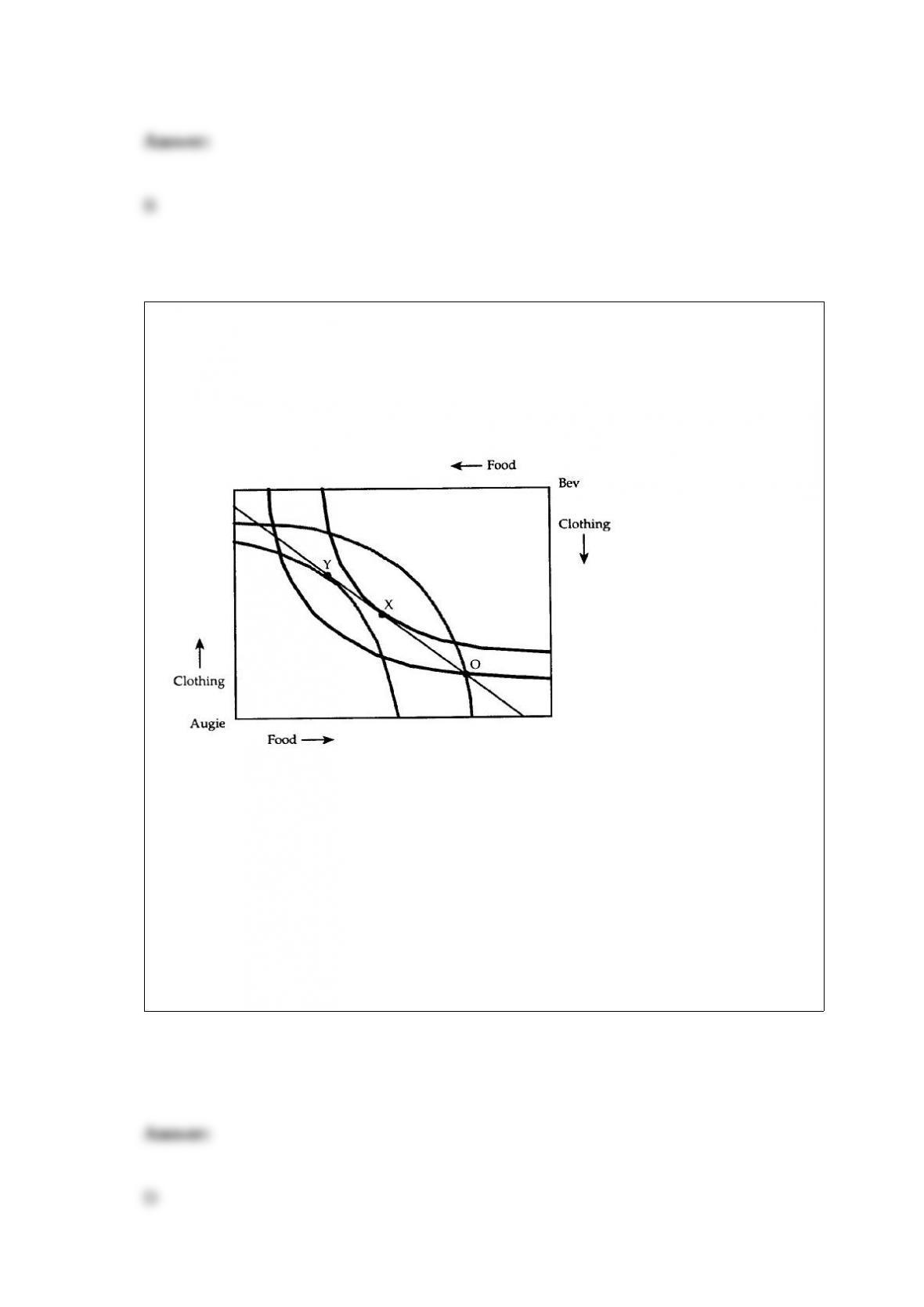
Edgeworth Box Economy
The accompanying diagram shows an Edgeworth box economy. The initial endowment
is point O. At current relative prices, Augie chooses point X and Bev chooses point Y.
In an Edgeworth box, a point where two indifference curves are tangent represents
a. the initial endowment point.
b. an allocation that both consumers prefer to the initial endowment.
c. a competitive equilibrium.
d. a Pareto-optimal allocation of goods.

Consider the indifference curve-budget line model of labor supply, and assume
consumption and leisure are both normal goods. A higher wage rate would result in
a. more consumption and less leisure.
b. a reduction in the worker’s marginal value of leisure.
c. reduced consumption if the income effect is larger than the substitution effect.
d. increased labor only if the substitution effect outweighs the income effect.
If both demand and supply rise, which of the following must be true?
a. The equilibrium quantity will rise.
b. The equilibrium quantity will fall.
c. The equilibrium quantity will not change.
d. The change in the equilibrium quantity is indeterminate.
One theory of unemployment argues that the unemployment rate will rise when
a. people have accurate expectations regarding the inflation rate.
b. unexpected inflation causes people to be “fooled” by high absolute wages.

c. people mistakenly believe their wages have greater purchasing power.
d. people overestimate the rate of inflation.
In the indifference curve-budget line model of labor supply, the vertical intercept of the
budget line represents
a. the worker’s nonlabor income.
b. the wage rate paid to the worker.
c. the number of leisure hours enjoyed by the worker.
d. the number of hours of labor that the worker supplies.
A firm is a monopoly if
a. it faces a demand curve for its product that equals market demand.
b. it is a very large firm.
c. it takes its rivals’ actions into account when choosing its price and output levels.
d. its production decisions do not affect the price of its product.

The option to buy a company’s stock at some future time at current prices is often given
to CEOs
a. as an incentive to take actions that will raise the share price.
b. because CEOs are often friends of those who hire them.
c. as a means of discouraging the CEO from taking any risky actions.
d. because this has become the custom of the business culture.
When a game has more than one Nash equilibrium
a. players will choose the strategies which maximize total welfare.
b. players are likely to choose the strategies which minimize total welfare.
c. it is difficult to predict which of the equilibria will occur or whether it is stable.
d. it is difficult to predict which of the equilibria will occur but once one is reached it is
likely to remain stable.

Which of the following is the best example of second-degree price discrimination?
a. A car salesperson’s attempts to discover and charge the highest price that the
customer is willing to pay.
b. A sub shop that gives you a half-price sandwich on every sixth visit.
c. Manufacturers’ use of discount coupons printed in Sunday newspapers.
d. Polaroid cameras and film.
If demand is downward sloping and there is tax on the good, Consumer surplus equals
a. The area between the demand curve and the price, up to the equilibrium quantity.
b. Total surplus minus producer surplus.
c. Total surplus minus producer surplus and government tax revenue.
d. Total surplus minus producer surplus, government tax revenue, and dead-weight loss.
The marginal rate of technical substitution of labor for capital (MRTSLK) measures
a. the amount of capital that can replace a unit of labor without affecting the firm’s

output.
b. the additional output attributable to a 1% increase in labor and capital usage.
c. the rate at which the firm can exchange labor for capital in the input markets.
d. the slope of the firm’s expansion path.
If an activity is worth pursuing at all, then it should be pursued up to the point where
a. total cost equals total benefit.
b. average cost equals average benefit.
c. marginal cost equals marginal benefit.
d. sunk costs equal zero.
The Pacific Pulp Company plans to clearcut 100 acres of land to produce paper pulp
which would earn the firm $50,000 in profits. One hundred nearby homeowners realize
that this would reduce the value of each of their properties by $1000. These 100
homeowners
a. face a logistical problem of getting together to offer a bribe to Pacific Pulp.
b. would not benefit from offering any side payment to Pacific Pulp not to clearcut.

c. have no legal option except to suffer the damages to their property values.
d. can costlessly organize to offer Pacific Pulp a side payment not to clearcut.
Suppose all firms in an industry are identical. In the long run, entry and exit guarantee
that all firms will have zero
a. marginal cost.
b. average cost.
c. economic profit.
d. accounting profit.
Suppose it is February, and a speculator believes that the demand for corn in March will
be higher than everyone else expects. In this situation, the speculator will
a. bid down the price of March futures contracts.
b. bid down the spot price of corn.
c. give suppliers an incentive to sell more corn in February.
d. buy March futures contracts.

The marginal cost curve crosses both the average cost and variable cost curves at the
minima.
As the price of good X increases, the budget line
a. makes a parallel shift outward.
b. makes a parallel shift inward.
c. pivots inward.
d. pivots outward.
Which of the following situations will shift a worker’s labor supply curve to the left?
a. Higher nonlabor income.
b. A lower wage rate, assuming the substitution effect dominates the income effect.

c. New machinery that substitutes for labor and lowers its marginal product.
d. A decrease in the marginal value of leisure.
The set of all baskets of inputs that can be employed at a given cost defines a(n)
a. isoquant curve.
b. isocost curve.
c. expansion path.
d. production function exhibiting constant returns to scale.
All other things being equal, wages will be higher when
a. employers provide less capital for their workers to use.
b. workers choose not to obtain signals like education.
c. workers possess less human capital.
d. the job has unpleasant or risky aspects.
As the amount of labor used in production increases, total product
a. increases at low levels of labor and decreases at high levels labor.
b. increases at high levels of labor and decreases at low levels of labor.
c. always increases.
d. always decreases.
A firm can sell as many units of its output as it wants for $10 a piece. The current
market wage rate for its workers is $20 per hour. It follows that the firm will hire
workers up to the point where the last worker hired produces how much per hour?
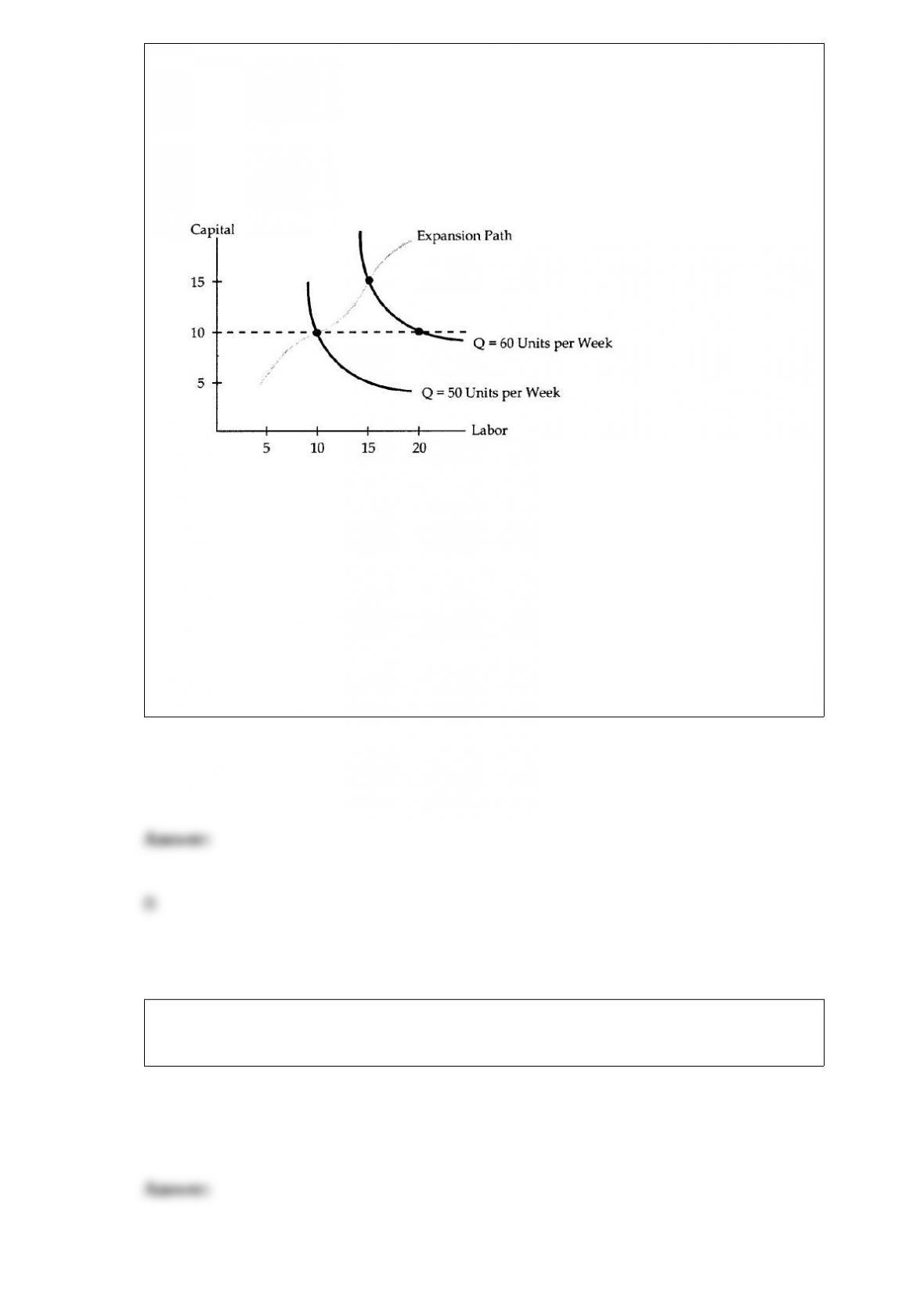
Cost of Production
The following questions refer to the diagram below. The wage rate is assumed to be $12
per hour, the rental rate is assumed to be $6 per hour, and capital is assumed to be fixed
in the short run at 10 hours.
The long-run total cost of producing 60 units of output per week is
a. $180.
b. $270.
c. $300.
d. $900.
The tragedy of the commons is a situation where too much of an input is used by
individuals, collectively making each individual worse off.

The marginal revenue curve of a first-degree price discriminating monopoly is identical
to the monopoly’s demand curve.
If one wants to apply the theoretical side of economics by examining data, they use a
family of statistical techniques called econometrics.
A representative agent is someone that acts as a proxy for an investor during corporate
votes.
Along a convex indifference curve, the marginal value of a good rises as the quantity of

the good rises.
If each person specializes in his area of comparative advantage and then trades for the
goods he wants to have, everyone will be made better off.
A perfectly competitive firm is one that can sell any quantity that it wants at any price it
wants.
A firm that has not shut down in the short run will not shut down in response to a
decrease in the marginal costs.
Many economic models are not sufficiently detailed to make precise numerical
predictions. What, then, is the value of such models?
Explain how positive externalities cause a wedge between private marginal costs and
social marginal costs. Give an example of a positive externality and explain why it is, in
fact, a positive externality. Draw a supply/demand diagram and add a social marginal
cost curve that represents the presence of the positive externality. Explain the
relationship between the equilibrium quantity and that which is socially efficient.

Tastes and preferences are relevant to individual choices for consumption but not
relevant to choices for supplying labor.
Since economists assume that people act in their own self-interest, economic analysis
does not apply to situations where people behave altruistically.
Artists as a whole would be better off if they received royalty payments each time their
work was resold.

Social welfare is unambiguously greater when two or more manufacturers merge to take
advantage of economies of scale.
If a firm can sell one more unit of its product for $5 and the marginal cost of producing
that one more unit is only $4, then it should definitely produce and sell one more unit.
Normal goods have upward-sloping Engel curves.
The short run is any period of time less than one year, while the long run refers to a
period of time one year or more in length.
Suppose the demand curve for bus travel is downward sloping, and the income
elasticity of demand for bus travel is negative.
(i) Design an indifference curve-budget line diagram showing the substitution and
income effects created when the price of bus travel falls. In your diagram, place bus
travel on the horizontal axis and all other goods on the vertical axis.
(ii) How you can tell from your diagram that the income elasticity of demand for bus
travel is negative? Explain.