The Laffer curve relates
a. the tax rate to tax revenue raised by the tax.
b. the tax rate to the deadweight loss of the tax.
c. the price elasticity of supply to the deadweight loss of the tax.
d. government welfare payments to the birth rate.
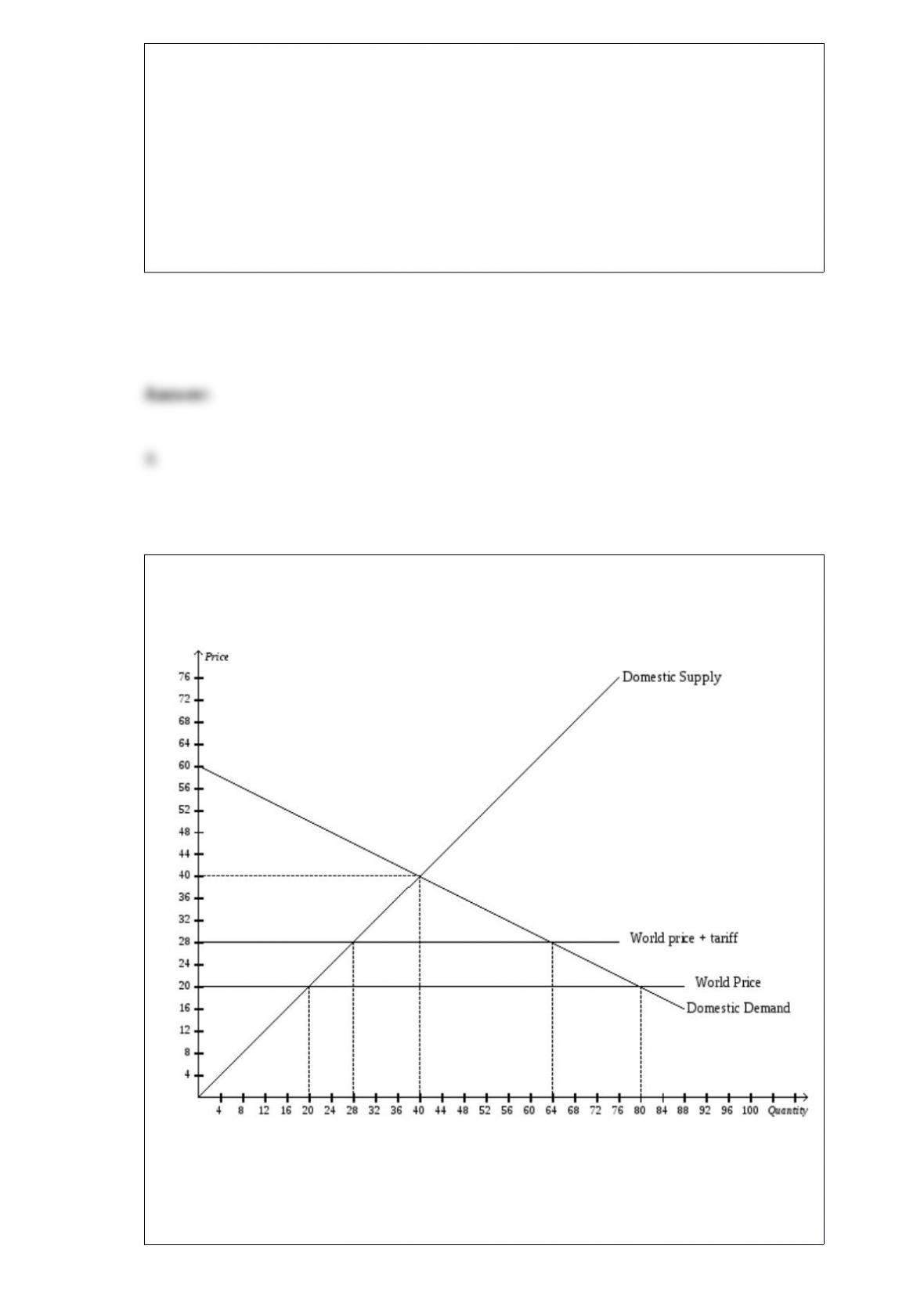
Figure 9-17
Refer to Figure 9-17. Without trade, consumer surplus is
a. $400 and producer surplus is $200.

b. $400 and producer surplus is $800.
c. $1,600 and producer surplus is $200.
d. $1,600 and producer surplus is $800.
Which of the following can be measured by the level of real GDP per person?
a. productivity and the standard of living
b. productivity but not the standard of living
c. the standard of living but not productivy
d. neither the standard of living nor productivity
If the price elasticity of supply is 0.8, and price increased by 5%, quantity supplied
would
a. increase by 4%.
b. increase by 6.25%.
c. decrease by 4%.
d. decrease by 6.25%.

The effect of an increase in the price level on the aggregate-demand curve is
represented by a
a. shift to the right of the aggregate-demand curve.
b. shift to the left of the aggregate-demand curve.
c. movement to the left along a given aggregate-demand curve.
d. movement to the right along a given aggregate-demand curve.
As the price level falls
a. people will want to buy more bonds, so the interest rate rises.
b. people will want to buy fewer bonds, so the interest rate falls.
c. people will want to buy more bonds, so the interest rate falls.
d. people will want to buy fewer bonds, so the interest rate rises.
Market power and externalities are examples of
a. laissez-faire economics.
b. public policy.
c. market failure.
d. welfare economics.
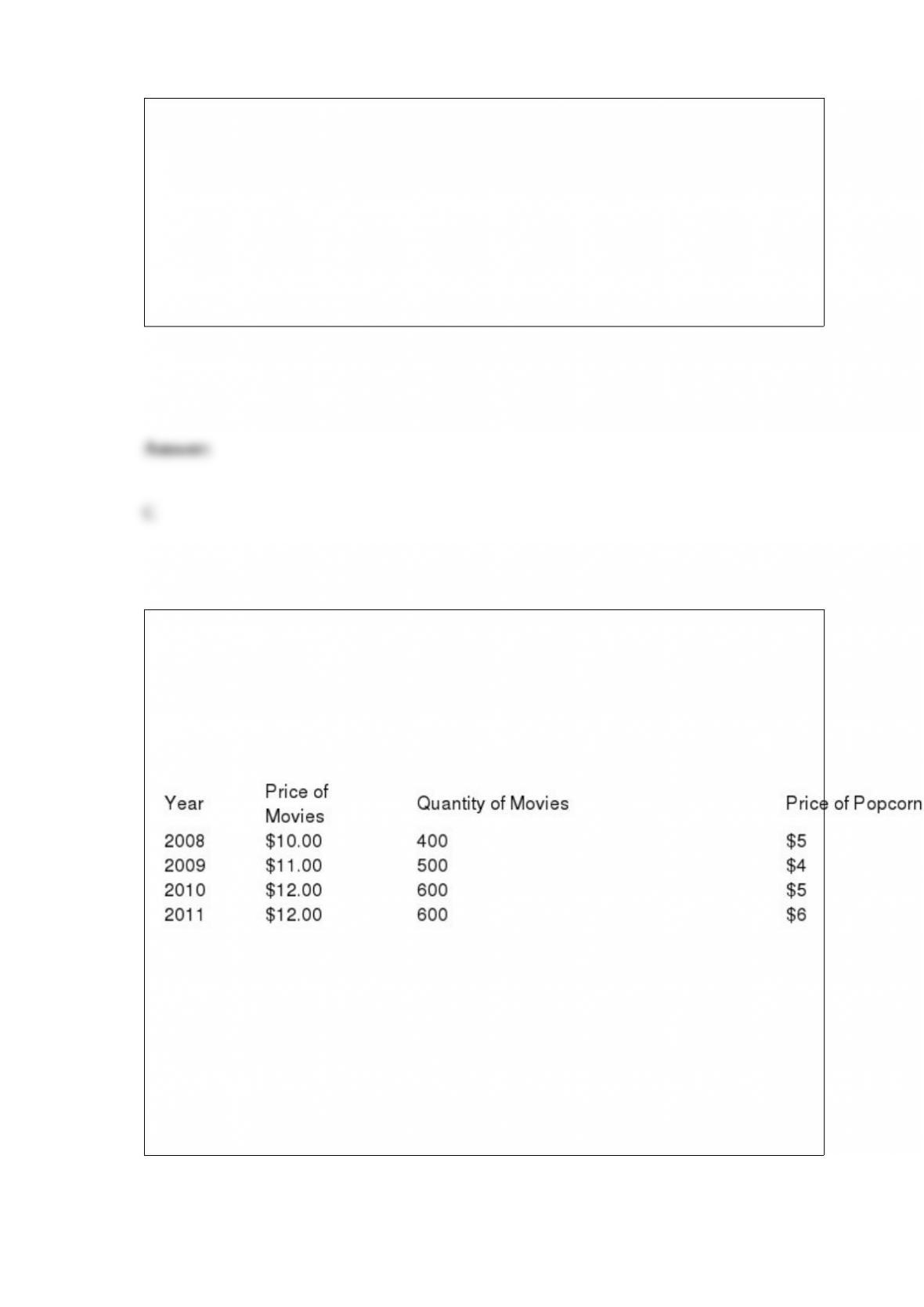
Table 10-5
A hypothetical country of Lahland produces only movies and popcorn. Quantities and
prices of these goods for the last several years are shown below. The base year is 2009.
Prices and Quantities
Refer to Table 10-5 What was this country’s GDP deflator in 2010?
a. 86.9
b. 115.1
c. 120.5
d. None of the above is correct.

If the price of Spanish olives imported into the United States decreases, then
a. both the GDP deflator and the consumer price index will decrease.
b. neither the GDP deflator nor the consumer price index will decrease.
c. the GDP deflator will decrease, but the consumer price index will not decrease.
d. the consumer price index will decrease, but the GDP deflator will not decrease.
The effects of a higher than expected price level are shown by
a. shifting the short-run aggregate supply curve right.
b. shifting the short-run aggregate supply curve left.
c. moving to the right along a given aggregate supply curve.
d. moving to the left along a given aggregate supply curve.

The interest rate falls if
a. either money demand or money supply shifts right.
b. money demand shifts right or money supply shifts left.
c. either money demand or money supply shifts left.
d. money demand shifts left or money supply shifts right.
Fundamental analysis is
a. the study of the relation between risk and return of stock portfolios.
b. the determination of the allocation of savings between stocks and bonds based on a
person’s degree of risk aversion.
c. the study of a company’s accounting statements and future prospects to determine its
value.
d. a method used to determine how adding stocks to a portfolio will change the risk of
the portfolio.
Figure 19-1
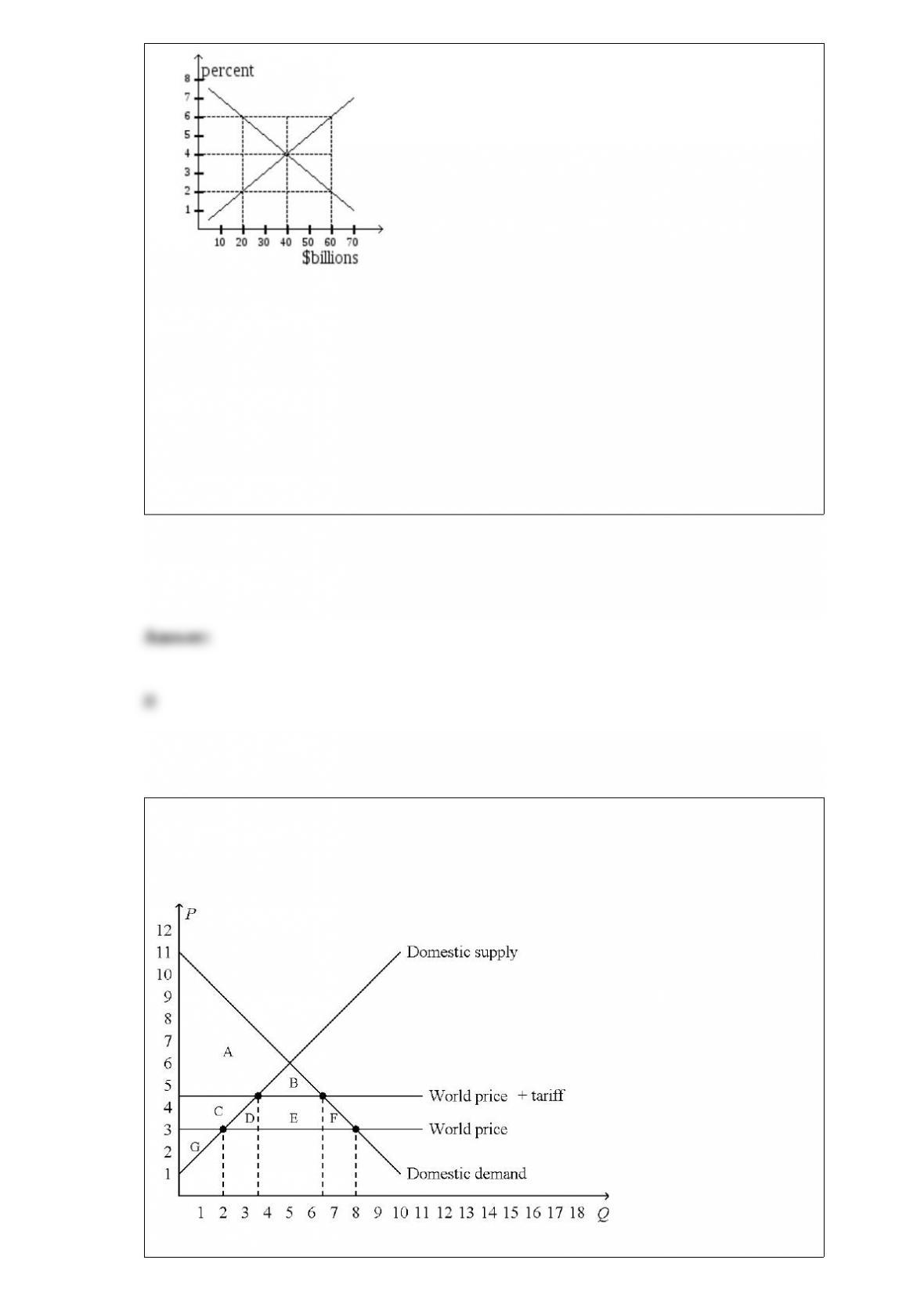
Refer to Figure 19-1. In the Figure shown, if the real interest rate is 6 percent, the
quantity of loanable funds demanded is
a. $20 billion, and the quantity supplied is $40 billion.
b. $20 billion, and the quantity supplied is $60 billion.
c. $60 billion, and the quantity supplied is $20 billion.
d. $60 billion, and the quantity supplied is $40 billion.
Figure 9-16. The figure below illustrates a tariff. On the graph, Q represents quantity
and P represents price.
Refer to Figure 9-16. The tariff

a. decreases producer surplus by the area C, decreases consumer surplus by the area C +
D + E, and decreases total surplus by the area D + F.
b. increases producer surplus by the area C, decreases consumer surplus by the area C +
D + E + F, and decreases total surplus by the area D + F.
c. creates government revenue represented by the area B + E and decreases total surplus
by the area D + E + F.
d. increases producer surplus by the area C + G and creates government revenue
represented by the area D + E + F.
The initial impact of the repeal of an investment tax credit is to shift
a. aggregate demand right.
b. aggregate demand left.
c. aggregate supply right.
d. aggregate supply left.
A U.S. based company sells semiconductors to an Italian firm. The U.S. company uses
all of the revenues from this sale to purchase automobiles from Italian firms. These
transactions

a. increase both U.S. net exports and U.S. net capital outflow.
b. decrease both U.S. net exports and U.S. net capital outflow.
c. increase U.S. net exports and do not affect U.S. net capital outflow.
d. None of the above is correct.
Suppose that when the price of good X falls from $10 to $8, the quantity demanded of
good Y rises from 20 units to 25 units. Using the midpoint method, the cross-price
elasticity of demand is
a. -1.0, and X and Y are complements.
b. -1.0, and X and Y are substitutes.
c. 1.0, and X and Y are complements.
d. 1.0, and X and Y are substitutes.
If a 20% change in price results in a 15% change in quantity supplied, then the price
elasticity of supply is about
a. 1.33, and supply is elastic.
b. 1.33, and supply is inelastic.

c. 0.75, and supply is elastic.
d. 0.75, and supply is inelastic.
Sam has no job but keeps applying to get a job with a business that is unionized. He is
qualified and he finds the pay attractive, but the firm is not hiring. Sam is
a. structurally unemployed. Structural unemployment exists even in the long run.
b. structurally unemployed. Structural unemployment does not exist in the long run.
c. frictionally unemployed. Frictional unemployment exists even in the long run.
d. frictionally unemployed. Frictional unemployment does not exist in the long run.
How does total revenue change as one moves downward and to the right along a linear
demand curve?
a. It always increases.
b. It always decreases.
c. It first increases, then decreases.
d. It is unaffected by a movement along the demand curve.

A judge requires Harry to make a payment to Sally. The judge says that Harry can pay
her either $10,000 today or $12,000 two years from today. Of the following interest
rates, which is the highest one at which Harry would be better off paying the money
today?
a. 4 percent
b. 6 percent
c. 9 percent
d. 11 percent
An economist advising a central bank intending to reduce the inflation rate would likely
point out that
a. the costs of reducing inflation persist and the costs of reducing it do not depend on
the public’s inflation expectations.
b. the costs of reducing inflation persist, but they are smaller if the public reduces its
inflation expectations.
c. the costs of reducing inflation are temporary and the costs of reducing it do not
depend on the public’s inflation expectations.
d. the costs of reducing inflation are temporary and the costs are smaller if the public
reduces its inflation expectations.
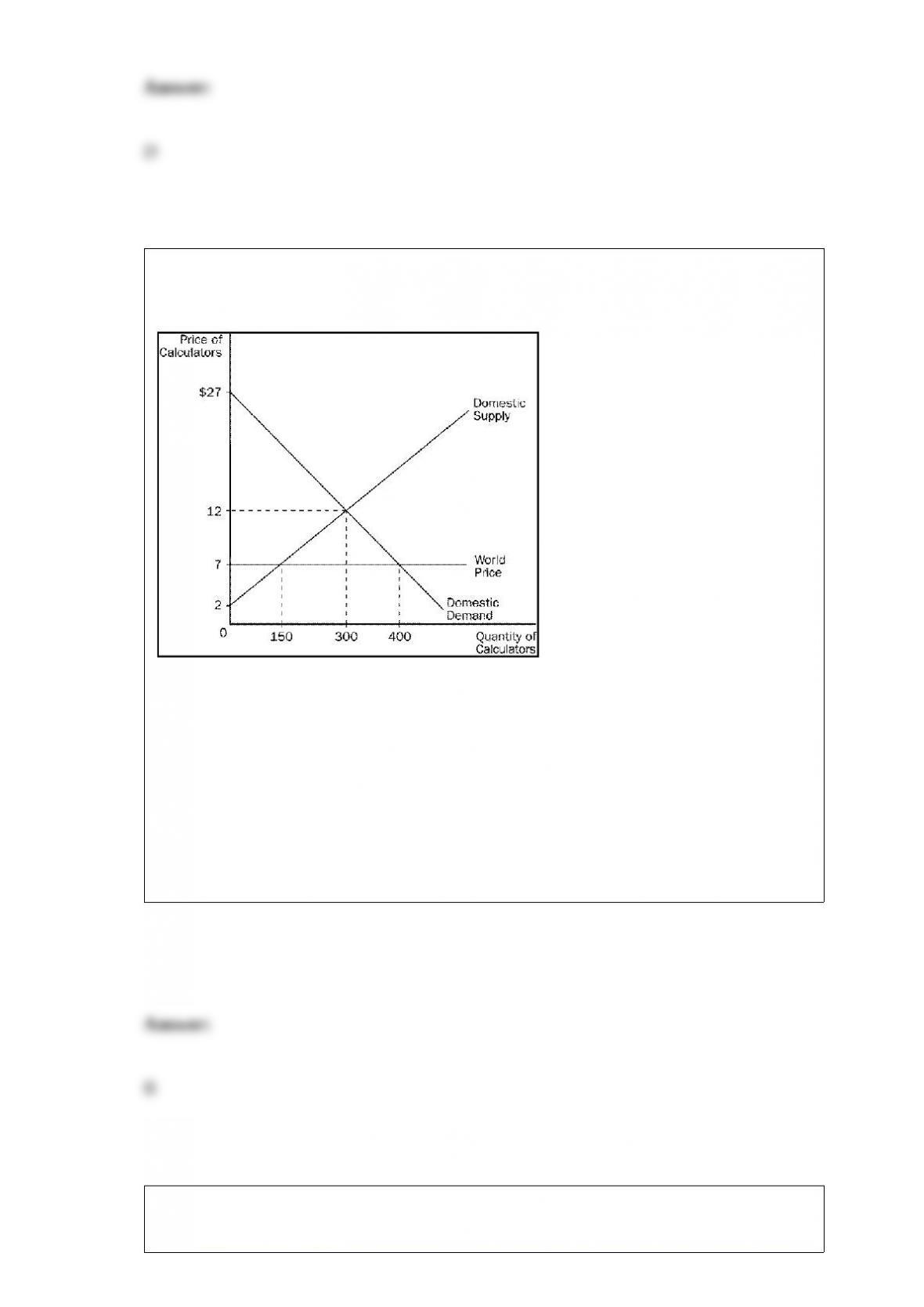
Figure 9-4. The domestic country is Nicaragua.
Refer to Figure 9-4. Which of the following statements is accurate?
a. Consumer surplus with trade is $3,200.
b. Producer surplus with trade is $375.
c. The gains from trade amount to $800.
d. The gains from trade are represented on the graph by the area bounded by the points
(0,$12), (300, $12), (300, $7) and (0, $7).
Which of the following did the Fed do during the recession of 2008-2009?

a. lowered the federal funds rate and sold securities and loans
b. lowered the federal funds rate and purchased securities and loans
c. raised the federal funds rate and sold securities and loans
d. raised the federal funds rate and purchased securities and loans
The imposition of a binding price floor on a market causes quantity demanded to be
a. greater than quantity supplied.
b. less than quantity supplied.
c. equal to quantity supplied.
d. Both a) and b) are possible.
Figure 4-9
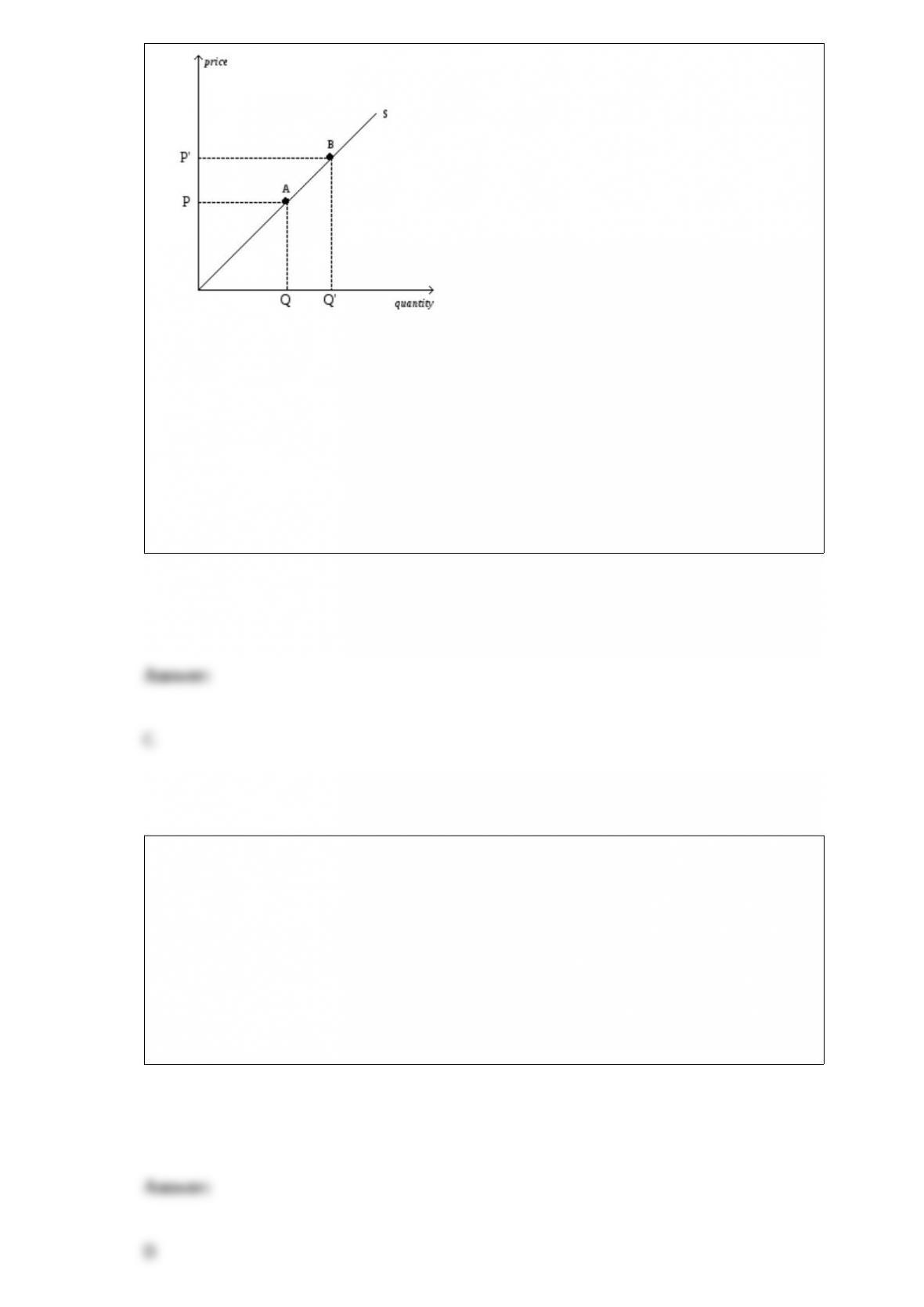
Refer to Figure 4-9. The movement from point A to point B on the graph is called
a. a decrease in supply.
b. an increase in supply.
c. an increase in the quantity supplied.
d. a decrease in the quantity supplied.
If Huedepool Beer runs into financial difficulty, the stockholders as
a. part owners of Huedepool are paid before bondholders get paid anything at all.
b. part owners of Huedepool are paid after bondholders get paid.
c. creditors of Huedepool are paid before bondholders get paid anything at all.
d. creditors of Huedepool are paid after bondholders get paid.
Today’s supply curve for gasoline could shift in response to a change in
a. today’s price of gasoline.
b. the expected future price of gasoline.
c. the number of buyers of gasoline.
d. All of the above are correct.
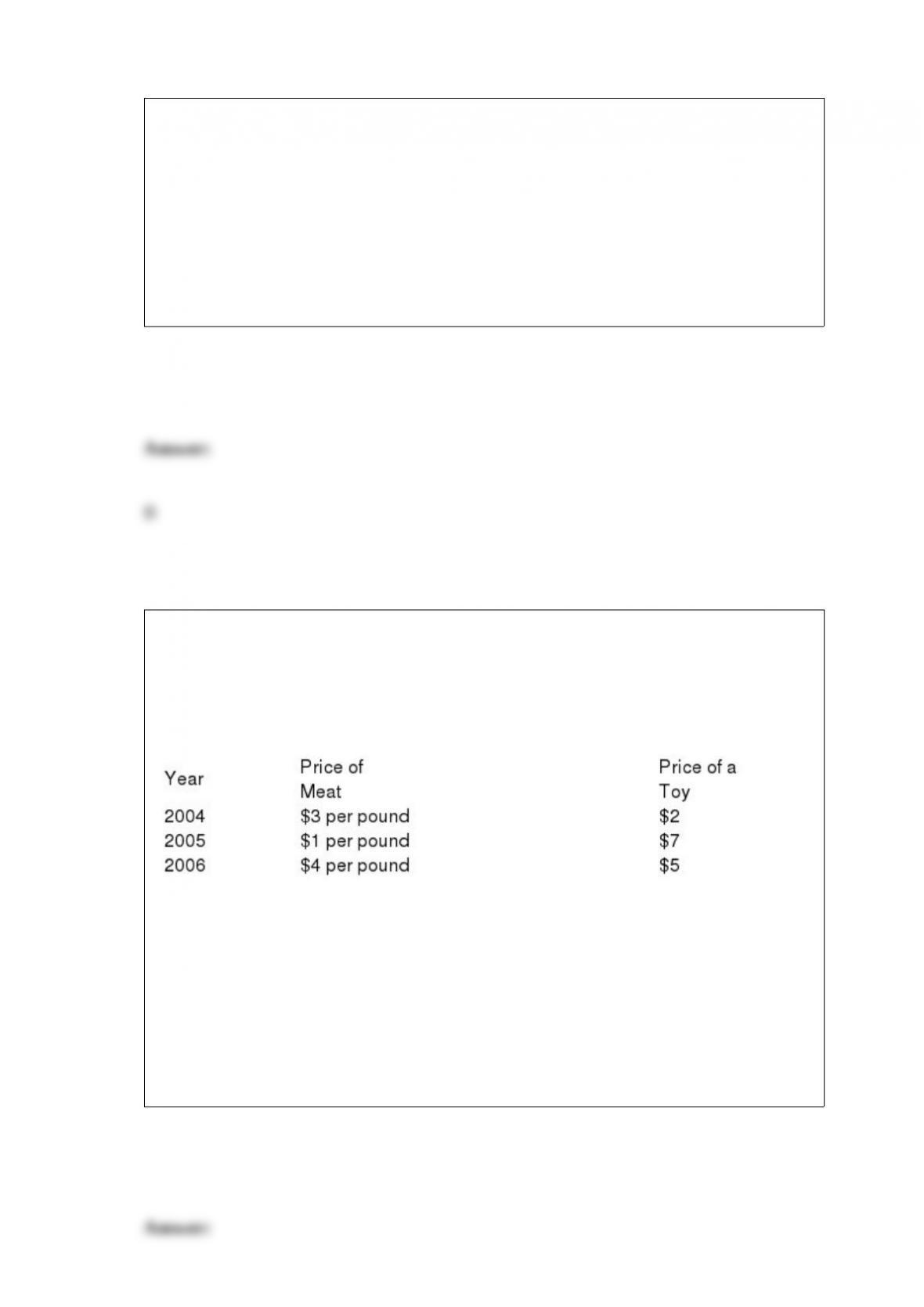
Table 11-4
The table below pertains to Wrexington, an economy in which the typical consumer’s
basket consists of 20 pounds of meat and 10 toys.
Refer to Table 11-4. The cost of the basket in 2006 was
a. $9.
b. $130.
c. $140.
d. $270.

At the equilibrium real interest rate in the open-economy macroeconomic model, the
equilibrium quantity of loanable funds equals
a. net capital outflow.
b. domestic investment.
c. foreign currency supplied.
d. national saving.
Which of the following is correct?
a. typically more than one third of the unemployed are new entrants into the job market.
b. most spells of unemployment are short.
c. most unemployment observed at any time is long term.
d. All of the above are correct.

Underground economic activity as a percentage of GDP was highest in
a. Bolivia.
b. Mexico.
c. Australia.
d. the United States.
When a tax is imposed on a good, the
a. supply curve for the good always shifts.
b. demand curve for the good always shifts.
c. amount of the good that buyers are willing to buy at each price always remains
unchanged.
d. equilibrium quantity of the good always decreases.
In 1972, one could buy model rocket engines for $1.50 each. If those same engines cost
$2.50 each today, then which pair of CPIs would make the engine prices in today’s
dollars the same for both years?
a. 60 in 1972 and 95 today

b. 60 in 1972 and 120 today
c. 90 in 1972 and 150 today
d. 96 in 1972 and 154 today
If the interest rate is 4.5 percent, what is the present value of a payment of $500 to be
made one year from today?
a. $457.14
b. $468.02
c. $478.47
d. None of the above are correct to the nearest cent.