
In the open-economy macroeconomic model, if foreign interest rates rise and the U.S
interest rate stays the same then, U.S.
a. net capital outflow rises, so the supply of dollars in the market for foreign exchange
shifts right.
b. net capital outflow rises, so the demand for dollars in the market for foreign
exchange shifts right.
c. net capital outflow falls, so the supply of dollars in the market for foreign exchange
shifts left.
d. net capital outflow falls, so the demand for dollars in the market for foreign exchange
shifts left.
Other things the same,if the Japanese real interest rate were to increase, Japanese net
capital outflow
a. and net capital outflow of other countries would rise.
b. and net capital outflow of other countries would fall.
c. would rise, while net capital outflow of other countries would fall.
d. would fall, while net capital outflow of other countries would rise.
In the short run, open-market sales

a. increase the price level and real GDP.
b. decrease the price level and real GDP.
c. increases the price level and decreases real GDP.
d. decreases the price level and increases real GDP.
Increasing the number of corporations whose stocks are in your portfolio reduces
market risk.
a. True
b. False
The arguments of Friedman and Phelps would suggest that other things the same, a
country that pursues a disinflationary policy that the public does not find completely
credible
a. should not see an increase in the unemployment rate even in the short run.
b. will having rising unemployment for a while, but then return to the natural rate of
unemployment.
c. will have a permanently higher unemployment rate.
d. None of the above is suggested by the arguments of Friedman and Phelps.
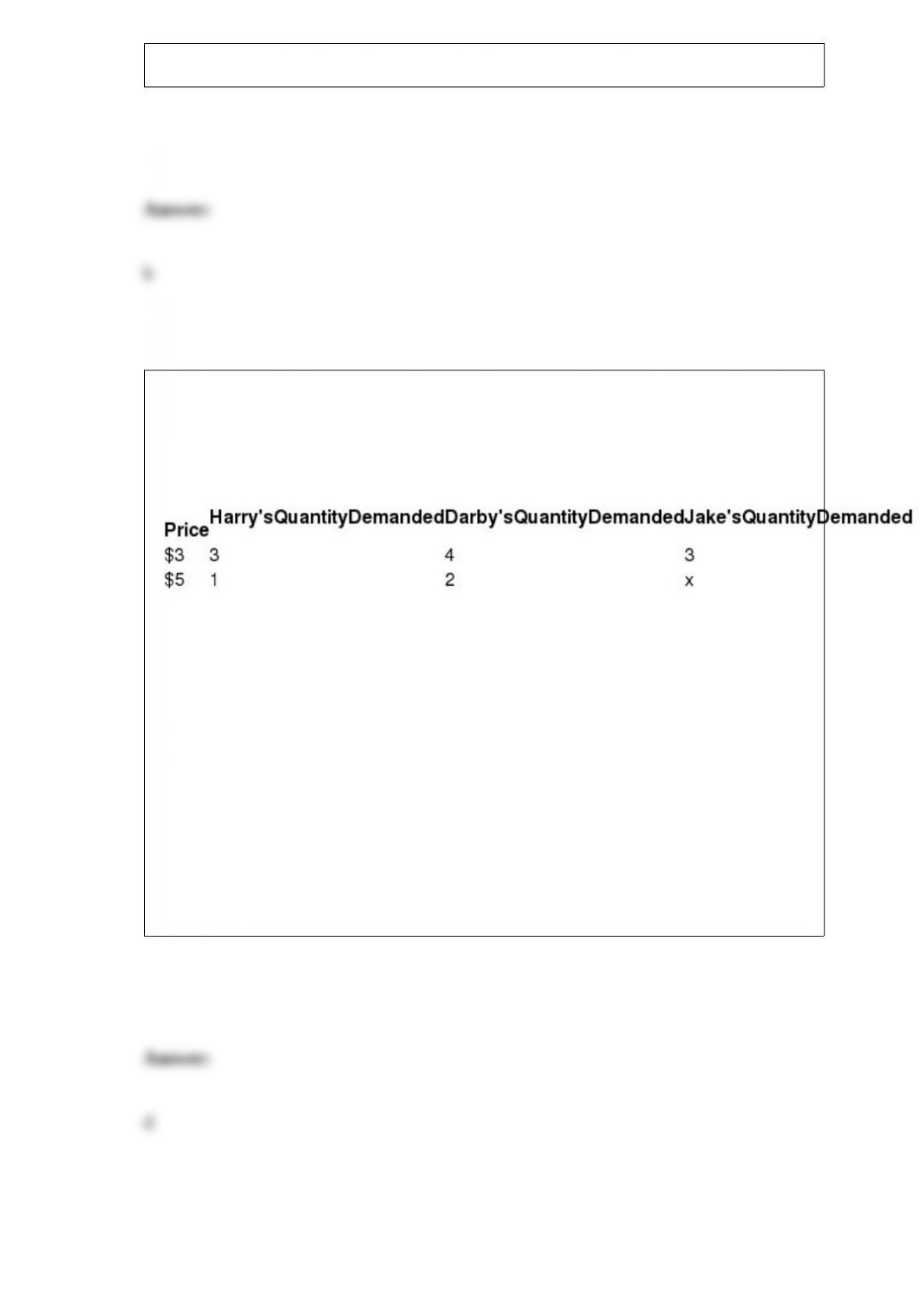
Table 4-13
The demand schedule below pertains to sandwiches demanded per week.
RefertoTable4-13.Suppose Harry, Darby, and Jake are the only demanders of
sandwiches. Also suppose x = 2. Then
a. the slope of Jake’s demand curve is 1/2, and the slope of the market demand curve is
5/2.
b. the slope of Jake’s demand curve is 1/2, and the slope of the market demand curve is
2/5.
c. the slope of Jake’s demand curve is 2, and the slope of the market demand curve is
5/2.
d. the slope of Jake’s demand curve is 2, and the slope of the market demand curve is
2/5.

In the economy of Talikastan in 2015, consumption was $1000, GDP was $1950,
government purchases were $500, and investment was $700. What were Talikastan’s net
exports in 2015?
a. -$250
b. $250
c. $2200
d. Net exports cannot be calculated from the information given.
Which of the following would tend to shorten recessions associated with anti-inflation
policies by central banks?
a. People adjust their expectations of inflation rapidly.
b. People believe policy announcements made by central bank officials.
c. The short-run Phillips shifts rapidly.
d. All of the above are correct.
By definition, government purchases and taxes are zero for a closedeconomy.
a. True

b. False
The labor-force participation rate tells us the fraction of the population that
a. is able to participate in the labor market.
b. has ever been employed.
c. has chosen to participate in the labor market.
d. has chosen not to participate in the labor market.
Sometimes economists disagree because their values differ. Which of the following
instances best reflects this source of disagreement?
a. One economist believes the North American Free Trade Agreement (NAFTA) has led
to a loss of American jobs; another economist disputes this claim.
b. One economist believes that when income taxes are cut, people will increase their
spending; another economist believes that when income taxes are cut, people will
increase their saving.
c. One economist advises against increases in sales taxes because she thinks such
increases are unfair to low- income people; another economist disputes the idea that
increases in sales taxes are unfair to low-income people.
d. One economist believes that, prior to the Civil War, slavery contributed to economic

growth in the South; another economist believes that slavery held back the South’s
economic growth.
In which case(s) does(do) a country’s demand for loanable funds shift right?
a. both an increase in the budget deficit and capital flight
b. an increase in the budget deficit, but not capital flight
c. capital flight, but not an increase in the budget deficit
d. neither an increase in the budget deficit nor capital flight
For which of the following policies is there a significant implementation lag?
a. fiscal policy and monetary policy
b. fiscal policy but not monetary policy
c. monetary policy but not fiscal policy
d. neither monetary policy nor fiscal policy

An increase in the tax rate on interest income
a. raises the amount earned on savings. Saving will rise if the income effect of the
increase in the tax rate is larger than the substitution effect.
b. raises the amount earned on savings. Saving will rise if the income effect of the
increase in the tax rate is smaller than the substitution effect.
c. reduces the amount earned on savings. Saving will fall if the income effect of the
increase in the tax rate is larger than the substitution effect.
d. reduces the amount earned on savings. Saving will fall if the income effect of the
increase in the tax rate is smaller than the substitution effect.
If Congress instituted an investment tax credit, the demand for loanable funds would
shift rightward.
a. True
b. False
Most studies have found that tobacco and marijuana are complements rather than

substitutes.
a. True
b. False
The unemployment that results from the process of matching workers and jobs is called
frictional unemployment.
a. True
b. False
In the context of the aggregate-demand curve, the interest-rate effect refers to the idea
that, when the price level increases,
a. the real value of money decreases; in turn, the real value of the dollar increases in
foreign exchange markets, which decreases net exports.
b. the real value of money decreases; in turn, interest rates increase, which decreases net
exports.
c. households increase their holdings of money; in turn, interest rates decrease, which
reduces spending on investment goods.
d. households increase their holdings of money; in turn, interest rates increase, which
reduces spending on investment goods.

Over the past several decades, the difference between the labor-force participation rates
of men and women in the U.S. has gradually decreased.
a. True
b. False
Table 4-10
The following table shows the number of cases of water each seller is willing to sell at
the prices listed.
RefertoTable4-10.If Alpine Springs and Dew Good are the only two suppliers in this
market, by how much does the market quantity supplied change with each $3 increase
in price?
a. -200 cases
b. -100 cases
c. 100 cases

d. 200 cases
Which of the following is notcorrect?
a. The higher average return on stocks than on bonds comes at the price of higher risk.
b. Risk-averse persons will take the risks involved in holding stocks if the average
return is high enough to compensate for the risk.
c. Insurance markets reduce risk, but not by diversification.
d. Risk can be reduced by placing a large number of small bets, rather than a small
number of large bets.
Table 3-36
Refer to Table3-36. Assume that Antigua and Barbuda each has 60 minutes available.
If each island spends all its time producing the good in which it has a comparative
advantage, then total production is

a. 4 towels and 3 umbrellas.
b. 5 towels and 6 umbrellas.
c. 8 towels and 10 umbrellas.
d. 9 towels and 9 umbrellas.
There was hyperinflation during the
a. period 1880-1896 in the United States.
b. 1970s in the United States.
c. early part of the current century in Zimbabwe.
d. All of the above are correct.
Currently a country has real GDP per person of 500. Raising capital per worker by one
would increase output per worker by 4. Other things the same, which of the following
long-run combinations are consistent with the effects of this country increasing its
saving rate?
a. real GDP per person is 520 and raising capital per worker by one would increase
output per worker by 3
b. real GDP per person is 520 and raising capital per worker by one would increase

output per worker by 5
c. real GDP per person is 480 and raising capital per worker by one would increase
output per worker by 3
d. real GDP per person is 480 and raising capital per worker by one would increase
output per worker by 5
A U.S. citizen buys a tea kettle manufactured in China by a company that is owned and
operated by U.S citizens. In which of the following components of U.S. GDP is this
transaction accounted for?
a. consumption and imports
b. consumption but not imports
c. imports but not consumption
d. neither consumption nor imports
Which of the following actions might we logically expect to result from rising stock
prices?
a. Jim decreases his consumption spending.
b. Firms sell fewer shares of new stock.

c. Firms spend more on investment.
d. None of the above is correct.
In which case can we be sure aggregate demand shifts left overall?
a. people want to save more for retirement and the Fed increases the money supply.
b. people want to save more for retirement and the Fed decreases the money supply.
c. people want to save less for retirement and the Fed increases the money supply.
d. people want to save less for retirement and the Fed decreases the money supply.
In 1983, one could buy a model radio-controlled airplane for $11.50 each. Those same
planes are available today and the price increased at exactly the rate of inflation. If the
CPI today is 220.5 and in 1983 was 105, what is the price of the airplane today?
a. $24.15
b. $11.50
c. $5.48
d. $2.10
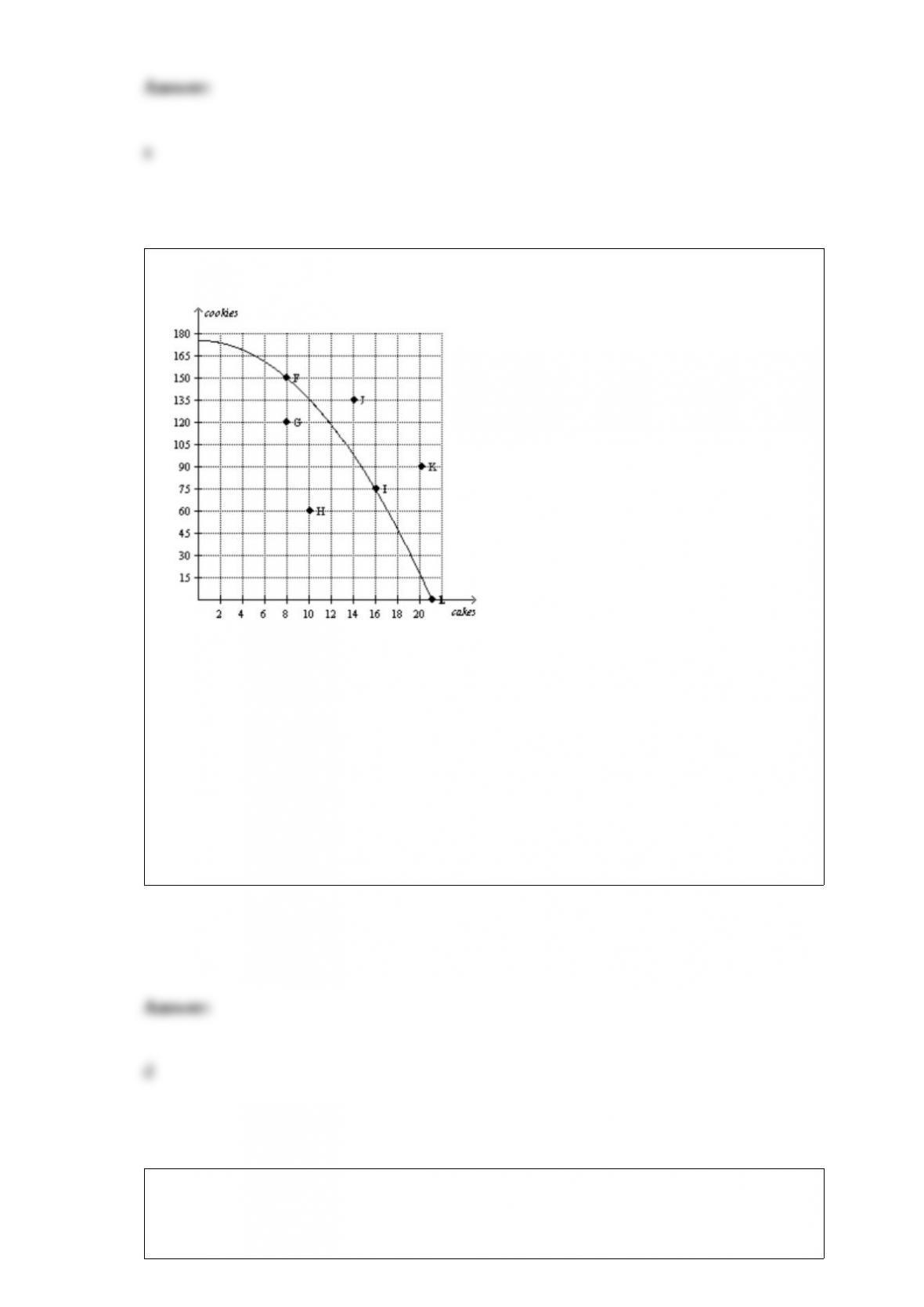
Figure 2-13
RefertoFigure2-13. Which of the following statements is true about point G for this
economy?
a. Point G is currently unattainable.
b. Point G is efficient.
c. At point G, more cakes are produced than cookies.
d. There is unemployment at point G.
Which of the following can a country increase in the long run by increasing its money
growth rate?

a. the nominal wage.
b. real output.
c. real interest rates.
d. the real wage.
For a competitive market,
a. a seller can always increase her profit by raising the price of her product.
b. if a seller charges more than the going price, buyers will go elsewhere to make their
purchases.
c. a seller often charges less than the going price to increase sales and profit.
d. a single buyer can influence the price of the product but only when purchasing from
several sellers in a short period of time.