Gross domestic product understates the total production of final goods and services
because of the omission of
A) exports.
B) inflation.
C) intermediate goods.
D) household production.
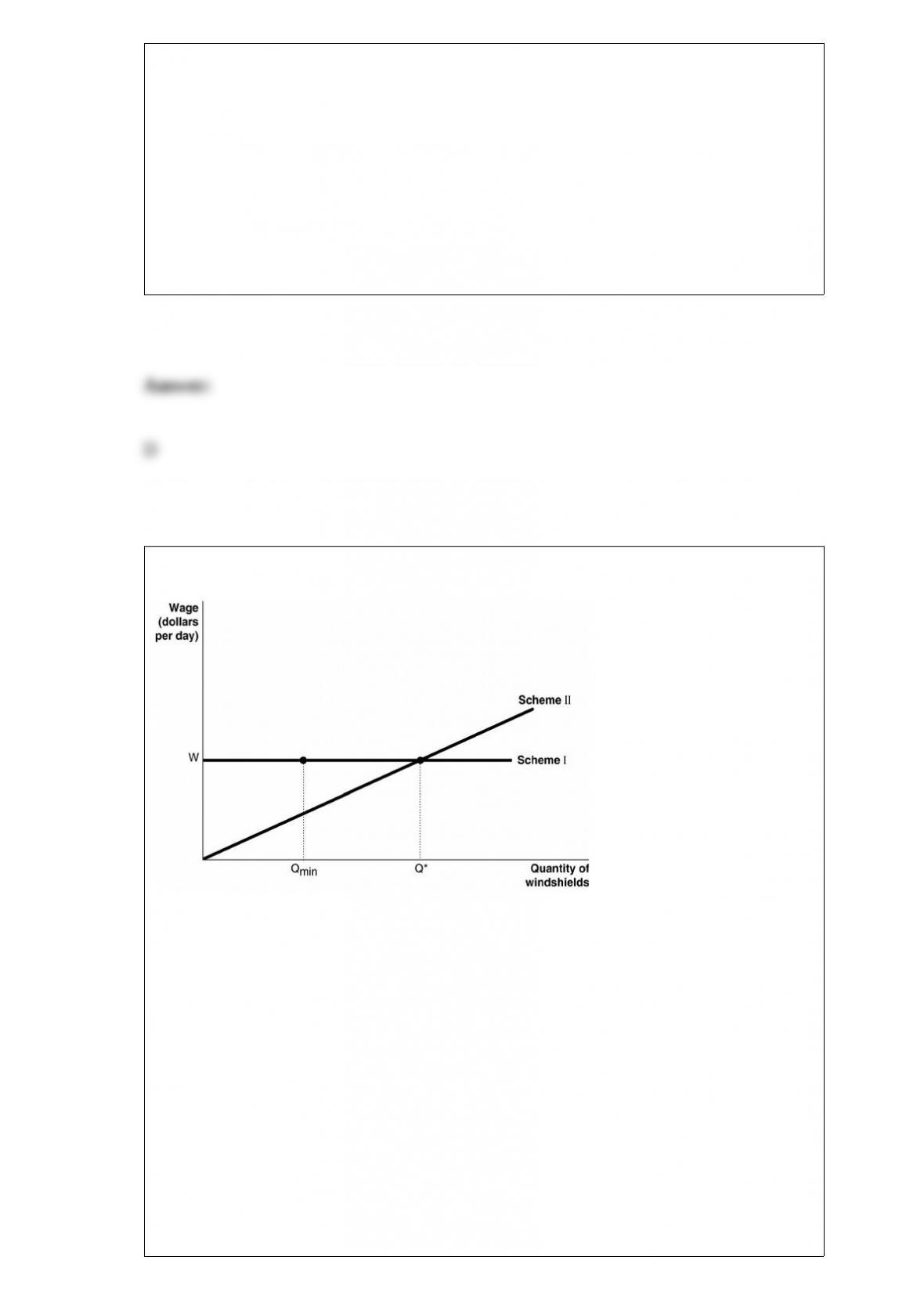
Figure 17-6
Figure 17-6 shows two
different compensation schemes for the Safelite Glass Corporation, an installer of auto
glass windshields. Under Scheme I, the firm pays a consistent wage of $80 per day
based on an 8-hour workday. Qmin represents the cut-off point under the hourly-wage
system: if a worker installed fewer than Qmin windshields, the worker got fired. Scheme
II represents a piece-rate scheme with an earnings floor: no worker would get less than
$80 per day (for an 8-hour workday) and would have to produce at least Qmin. For any
output level beyond Q* the worker earned an additional $20 for each unit produced.
Suppose Qmin = 2 windshields and Q*=5 windshields. Under Scheme II, a worker has
to install Q* windshields before she earns an additional $20 per windshield installed.
What is a potential problem with this scheme?
A) Workers might be more concerned with increasing output beyond Q* and less
concerned with the quality of their work.

B) Any increase in output between Qmin and Q* benefits the employer only.
C) It violates labor laws because workers are not compensated for output between Qmin
and Q*.
D) Workers have no incentive to produce output to between Qmin and Q*.
A minimum wage law dictates
A) the minimum quantity of labor that a firm must employ.
B) the lowest wage that firms may pay for labor.
C) the highest wage that firms must pay for labor.
D) the minimum qualifications for labor.
Which of the following will decrease aggregate expenditure in the United States?
A) a decrease in the value of the dollar
B) a decrease in the price level
C) a decrease in interest rates

D) a decrease in government purchases
If the price of automobiles was to increase, then
A) the demand for gasoline would decrease.
B) the demand for gasoline would increase.
C) the supply of gasoline would increase.
D) the quantity demanded of gasoline would decrease.
The natural rate of unemployment is made up of
A) frictional, cyclical, and structural unemployment.
B) frictional and cyclical unemployment.
C) cyclical and structural unemployment.
D) frictional and structural unemployment.
E) seasonal and structural unemployment.

Article Summary. Over the past two years, the Indian rupee has fallen 26 percent in
value against the U.S. dollar, reaching a record low of 61.80 rupees per dollar in
August 2013. The decline reflects increasing capital outflows and pessimism
regarding the government’s attempts to reverse this trend. The Indian government
was expected to announce potential measures to increase the inflow of capital,
including the possibility of raising debt abroad, raising money from Indians who
live abroad, easing restrictions on overseas borrowing, and raising interest rates.
Critics argue that current and well-entrenched policies deter capital inflow from
investors and corporations, and raising interest rates may reduce confidence in the
economy, which experienced a decade-low growth rate of 5 percent in 2013.
Source: Rafael Nam, “Rupee over 60: Why Indian currency weakness may be here
to stay,” Reuters, August 8, 2013.
All else equal, a depreciation of the Indian rupee relative to a currency such as the U.S.
dollar should ________ the current account balance in India and therefore ________
the financial account balance in India.
A) increase; increase
B) increase; decrease
C) decrease; increase
D) decrease; decrease
In a market economy, the high salaries of some star baseball players such as Zach
Greinke, are determined by
A) team owners, based on the total number of star athletes they plan to hire.
B) advertising companies, based on what they are willing to pay to advertise their
products at baseball games.
C) the interaction of the demand for star athletes and the supply of star athletes.
D) consumers, based on their willingness to watch baseball games.

When there is a negative externality, the private cost of production ________ the social
cost of production.
A) is greater than
B) is equal to
C) eliminates
D) is less than
Which of the following is a characteristic of a monopoly?
A) It is easy for new firms to enter the market.
B) There is only one seller in the market.
C) The product is not unique.
D) The firm has no control over price.
The demand for most farm products is relatively inelastic. All else constant, what is the

effect on farm revenues as a result of the introduction of new and better farm equipment
which increases in productivity?
A) Farm revenues increase.
B) Farm revenues decrease.
C) Farm revenues remain constant because consumers will not increase their
consumption of farm products by much.
D) Farm revenues could increase or decrease depending on the cost of this new
equipment.
There is a government budget surplus if
A) T – TR > G.
B) G > T.
C) G > TR.
D) TR < T.
The substitution effect of an increase in the price of Raisin Bran refers to
A) the decrease in the demand for Raisin Bran when its price rises.
B) the result that consumers will now switch to a substitute good such as Cheerios, and
the demand curve for Raisin Bran shifts to the left.

C) the fact that the higher price of Raisin Bran lowers consumer’s purchasing power,
holding money income constant.
D) the fact that the higher price of Raisin Bran relative to its substitutes, such as
Cheerios, cause consumers to buy less Raisin Bran.
An example of business fixed investment spending is
A) a purchase of a home by a household.
B) a purchase of a computer by an accounting firm.
C) a purchase of a bond by General Electric Corporation.
D) $200 million of unsold cars at a car dealership.