1) Stabilizing a nation’s price level and the purchasing power of its money can be
achieved:
A.only with fiscal policy.
B.only with monetary policy.
C.with both fiscal and monetary policy.
D.with neither fiscal nor monetary policy.
2) Which of the following tools of monetary policy is considered the most important?
A.the discount rate
B.the reserve ratio
C.open market operations
D.the term auction facility
3) when the price of a product rises, consumers shift their purchases to other products
whose prices are now relatively lower. this statement describes:
a.an inferior good.
b.the rationing function of prices.
c.the substitution effect.
d.the income effect.
4) AFL-CIO stands for:
A.American Federation of Labor-Congress of Industrial Organizations.
B.American Federation of Labor-Committee for Industrial Opportunity.
C.Assembly of Factory Laborers-Congress of Industrial Organizations.
D.Assembly of Factory Laborers-Committee for Industrial Opportunity.
5) Assuming no other changes, if checkable deposits decrease by $40 billion and
balances in money market mutual funds increase by $40 billion, the:
A.M1 money supply will decline and M2 money supply will remain unchanged.
B.M1 and M2 money supplies will not change.
C.M1 money supply will increase and M2 money supply will remain unchanged.
D. M1 and M2 money supplies will both decline.
6) State right-to-work laws:
A.permit employers to hire nonunion workers only if union labor is unavailable.
B.prohibit employers from discriminating against minority groups in hiring workers.
C.prohibit unions from discriminating against minority groups in recruiting members.
D.make compulsory union membership (for example, a union shop) illegal.
7) The aggregate supply curve (short-run) is upsloping because:
A.wages and other resource prices match changes in the price level.
B.the price level is flexible upward but inflexible downward.
C.per-unit production costs rise as the economy moves toward and beyond its
full-employment real output.
D.wages and other resource prices are flexible upward but inflexible downward.
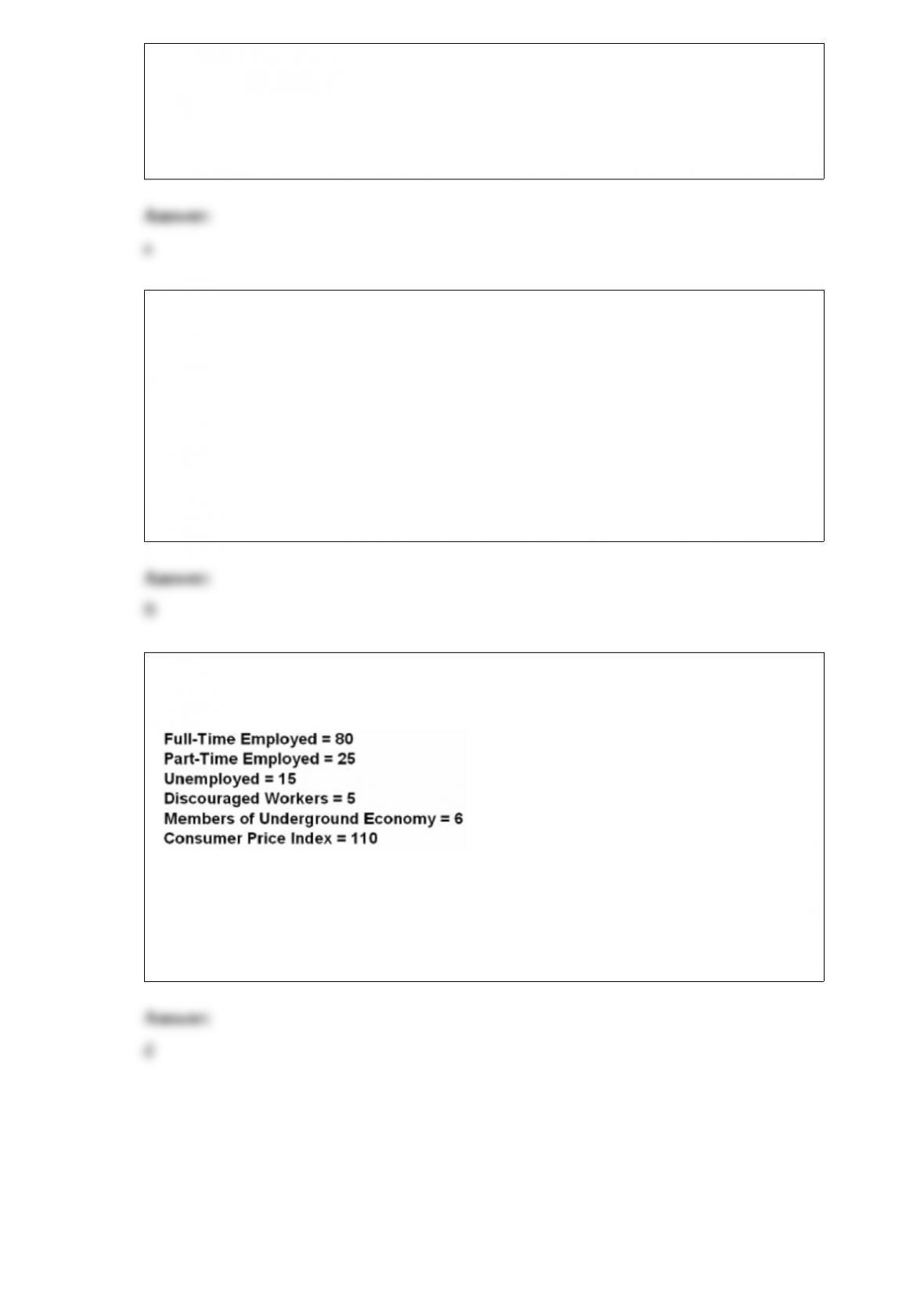
8)
Refer to the above figure and assume the economy initially is in equilibrium at point a.
In the new classical theory, a fully anticipated increase in aggregate demand from AD2
to AD1 would move the economy:
A.directly from a to d
B.from a to b to d
C.from a to e to d
D.directly from a to f
9) which of the following is a fundamental characteristic of the market system?
a.property rights.
b.central planning by government.
c.unselfish behavior.
d.government-set wages and prices.
10) Which of the following combinations is plausible, as it relates to a nation’s balance
of payments?
A.current account = $+40 billion; capital account = $+20 billion; financial account =
$-50 billion.
B.current account = $-50 billion; capital account = $+20 billion; financial account = $
+30 billion.
C.current account = $+10 billion; capital account = $+40 billion; financial account = $
+50 billion.
D.current account = $+30 billion; capital account = $-20 billion; financial account =
$-50 billion.
11) answer the next question(s) on the basis of the following information about a
hypothetical economy:
refer to the above information. the rate of inflation:
a.is 110 percent.
b.is 10 percent.
c.is 0 percent.
d.cannot be determined from the data.
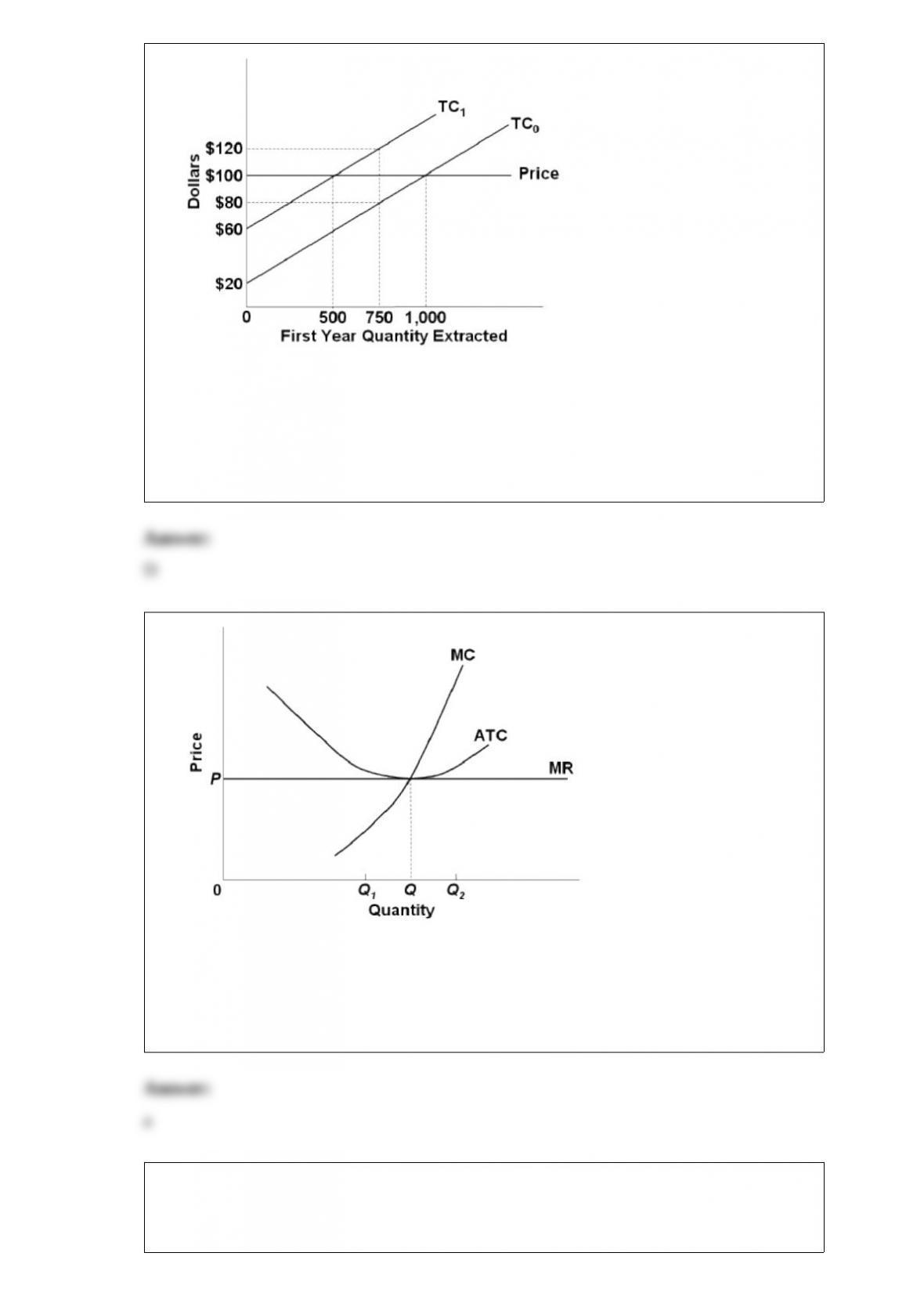
12)
Refer to the diagram above, assuming that the firm represented is operating on curve
TC0. What is the user cost of extracting a unit of this resource?
A.$20.
B.$40.
C.$60.
D.It cannot be determined with the information given.
13)
refer to the above diagram. at output level q2:
a.resources are overallocated to this product and productive efficiency is not realized.
b.resources are underallocated to this product and productive efficiency is not realized.
c.productive efficiency is achieved, but resources are underallocated to this product.
d.productive efficiency is achieved, but resources are overallocated to this product.
14) The prime interest rate:
A.affects investment spending while the Federal funds rate affects consumption
spending.
B.affects consumption spending while the Federal funds rate affects investment
spending.
C.has no affect on exchange rates and net exports.
D.affects investment spending while the Federal funds rate affects overnight borrowing
of bank reserves.
15) for economists, the word “utility” means:
a.versatility and flexibility.
b.rationality.
c.pleasure and satisfaction.
d.purposefulness.
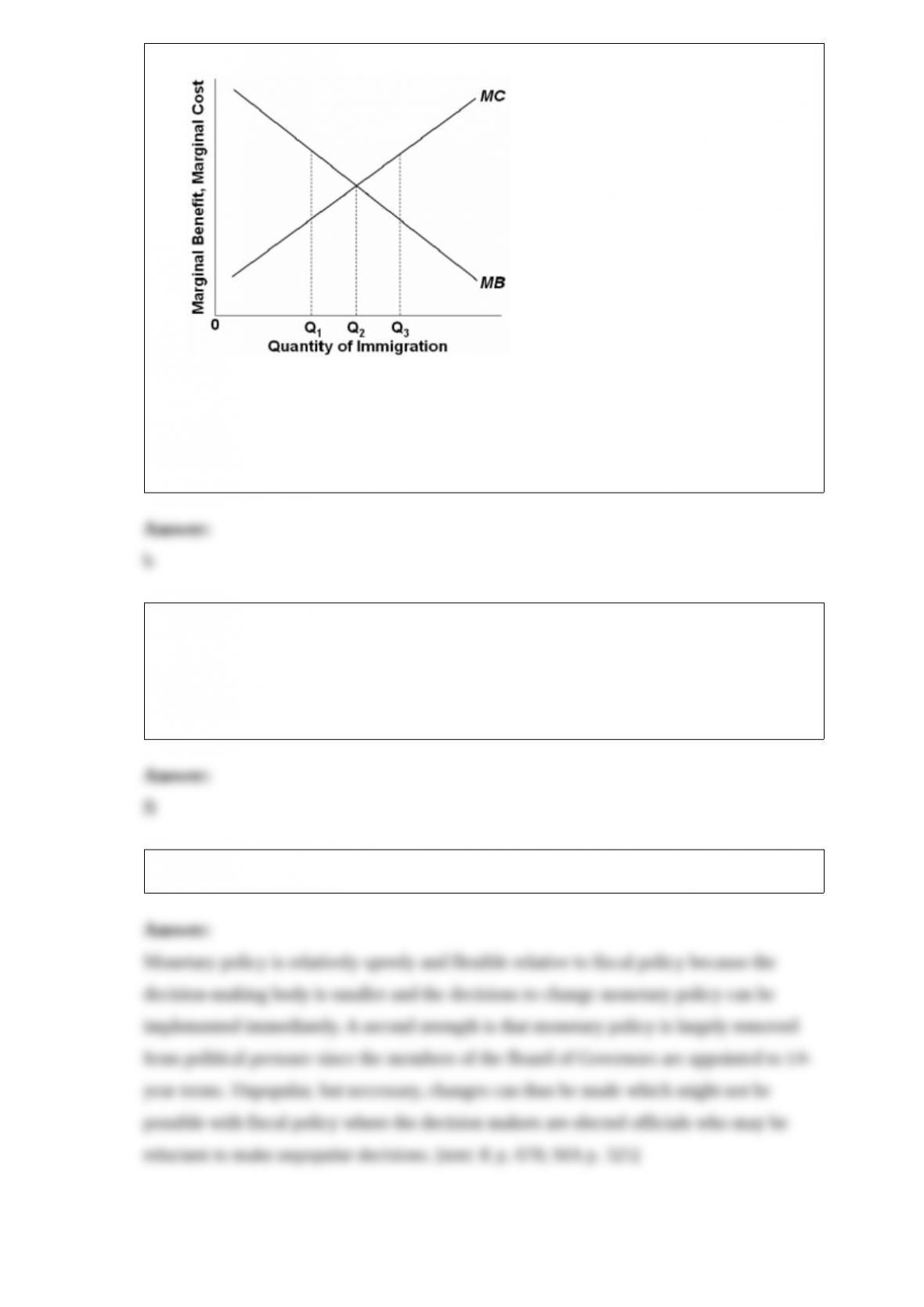
16) The table below shows the quantity of gold bars (Qb) in thousands, the extraction
cost for each thousand bars (in millions of dollars), and user cost of each thousand bars
(in millions of dollars) facing the OZ Mining Company this year.
Suppose that a new government regulation is going to shut down OZ’s mining operation
1 year from now. Assuming that all gold extracted is sold in the same year (cannot be
stockpiled for later sale), how will the regulation affect the user cost?
A.It will have no effect on the user cost.
B.The effect on the user cost cannot be determined.
C.The user cost will rise because the rate of extraction will rise.
D.The user cost will become zero because they will not be able to extract in the future.
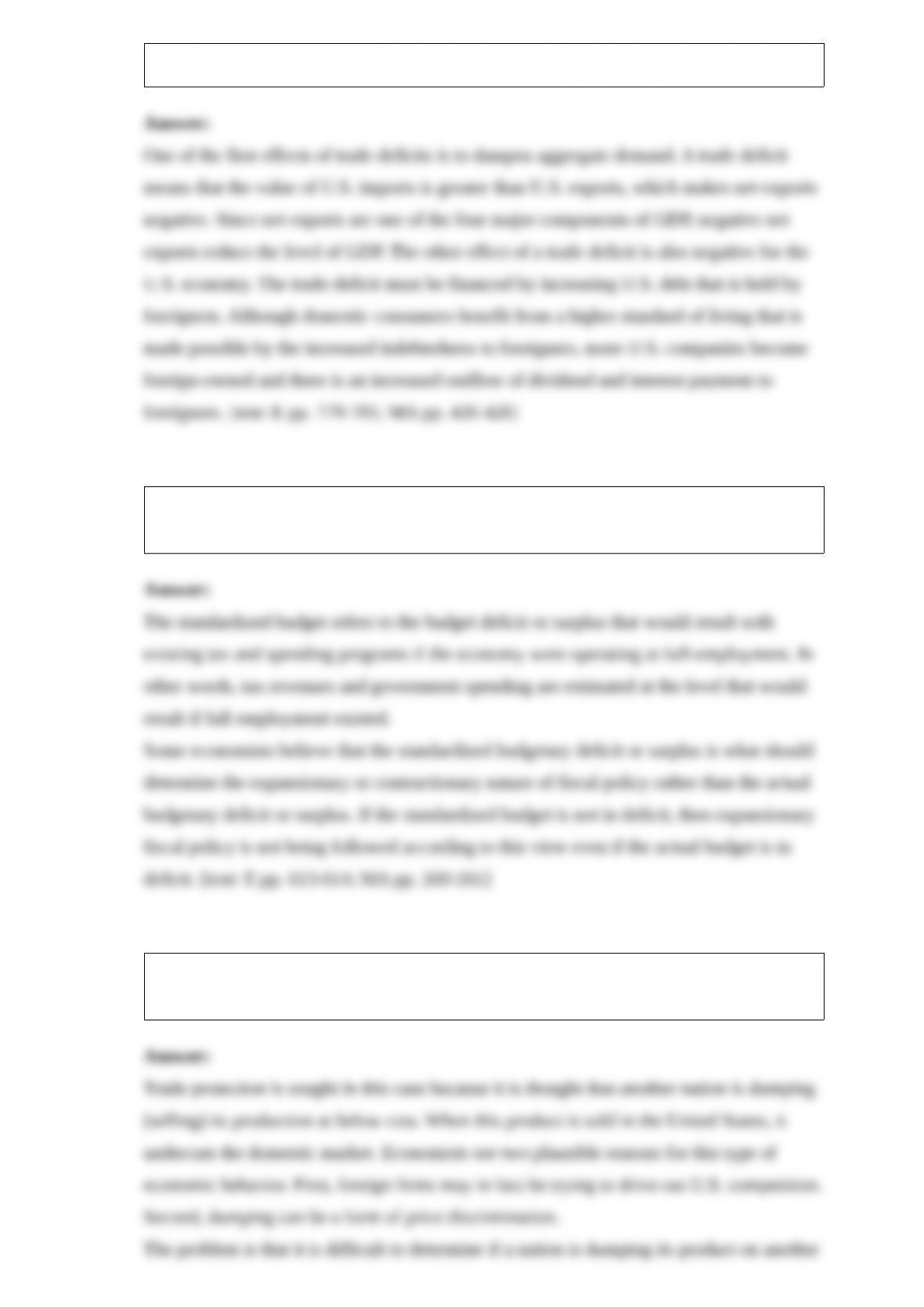
17)
refer to the above figure. the optimal level of immigration in this country:
a.is q1.
b.is q2.
c.is q3.
d.cannot be determined with the information given
18) Which of the following is a noncash transfer?
A.a payment to a divorced mother under TANF
B.food stamps
C.a social security payment to a retiree
D.unemployment compensation benefits
19) Explain two strengths of monetary policy for achieving economic stability.
20) What effects do U.S. trade deficits have on the U.S. economy?
21) What does the standardized budget measure and of what significance is this
concept?
22) What is the problem with protecting industries in the United States from the
dumping of foreign products on the domestic market?
23) How does the invisible hand work in a competitive market system?