
1) if a country realizes a current-account deficit in its balance of payments, it becomes a
net supplier of funds to the rest of the world.
a.true
b.false
2) important trading partners of the united states include canada, mexico, japan, and
china.
a.true
b.false
3) a nation experiences external balance if it achieves:
a.no net changes in its international gold stocks
b.productivity levels equal to those of its trading partners
c.an increase in its money supply equal to increases overseas
d.equilibrium in its balance of payments
4) under the gold standard, a nation with a current-account surplus would realize gold
outflows, a decrease in its money supply, and a fall in its domestic price level.
a.true
b.false
5) the theory of reciprocal demand asserts that as the u.s. demand for canadian wheat
rises, the equilibrium terms of trade improve for the united states.
a.true
b.false
6) a primary reason why nations conduct international trade is because:

a.some nations prefer to produce one thing while others produce other things
b.resources are not equally distributed among all trading nations
c.trade enhances opportunities to accumulate profits
d.interest rates are not identical in all trading nations
7) international trade forces domestic firms to become more competitive in terms of:
a.the introduction of new products
b.product design and quality
c.product price
d.all of the above
8) the commodity terms of trade measures
a.the rate at which exports exchange for imports
b.the influence trade has on productivity levels
c.the effect on income of the trading nation
d.the improvement in a nation’s welfare
9) figure 6.3 represents the iraqi computer market. assume iraq purchases all of its
computers from the united states.
figure 6.3 iraqi computer market and economic sanctions
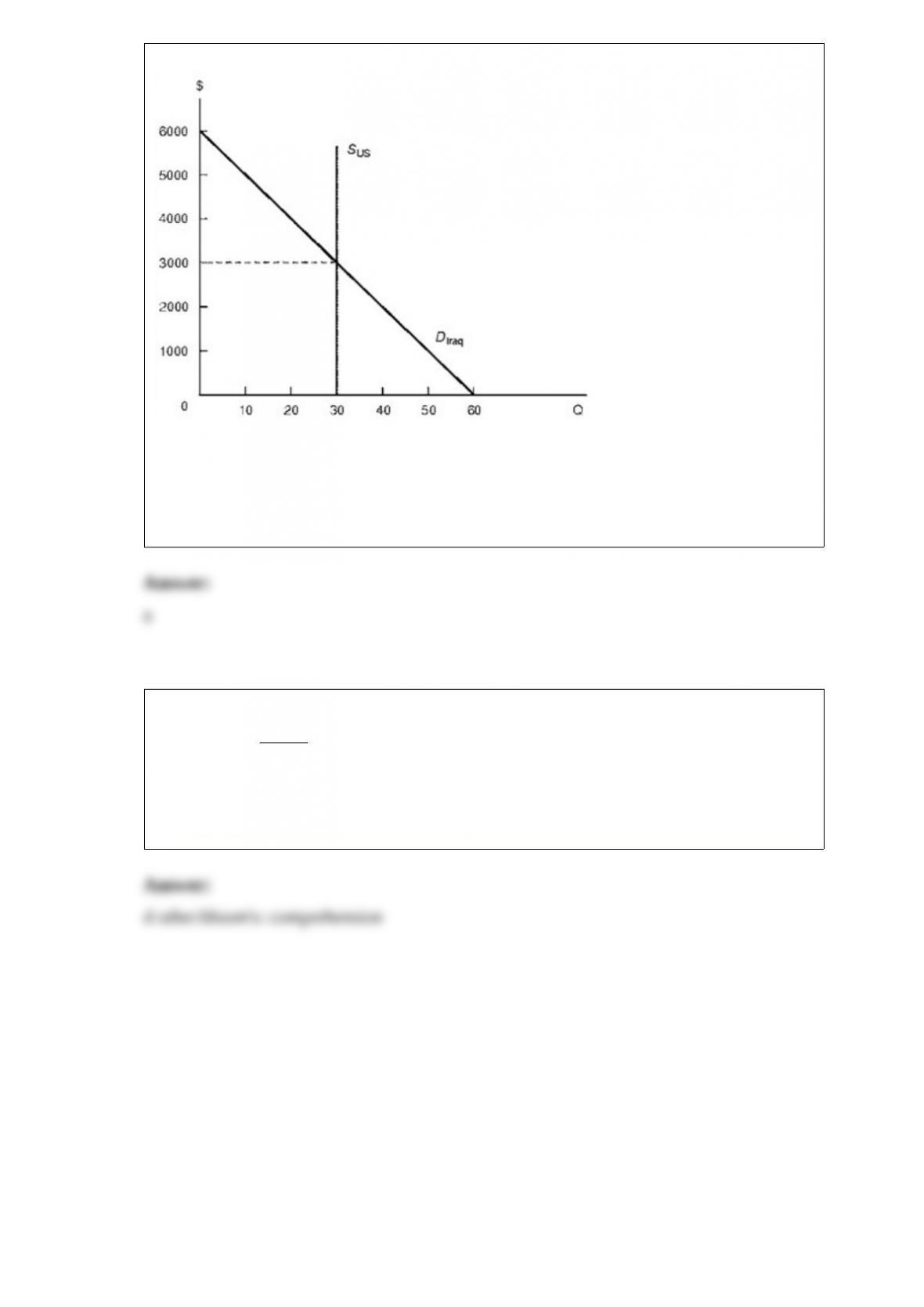
consider figure 6.3. for the united states, the export quota results in a (an):
a.improvement in its terms of trade with iraq
b.increase in its export revenue
c.increase in domestic computer prices
d.decrease in domestic consumer surplus
10) free traders maintain that an open economy is advantageous in that it provides all of
the following except:
a.increased competition for world producers
b.a wider selection of products for consumers
c.the utilization of the most efficient production methods
d.relatively high wage levels for all domestic workers