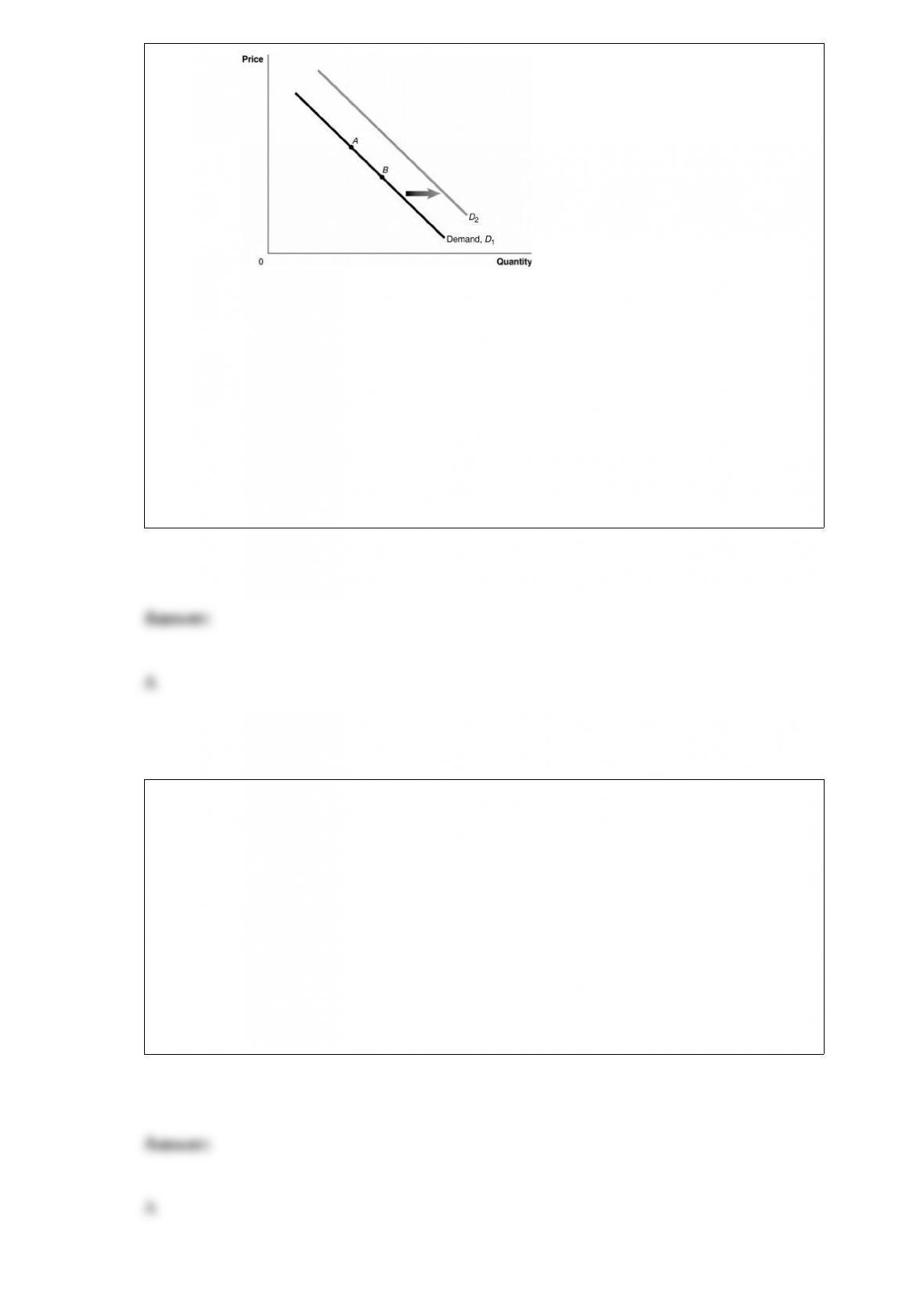
Figure 3-1
A decrease in the price of the product would be represented by a movement from
A) A to B.
B) B to A.
C) D1 to D2.
D) D2 to D1.
U.S. taxpayers spend many hours during the year maintaining records for tax purposes
and preparing their income tax returns. This administrative cost
A) is part of the deadweight loss of taxation.
B) is equal to the value of consumer surplus associated with the income tax system.
C) can be claimed as a deduction on income tax returns.
D) is larger for individuals in the lowest income quintile than for individuals in the
highest income quintile.

Article Summary. In an attempt to discourage smoking, New York City Mayor
Michael Bloomberg proposed a bill which would set a $10.50 minimum price for a
pack of cigarettes. The bill would also prohibit retailers from offering any
discounts such as 2-for-1 offers or accepting discount coupons. New York City
already has the highest cigarette tax in the country, at $5.85 per pack, and the state
of New York is one of many which already require cigarettes be marked up by a
specified percentage. This bill is a companion to one which would require stores to
keep tobacco products hidden from sight. Although the bills are expected to be
challenged in court, a precedent has been set in Rhode Island, where a court
upheld a ruling allowing the city of Providence to forbid retailers from accepting
coupons and offering discounts on cigarettes.
Source: Vivian Yee, “Bloomberg Seeks End to Cheap Cigarettes,” New York Times,
March 26, 2013.
The minimum price of $10.50 per pack of cigarettes being proposed by mayor
Bloomberg would have which of the following effects on the market for cigarettes?
A) Consumer surplus will decrease.
B) Some producer surplus will be transferred to consumers.
C) Deadweight loss will decrease.
D) Marginal benefit will be less than marginal cost.
Suppose Argyle Sachs has to choose between building a smaller sweater factory and a
larger sweater factory. In the following graph, the relationship between costs and output
for the smaller factory is represented by the curve ATC1, and the relationship between
costs and output for the larger factory is represented by the curve ATC2.
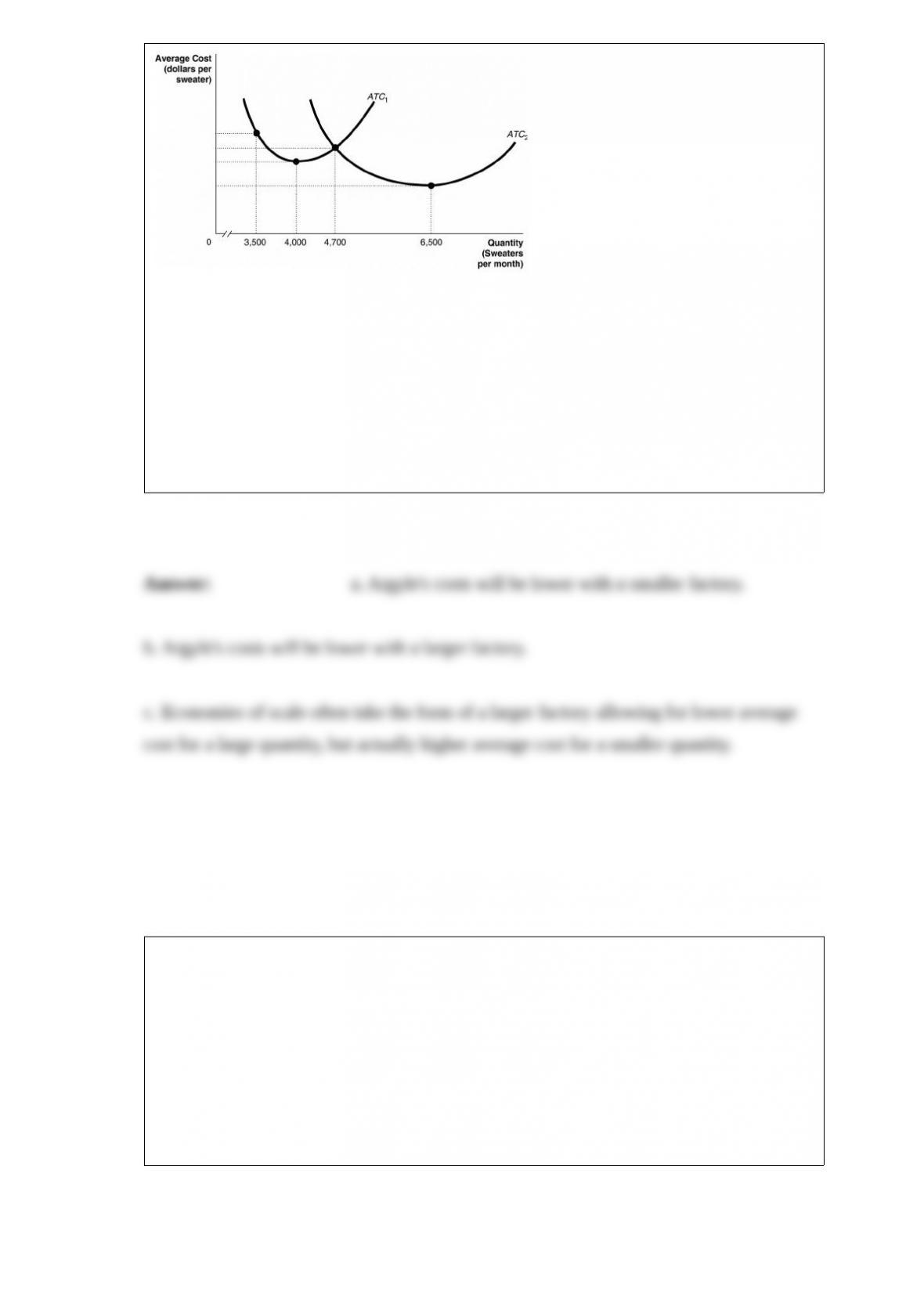
a. If Argyle expects to produce 3,600
sweaters per month, should he build a smaller factory or a larger factory? Briefly
explain?
b. If Argyle expects to produce 5,000 sweaters per month, should he build a smaller
factory or a larger factory? Briefly explain.
c. If the average cost of producing sweaters is lower in the larger factory when Argyle
produces 6,500 sweaters per week, why isn’t it also lower when Argyle produces 4,000
sweaters per week?
Which of the following is a normative statement about economic growth?
A) Economic growth is associated with higher labor productivity growth.
B) Economic growth increases GDP per capita.
C) Economic growth hurts developing countries.
D) Foreign direct investment stimulates economic growth.
A tragedy of the commons occurs when a resource is
A) rival and excludable.
B) ) rival and non-excludable.
C) non-rival and non-excludable.
D) non-rival and excludable.
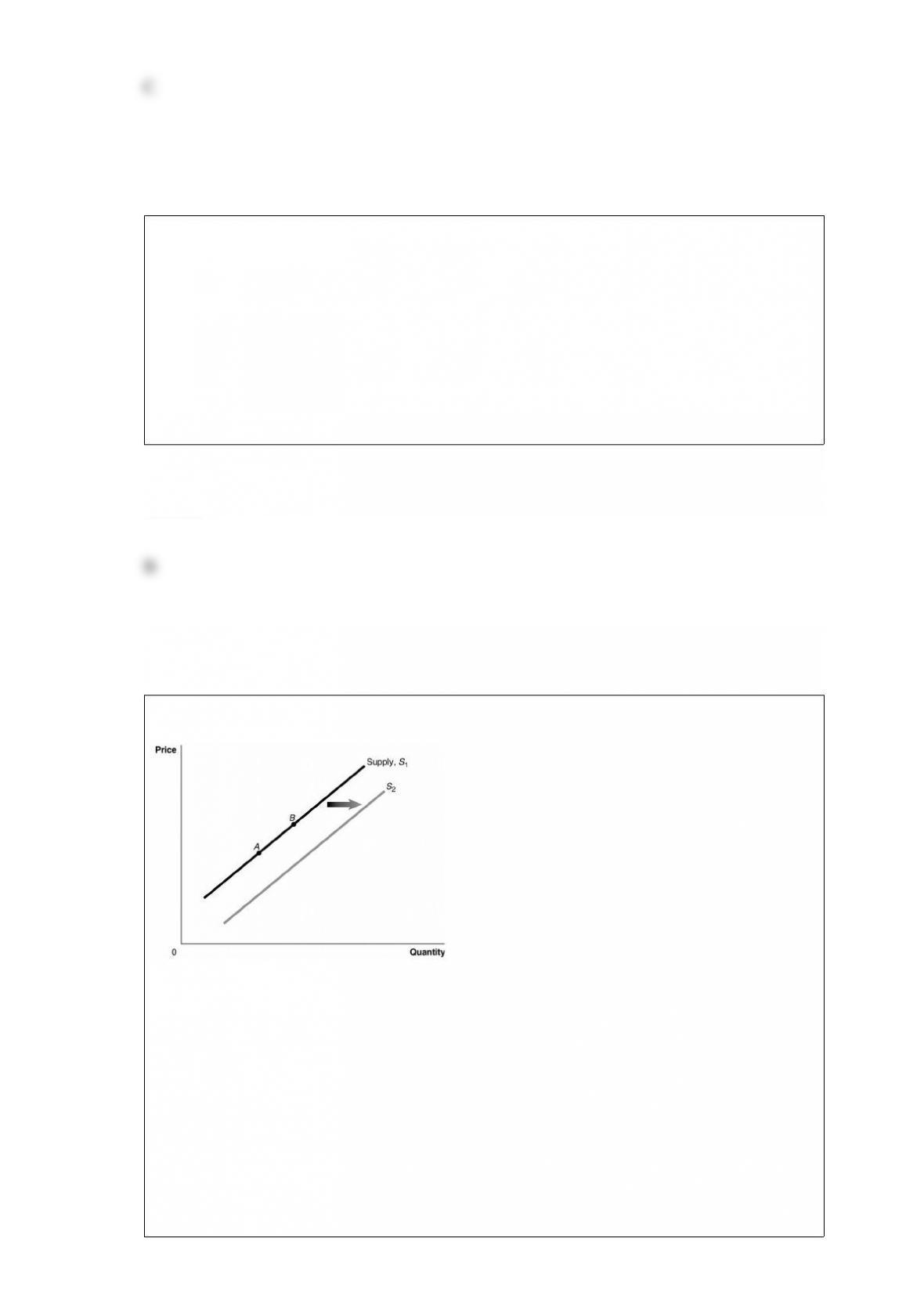
Figure 3-2
An increase in the number of firms in the market would be represented by a movement
from
A) A to B.
B) B to A.
C) S1 to S2.
D) S2 to S1.

Insurance companies typically charge women lower prices than men for automobile
insurance. Is this an example of price discrimination?
A) No, because, on average, women have better driving records than men and the costs
of insuring men are greater than the costs of insuring women.
B) Yes, because the costs of selling insurance to men and women are the same.
C) Yes, because insurance companies can prevent arbitrage; that is, women cannot
transfer their insurance coverage to men.
D) No, because there are too many insurance companies for any one company to have
market power. A firm must possess market power in order to practice price
discrimination.
The federal budget deficit and the trade balance are often referred to as the
A) balance of payments.
B) dueling depreciators.
C) twin deficits.
D) national debt.

The price elasticity of demand for Stork ice cream is -4. Suppose you’re told that
following a price increase, quantity demanded fell by 10 percent. What was the
percentage change in price that brought about this change in quantity demanded?
A) 40 percent
B) 25 percent
C) 2.5 percent
D) 0.4 percent
On the 45-degree line diagram, the 45-degree line shows points where
A) real income equals real GDP.
B) real aggregate expenditure equals C + I.
C) real aggregate expenditure equals real GDP.
D) real aggregate output equals the quantity produced.
Figure 6-10
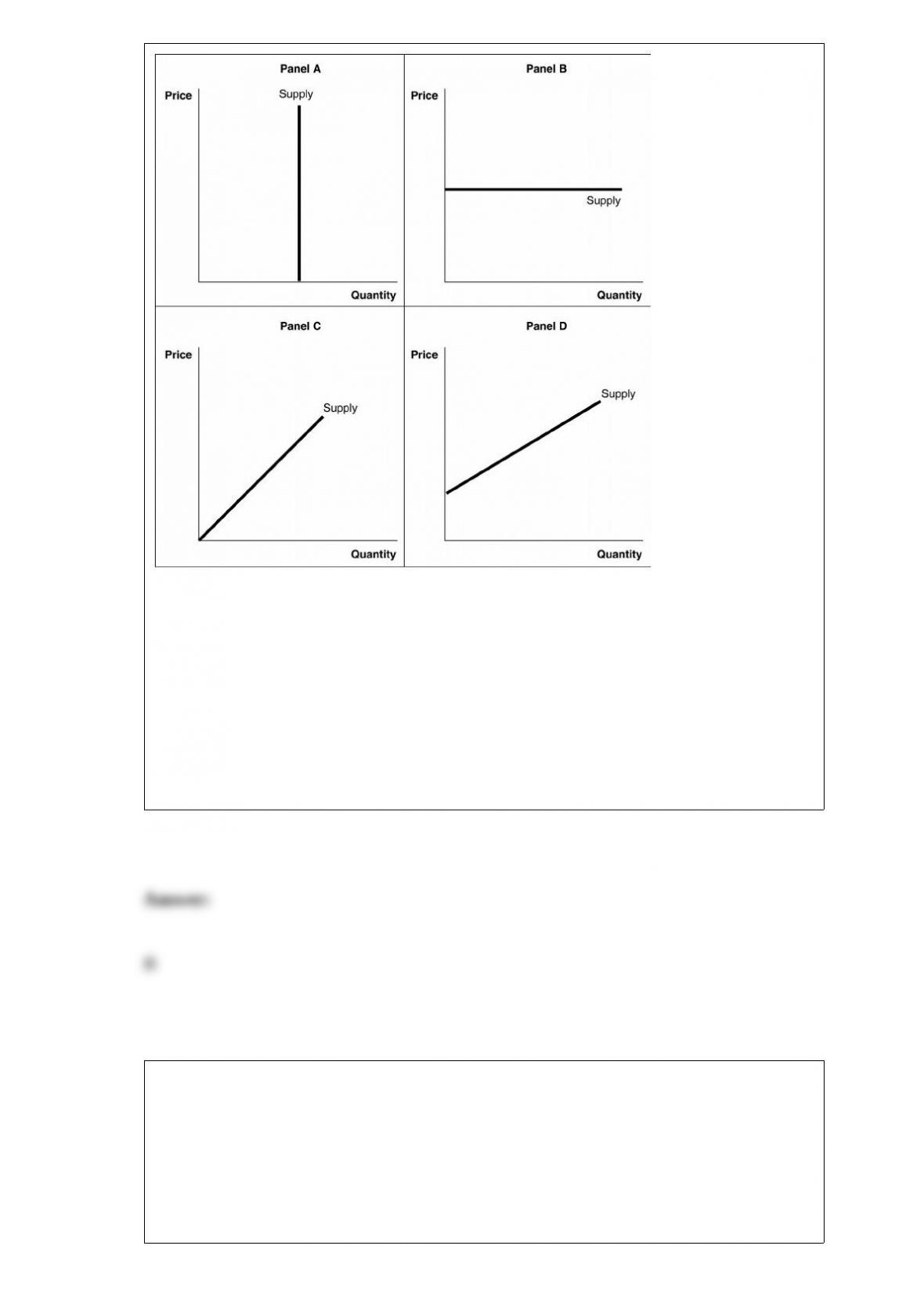
A perfectly elastic supply curve is shown in
A) Panel A.
B) Panel B.
C) Panel C.
D) Panel D.
A decision by foreign central banks to sell their holdings of U.S. Treasury bonds will
A) lower bond prices and interest rates in the United States.
B) increase bond prices and interest rates in the United States.
C) increase bond prices and lower interest rates in the United States.

D) lower bond prices and increase interest rates in the United States.
Which of the following is not an advantage of starting a new business as a corporation?
A) separation of ownership and business liability
B) enhanced ability to raise funds
C) ability to share risks
D) possibility of double taxation
According to Joseph Schumpeter, which of the factors of production is central to
economic growth?
A) land
B) labor
C) natural resources
D) the entrepreneur
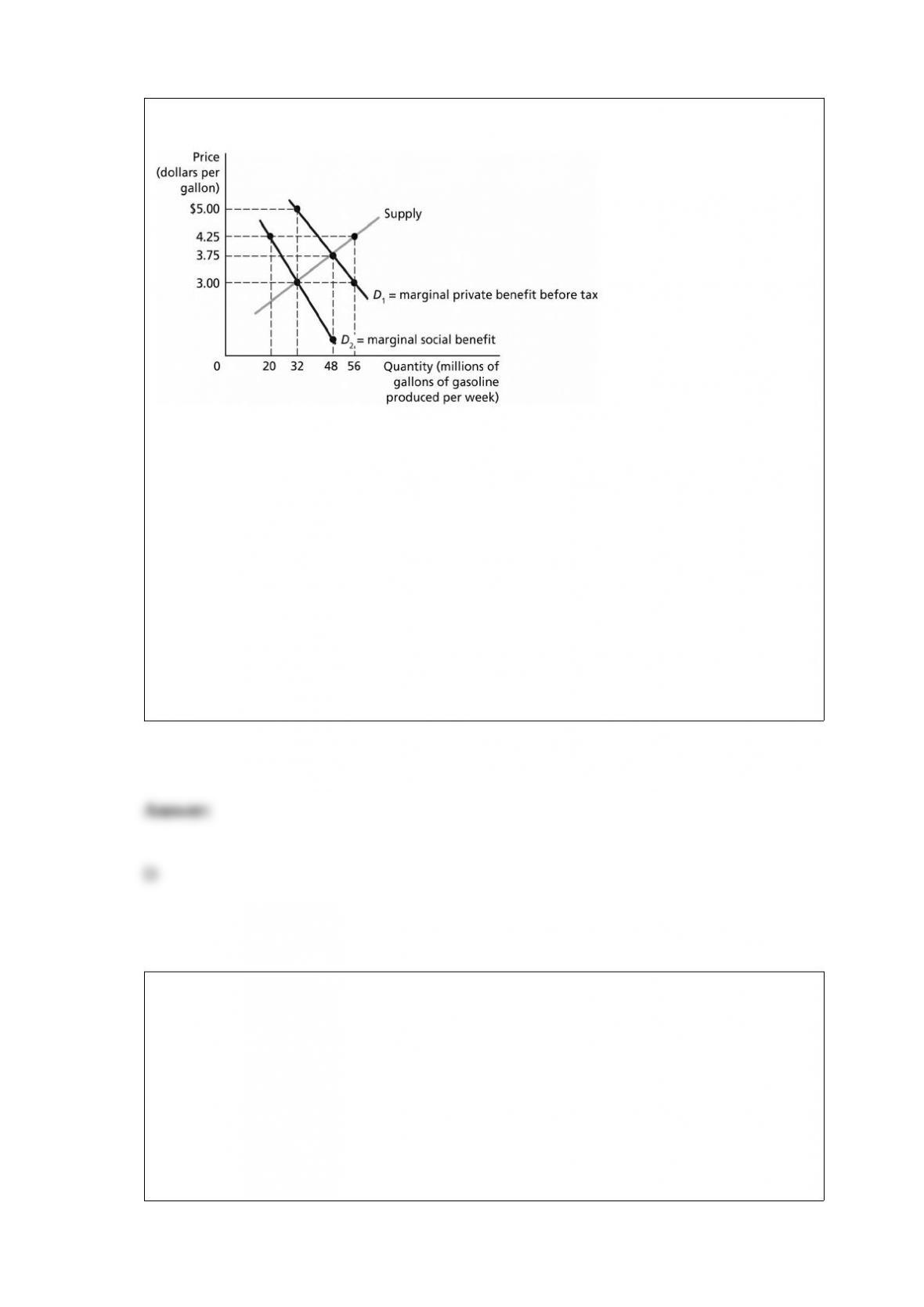
Figure 5-13
Figure 5-13 illustrates the
market for gasoline before and after the government imposes a tax to bring about the
efficient level of gasoline production.
The actual price of gasoline paid by consumers after the tax is implemented is
________ per gallon.
A) $3.00
B) $3.75
C) $4.25
D) $5.00
The phrase “demand has increased” means that
A) a demand curve has shifted to the left.
B) there has been an upward movement along a demand curve.
C) there has been a downward movement along a demand curve.
D) a demand curve has shifted to the right.

One reason Starbucks experienced a decline in sales in the late 2000s is because
A) the product they offered was becoming less differentiated from their competitors’
products.
B) the coffeehouse market transitioned from being monopolistically competitive to
perfectly competitive.
C) barriers to entry became more restrictive in the coffeehouse market.
D) the number of competitors in the market declined dramatically.