
Tax Problem. Consider a perfectly competitive market were demand is Q = 100 – P and
Supply isQ = P – 10.
In the absence of any government intervention (e.g. taxes or price controls), the market
equilibrium is
a. P = 45, Q = 45
b. P = 55, Q = 45
c. P = 45, Q = 55
d. P = 55, Q = 55
Why are corporate executives are often guaranteed “golden parachutes” if they should
be fired?
a. To give them the incentive to take the higher levels of risk desired by stockholders.
b. To ensure that they exercise great caution in spending stockholders’ money.
c. To encourage the most experienced people to apply for the executive positions.
d. To provide a signal to the public that the firm is on solid financial ground.
To construct an ordinary demand curve for good X,

a. change the price of good X in the consumer choice diagram and observe the change
in the quantity of good X among the optimum market baskets.
b. change the prices of both goods in the consumer choice diagram and observe the
change in the quantity of good X among the optimum market baskets.
c. change the price of good Y in the consumer choice diagram and observe the change
in the quantity of good X among the optimum market baskets.
d. change the consumer’s income in the consumer choice diagram and observe the
change in the quantity of good X.
People tend to “dress up” for job interviews, even though their clothes do not make
them more productive in their positions. This situation is an example of
a. signaling.
b. adverse selection.
c. the principal-agent problem.
d. moral hazard.
If Hispanics are paid less than their marginal product, then
a. cooperation among firms can perpetuate this wage discrimination.

b. employers can engage in discrimination at zero cost.
c. nondiscriminating firms will hire more Hispanics.
d. whites will be paid compensating differentials.
The absolute price of a commodity is the amount of
a. other goods that must be sacrificed in order to purchase one unit of the commodity.
b. resources required to produce one unit of the commodity.
c. currency needed to purchase one unit of the commodity.
d. time and effort used to develop a market for the buying and selling of the commodity.
All of the following can be true about the optimal basket consumed by a consumer,
except
a. The basket is on the budget line.
b. The person is spending all of their money on the basket.
c. The basket is on the highest indifference curve.
d. The budget line is tangent to an indifference curve at the optimal basket.

According to the Invisible Hand Theorem, when competitive markets are used to
allocate resources,
a. no further gains from trade can be created.
b. selfish behavior will cause socially undesirable outcomes.
c. the resulting distribution of income will be fair and equitable.
d. each good’s price will equal the value of the labor used in its production.
The term demand refers to
a. a collection of numbers, listing the quantities demanded at a variety of hypothetical
prices.
b. the information on tastes, incomes, and prices needed to determine people’s desired
purchases of a commodity.
c. the amount of a commodity that is being purchased under current market conditions.
d. the quantity purchased at each and every possible level of income.

If a firm has monopoly power in the market for its output, the marginal revenue product
of labor
a. is no different than for a competitive firm.
b. is less for each unit of labor than for a competitive firm.
c. continuously slopes upward instead of turning downward.
d. is greater for each unit of labor than for a competitive firm.
An explanation for how the price of water can be less than the price of diamonds, even
though water is more valuable, is that
a. price is a poor guide to value.
b. markets for water and diamonds are not competitive.
c. price reflects marginal value, not total value.
d. diamond production requires more labor, and value is based on labor.

In the indifference curve-budget line model of labor supply, labor consists of
a. all productive activities outside of the marketplace.
b. working in the marketplace for the going wage.
c. engaging in productive activities, whether in the marketplace or not.
d. working in the marketplace for the going wage and entrepreneurial activities.
When the price of a good rises, the resulting change in relative price causes the
consumer to reduce his quantity demanded of that good, even when the consumer is
income-compensated so that he remains indifferent about the price change. This
observation is known as the
a. Giffen good phenomenon.
b. law of demand.
c. substitution effect.
d. income effect.
By setting MR = MC, a competitive firm decides to sell 100 units when the market
price is $20. The average cost of producing the 100 units is $18 per unit. If the firm has
fixed costs of $500, then the firm should
A firm is currently producing at a level where its MC = 10 and its MR = We can
conclude that this firm is
a. profit maximizing.
b. under-producing.
c. over-producing.
d. no definite conclusion can be made about the firm’s level of production.
Which of the following is excludable but not rivalrous in consumption?
a. Cable television

b. Non congested toll roads
c. Near empty gold courses.
d. All of the above.
With an increase in income, we can predict that a consumer will choose a new market
basket
a. on a lower indifference curve.
b. on the same indifference curve but the new budget line.
c. on a higher indifference curve that passes through the new budget line.
d. on a higher indifference curve that is tangent to the new budget line
Which of the following is a good example of a firm that is not likely to be perfectly
competitive?
a. Farmer Joe’s wheat.
b. Coyote Wile’s beef ranch.
c. Captain John’s salmon farm.
d. Aviator Alan’s nonstop airline service from Seattle to Nome.
Sales Tax
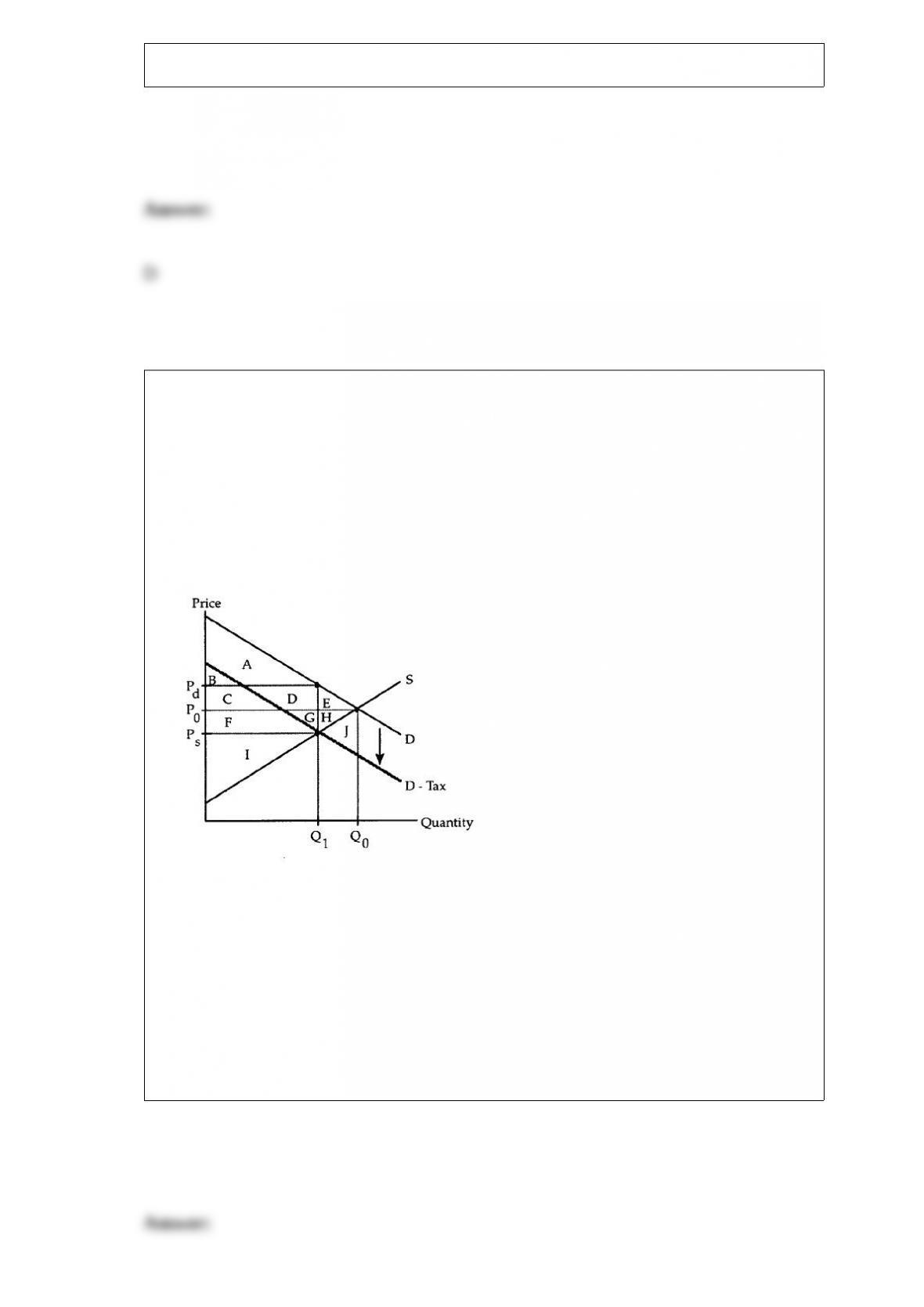
The following questions refer to the accompanying diagram which shows the effects of
a sales tax imposed on consumers. The initial price and quantity are P0 and Q0,
respectively. After the tax is imposed, the equilibrium quantity is Q1, firms receive the
price Ps, and consumers pay the price Pd.
After the tax is imposed, social welfare is equal to
a. area A + D + E + G + H + J.
b. area B + C + F + I – J.
c. area A + B + C + D + E + F + G + H + I.
d. area A + B + C + D + F + G + I.

In rate-of-return regulation, a monopoly is required to have zero
a. profit.
b. rent.
c. producer’s surplus.
d. deadweight loss.
The price elasticity of cigarettes has been estimated as -0.5. The government has
decided that they want to decrease the amount that people in the United States smoke
by 10%. It follows that they must institute measures that would raise the price of
cigarettes by
a. 5%
b. 10%
c. 15%
d. 20%

Farmer Joe grows wheat on land that is bought and paid for. He figures her profit per
acre is $60 because each he puts $30 of purchased inputs onto each acre, $10 worth of
his time into working on each acre, and the harvested wheat sells for $100. Farmer Joe
a. has correctly calculated her economic profit.
b. has forgotten to include the opportunity cost of the land in her calculation of profit.
c. should not have included the value of her time in calculating profits.
d. should sell her wheat only for a price that would bring a higher profit.
In the short run, a competitive firm will
a. Will produce a quantity where AC = MR.
b. Will produce a quantity where AVC = MR.
c. Will produce a quantity where MC = MR.
d. Will shut down if price falls below the minimum of average costs.
Under a strict liability standard, the person who causes an accident is liable
a. whether or not he has been negligent.
b. if he could have prevented the accident at a cost less than the damages caused.

c. if he could have prevented the accident at a cost less than the damages caused times
the probability of the accident’s occurrence.
d. unless the plaintiff could have prevented the accident at a cost less than the damages
incurred times the probability of the accident’s occurrence.
The adverse selection process is prevalent in the used car market because
a. only poorer people are likely to purchase used cars.
b. sellers know more about the vehicles being sold than do potential buyers.
c. the price of the car sends a signal about its quality.
d. so many consumers are adverse to buying used cars.
People will continue to use a common property until the marginal cost of using it equals
a. zero.
b. the social marginal benefit from using it.
c. the admission fee that a competitive firm would charge for its use.
d. the value they receive, on average, from using it.
Monopoly Problem. Consider a monopoly with constant marginal costs of $20.
Consumers in the market for this monopoly’s product have demand of Q = 100 – 2P.
This monopoly will charge
a. $20
b. $25
c. $30
d. $35
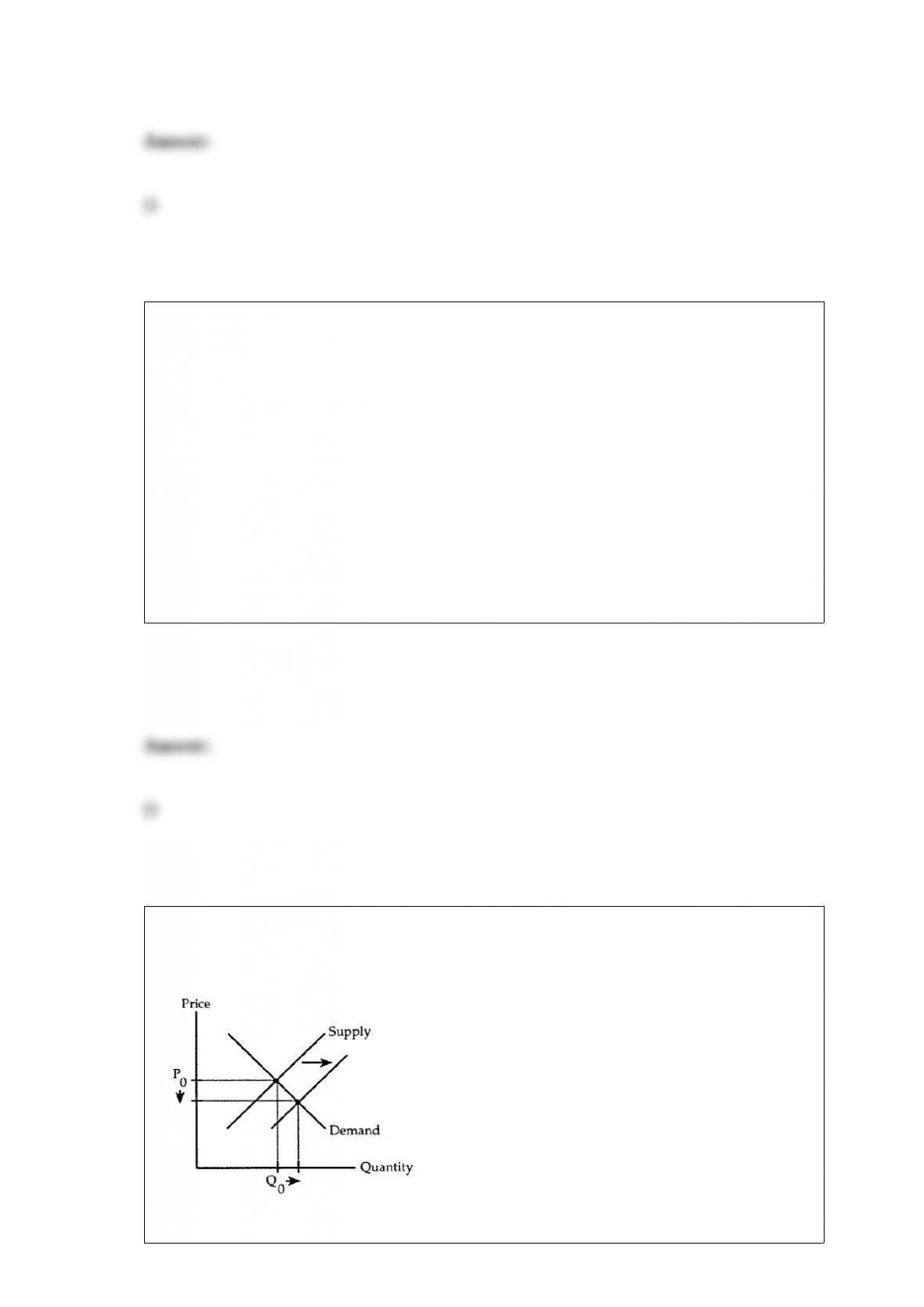
The accompanying supply-demand diagram shows the market for calculators. The
initial price of calculators is P0, and the initial quantity exchanged is Q0.

Which of the following situations could be correctly illustrated by the diagram?
a. Graphing capabilities and other new features lead people to buy more calculators.
b. The cost of memory chips used in calculators falls, lowering the price of calculators.
c. Personal computerized notepads with substantial computing power are introduced,
reducing people’s need for calculators.
d. A heavy tariff is placed on calculators imported from overseas.
The price of wine has risen from $7 to $9 per bottle and the price of cheese has fallen
from $6 to $5 per pound, while Anne’s income has stayed fixed at $46 per week. Since
the price changes, Anne has been buying 4 bottles of wine and 2 pounds of cheese per
week. We can conclude that
a. Anne is indifferent about the price changes.
b. Anne is worse off after the price changes.
c. Anne is better off after the price changes.
d. Anne may be worse off, better off, or indifferent after the price changes.
Amanda can prepare a Thai meal for a group in 2 hours and can type a 10 page paper in
the same amount of time. Morgan can prepare the meal in 3 hours. Morgan will be the
more efficient typist as long as she can type the a paper in less than

a. 4 hours.
b. 3 hours.
c. 2 hours.
d. 1 hour.
When the annual interest rate is 10 percent, what is the present value of receiving a
payment of $10,000 three years from now?
a. $13,310.00.
b. $11,111.11
c. $9,000.00
d. $7,513.15
Prices are commonly measured in “dollars per unit.” In this context, the term dollar as
used by the microeconomist
a. is another term for currency.
b. refers to a representative basket of goods in the economy.
c. represents the resources used in the production of the good being considered.
d. means that the price has been adjusted for inflation.
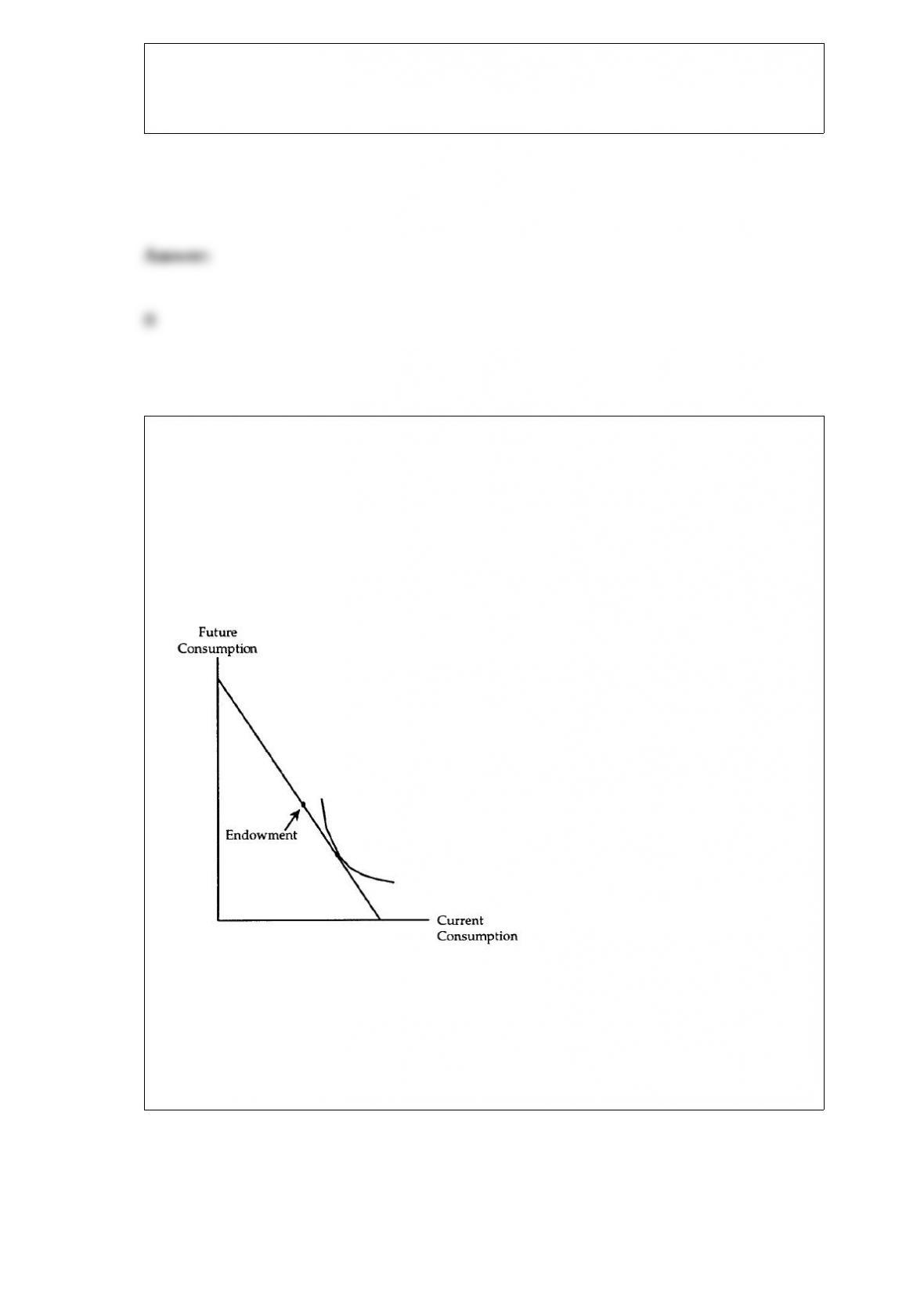
Consider the following:
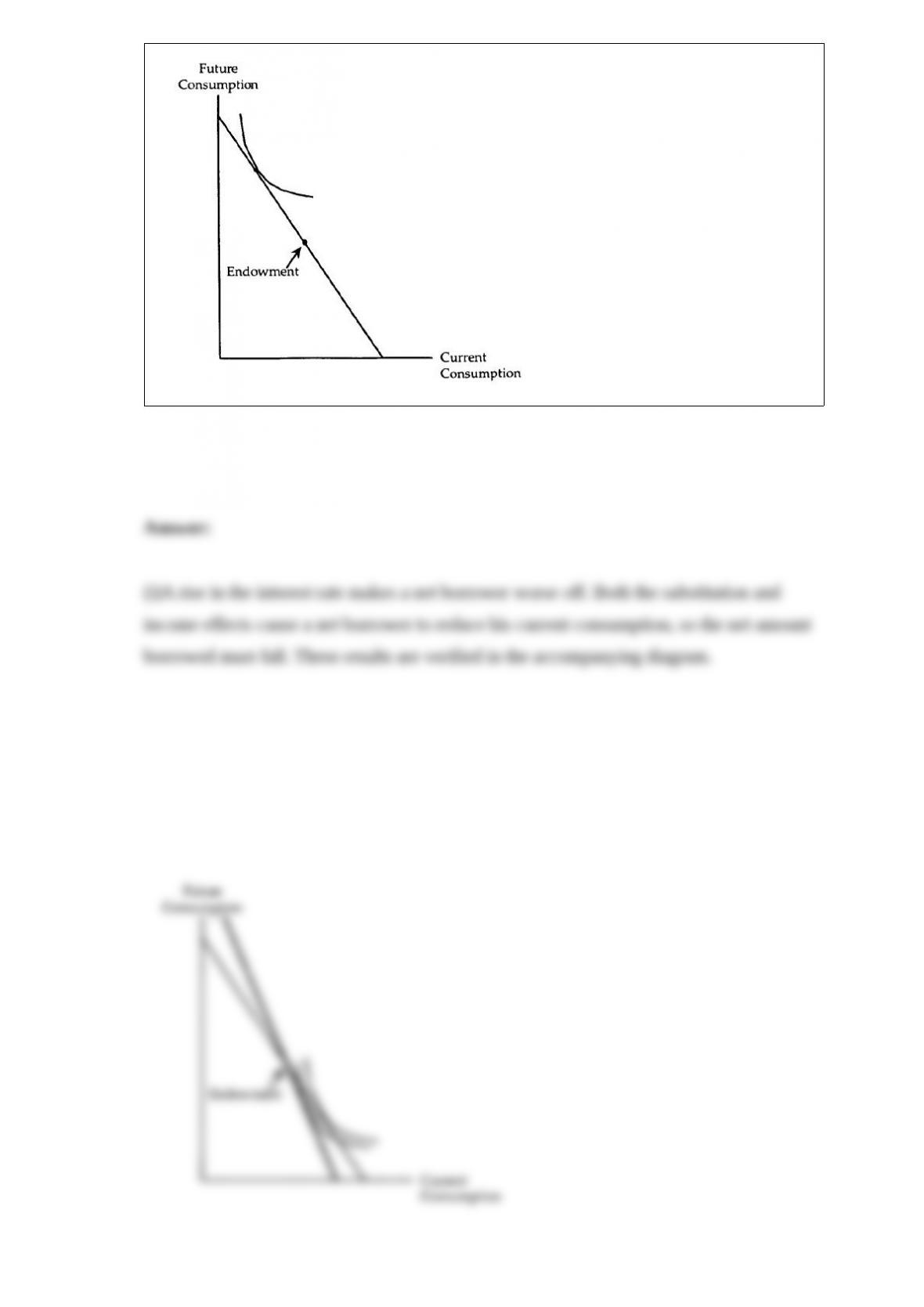
(i)The accompanying diagram shows a net borrower. Complete the diagram to show
how a net borrower is affected by a rise in the interest rate. Is the net borrower better off
or worse off? Does the net amount borrowed increase or decrease? Explain, using
substitution and income effects.
(ii)The accompanying diagram shows a net lender. Complete the diagram to show how
a net lender is affected by a rise in the interest rate. Is the net lender better off or worse
off? Does the net amount lent increase or decrease? Explain, using substitution and
income effects.
If a monopoly desires to raise its profits, it can simply raise the price it charges.
Since the quantity of good X is measured along the horizontal axis when drawing
indifference curves and demand curves, both can be drawn in the same diagram.
Why do economists insist on assuming that people behave rationally, when such an
assumption is clearly false?
People use a common property up to the point where the marginal cost of using it
equals the social marginal benefit received from it.
Human capital tends to increase over the course of a person’s life.
Efficient financial markets are called so because they produce an amount of financial
products that maximizes total surplus in the financial industry.
A competitive industry is a viable alternative to a natural monopoly.
Consider the following:
CAPM is often criticized because it only places importance on an asset’s return, but not
on how rick it is.
The Marginal Benefit of consuming an additional unit of a good tends to increase as the
number of units consumed increases.
The problem with splitting checks is that no one orders as much as they truly want to
eat in order to keep the total bill low.
When labor and capital are complements in production, a higher wage will cause a firm
to use more capital in the long run.
How is the marginal product of labor calculated? As the firm increases its output, what
pattern will we observe in the marginal product of labor and why does it occur?
If the consumer has the same tax bill under a head tax as under an income tax, then the
consumer will be indifferent between the two taxes.

A competitive firm will exit an industry in the long run if the market price falls below
the firm’s break-even price.
An economic model, even if unrealistic, is useful as long as it makes predictions that
are realistic.
A buy-out is more likely to delay a rival’s reemergence than is predatory pricing.

When suppliers are not satisfied, they lower their prices to attract more demanders.