
Which of the following has not contributed to the overall decline in death rates in the
United States since 1981?
A) a decline in smoking
B) the decline in the population
C) the availability of new prescription drugs
D) new surgical techniques
Which of the following statements is true?
A) Consumer surplus under perfect price discrimination is greater than under
single-price monopoly pricing.
B) Consumer surplus under an optimal two-part tariff is greater than that under
single-price monopoly pricing.
C) Although consumers reap some consumer surplus under a single-price monopoly,
society is better off with optimal two-part tariff pricing.
D) Of the three pricing schedules, single-price monopoly, an optimal two-part tariff and
perfect price discrimination, profit is highest under single-price monopoly pricing.
Table 10-7
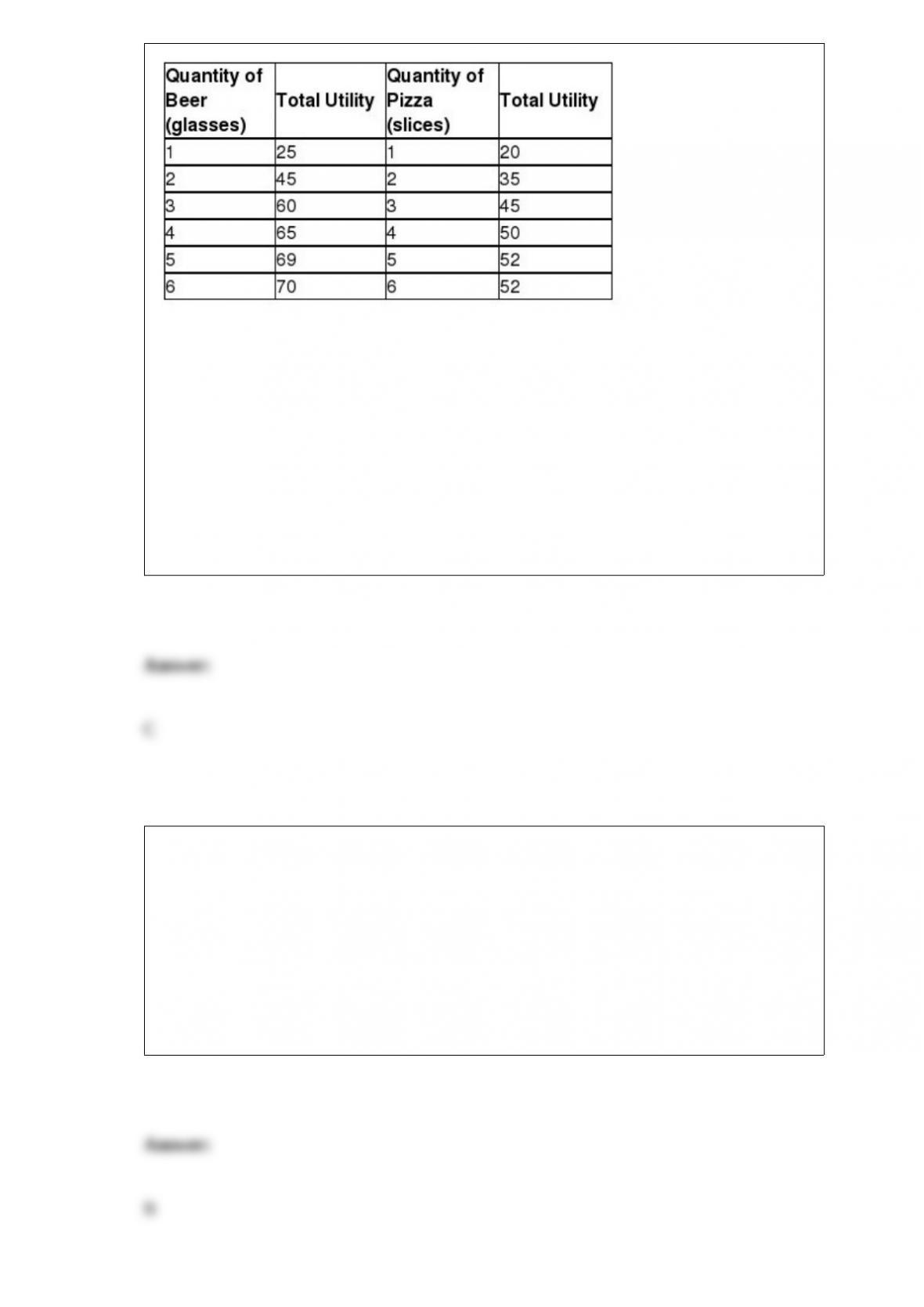
Table 10-7 shows Antonio’s utility from beer and pizza. Suppose Antonio has $10 to
spend and the price of beer = $2 per glass and the price of pizza = $2 per slice. How
many of each good will he consume when he maximizes his utility?
A) 2 glasses of beer, 1 slice of pizza
B) 2 glasses of beer, 3 slices of pizza
C) 3 glasses of beer, 2 slices of pizza
D) 4 glasses of beer, 5 slices of pizza
Adam Smith’s behavioral assumption about humans was that people
A) typically act irrationally.
B) usually act in a rational, self-interested way.
C) are consistently greedy.
D) typically act randomly.

M1 includes
A) currency in circulation, checking account deposits in banks, and holdings of
traveler’s checks.
B) currency in circulation, savings account balances, and checking account deposits in
banks.
C) currency in circulation, savings account balances, checking account deposits in
banks, and holdings of traveler’s checks.
D) coins, savings account balances, traveler’s checks.
Technological advances generally result in
A) decreased incomes.
B) increased life expectancy.
C) increased infant mortality rates.
D) increased average number of hours worked per day.
Firms pay famous individuals to endorse their products because
A) apparently demand is affected not just by the number of people who use a product
but also by the type of person that uses the product.

B) the firms are irrational and are wasting advertising expenditures.
C) famous people obviously know what are the best goods and services.
D) famous people only consume high quality products.
Laura’s Pizza Place incurs $800,000 per year in explicit costs and $100,000 in implicit
costs. The restaurant earns $1.3 million in revenues and has $5 million in net worth.
Based on this information, what is economic profit for Laura’s Pizza Place?
A) $200,000
B) $400,000
C) $500,000
D) $2.8 million
When the government runs a budget deficit, we would expect to see that
A) private saving will fall.
B) investment will fall.
C) G + TR < T.
D) public saving is positive.
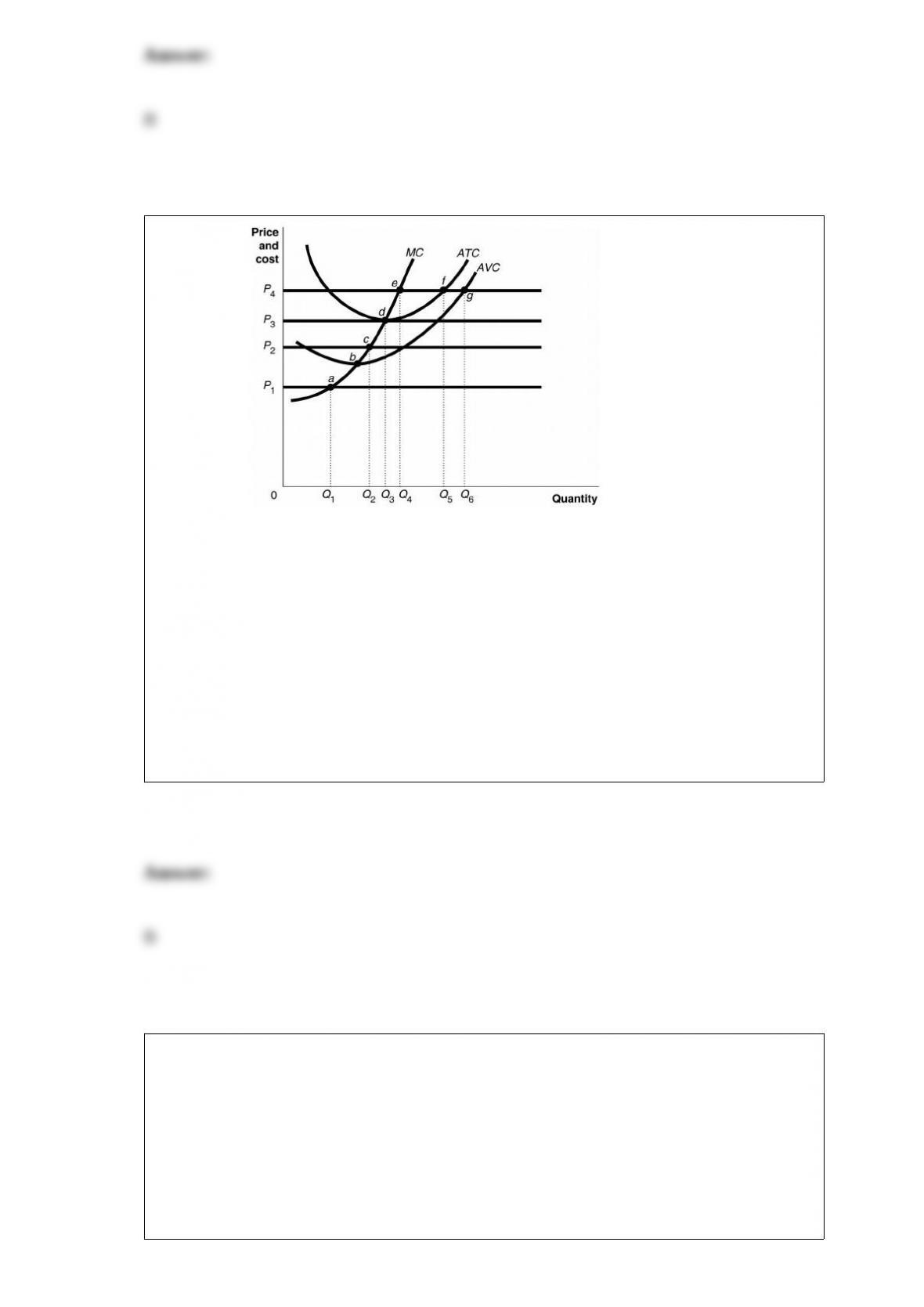
Figure 12-9 Figure 12-9 shows cost and
demand curves facing a profit-maximizing, perfectly competitive firm.
At price P4, the firm would
A) lose an amount equal to its fixed cost.
B) make a profit.
C) lose an amount less than fixed cost.
D) make a normal profit.
Which of the following is a part of the “employer mandate” provision of the Patient
Protection and Affordable Care Act (ACA)?
A) Every firm with more than 3 full-time employees must offer health insurance to its
employees and must automatically enroll them in the plan.
B) small businesses with fewer than 50 employees will be exempt from being required
to participate in the program.
C) Firms with more than 50 full-time employees must offer health insurance or pay a
$3,000 fine to the federal government for every employee who receives a tax credit
from the federal government for obtaining health insurance through a health exchange.
D) Every resident of the United States must have health insurance that meets certain
basic requirements.
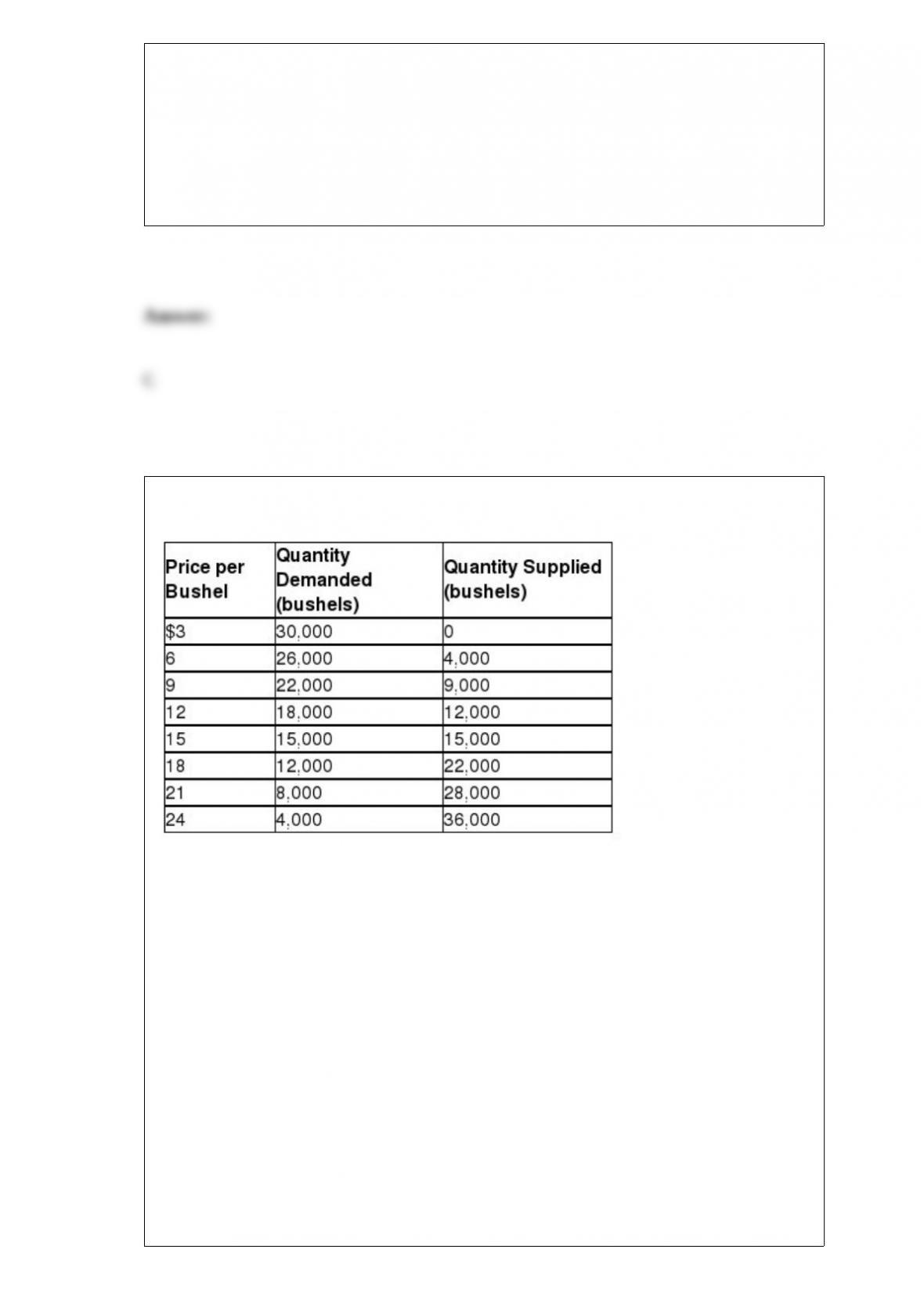
Table 3-3
The table contains information about the corn market. Use the table to answer the
following questions.
a. What are the equilibrium price and quantity of corn?
b. Suppose the prevailing price is $9 per bushel. Is there a shortage or a surplus in the
market?
c. What is the quantity of the shortage or surplus?
d. How many bushels will be sold if the market price is $9 per bushel?
e. If the market price is $9 per bushel, what must happen to restore equilibrium in the
market?
f. At what price will suppliers be able to sell 22,000 bushels of corn?

g. Suppose the market price is $21 per bushel. Is there a shortage or a surplus in the
market?
h. What is the quantity of the shortage or surplus?
i. How many bushels will be sold if the market price is $21 per bushel?
j. If the market price is $21 per bushel, what must happen to restore equilibrium in the
market?
If Ewan is consuming his utility maximizing bundle and the price of one good falls,
what happens to the marginal utility per dollar spent on this good (MU/P), and what
should Ewan do?

A) MU/P has increased, and Ewan should buy more of this good.
B) MU/P has increased, and Ewan should buy less of this good.
C) MU/P has decreased, and Ewan should buy more of this good.
D) MU/P has decreased, and Ewan should buy less of this good.
All of the following are examples of spending on goods and services in the circular
flow model except
A) Amanda purchases a new electric guitar to pursue her hobby seriously.
B) Chaitanya buys a new spa pedicure chair for her expanding nail salon business.
C) Hernan buys a pizza at Papa C’s.
D) Lenny buys a new digital camera to take pictures at his son’s graduation.
Figure 16-3
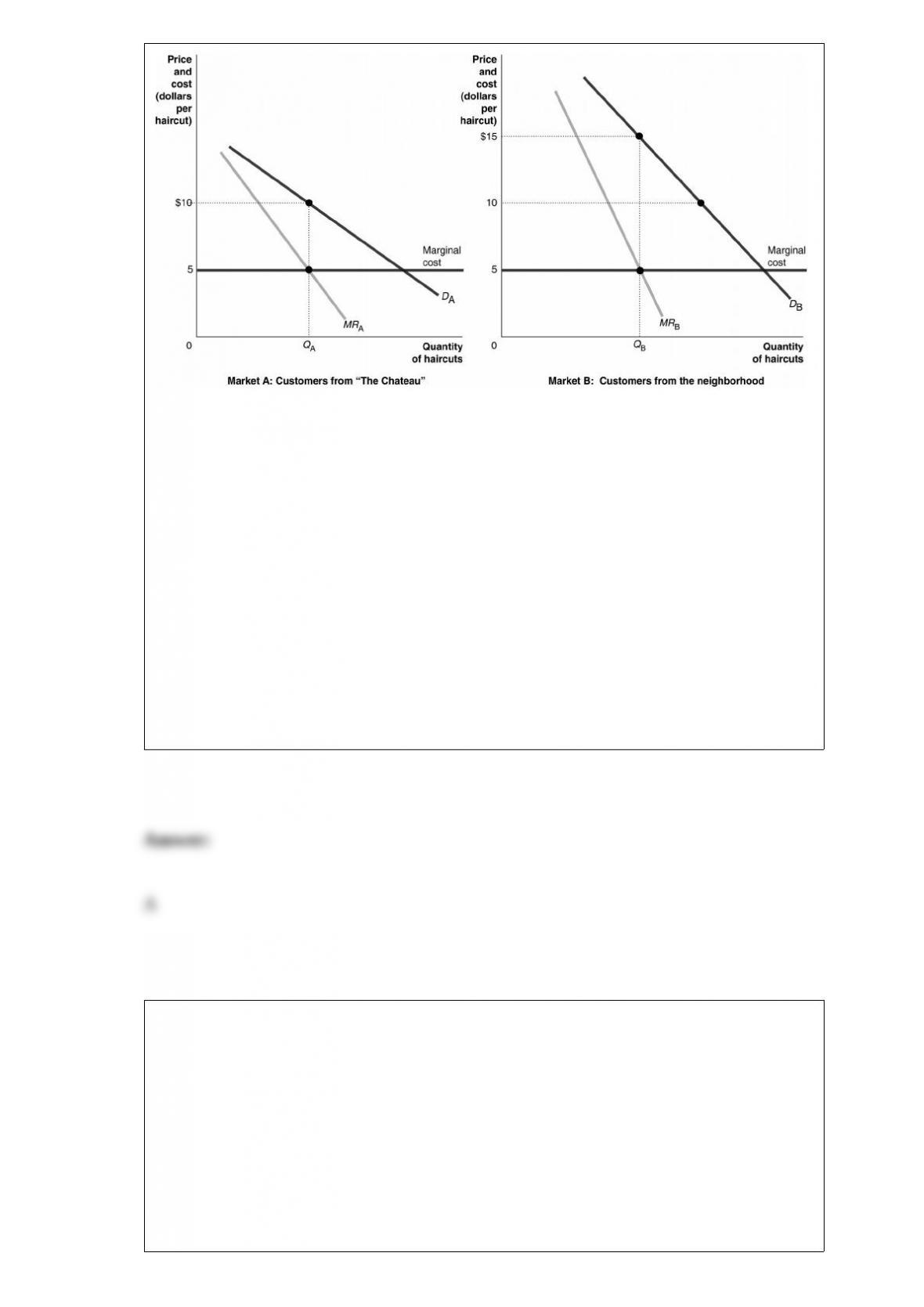
Chantal owns a hairdressing salon which caters to two main groups of customers:
residents of “The Chateau,” a retirement community, and other residents in the
neighborhood. Figure 16-3 shows the demand curves for the residents of the retirement
community, labeled Market A, and other residents in the neighborhood, labeled Market
B. The demand curves are not identical. Suppose Chantal charges all her customers a
uniform price of $10 for a haircut. Which of the following statements is true?
A) Chantal is selling more than the profit-maximizing quantity of haircuts in market B.
B) Chantal is selling less than the profit-maximizing quantity of haircuts in market B.
C) Chantal is maximizing revenue in market B.
D) Chantal will earn a greater profit through uniform pricing than if she practices price
discriminates.
Which of the following does not describe governmental policy actions that are helpful
in supporting growth in an economy? Governmental policies that
A) avoid playing any role in developing communication systems.
B) provide secure rights to private property.
C) establish an independent court system that enforces contracts.
D) facilitate the development of an efficient financial system.
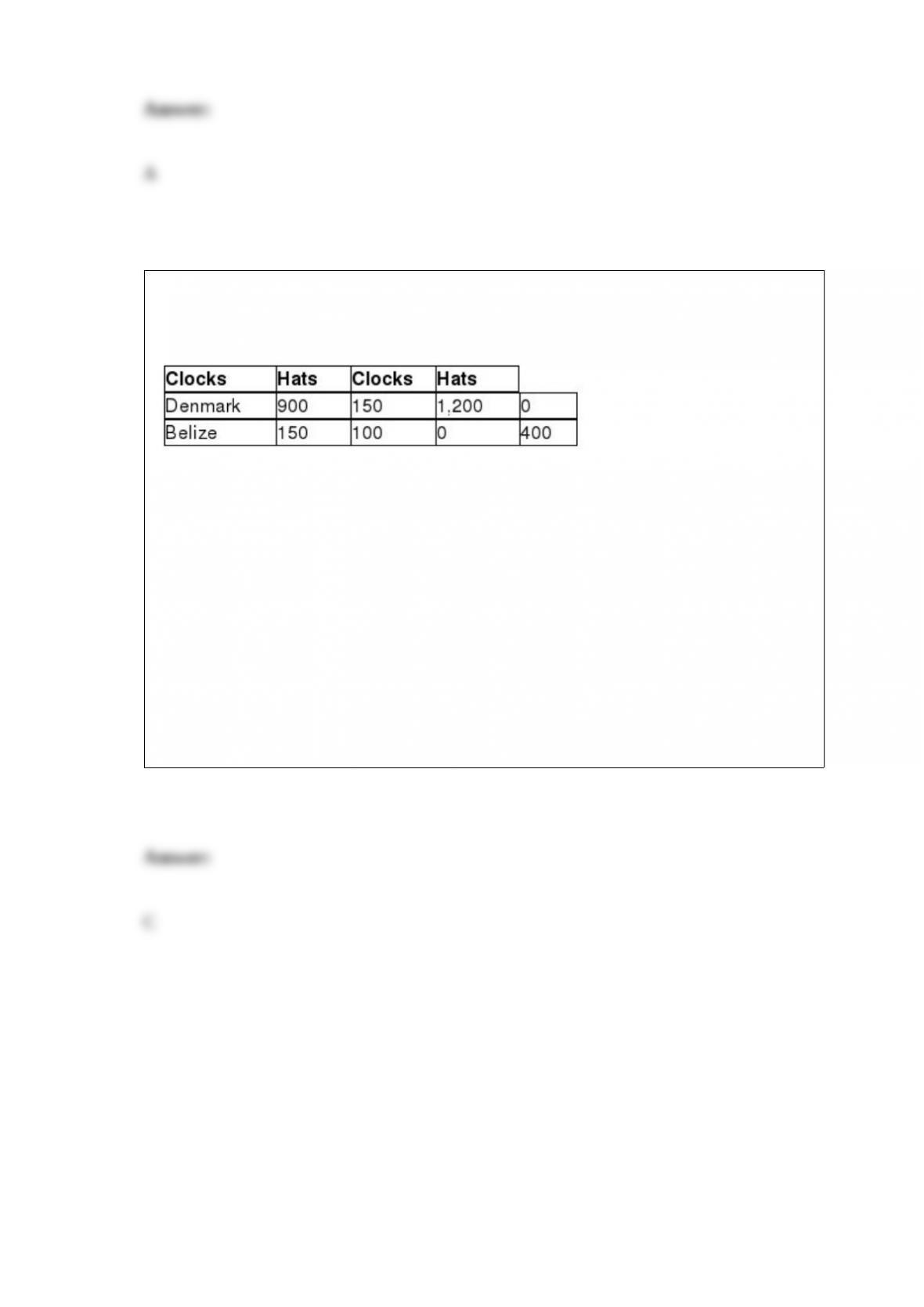
Table 9-11 Production and
Consumption Production
Without Trade With Trade
Denmark and Belize can produce both clocks and hats. Table 9-11 shows the production
and consumption quantities without trade, and the production numbers with trade.
If the actual terms of trade are 1 hat for 1.8 clocks and 150 hats are traded, how many
clocks will Denmark consume?
A) 270
B) 900
C) 930
D) 1,200
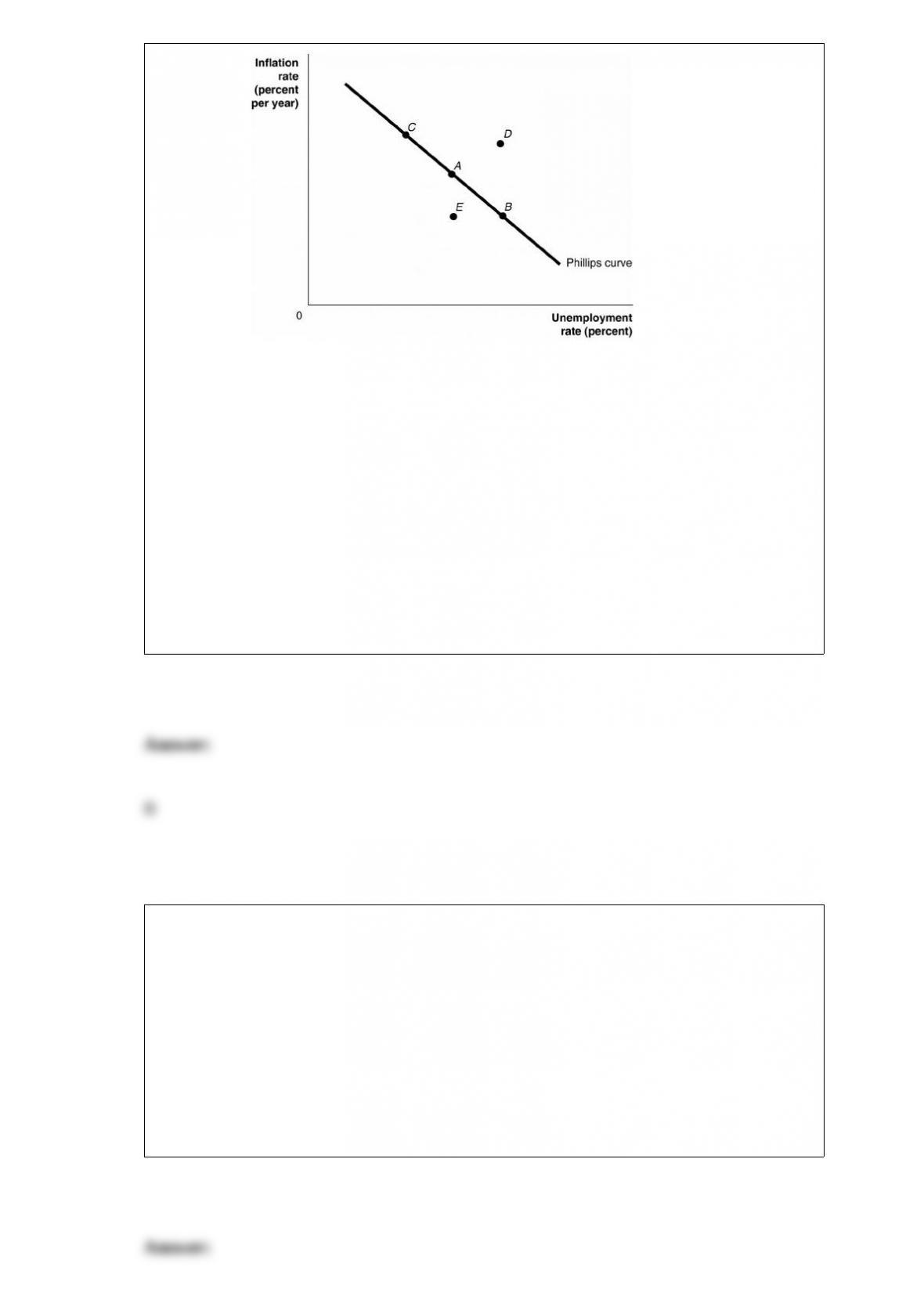
Figure 28-1
What should the Federal Reserve do if it wants to move from point A to point B in the
short-run Phillips curve depicted in the figure above?
A) buy treasury bills
B) sell treasury bills
C) lower the discount rate
D) increase the money supply
E) lower taxes
A perfectly competitive industry achieves allocative efficiency because
A) goods and services are produced at the lowest possible cost.
B) goods and services are produced up to the point where the last unit provides a
marginal benefit to consumers equal to the marginal cost of producing it.
C) it produces where market price equals marginal production cost.
D) firms carry production surpluses.
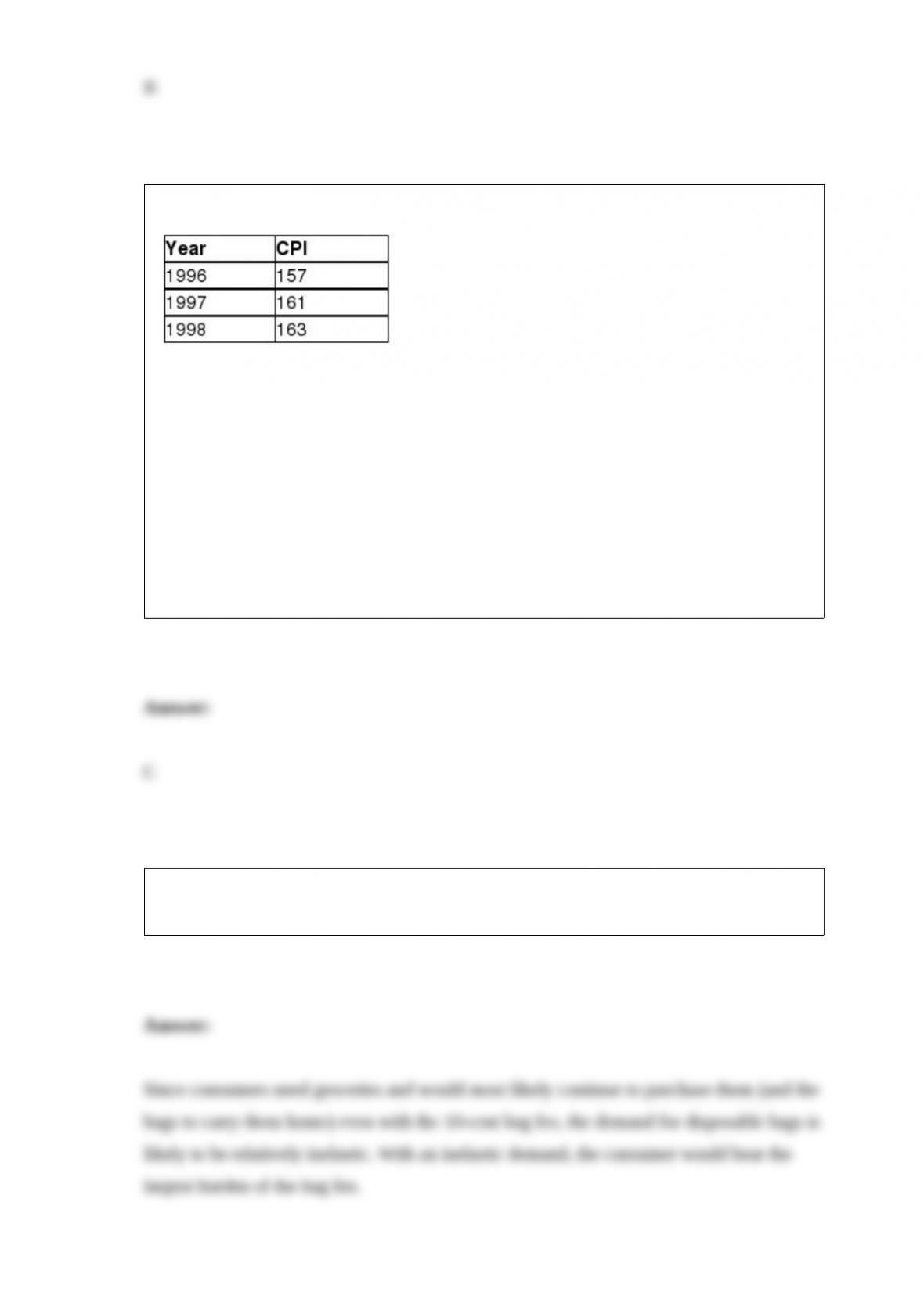
Table 20-6
Consider the following values of the consumer price index for 1996, 1997, and 1998:
The inflation rate for 1997 was equal to
A) 1.2 percent.
B) 2.0 percent.
C) 2.5 percent.
D) 4.0 percent.
If grocery stores were legally required to charge a 10-cent fee for disposable grocery
bags, who would bear the largest burden of this fee?

Describe what has happened to state obesity rates in the United States since 1994.
What are the five steps by which economists arrive at a useful economic model?
How do unlimited and limited liability differ?
What are sticky prices, and how can contracts make them ‘sticky”?
Discuss the correct and incorrect economic analysis in the following statements. “If
good weather in Hawaii creates a bumper crop of pineapples, the supply of pineapples
will increase. This will result in a price decrease, which will then cause the supply of
pineapples to decrease.”