
Money’s most narrow definition is based on its function as a
A) store of value.
B) unit of account.
C) standard of deferred payment.
D) medium of exchange.
E) standard of barter.
The real business cycle model focuses on how
A) wage and price stickiness explains fluctuations in real GDP.
B) the labor theory of value is the best measure of value of a good or service.
C) the Federal Reserve should adopt a monetary growth rule.
D) productivity shocks explain fluctuations in real GDP.
Jake sells Star Wars memorabilia on eBay. His annual revenue is $42,000 per year, and
the explicit costs of his business are $10,000. What is his accounting profit?
A) $10,000
B) $22,000
C) $32,000
D) $42,000
Identify whether each of the following transactions will take place in the factor market
or in the product market.
a. Graciela buys a Tesla Motors Model X.
b. Lashan works 60 hours a week at a law firm.
c. Tito sells his family’s farmland to a housing developer.
d. Tesla Motors increases employment at its Fremont, California plant.
When the Fed uses contractionary policy,
A) the price level rises higher than it would if the Fed did not pursue policy.
B) the price level rises less than it would if the Fed did not pursue policy.
C) it does not change the price level.
D) it causes inflation.

A tax that imposes a small excess burden relative to the tax revenue that it raises is
A) a payroll tax.
B) a sin tax.
C) an efficient tax.
D) a FICA tax.
If whole tomatoes were money, which of the following functions of money would be
the hardest for tomatoes to satisfy?
A) unit of account
B) store of value
C) certificate of gold
D) medium of exchange
How might a budget deficit affect the balance of trade?
A) A budget deficit raises interest rates, which raises exchange rates and increases the

balance of trade.
B) A budget deficit raises interest rates, which raises exchange rates and reduces the
balance of trade.
C) A budget deficit reduces interest rates, which raises exchange rates and reduces the
balance of trade.
D) A budget deficit reduces interest rates, which reduces exchange rates and reduces the
balance of trade.
________ consumption is consumption that does not depend upon the level of GDP.
A) Autonomous
B) Induced
C) Voluntary
D) Disposable
Table 3-3
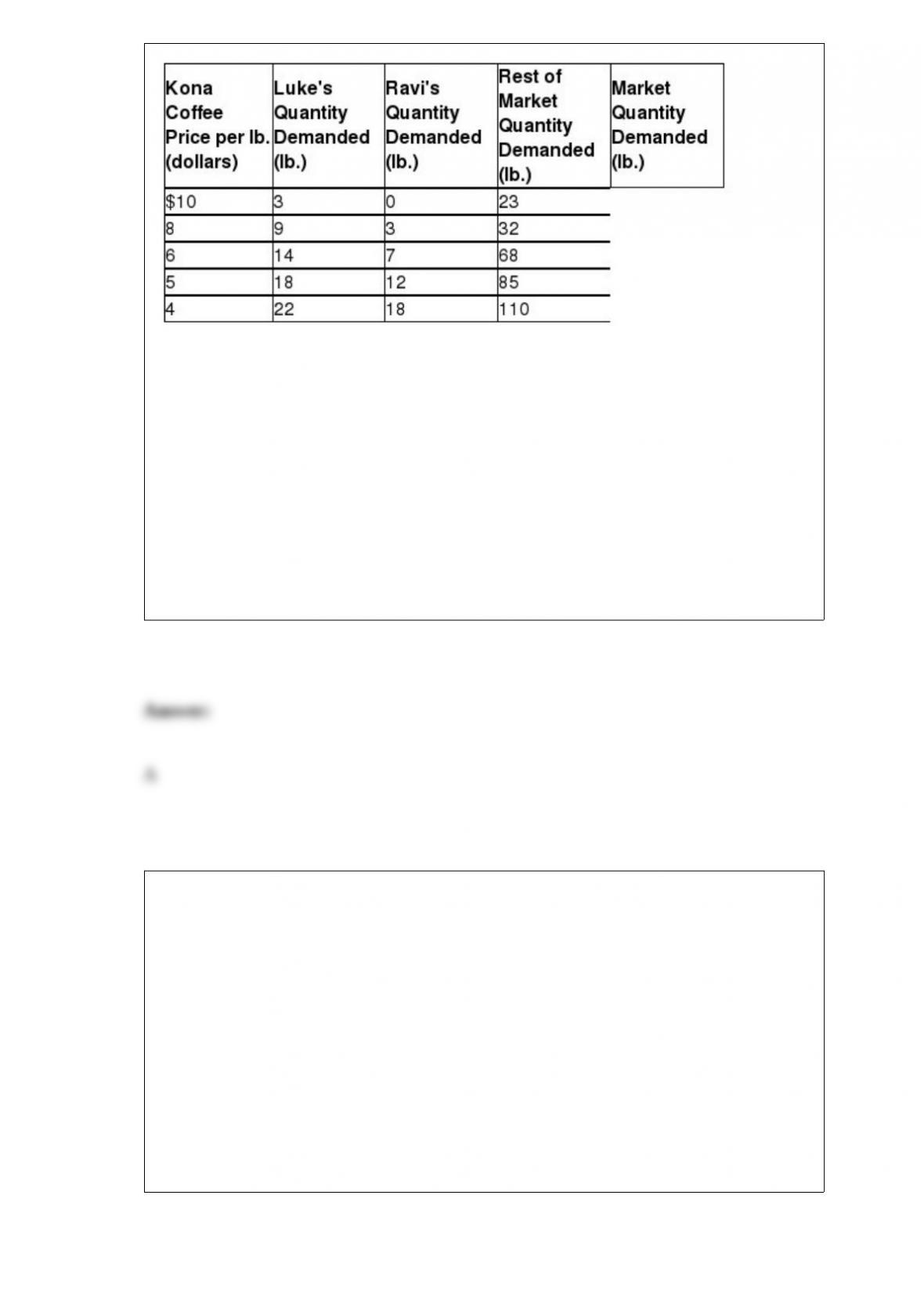
The table above shows the demand schedules for Kona coffee of two individuals (Luke
and Ravi) and the rest of the market. If the price of Kona coffee rises from $4 to $5, the
market quantity demanded would
A) decrease by 35 lb.
B) increase by 115 lb.
C) increase by 35 lb.
D) decrease by 115 lb.
The “Buy American” provision in the 2009 stimulus package required that stimulus
money be spent only on U.S.-made goods, effectively acting as a quota of zero imports
when stimulus money was being spent. The “Buy American” provision would
________ consumer surplus and ________ producer surplus for industries that
produced protected products in the United States.
A) increase; increase
B) increase; decrease
C) decrease; increase
D) decrease; decrease
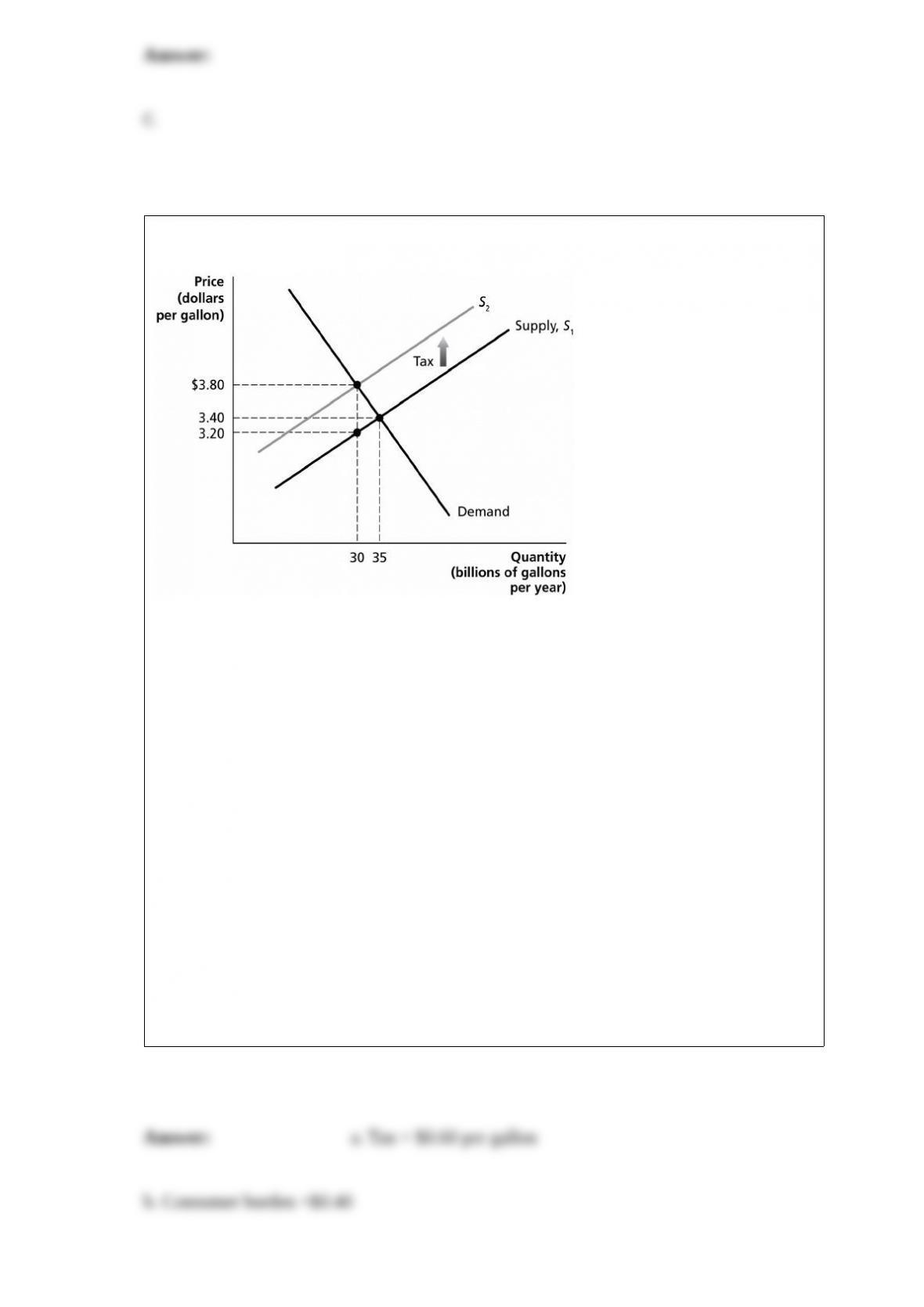
Figure 4-12
The figure above represents demand and supply in the market for gasoline. Use the
diagram to answer the following questions.
a. How much is the government tax on each gallon of gasoline?
b. What portion of the unit tax is paid by consumers?
c. What portion of the unit tax is paid by producers?
d. What is the quantity sold after the imposition of the tax?
e. What is the after-tax revenue per gallon received by producers?
f. What is the total tax revenue collected by the government?
g. What is the value of the excess burden of the tax?
h. Is this gasoline tax efficient?
Suppose a chain of convenience stores reorganized its system of supplying its stores
with food. This led to a sharp reduction in the number of trucks that the company had to
use and increased the amount of fresh food on store shelves. Which of the following
statements best describes the chain stores’ actions?
A) The change implemented is not an example of technological change because it did
not require the use of new machinery of equipment.
B) Technological change refers only to the introduction of new products or
improvements to existing product. As such, the scenario described in the question is not
technological change.
C) The firm is able to produce more output (increase its sales) using fewer inputs (less
trucks). Therefore, the chain of convenience stores has implemented a positive
technological change.
D) The scenario described is an example of management efficiency and not
technological change. Essentially, the chain changes its way of operating its business.
Table 17-1
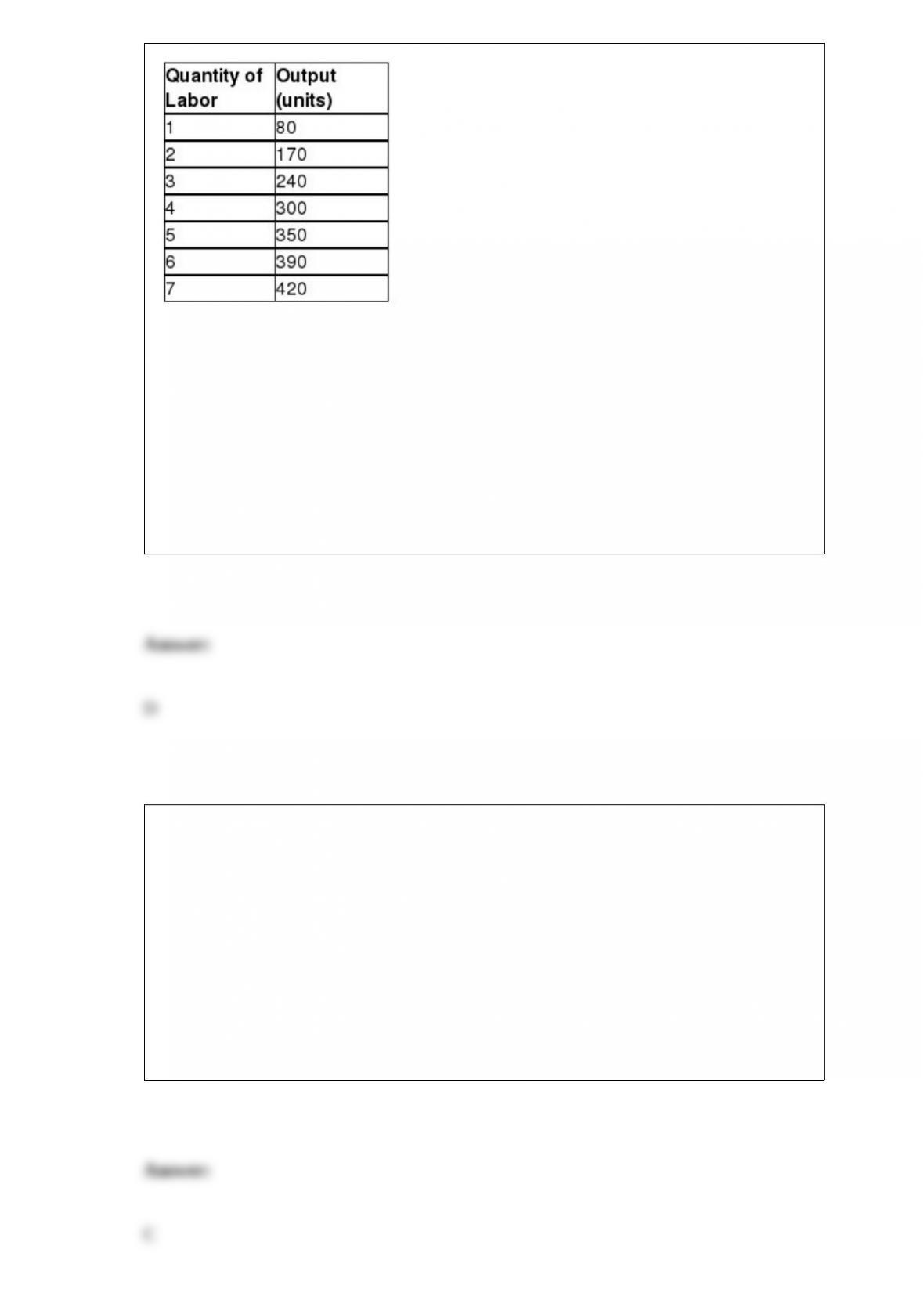
If the output price is $3, what is the marginal revenue product of the fifth unit of labor?
A) $1,050
B) $360
C) $210
D) $150
Your grandfather tells you that he earned $7,000/year in his first job in 1961. You earn
$35,000/year in your first job in 2013. You know that average prices have risen steadily
since 1961. You earn
A) 5 times as much as your grandfather in terms of real income.
B) more than 5 times as much as your grandfather in terms of real income.
C) less than 5 times as much as your grandfather in terms of real income.
D) less than 5 times as much as your grandfather in terms of nominal income.
The Patient Protection and Affordable Care Act (ACA) is scheduled ________, at
which point more than 30 million additional individuals are expected to have health
care coverage.
A) to be phased in over the next 20 years
B) to be fully implemented by 2019
C) to be phased out by 2015
D) to be completely in place by 2012
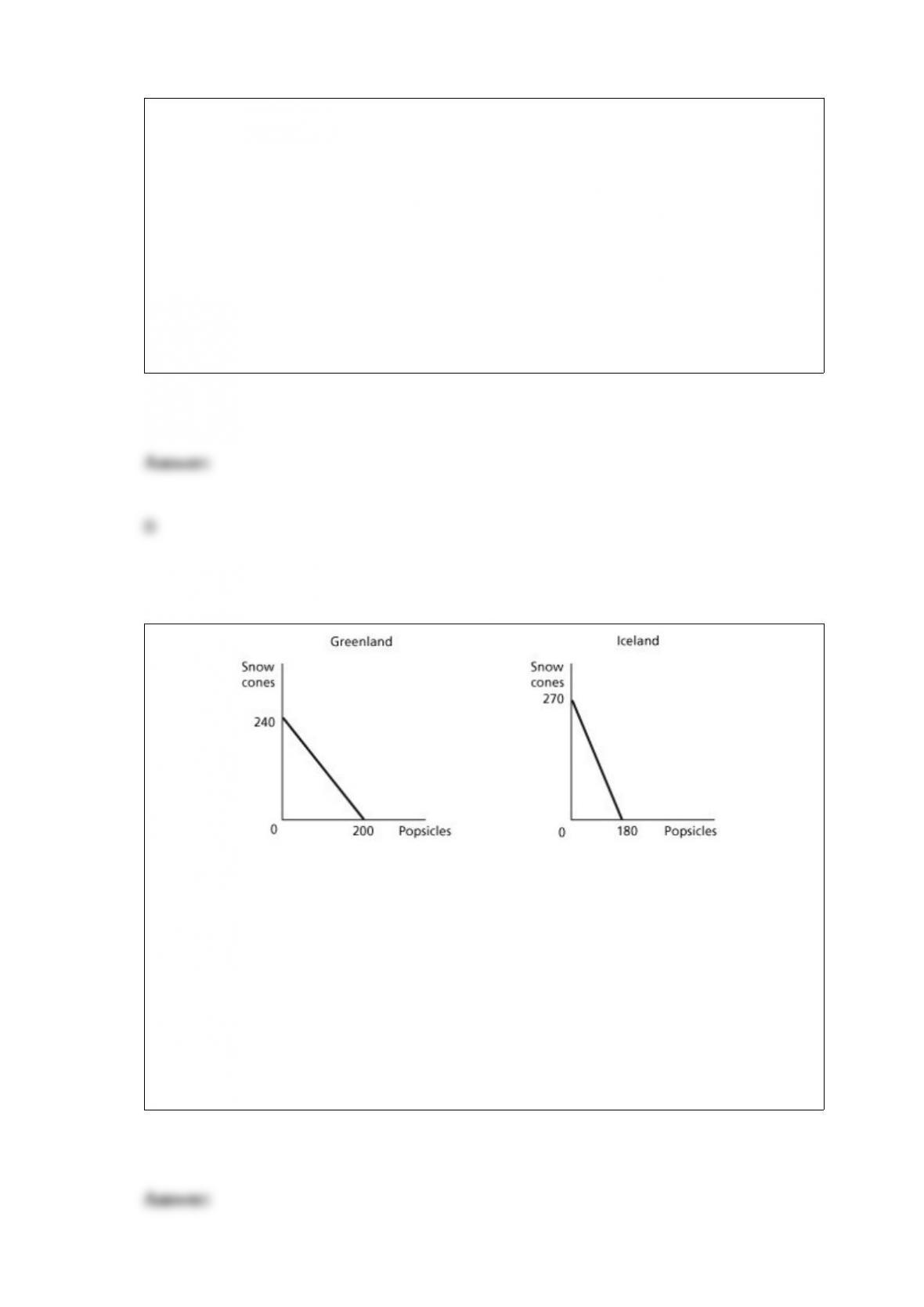
Figure 2-9 Figure 2-9
shows the production possibilities frontiers for Greenland and Iceland. Each country
produces two goods, snow cones and popsicles. Which country has a comparative
advantage in the production of popsicles?
A) Greenland
B) They have equal productive abilities.
C) Iceland
D) neither country
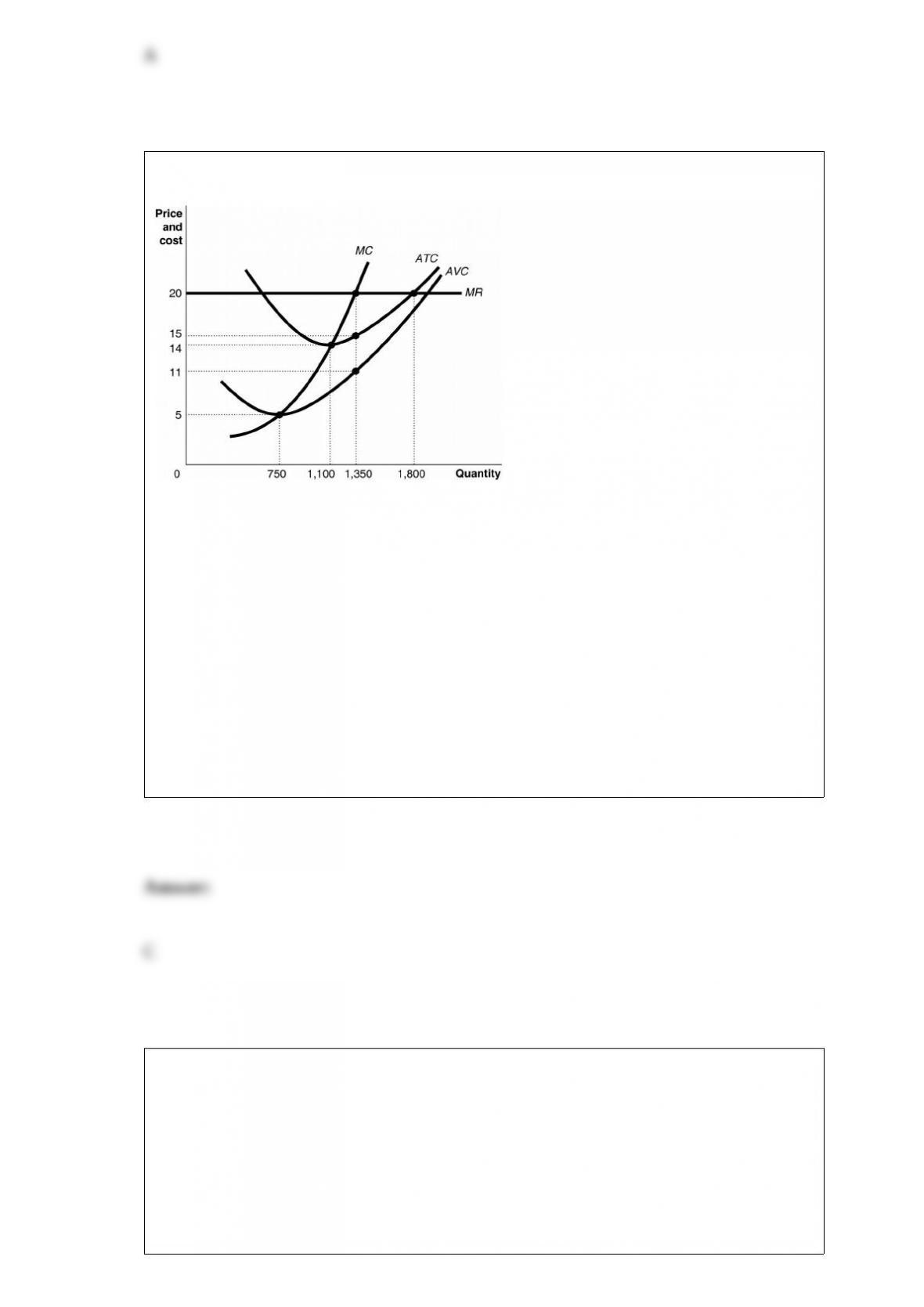
Figure 12-5
Figure 12-5 shows cost and demand
curves facing a typical firm in a constant-cost, perfectly competitive industry. The
figure shows the cost structure of a firm in a perfectly competitive market. If the firm’s
fixed cost increases by $1,000 due to a new environmental regulation, what happens to
its profit-maximizing output level?
A) It increases.
B) It decreases.
C) It remains the same.
D) It could increase, decrease or remain constant, depending on whether the firm is able
to cut costs somewhere else.
The change in a firm’s total cost from producing one more unit of a good or service is
A) the result of economies of scale.
B) the definition of marginal product.
C) the definition of marginal cost.

D) impossible to observe in large firms with many manufacturing plants.
If an employee receives health insurance through his or her employer, the employer
A) still withholds contributions for Medicare and Medicaid from the employee’s
paycheck.
B) still withholds contributions for Medicare, but not Medicaid, from the employee’s
paycheck.
C) still withholds contributions for Medicaid, but not Medicare, from the employee’s
paycheck.
D) is no longer required to withhold contributions for Medicare or Medicaid from the
employee’s paycheck.