
1) the physical import of dvd players to the united states from japan best illustrates a:
a.resource flow.
b.financial flow.
c.trade flow.
d.technology flow.
2) The U.S. income maintenance program consists of two kinds of programs. They are:
A.the minimum wage law and Social Security.
B.antidiscrimination law and education and training programs.
C.social insurance and public assistance or “welfare.”
D.progressive income taxes and transfer payments.
3) which of the following would be most likely to shift the production possibilities
curve to the right?
a.a sudden and substantial expansion of consumer wants
b.an improvement in the literacy level and general level of education
c.a decline in the size of the population and labor force
d.shifting resources from the production of capital goods to the production of consumer
goods
4) It is true that:
A.equal increases in government spending and taxes do not change the equilibrium
GDP.
B.equal increases in government spending and taxes reduce the equilibrium GDP.
C.equal increases in government spending and taxes increase the equilibrium GDP.
D.taxes have a stronger effect upon equilibrium GDP than do government purchases.
5) the entry of generic drugs into a previously monopolized pharmaceutical market will:
a.discourage the development of new drugs.
b.increase efficiency by increasing consumer surplus.
c.create inefficiency by introducing chemically-inferior medications.
d.not affect the market price because pharmaceutical firms are “price takers.”
6) which form of business enterprise accounts for the largest proportion of total output?
a.corporations
b.proprietorships
c.partnerships
d.cooperatives
7) the average tax rate is:
a.change in taxes / change in taxable income.
b.total taxes / total taxable income.
c.the sum of the marginal tax rate and the rate of transfer payments.
d.the tax on incremental income less the tax on total income.
8) in national income accounting, g stands for:
a.government purchases.
b.gross investment.
c.government transfer payments.
d.gross saving.
9) about ________ of u.s. economic growth between 1990 and 2007 came from
improved productivity (as opposed to added inputs).
a.one-fourth.
b.one-third.
c.one-half.
d.two-thirds.
10) The following balance sheet for the ABC National Bank in answering the next
question(s). Assume the required reserve ratio is 20 percent.
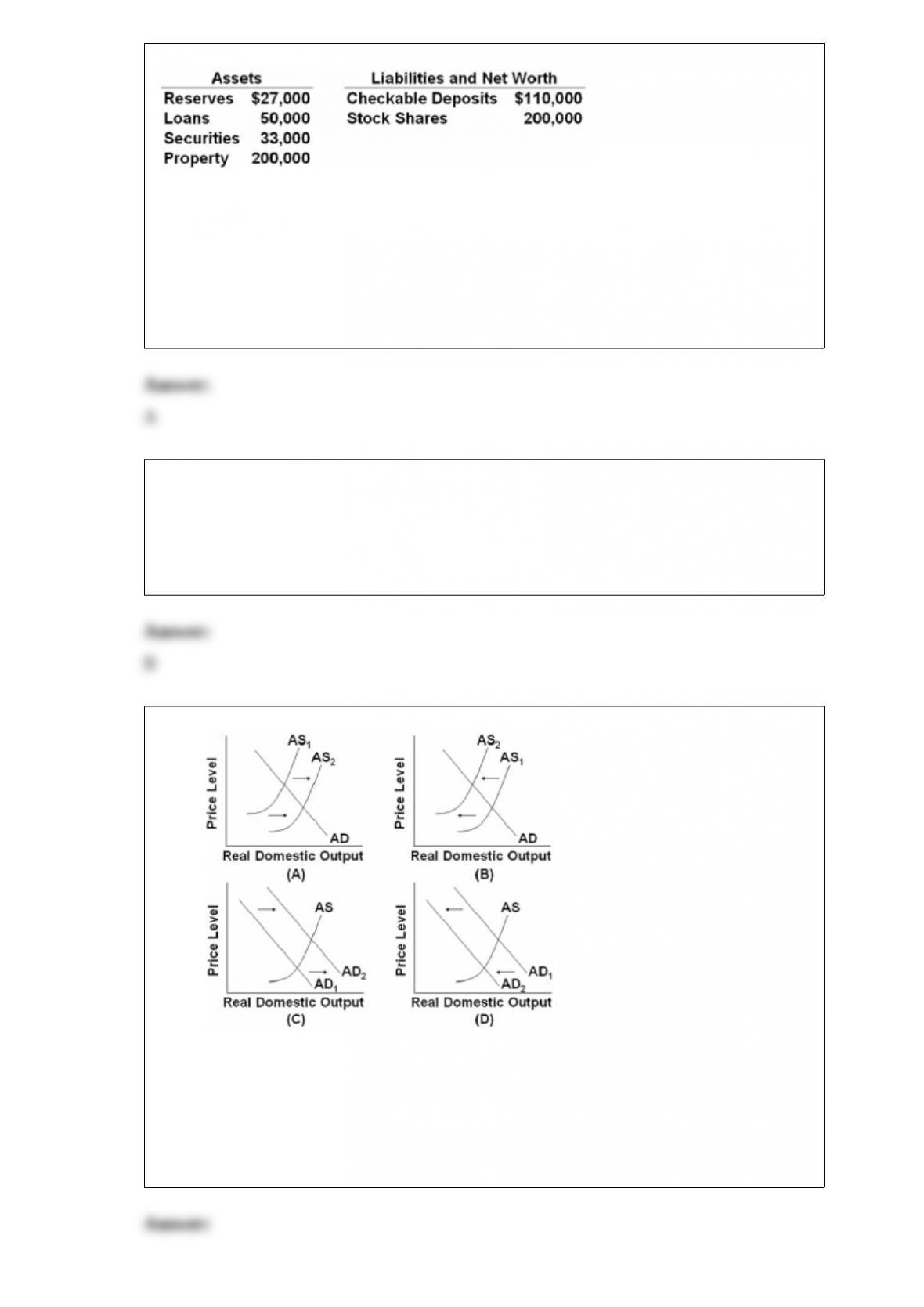
Refer to the above data. Assuming the bank loans out all of its remaining excess
reserves as a checkable deposit, and has a check cleared against it for that amount, the
bank will now have excess reserves of:
A.$0.
B.$3,000.
C.$12,000.
D.$5,000.
11) The fact that people prefer present consumption to future consumption results in:
A.a downsloping demand for loanable funds curve.
B.an upsloping supply of loanable funds curve.
C.a downsloping supply of loanable funds curve.
D.an upsloping demand for loanable funds curve.
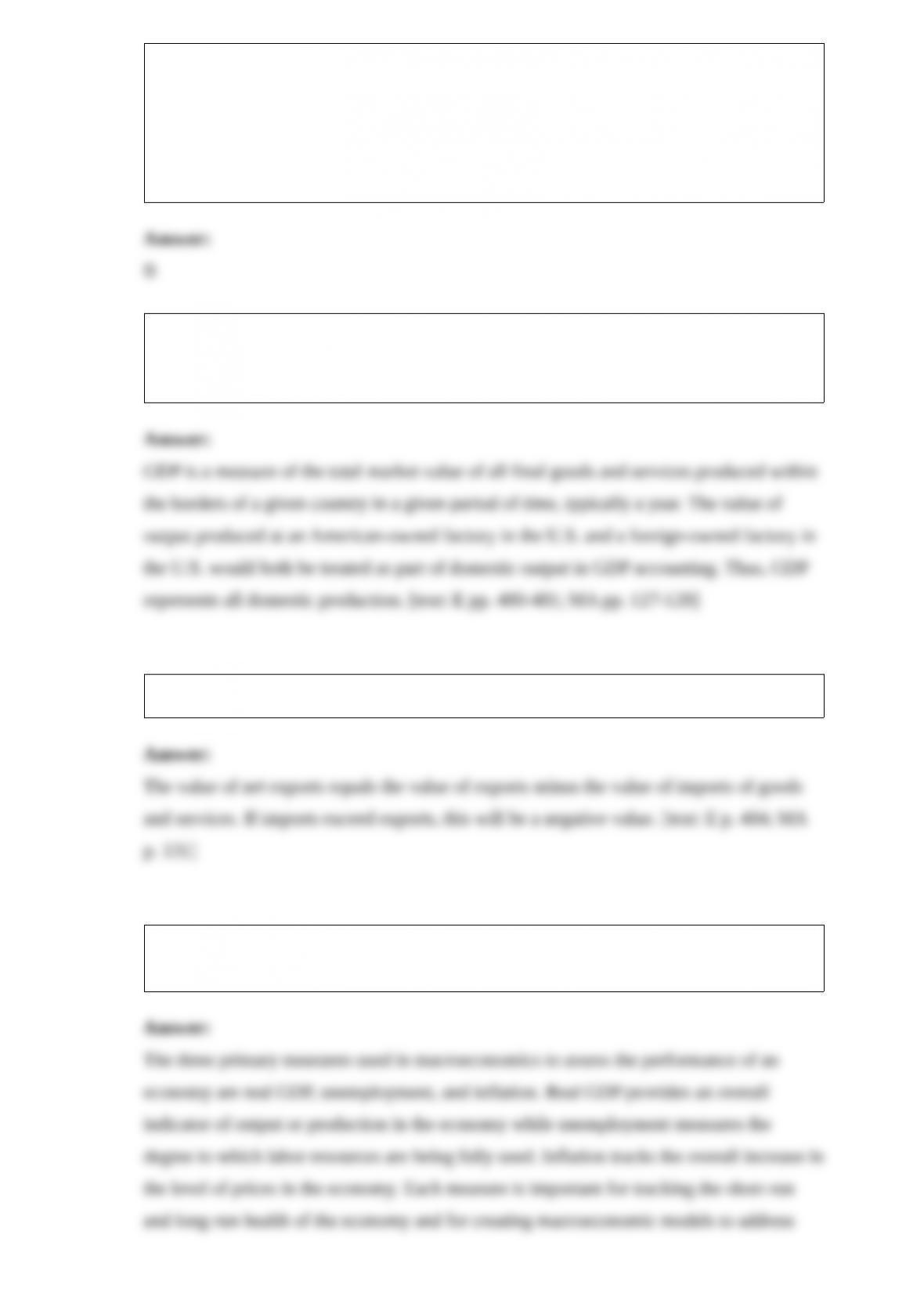
12)
Which of the above diagrams best portrays the effects of an increase in consumer
spending?
A.A
B.B
C.C
D.D

13) The gain from international trade is:
A.increased employment in the domestic export sector.
B.more goods than would be attainable through domestic production alone.
C.tariff revenue.
D.increased employment in the domestic import sector.
14)
Effective usury laws cause:
A.a surplus in the market for loanable funds.
B.the quantity of loanable funds demanded to be brought into balance with the quantity
supplied.
C.the quantity of loanable funds demanded to exceed the quantity supplied.
D.the quantity of loanable funds supplied to exceed the quantity demanded.
15) in industrially advanced countries the price elasticity of demand for health care is
about:
a.2.0.
b.0.2.
c.4.5.
d.1.0.
16) all of the following are designed to reduce health care expenses for consumers
except:
a.hmos.
b.ppos.
c.the drg payment system.
d.the fee-for-service system.
17) If the money supply is constant when both nominal and real GDP are rising, we can
conclude that:
A.tax rates have been increased.
B.the velocity of money is rising.
C.interest rates are falling.
D.the unemployment rate is rising.
18) What is the definition of GDP? How would the value of output produced at an
American-owned factory in the U.S. and a foreign-owned factory in the U.S. be treated
in GDP accounting?
19) Define net exports.
20) What are the three primary measures used in macroeconomics to assess the
performance of an economy?
21) Draw a graph on the below diagram showing the long-run equilibrium position of a
competitive firm. Write a formula to express the equalities in the graph.
22) Trace the cause-effect chain that results from a restrictive monetary policy.