
One reason purchasing power parity does not exactly hold is that many goods are not
traded internationally.
In face of rational expectations regarding changes in monetary policy, the short-run
Phillips Curve may be vertical.
For a person to have a comparative advantage in producing a product, she must be able
to produce that product at a lower opportunity cost than her competitors.
If marginal revenue is negative then the revenue lost from receiving a lower price on all
the units that could have been sold at the original price is smaller than the additional
revenue from selling one more unit of the good.

The situation in which one party to a transaction takes advantage of knowing more than
the other party to the transaction is known as adverse selection.
If marginal costs differ quite substantially from average total costs, then using a
cost-plus pricing schedule will not lead to the profit maximizing price.
In most circumstances, employees pay taxes on the value of health insurance their
employers provide them.
The larger the MPC, the smaller the value of the multiplier.

The productivity slowdown experience in the United States from the mid-1970s to the
mid-1990s was actually a global phenomenon.
It is possible to have an absolute advantage in producing a good or service without
having a comparative advantage.
For a person to have a comparative advantage in producing a product, he must be able
to produce that product at a higher opportunity cost than his competitors.
Contractionary monetary policy will result in
A) higher interest rates.
B) increased rates of inflation.
C) an upward shift in the short-run Phillips curve.
D) a leftward shift in the long-run Phillips curve.
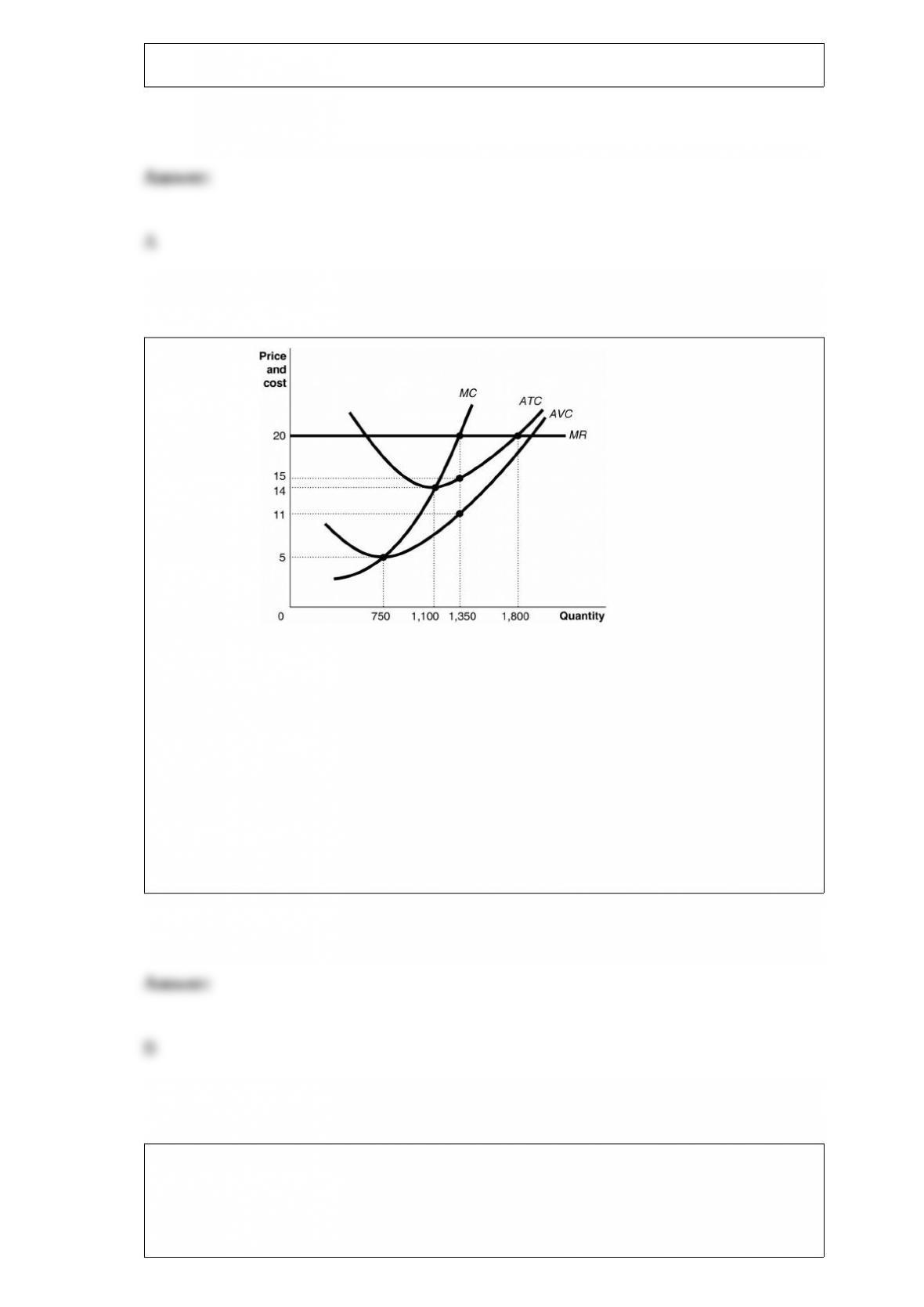
Figure 12-11
Suppose the prevailing price is $20 and the firm is currently producing 1,350 units. In
the long-run equilibrium, the firm represented in the diagram
A) will continue to produce the same quantity.
B) will reduce its output to 1,100 units.
C) will reduce its output to 750 units.
D) will cease to exist.
If, in a competitive market, marginal benefit is less than marginal cost
A) the net benefit to consumers from participating in the market is less than the net
benefit to producers.

B) the government must force producers to raise prices in order to achieve economic
efficiency.
C) the quantity sold is greater than the equilibrium quantity.
D) the quantity sold is less than the equilibrium quantity.
A supply curve that is vertical
A) is perfectly elastic.
B) is perfectly inelastic.
C) is impossible.
D) has an elasticity equal to 1.
Figure 13-14
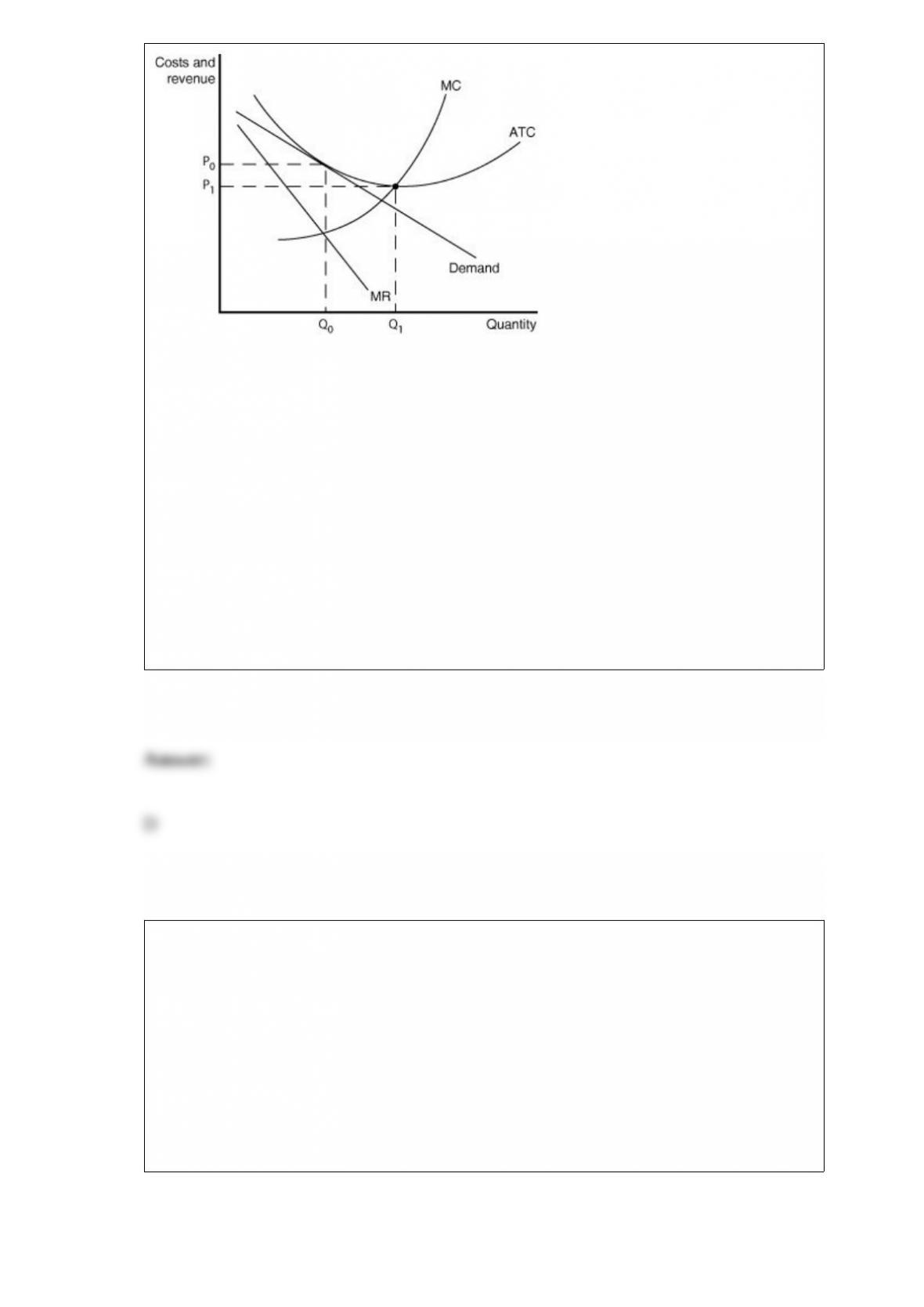
Figure 13-14 illustrates a monopolistically competitive firm.
Which of the following statements describes the firm depicted in the diagram?
A) The firm is making no economic profit and will exit the industry.
B) The firm is suffering an economic loss by producing at Q0 but will break even it
increases its output to Q1.
C) The firm achieves productive efficiency by producing at Q0.
D) The firm is in long-run equilibrium and is breaking even.
What does a Lorenz curve illustrate?
A) a comparison of the distribution of income in two different countries
B) the distribution of income within a country in a given time period
C) the share of taxes paid by different groups of households
D) the change over time in the percentage of households with incomes that place them
below the poverty line

If Marlowe obtains 9 units of utility per dollar spent on apples and 6 units of utility per
dollar spent on oranges, then Marlowe
A) is maximizing total utility.
B) should buy more apples and fewer oranges.
C) should buy more oranges and fewer apples.
D) should buy fewer oranges and fewer apples.
Calculate the government purchases multiplier if the marginal propensity to consume
equals 0.75, the tax rate is 0.2, and the marginal propensity to import equals 0.3.
A) 1.43
B) 1.6
C) 3.33
D) 4
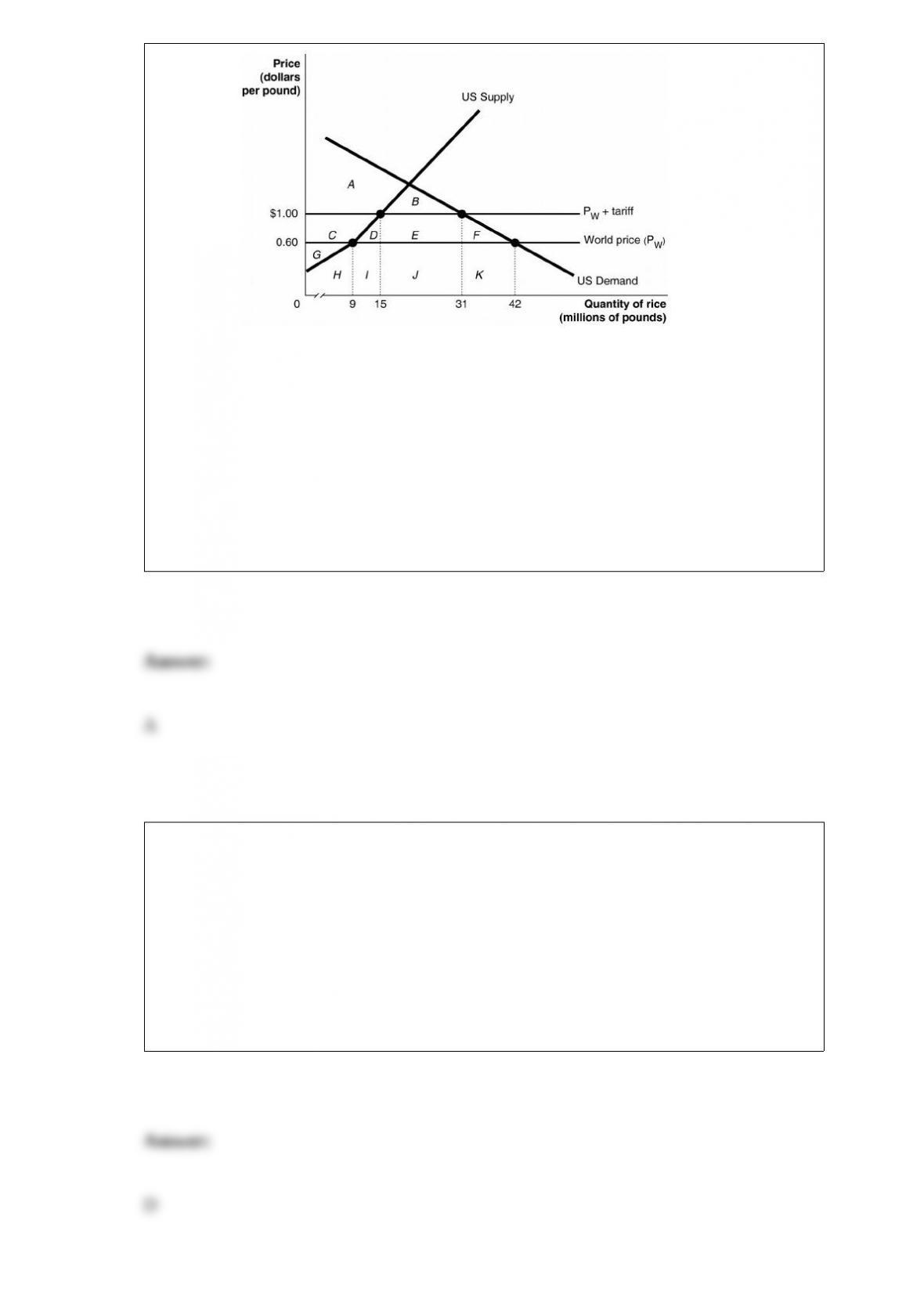
Figure 9-2 Suppose the U.S.
government imposes a $0.40 per pound tariff on rice imports. Figure 9-2 shows the
impact of this tariff. Without the tariff in place, the United States produces
A) 9 million pounds of rice.
B) 15 million pounds of rice.
C) 31 million pounds of rice.
D) 42 million pounds of rice.
Which of the following would shift the supply curve for smartphones to the right?
A) an increase in the price of a substitute in production
B) an increase in consumer income (assuming that all smartphones are normal goods)
C) a decrease in the number of firms that produce smartphones
D) a decrease in the price of an input used to produce smartphones

A partnership is ________ type of business.
A) the most common.
B) the least common
C) the least risky
D) the most profitable
In England during the Middle Ages each village had an area of pasture on which any
family in the village was allowed to graze its cows and sheep without charge.
Eventually, the grass in the pasture would be depleted and no family’s cow or sheep
would get enough to eat. The reason the grass was depleted was
A) the area of pasture was nonexcludable and the consumption of the grass was rival.
B) self-interest motives led livestock owners to raise too many cows and sheep.
C) due to a policy of neglect on the part of the English government.
D) it did not get enough rainfall.
A decrease in the price level will
A) shift the short-run aggregate supply curve to the left.
B) shift the short-run aggregate supply curve to the right.
C) move the economy up along a stationary short-run aggregate supply curve.
D) move the economy down along a stationary short-run aggregate supply curve.
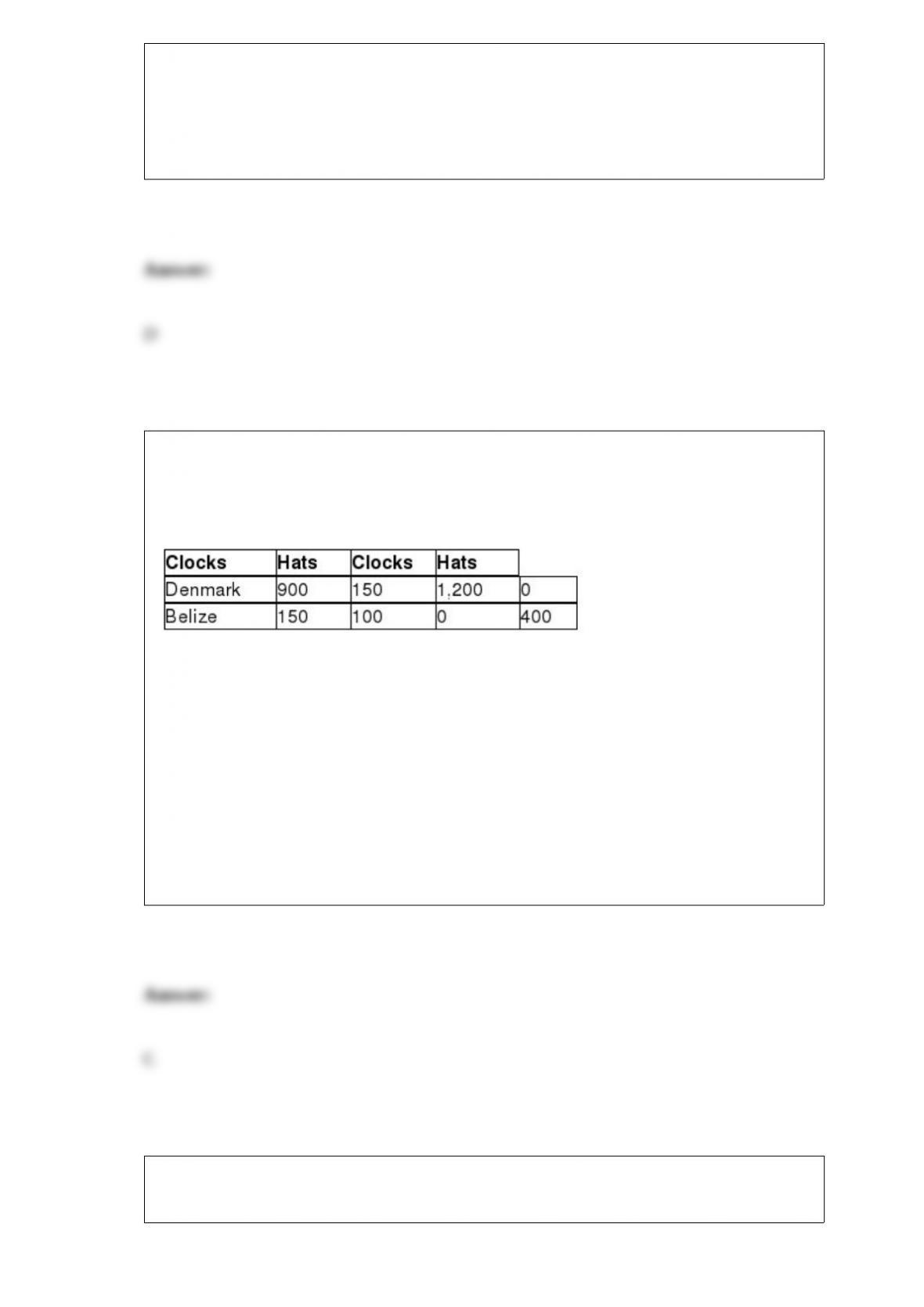
Table 9-6
Production and
Consumption Production
Without Trade With Trade
Denmark and Belize can produce both clocks and hats. Table 9-6 shows the production
and consumption quantities without trade, and the production numbers with trade. Prior
to trade, what was the opportunity cost to produce 1 hat in Belize?
A) 1/6 of a clock
B) 2/3 of a clock
C) 1.5 clocks
D) 6 clocks
Suppose that a perfectly competitive industry becomes a monopoly. What effect will
this have on consumer surplus, producer surplus, and deadweight loss?
The “Big Mac Theory of Exchange Rates” tests the accuracy of purchasing power
parity theory. In July 2013, The Economist reported that the average price of a Big Mac
in the United States was $4.56. In Switzerland, the average price of a Big Mac at that
time was 6.50 Swiss francs. If the exchange rate between the dollar and the Swiss franc
was 0.93 Swiss francs per dollar, explain how it would be profitable to buy Big Macs in
the United States instead of in Switzerland.
Behavioral economists examine choices that consumers make that are not economically
rational. Economists generally assume that people are rational; that is, they weigh the
benefits and costs of an action and choose an action only if the benefits outweigh the
costs. Why do consumers not act rationally when the result is that they make
themselves worse off?
What is the relationship between the balance of trade and the current account balance?
What is a public franchise? Are all public franchises natural monopolies?