
Government gives subsidies to encourage production of products with beneficial
externalities.
a. True
b. False
Total profit is maximized if the slope of the total profit curve is
a. positive.
b. negative.
c. increasing.
d. zero.
In short-run equilibrium, a perfectly competitive firm
a. may earn a profit or a loss.
b. always earns a profit.
c. never earns a profit.
d. earns a profit only if the firm has no fixed cost.

A “backstop resource” is a close substitute for a depletable resource that is available in
almost unlimited supply but at a higher cost. Shale oil is a backstop resource for crude
oil. Which of the following statements is correct?
a. The production of shale oil is likely to increase over time even if crude oil is still
available.
b. Shale oil is unlikely to be produced until all the crude oil has been depleted.
c. The existence of shale oil as a backstop resource will discourage firms from seeking
new reserves of crude oil.
d. In the future, shale oil is likely to be produced at the same time as crude oil and to
sell for a lower price.
The market structure that is associated with big business in developed economies is
a. perfect competition.
b. monopolistic competition.
c. monopoly.
d. oligopoly.
If MC > MR,
a. output should be reduced.
b. marginal profit is positive.
c. there are losses.
d. output should be increased.
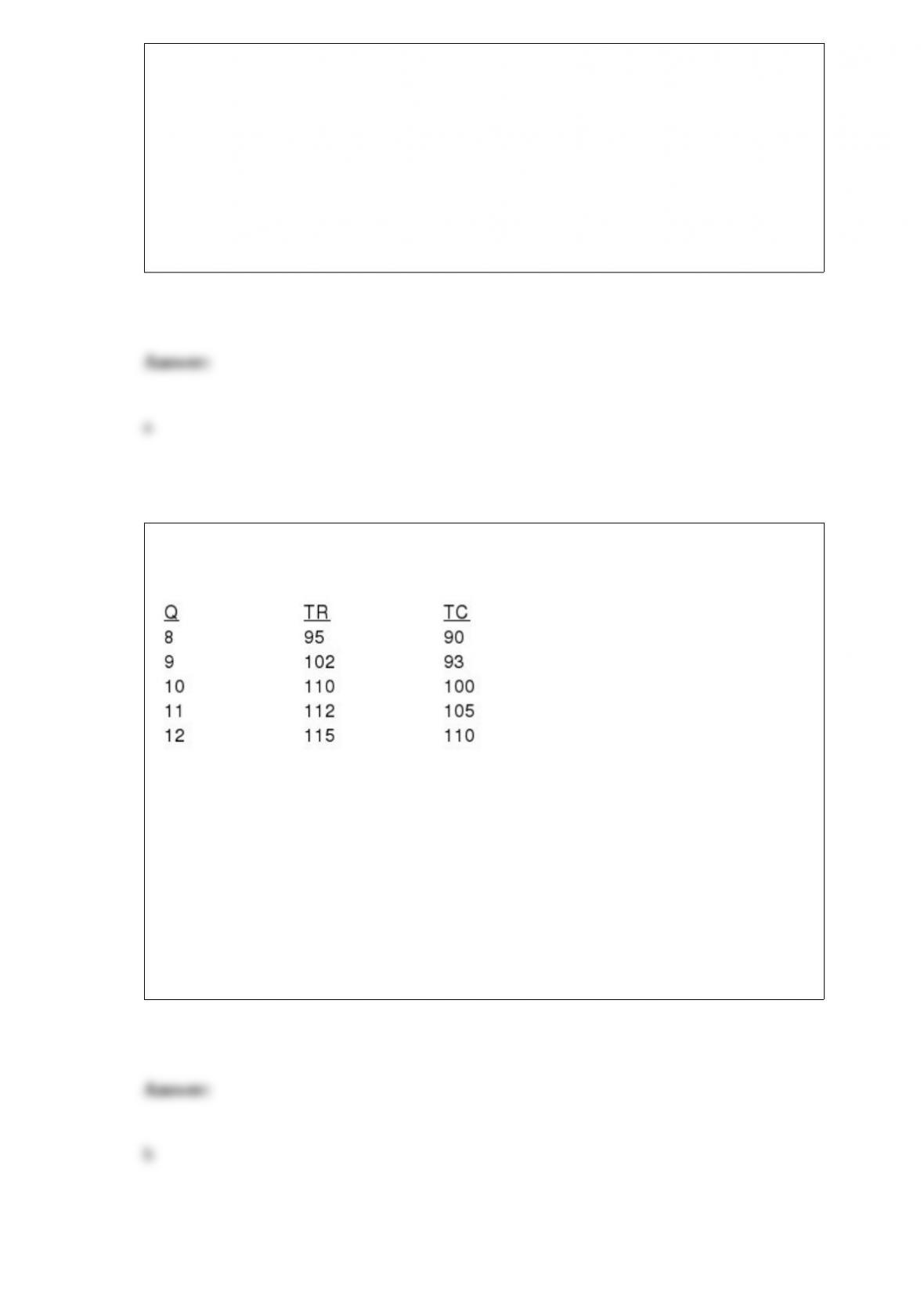
Table 11-2
In Table 11-2, MC of the last unit produced at the profit-maximizing output is
a. $5
b. $7
c. $8
d. $10

An “optimally imperfect” decision is one that
a. is vaguely right instead of precisely wrong.
b. recognizes that the decision could always be better if given more time.
c. recognizes that the cost of additional information probably exceeds the potential gain
from making a better decision.
d. recognizes that any decision is imperfect because humans have limited intellectual
capacities.
Which type of economic system will produce the highest degree of allocative
efficiency?
a. a perfectly competitive market system
b. a purely command economic system
c. a market system with limited price controls and price ceilings
d. a command system with limited market activity for non-essentials
Taken as a whole, antipoverty programs may actually put a poor family in a position in
which the family becomes worse off if its earnings rise.
a. True
b. False
MPP is the additional output that results from a one-unit increase in use of the input.
a. True
b. False
A demand schedule is a table showing how the ____ of some product during a specified
period of time changes as ____ changes, holding all other determinants of quantity
demanded constant.
a. demand; the price of its complement
b. demand; the quantity supplied
c. quantity demanded; the price of its substitute
d. quantity demanded; the price of that product
The real minimum wage has increased significantly over the last 40 years.
a. True
b. False
“Those most able should pay the highest taxes” reflects the
a. ability-to-pay principle.
b. concept of horizontal equity.
c. idea of fiscal federalism.
d. benefits principle.
In ____, each competing firm is determined to sell at a price that is lower than the
prices of its rivals, often regardless of whether that price covers the pertinent cost.
a. market skimming
b. a monopoly
c. a price war
d. perfect competition
The incidence of a payroll tax is borne by both employers and employees.
a. True
b. False
Models are simplifications that are used to observe the workings of a system.
a. True
b. False
Total expenditure equals price times elasticity.
a. True
b. False

The concept of “an invisible hand” led Adam Smith to believe that
a. if each person looks out for himself or herself, then chaos will inevitably ensue.
b. pursuit of self-interest promotes economic well-being for society as a whole.
c. governmental rule actually results in greater good than is apparent at the time.
d. traditional religion is an appropriate guide for human behavior.
e. All of the above are correct.
An optimal level of output is one at which marginal profit > 0.
a. True
b. False
Cartels are
a. difficult to organize.
b. difficult to preserve.
c. especially unlikely to succeed if the members sell many varied products.
d. All of the above are correct.
Draw a production possibilities frontier for an economy, with the axes labeled “military
goods” and “peace goods.” Indicate the region that is attainable and the region that is
not. Explain the shape of the curve-what assumptions did you make in drawing it?
During the 1992 presidential campaign, H. Ross Perot made much of the various
‘special interests” which lobby in Washington, D.C. How might an economist view this?
Which specific market breakdown may occur if there is lobbying? Relate your answer
to the study of monopoly and oligopoly.
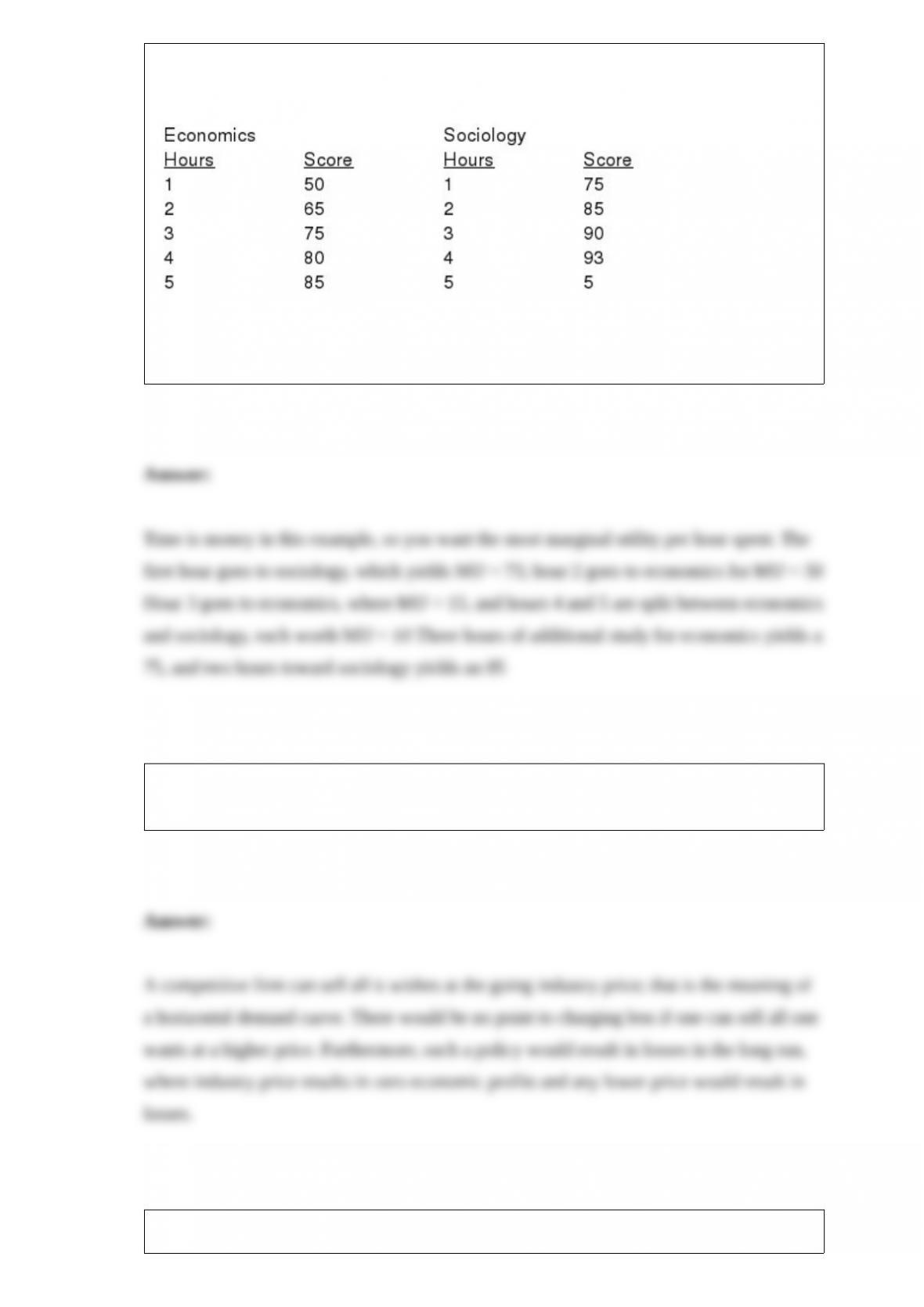
You have five hours left to study for two exams tomorrow. The relationship between
hours of study and test scores is as follows:
Use the rule for determining optimal purchases to allocate your time, where each point
is one “util” of utility.
Why doesn’t a competitive firm reduce its price below the industry price to increase
sales?
Economists cite some beneficial effects of price discrimination. What are these benefits
and how do the antitrust laws treat price discrimination?
Explain the prisoner’s dilemma case in game theory and its relevance to the maximin
criterion.