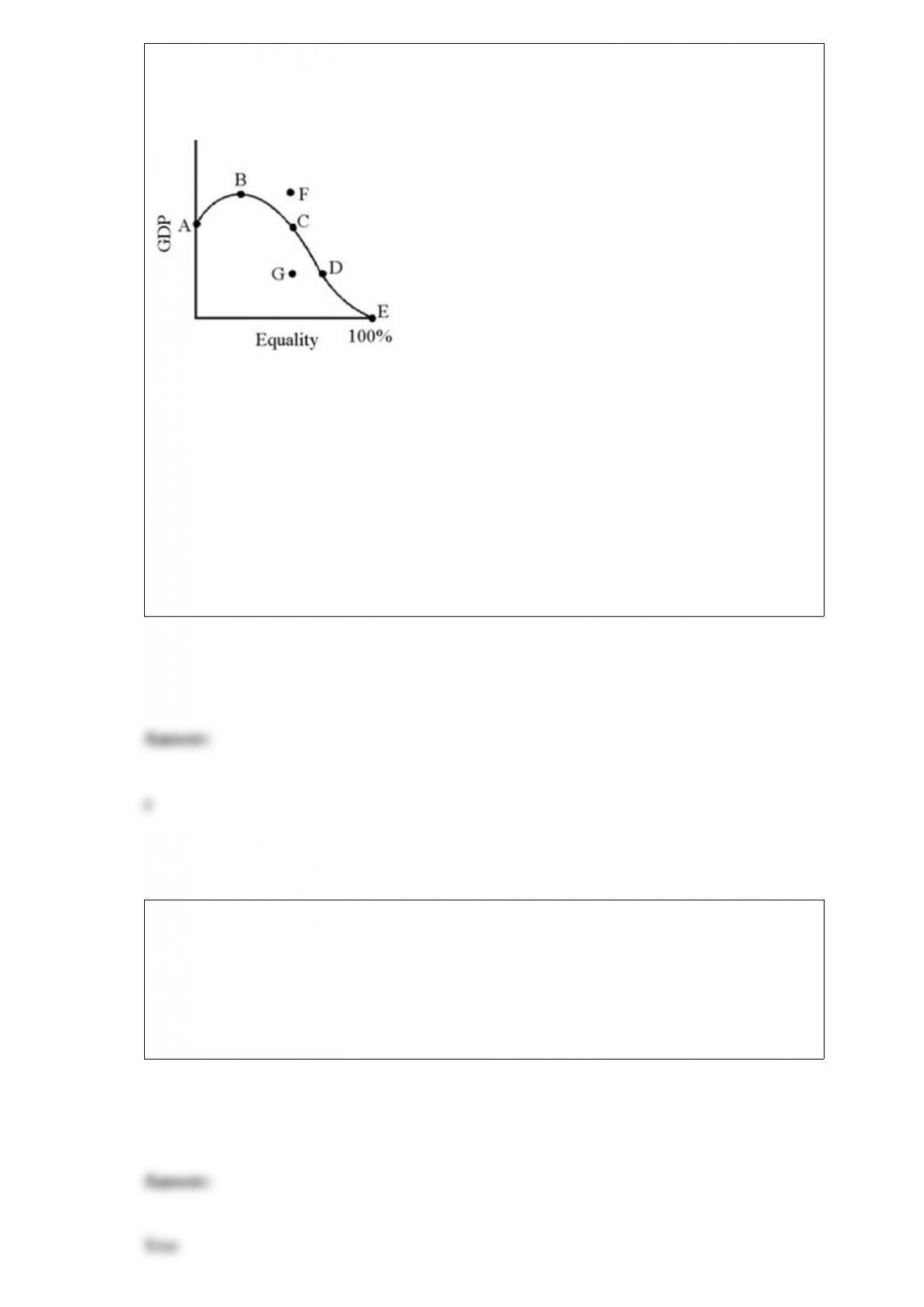
Figure 21-1
In Figure 21-1, if the existing antipoverty program were replaced by a negative income
tax, most economists believe that it would result in a move like which of the following?
a. C to F
b. A to B
c. D to E
d. G to D
A major difference between a monopoly and perfect competition is that monopolies can
earn an economic profit in the long run and a perfectly competitive firm cannot.
a. True
b. False

Recessions and depressions are the principal examples of
a. market failure.
b. coordination failure.
c. central planning.
d. socialist contradictions.
In some respects, the U.S. has fallen behind other nations.
a. True
b. False
Figure 22-8
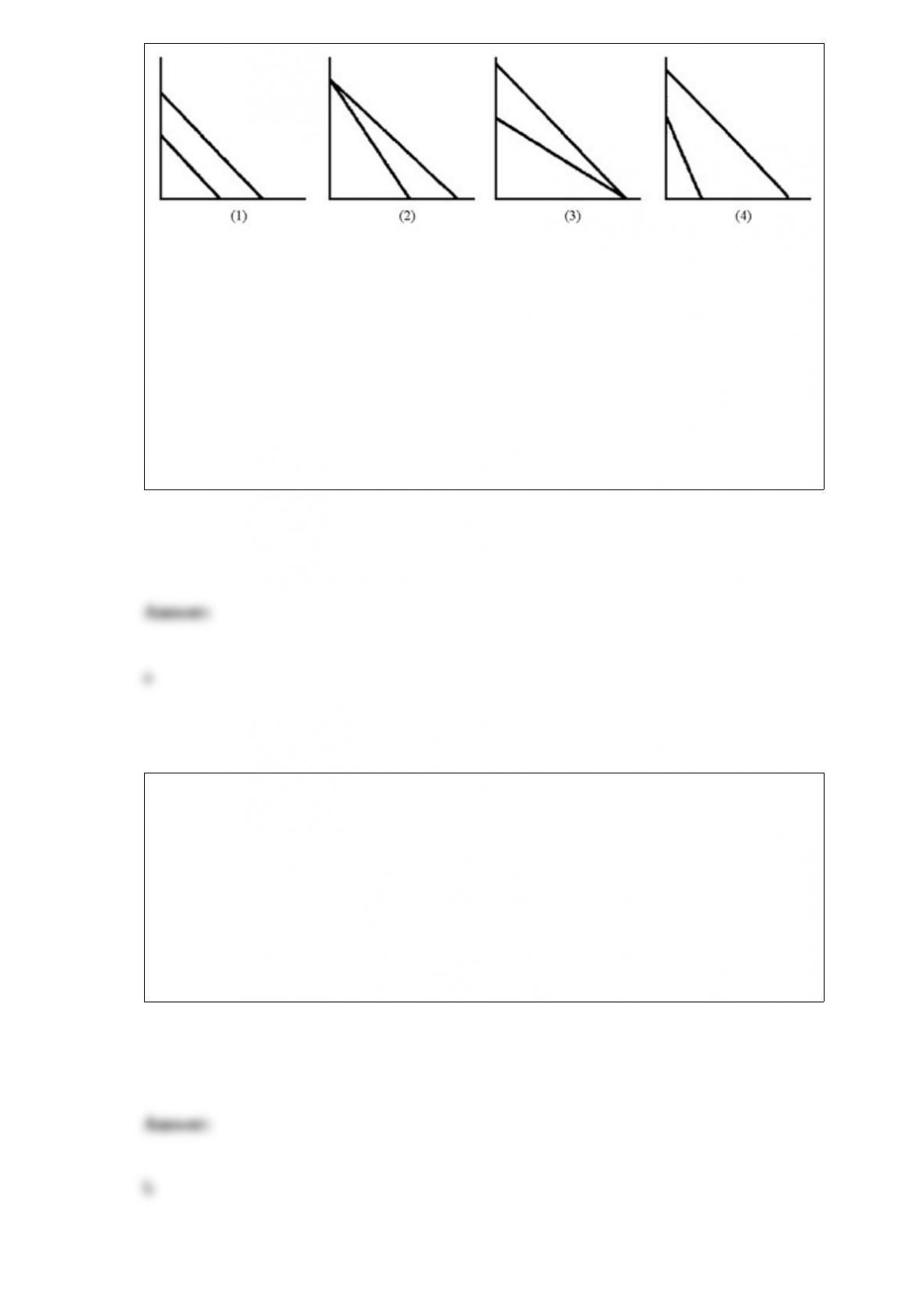
Figure 22-8 has four sets of production possibility curves for two hypothetical
countries. In which case will there be no advantage to trade between the two countries?
a. 1
b. 2
c. 3
d. 4
Which of the following is not potentially a barrier to entry into the widget market?
a. patent protection on the design of widgets
b. high prices for widgets
c. government licensing of widget producers
d. massive advertising by existing widget producers

Which of the following are included in the M2 definition of the money supply?
a. cash and currency
b. checkable deposits
c. money market deposit accounts
d. money market mutual funds
e. All of the above are included.
According to the quantity theory of money currently used by monetarists, assuming
velocity is constant (at a value of 5), a 10 percent increase in the money supply will
raise
a. nominal GDP by 50 percent.
b. real GDP by 10 percent.
c. nominal GDP by 10 percent.
d. real GDP by 50 percent.
On January 1, 2010, a homeowner borrowed $5,000 for a term of six months to
complete some home improvements, paying an annual interest rate of 8 percent. How
much principal and interest will the homeowner pay back on July 1, 2010?
a. $2,500
b. $2,900
c. $5,200
d. $5,400
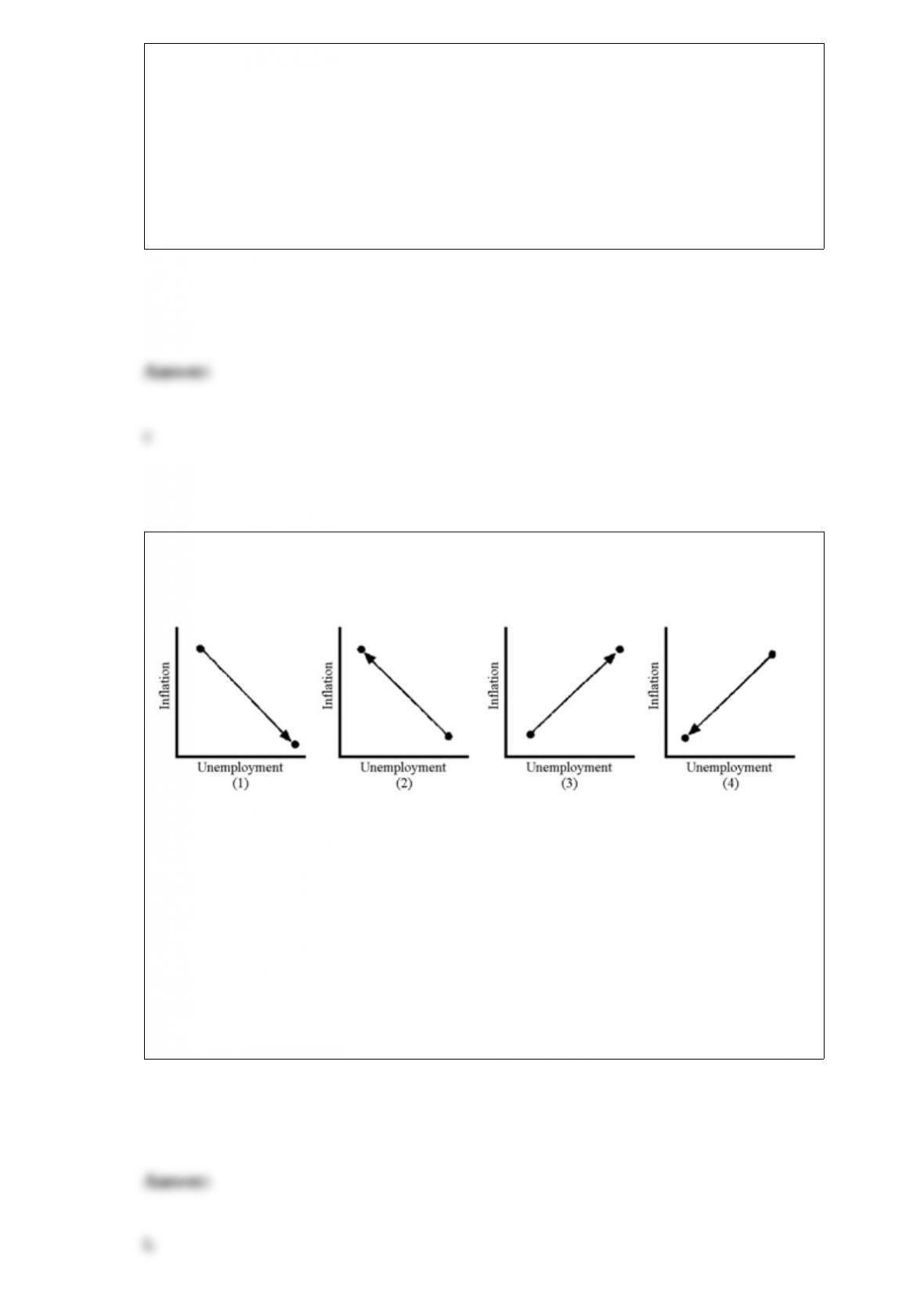
Figure 17-4
Which panel in Figure 17-4 shows the movement associated with a demand-side
inflation?
a. 1
b. 2
c. 3
d. 4

In economics, abstraction from reality is necessary because of the complexity of the
real world.
a. True
b. False
The unemployment rate for the U.S. economy in 2014 averaged about
a. 10.2 percent.
b. 8.5 percent.
c. 6.5 percent.
d. 4 percent.
Workers earn more than half of the income generated by the production process.
a. True
b. False

The effect throughout the entire economy of one individual’s increase in spending will
be
a. less than the individual’s spending.
b. equal to the individual’s spending.
c. greater than the individual’s spending.
d. offset by another individual’s saving.
The optimal purchase rule is stated as
a. TU = MU.
b. MU = P.
c. TU = P.
d. MU = 0.

Open market operations refer to the purchase and sales of stocks listed on the New York
Stock Exchange.
a. True
b. False
When prices rise
a. the rich benefit at the expense of the poor.
b. the poor benefit at the expense of the rich.
c. both the rich and poor lose real income.
d. the effect in the rich and poor is uncertain.
Microsoft has been accused of violating an antitrust law pertaining to bundling.
a. True
b. False

The current chair of the Federal Reserve System is
a. Tim Geithner.
b. Hillary Clinton.
c. Ben Bernanke.
d. Alan Greenspan.
e. Janet Yellen
The U.S. economy in 2009 was characterized by an excess level of output. This
corresponds to a recessionary gap.
a. True
b. False
In high schools, all teachers were paid the same based on years of service and

regardless of specialization. Beginning in the 1970s, a shortage of science and math
teachers developed as private industry paid more for math and science skills than
schools could offer. At the same time, a decline in the number of school-age children
tended to reduce the demand for all other teachers, which led to a surplus. The
economist’s solution to this problem would be
a. merit pay to reward the best teachers.
b. recognition that all teachers do comparable work and should be paid the same.
c. to raise the wages of all teachers.
d. to raise the wages of teachers in fields that are in short supply and lower those of
others.
Efficient allocation of resources makes everyone better off.
a. True
b. False
Table 7-1
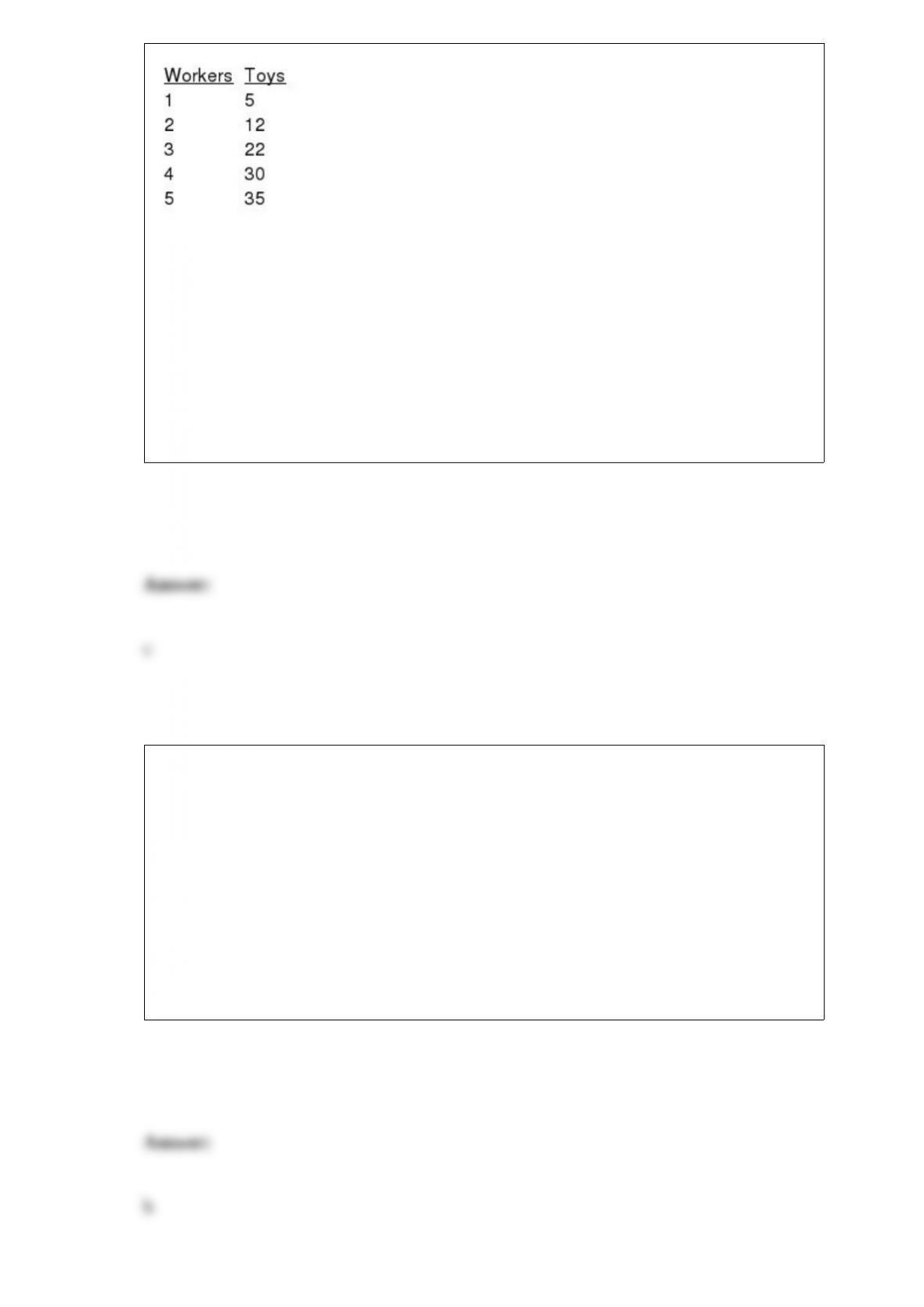
In Table 7-1, the marginal physical product begins to diminish with the addition of the
a. second worker.
b. third worker.
c. fourth worker.
d. Marginal returns never diminish in Table 7-1.
If total utility declines as an additional unit of a commodity is purchased,
a. marginal utility must be rising.
b. marginal utility is negative.
c. marginal utility is positive but falling.
d. its price must have risen.
e. marginal utility is zero.

If government forced a firm to charge a price equal to marginal cost in a situation where
there are scale economies,
a. new firms would enter the industry.
b. the firm would be forced to go bankrupt.
c. positive economic profit would grow even larger.
d. marginal cost would exceed average cost.
The Clayton Act prohibits “all contracts, combinations and conspiracies in restraint of
trade.”
a. True
b. False
Contractionary fiscal policies used to reduce the deficit in the 1990s did not hurt the
economy because fiscal and monetary policies were well coordinated at that time.
a. True
b. False

A demand curve with an elasticity of 1.0 is a unit-elastic demand curve.
a. True
b. False
You can generally distinguish an aggregate supply-caused recession from an aggregate
demand-caused recession because
a. real GDP will rise in an aggregate supply recession.
b. the price level will fall in an aggregate supply recession.
c. the price level will fall in an aggregate demand recession.
d. real GDP will rise in an aggregate demand recession.

The Japanese economy has been consistently weak throughout the 1990s. This has
caused a slight deflation, illustrating the
a. negligible cost of eliminating inflation.
b. very slow operation of the economy’s self-correcting mechanism.
c. tendency of inflation to accelerate during recessions.
d. rapidity with which inflation can be stopped.
Indirect taxes are levied on specific economic activities.
a. True
b. False
Figure 7-1
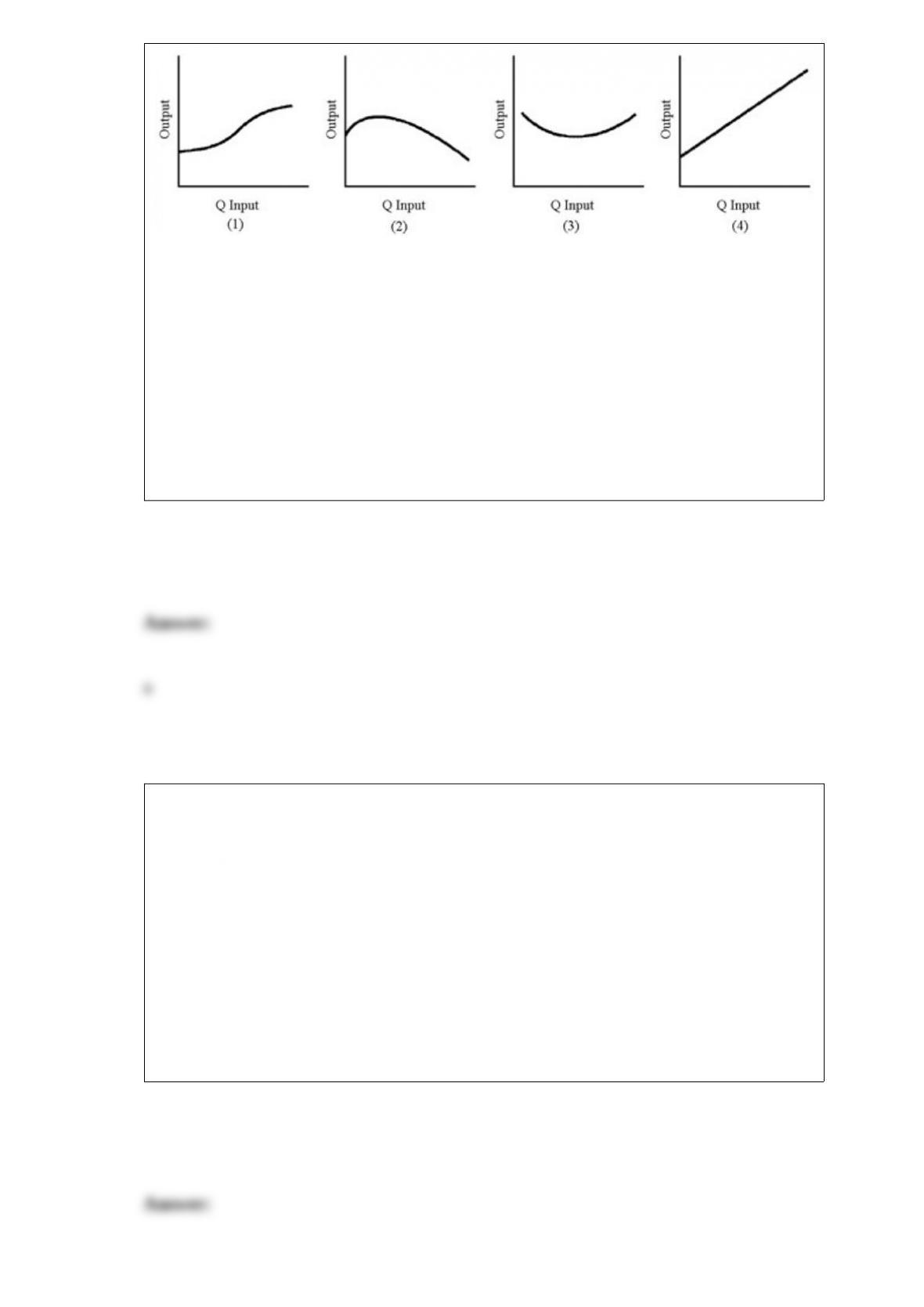
In Figure 7-1, which graph best represents total physical product with diminishing
returns?
a. 1
b. 2
c. 3
d. 4
A budget line is a straight line designed to show
a. how income is related to hours worked.
b. all combinations of two goods that can be purchased with a given income.
c. the way a homemaker should divide money among several commodities.
d. that if more money is spent on one good, the breadwinner must work all the harder to
maintain a satisfactory level of living.
e. preferences for goods and services.

How will a decrease in price tend to affect supply?
a. Supply will increase.
b. Supply will decrease.
c. Supply will not change.
d. Uncertain.
When a demand schedule is drawn as a graph,
a. price is measured on the vertical axis.
b. quantity is measured on the horizontal axis.
c. the resulting curve has a negative slope.
d. the other variables (besides price and quantity) are held constant.
e. All of the above are correct.
Why did President Obama want to repeal the Bush era tax cuts on upper income
taxpayers? How would the repeal of these tax cuts impact aggregate demand and to
what degree? How did the economic conditions in 2010 make such a repeal less likely
to take place?
In a past fare war, U.S. Air reduced the price of its Charlotte, North Carolina, to New
York City round-trip fare from $198 to $138 to match American Airlines. U.S. Air did
so reluctantly, saying it would cost the company millions of dollars in revenue.
American, on the other hand, believed the fare cut would increase its revenue. What
different assumptions about the underlying price elasticity of demand did each airline
believe true?
What are intermediate goods? Why do economists exclude the value of intermediate
goods while calculating national income?
What causes the aggregate supply curve to have an upward slope in the short run, but a
vertical slope in the long run?
Suppose that on a Saturday night at 10pm a large hotel has 300 vacant rooms, with little
expectation of renting them at such a late hour on a weekend. A traveler comes in the
door, looking a bit down on his luck, and asks how much a room will cost. Since he
can’t afford the normal rate of $150, the night manager decides to let him stay in the
room for only $40. Is it likely that this decision reduced, or increased, the hotel’s
profits? Explain your answer.
There is concern that CFCs, a chemical by-product of refrigeration, are destroying
Earth’s protective ozone layer, leaving us more vulnerable to cataracts and skin cancer.
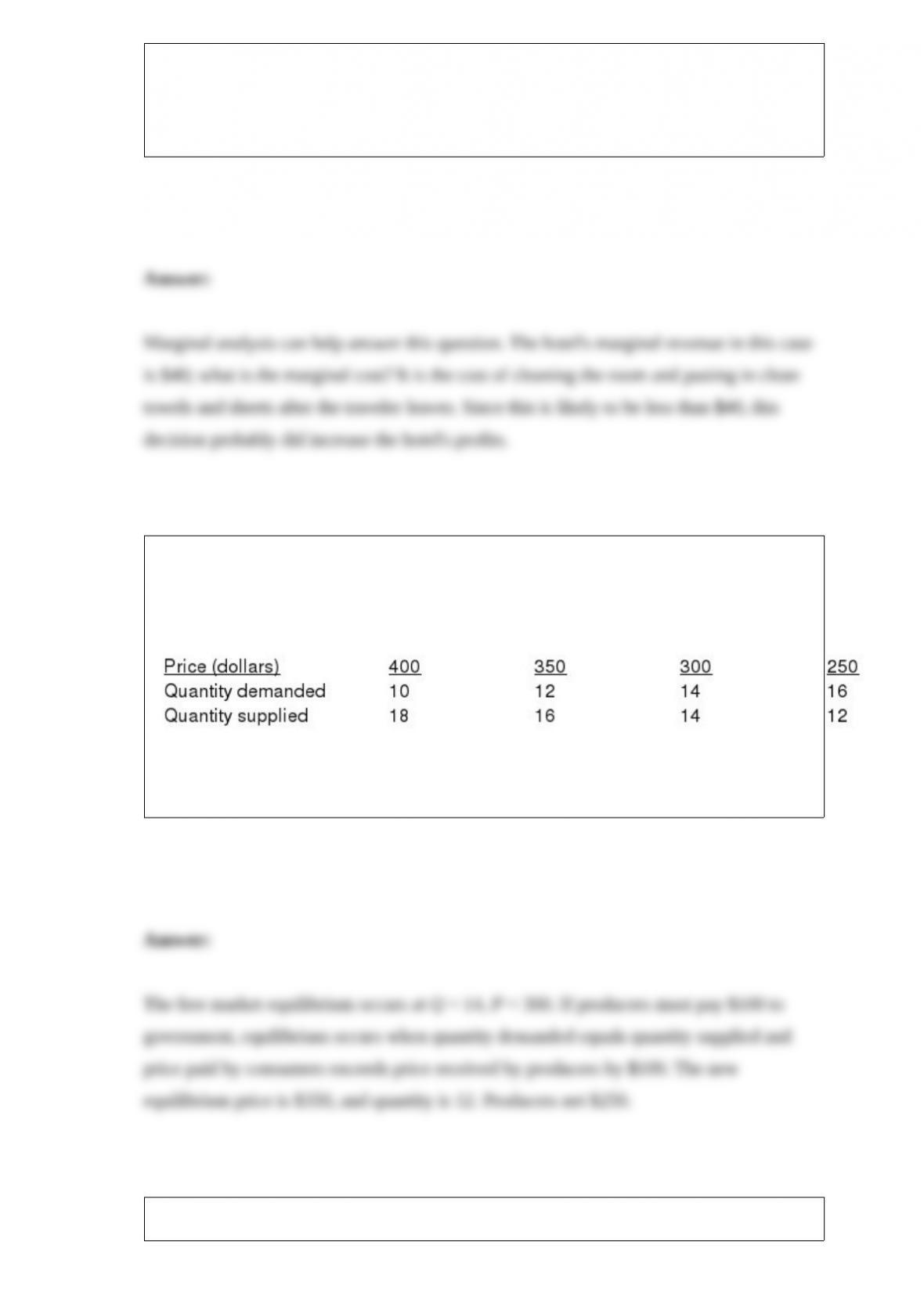
Suppose each air conditioner creates 10 pounds of CFCs. The demand and supply of air
conditioners follow:
What will be the free market price and quantity, and what will be the price and quantity
if the government forces suppliers to pay a $100 tax for each air conditioner produced?
What arguments have been advanced in defense of price discrimination?
How do income redistribution programs affect equality and efficiency?
Explain the distinction between investment and capital.
Explain why the long-run average cost is typically U-shaped.
The authors of the text suggest that a comprehensive personal income tax with few
loopholes would be efficient and equitable. What is their reasoning for this statement?
An economy consists of two goods: beef and lamb. Of all the points on this economy’s
production possibilities frontier, which one is best in terms of efficiency?
Why assume that firms maximize profit, when it is easy to find companies that pursue
other goals such as saving rain forests (Ben and Jerry’s) and sponsoring Mister Rogers
(Sears)?
What is the marginal rate of substitution, and what role does it play in determining the
consumer’s optimum choice?
What are the three noteworthy labor market trends that Americans have experienced for
about two decades?
In many cities, the price of summer pops concerts has risen. In Charlotte, North
Carolina, and Columbus, Ohio, for example, concerts that were once free now cost $5.
If there are only fixed costs and no variable costs nor marginal costs in an orchestra
concert, what is the efficient price? Explain the reason why some people will find the
efficient price unfair.
Is it a good thing to go to a point where marginal profit is zero? Explain.
How do the fluctuations in the exchange rate influence the domestic price level?
Explain how exchange rates affect the level of aggregate economic activity and the
price level. Use appropriate AS/AD diagrams to illustrate your answer.
Voluntarism often has proved to be weak and unreliable. Does it still have a place in
controlling activities that damage the environment?