
During a business cycle expansion, total production ________ and total employment
________.
A) increases; increases
B) increases; decreases
C) decreases; increases
D) decreases; decreases
The Brooks Appliance Store and the Lefingwell Appliance Store (both are located in the
same city) each sell an identical washer-dryer. The owner of each store considered
offering the washer-dryer for $700, but decided on a price of $500. If this is a Nash
equilibrium we can conclude that
A) each store owner feared charging the higher price would result in being undercut by
the other store charging the lower price.
B) the owners of the stores feared that charging $700 could be used as evidence of
collusion.
C) charging $500 was the most profitable strategy for each store, regardless of what
price was charged by the other store.
D) the stores were less concerned about making a profit from the washer-dryers than
they were with attracting customers who would also buy other appliances.
If production displays increasing marginal returns, then

A) total product rises by a constant amount throughout.
B) each new worker hired adds more to output than previous hires.
C) the firm must be adding new capital to keep boosting productivity.
D) total product reaches a maximum sooner than if production displayed decreasing
returns.
Which of the following is evidence of a shortage of walnuts?
A) Firms lower the price of walnuts.
B) The price of cashews is lowered in order to make up for the walnut shortage.
C) The equilibrium price of walnuts falls due to a decrease in demand.
D) The quantity demanded of walnuts is greater than the quantity supplied.
With the increased usage of cell phone services, what has happened to the price
elasticity of demand for land-line telephone services?
A) It has become more price inelastic.
B) It has become more price elastic.
C) It has become more income elastic.
D) The absolute value of the price elasticity coefficient has probably gone down.
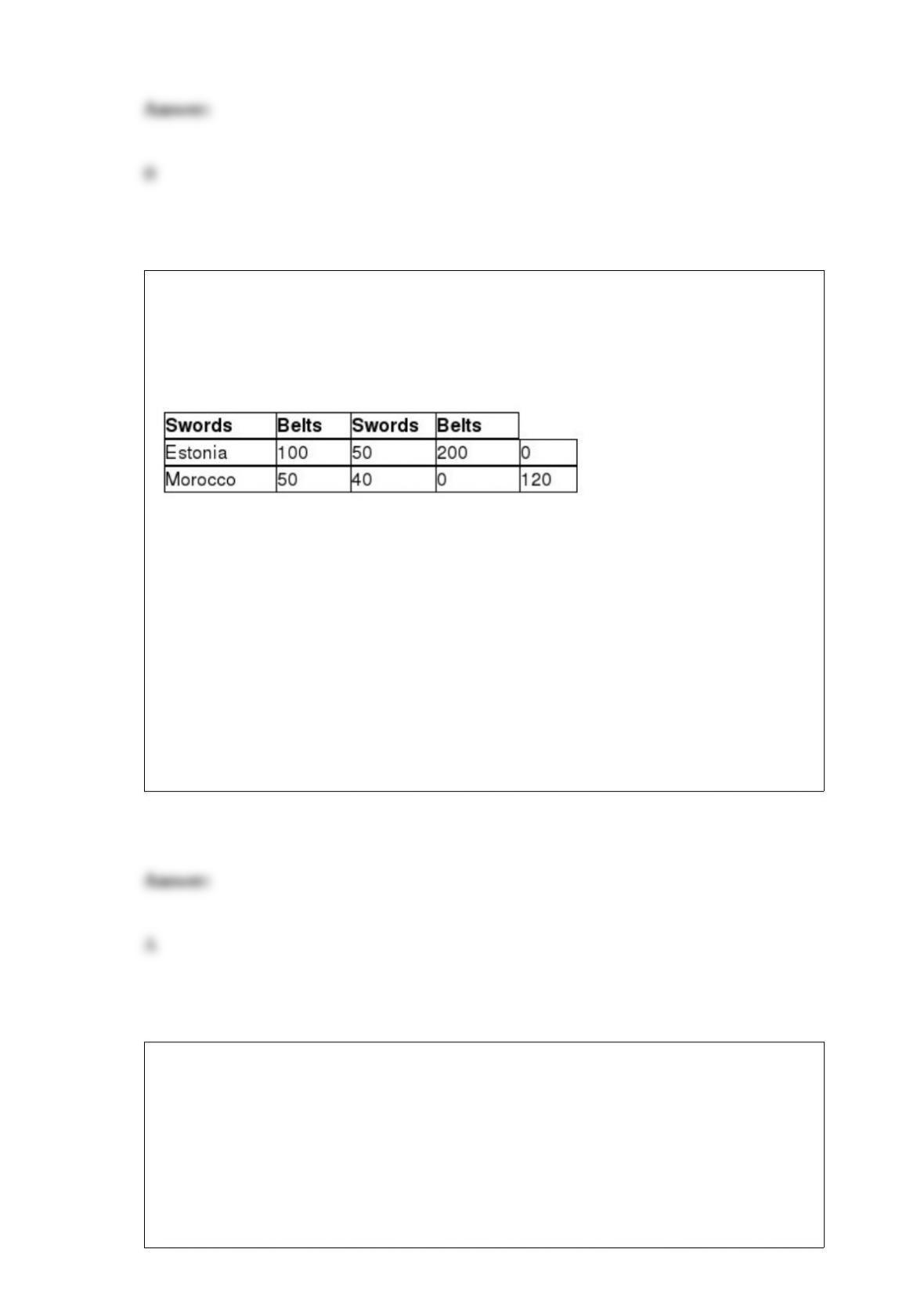
Table 7-6 Production and
Consumption Production
Without Trade With Trade
Estonia and Morocco can produce both swords and belts. Table 7-6 shows the
production and consumption quantities without trade, and the production numbers with
trade. If the actual terms of trade are 1 belt for 1.5 swords and 70 belts are traded, how
many swords will Estonia gain compared to the “without trade” numbers?
A) 5
B) 45
C) 100
D) 105
Fluctuating exchange rates can alter a multinational firm’s profits and losses. The U.S.
corporation, Motorola, produces cell phones and sells cell phones in Mexico. If the
dollar appreciates against the peso, then Motorola’s revenues from these operations
should ________ and its costs from these operations should ________.
A) rise; fall
B) rise; rise

C) fall; fall
D) fall; rise
The financial situation at Starbucks in the late 2000s illustrates the fact that maintaining
long-run profits in a monopolistically competitive market is
A) impossible.
B) very difficult.
C) fairly easy.
D) almost always guaranteed.
If real GDP in the United States is growing at an annual rate of 3.2% per capita and
Bolivia’s real GDP per capita is growing at a rate of 1.3%, which of the following
would we expect in the long run? Assume real GDP per capita in the United States
begins at a level above that of real GDP per capita in Bolivia.
A) Real GDP per capita in the United States will always be 1.9% higher than real GDP
per capital in Bolivia.
B) The difference between the level of real GDP per capita in the United States and real
GDP per capita in Bolivia will shrink over time.
C) The difference between the level of real GDP per capita in the United States and real
GDP per capita in Bolivia will increase over time.

D) The difference between the level of real GDP per capita in the United States and real
GDP per capita in Bolivia will always be $1.9 trillion.
An increase in the interest rate
A) decreases the opportunity cost of holding money.
B) increases the opportunity cost of holding money.
C) decreases the percentage yield of holding money.
D) increases the percentage yield of holding money.