
An implicit cost is
A) a nonmonetary opportunity cost.
B) a cost unique to sole proprietorships.
C) a cost that involves spending money.
D) a cost unique to corporations.
Economics does not study correct or incorrect behaviors, but rather it assumes that
economic agents behave ________, meaning they make the best decisions given their
knowledge of the costs and benefits.
A) equitably
B) rationally
C) emotionally
D) selfishly
Ordinarily, governments attempt to promote competition in markets. Why do
governments use patents to block entry into some markets when this prohibits
competition?
A) Patents encourage firms to spend money on research necessary to create new
products.
B) Politicians sometimes succumb to pressure from lobbyists to grant favors to

businesses for political reasons.
C) Patents are an important source of government revenue.
D) Patents are justified because they are an important means for creating network
externalities.
The bargaining power of suppliers increases if
A) the cost of switching suppliers is relatively low.
B) there are only a few competitors to the supplier.
C) the input in question is not a critical component of production.
D) the input supplied is relatively standardized.
“Household production” refers to
A) the manufacturing of durable household products.
B) the home building sector of the economy.
C) home-based craft businesses.
D) goods and services people produce for themselves.
The sum of consumer surplus and producer surplus is equal to
A) the deadweight loss.
B) the economic surplus.
C) zero.
D) total profit.
Delaware and North Dakota have identical state gasoline taxes of 23.0 cents per gallon.
When added to the federal gasoline tax of 18.4 cents per gallon, the total tax on one
gallon of gasoline in these two states is 41.4 cents. On October 8, 2013, the average
price of one gallon of regular gasoline was $3.309 in Delaware and $3.394 in North
Dakota. Briefly explain whether this is an example of price discrimination. Assume that
the gasoline being sold is identical in both states. Sources: gaspricewatch.com and
gasbuddy.com.
Figure 14-1
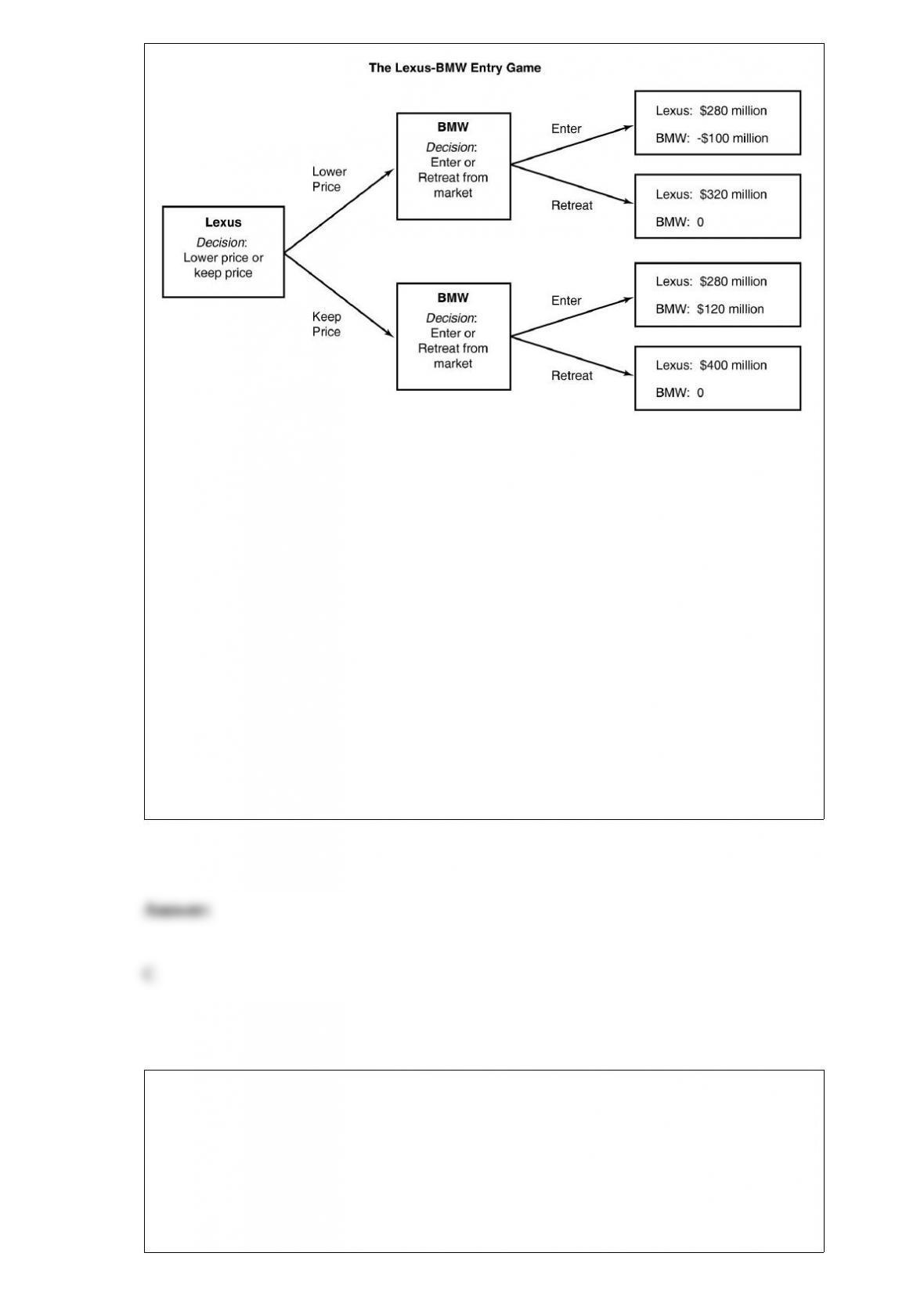
Assume that Lexus (L) is the first automobile company to produce a luxury class hybrid
automobile and is the only such company for the past four years. BMW is now
considering producing its own luxury hybrid automobile and Lexus must decide
whether or not to lower the price of its luxury hybrid to counter BMW’s entry into the
luxury hybrid niche. Should Lexus lower its price in order to deter BMW’s entry into
the luxury hybrid automobile market?
A) In terms of profit earned, it makes no difference whether Lexus lowers its price or
not; in either case it will make $280 million profit if BMW enters.
B) No, it should keep the same price and work to capitalize on its brand loyalty.
C) Yes, it will drive BMW out of the market.
D) No, because BMW will enter the market regardless of Lexus’ decision about its
price.
If a firm faces a downward-sloping demand curve,
A) the demand for its product must be inelastic.
B) it can control both price and quantity sold.
C) it must reduce its price to sell more units.
D) it will always make a profit.
All of the following cost curves are U-shaped except one. Which curve is not
U-shaped?
A) the marginal cost curve
B) the average fixed cost curve
C) the average total cost curve
D) the average variable cost curve
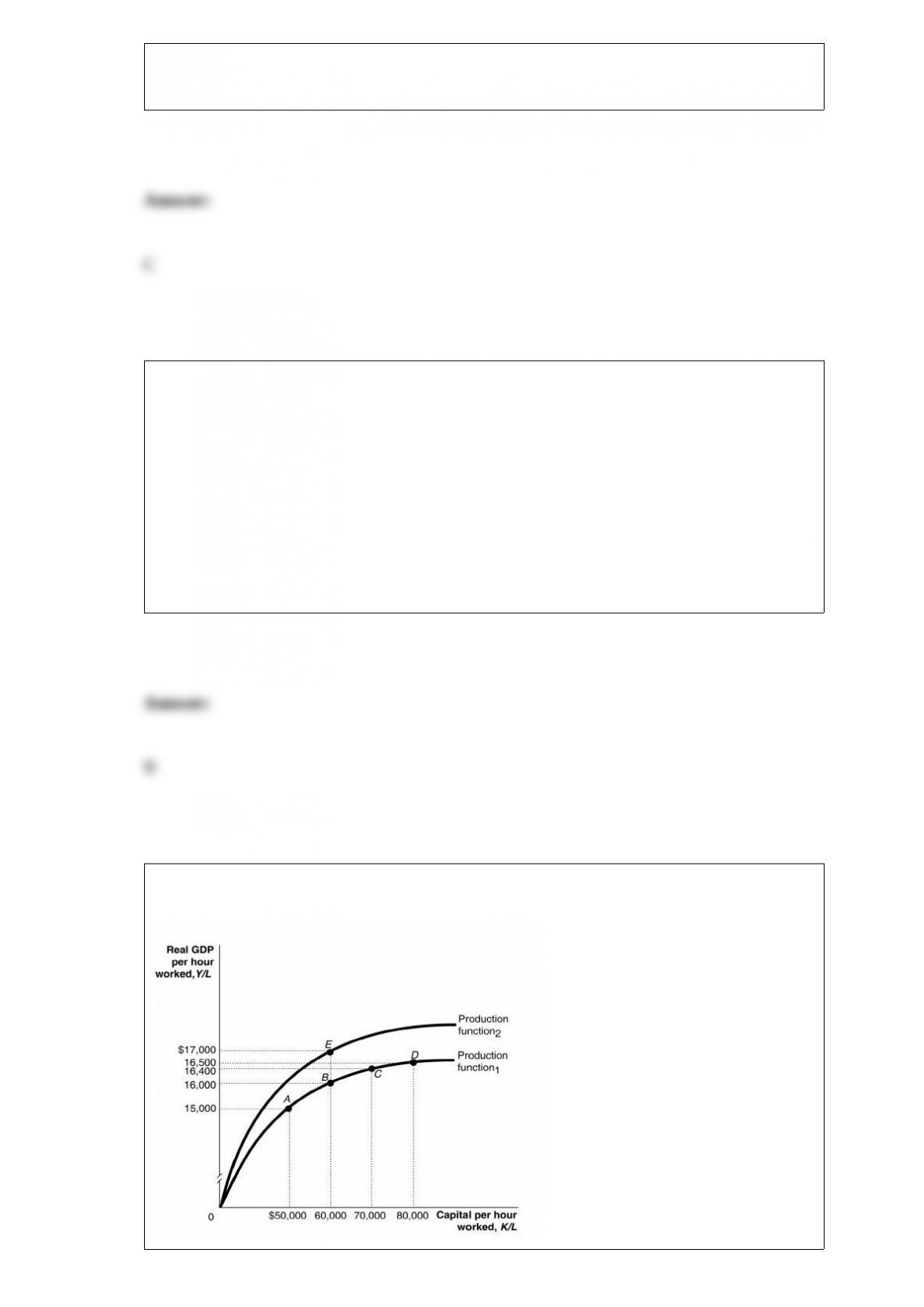
Figure 11-3

Which of the following would cause an economy to move from a point like A in the
figure above to a point like B?
A) an improvement in technology
B) a decrease in capital per hour worked
C) an increase in capital per hour worked
D) a technological regression
Who hires the managers of a corporation?
A) the board of directors
B) stockholders
C) managers
D) employees
Lilly Davis has $5 per week to spend on any combination of ice cream and candy. The
price of an ice cream cone is $2 and the price of a candy bar is $1. The table below
shows Lilly’s utility values. Use the table to answer the questions that follow the table.
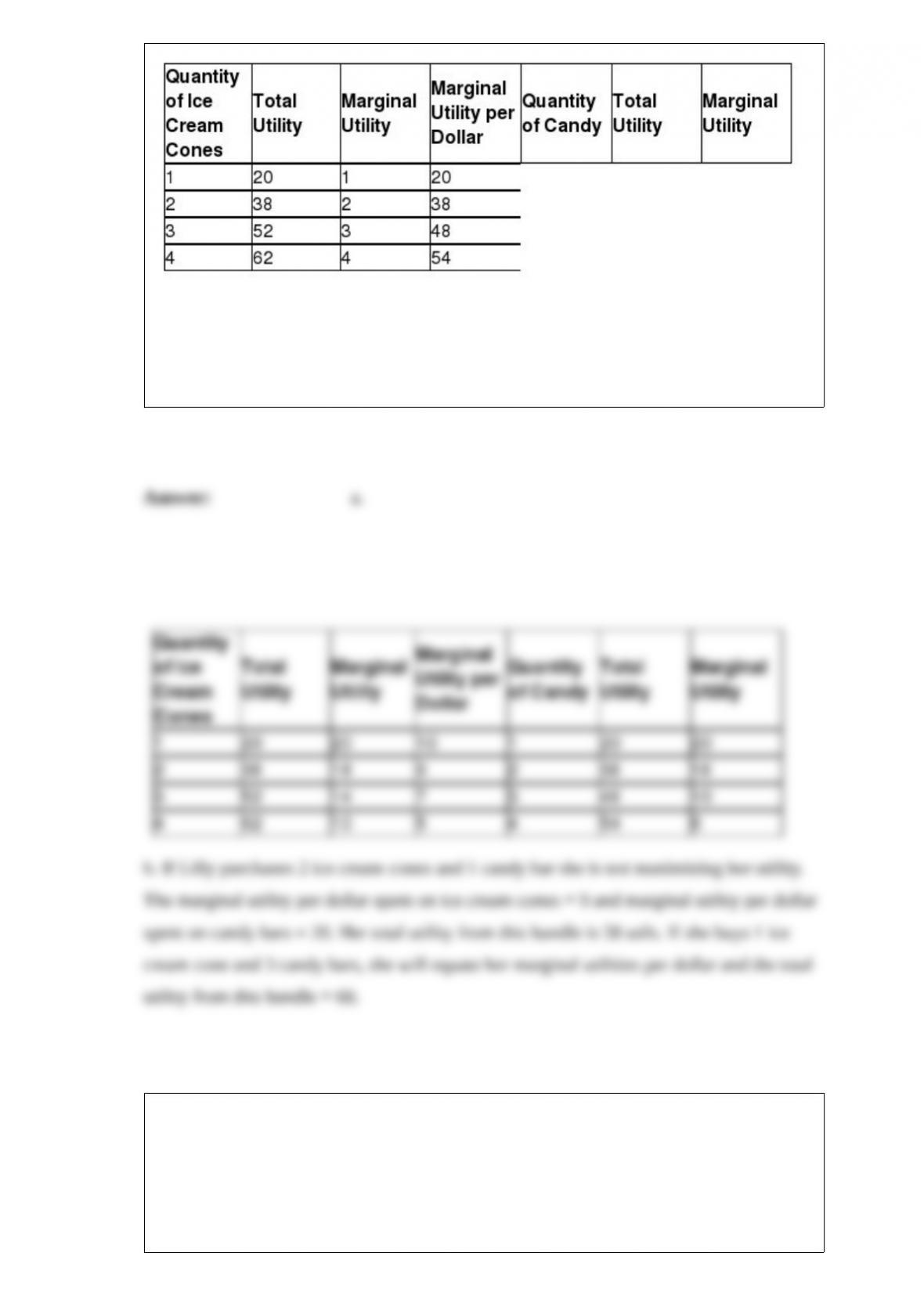
a. Complete the table by filling in the blank spaces.
b. Suppose Lilly purchases 2 ice cream cones and 1 candy bar. Is she consuming the
optimal consumption bundle? If so, explain why. If not, what combination should she
buy and why?
The highest valued alternative that must be given up to engage in an activity is the
definition of
A) economic equity.
B) marginal benefit.
C) opportunity cost.
D) marginal cost.
Some economists have proposed making the tax treatment of employer-provided health
insurance the same as the tax treatment of individually purchased health insurance and
out-of-pocket health care spending. Such changes would make it more likely that
A) consumers would pay prices closer to the actual costs for routine medical care.
B) employers would provide more generous medical coverage to their employees.
C) insurance deductibles would decrease.
D) the quantity of medical services demanded would increase.
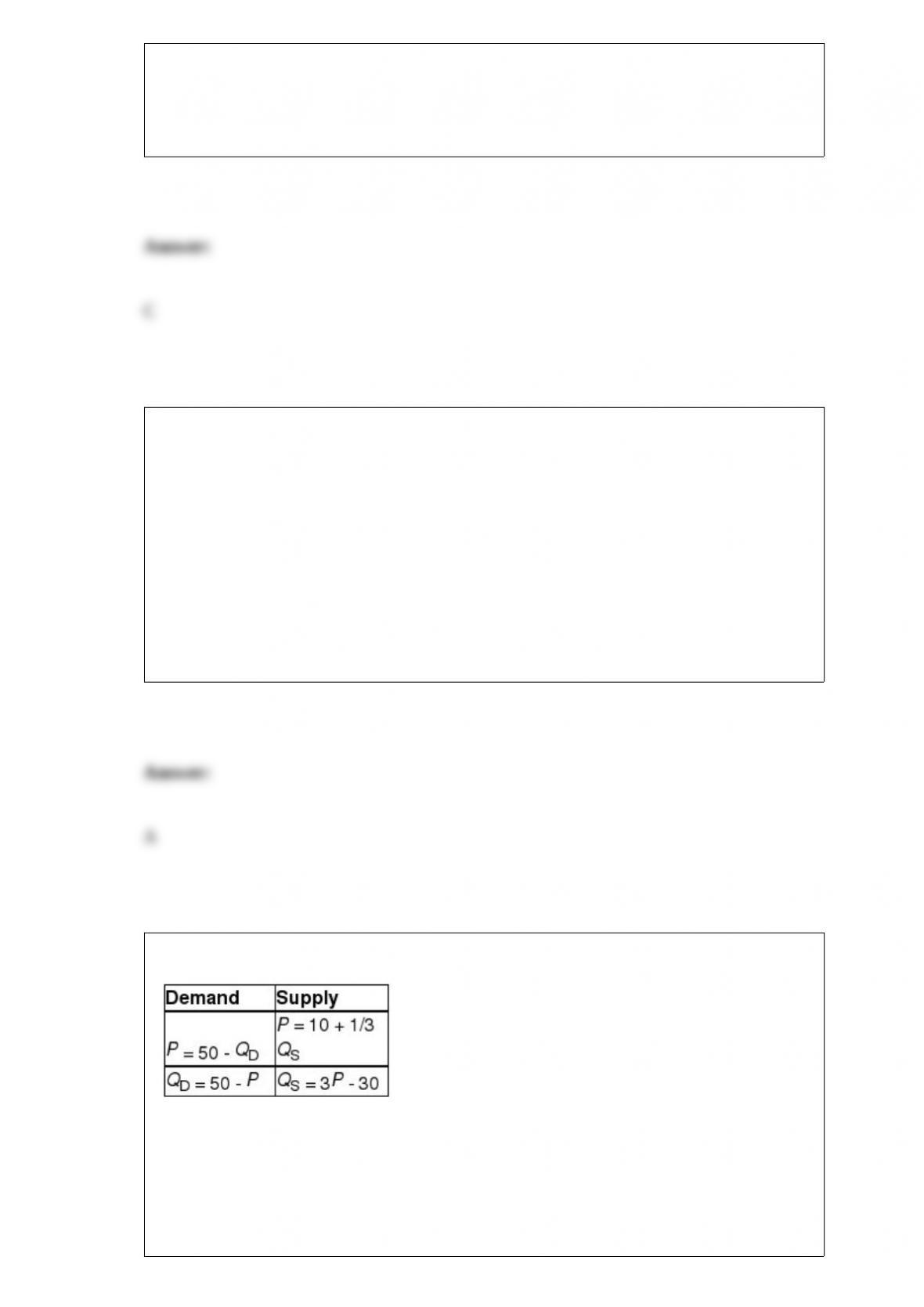
Table 4-13
The equations above describe the demand and supply for Aunt Maud’s Premium Hand
Lotion. The equilibrium price and quantity for Aunt Maud’s lotion are $20 and 30
thousand units. What is the value of producer surplus?
A) $600 thousand

B) $300 thousand
C) $150 thousand
D) $30 thousand
Your roommate argues that he can think of no better situation than living in a
deflationary economy, as prices of goods and services would continuously fall. You
disagree and argue that during a deflation, people can be made worse off because
A) the purchasing power of people’s incomes would increase.
B) the purchasing power of the currency would decrease.
C) the value of the real interest rate will drop below the nominal interest rate.
D) borrowers will have to pay increasing amounts in real terms over time.
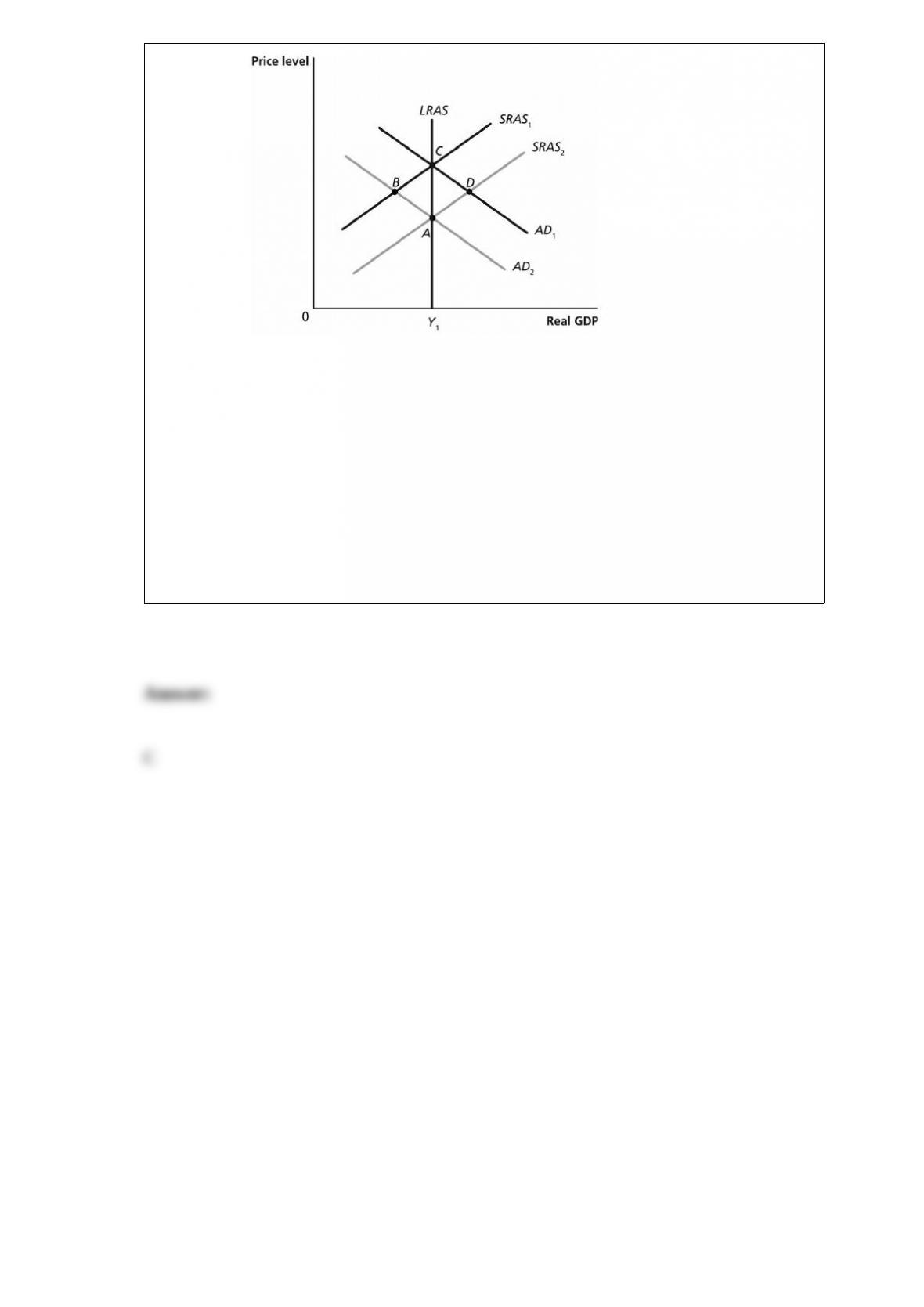
Figure 24-3
Suppose the economy is at point A. If investment spending increases in the economy,
where will the eventual long-run equilibrium be?
A) A
B) B
C) C
D) D