
When the government enacts policies that lead to lower mortgage lending standards and
lower interest rates, their actions can indirectly lead to higher home prices.
a. True
b. False
The difference between artificial rents and real rents is that
a. artificial rents are contrived by government and real rents are not.
b. real rents are usually bigger than artificial rents.
c. artificial rents occur only if the supply curve for the good in question is perfectly
inelastic.
d. artificial rents are subject to rent seeking and real rents are not.
Theories should be judged based upon how
a. well they explain things.
b. consistently and accurately they predict.
c. famous the economist is making the prediction.
d. the amount of attention given to them by the media.
e. a and b
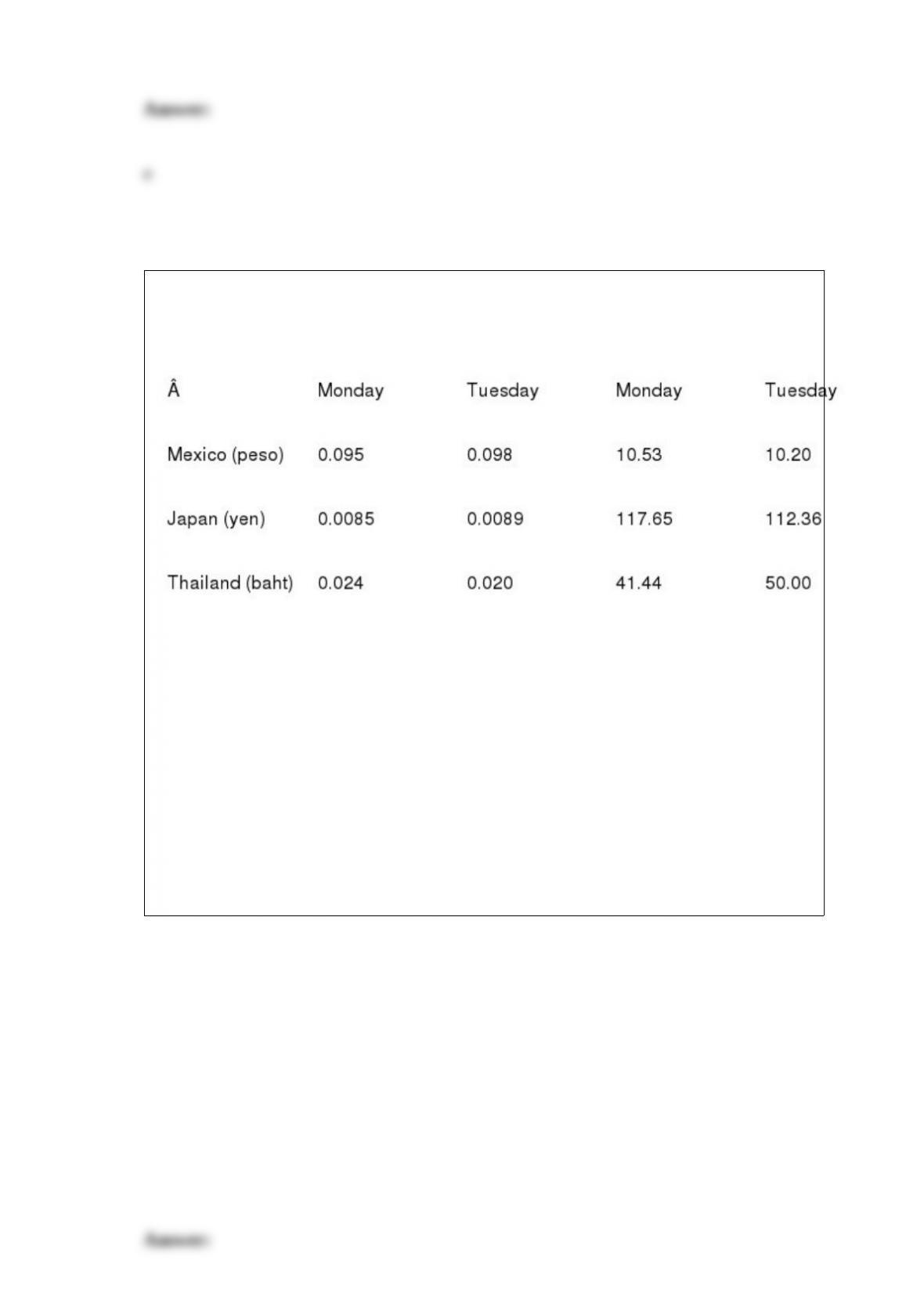
Exhibit 35-5 U.S. $ Equivalent Foreign Currency
per U.S. $
Based on the information provided in this table, between Monday and Tuesday, the U.S.
dollar ____________ against the Thai baht and the baht _____________ against the
U.S. dollar.
a. appreciated; appreciated
b. depreciated; appreciated
c. appreciated; depreciated
d. depreciated; depreciated

Equilibrium price is $10 in a perfectly competitive market. For a perfectly competitive
firm, MR = MC at 1,200 units of output. At 1,200 units, ATC is $23, and AVC is $18.
The best policy for this firm is to __________ in the short run. Also, this firm earns
__________ of __________ if it produces and sells 1,200 units.
a. shut down; losses; $15,600
b. shut down; losses; $9,600
c. continue to produce; losses; $15,600
d. continue to produce; profits; $15,600
A monopolist can sell 26,000 units at a price of $30 per unit. Lowering price by $1
raises the quantity demanded by 1,000 units. What is the change in total revenue
resulting from this price change?
a. $1,500
b. $3,000
c. $5,500
d. -$2,800
A network good is one whose value
a. increases as the expected number of units sold increases.
b. was created by the Internet.
c. is dependent upon interconnection to another good.
d. is defined by its links to other markets.
Insurance deductibles __________ the __________ problem of insurance coverage.
a. are meant to reduce; adverse selection
b. are meant to reduce; moral hazard
c. unintentionally worsen; adverse selection
d. unintentionally worsen; moral hazard
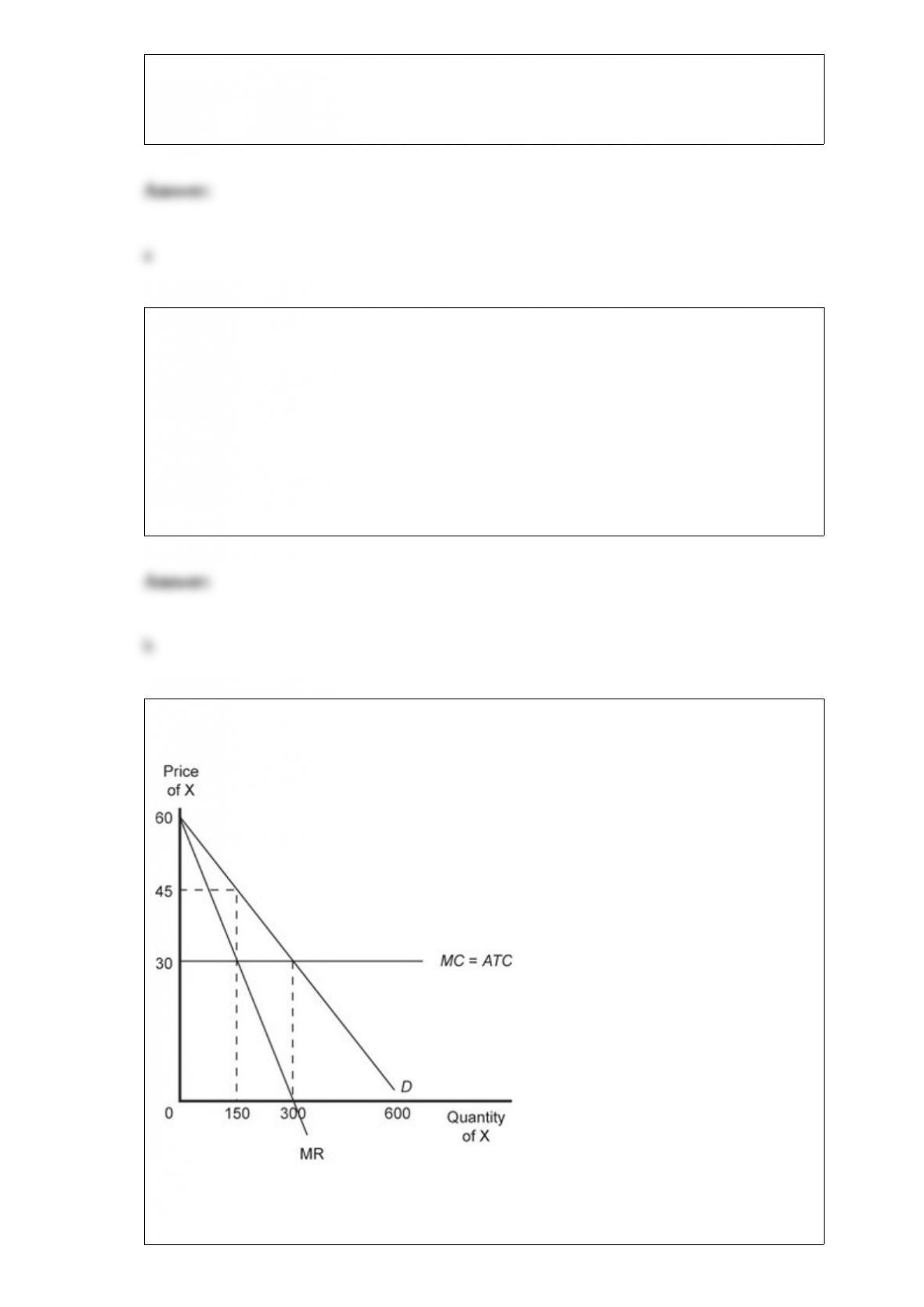
Exhibit 24-7
Let D be the demand curve facing a perfectly price-discriminating monopolist. The
marginal revenue it receives from selling the 150th unit of good X sold equals

a. $60.
b. $45.
c. $30.
d. $0, since it sells less than 150 units.
Government provides a nonexcludable public good that no one wants.This situation is
most closely related with:
a. government solving a market failure.
b. government failure.
c. market failure.
d. the market solving a government failure.
There are ten firms in an industry. Five of the firms each have a market share of 12
percent and five of the firms each have a market share of 8 percent. The Herfindahl
index is
a. 1,000.
b. 1,040.
c. 100.
d. 920.
e. none of the above
If labor is the variable input, then marginal cost equals
a. MPP divided by the wage rate.
b. average variable (labor) costs divided by MPP.
c. average variable (labor) costs multiplied by MPP.
d. the wage rate divided by MPP.
e. the wage rate multiplied by MPP.
Price elasticity of demand is the ratio of the percentage change in price of one good to
the percentage change in quantity demanded of another good.
a. True
b. False
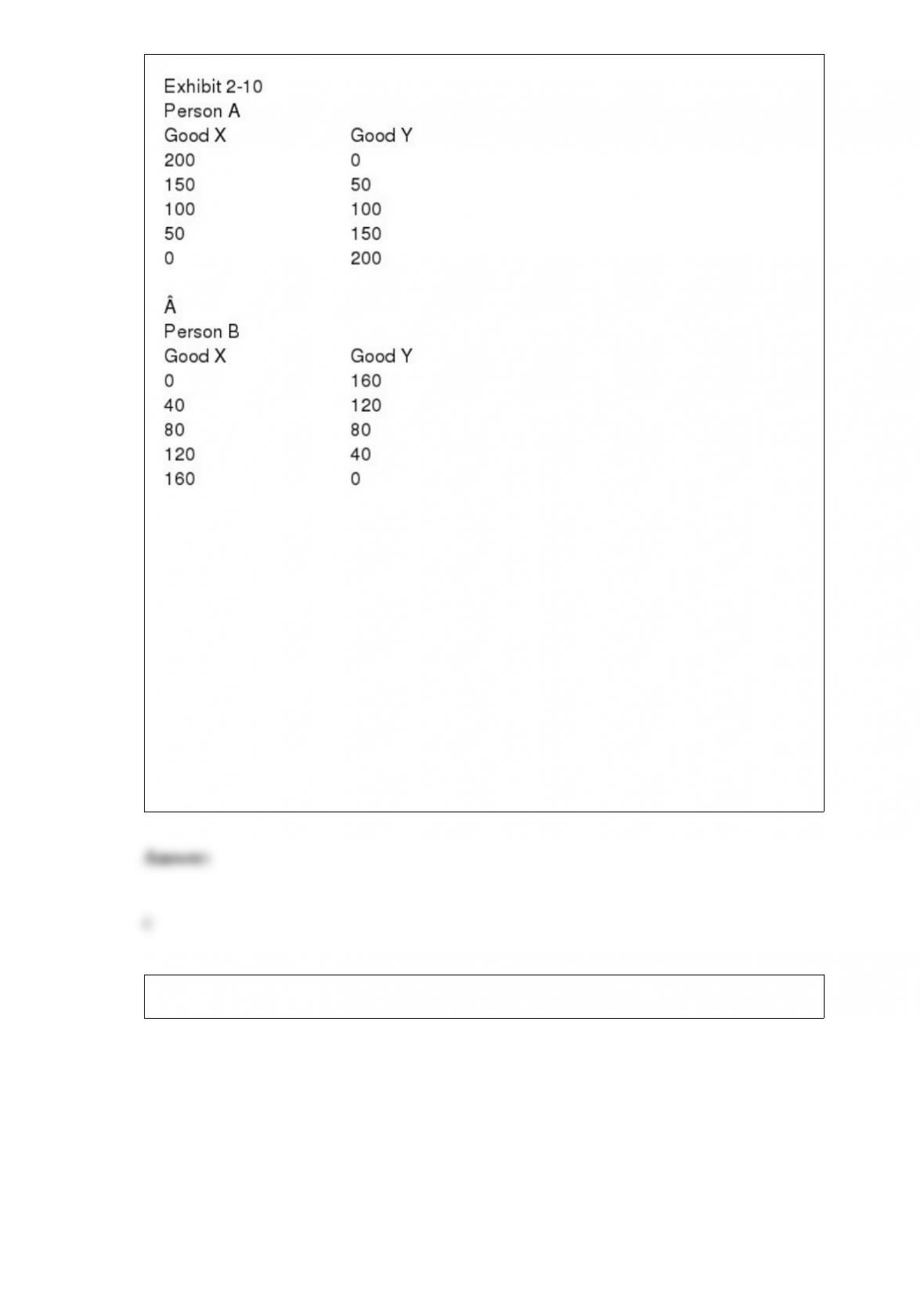
Person A has the comparative advantage in the production of _____________ and
person B has the comparative advantage in the production of __________________.
a. X; Y
b. Y; X
c. neither good X nor good Y; neither good X nor good Y
d. both good X and good Y; neither good X nor good Y
e. neither good X nor good Y; both good X and good Y
Exhibit 32-2
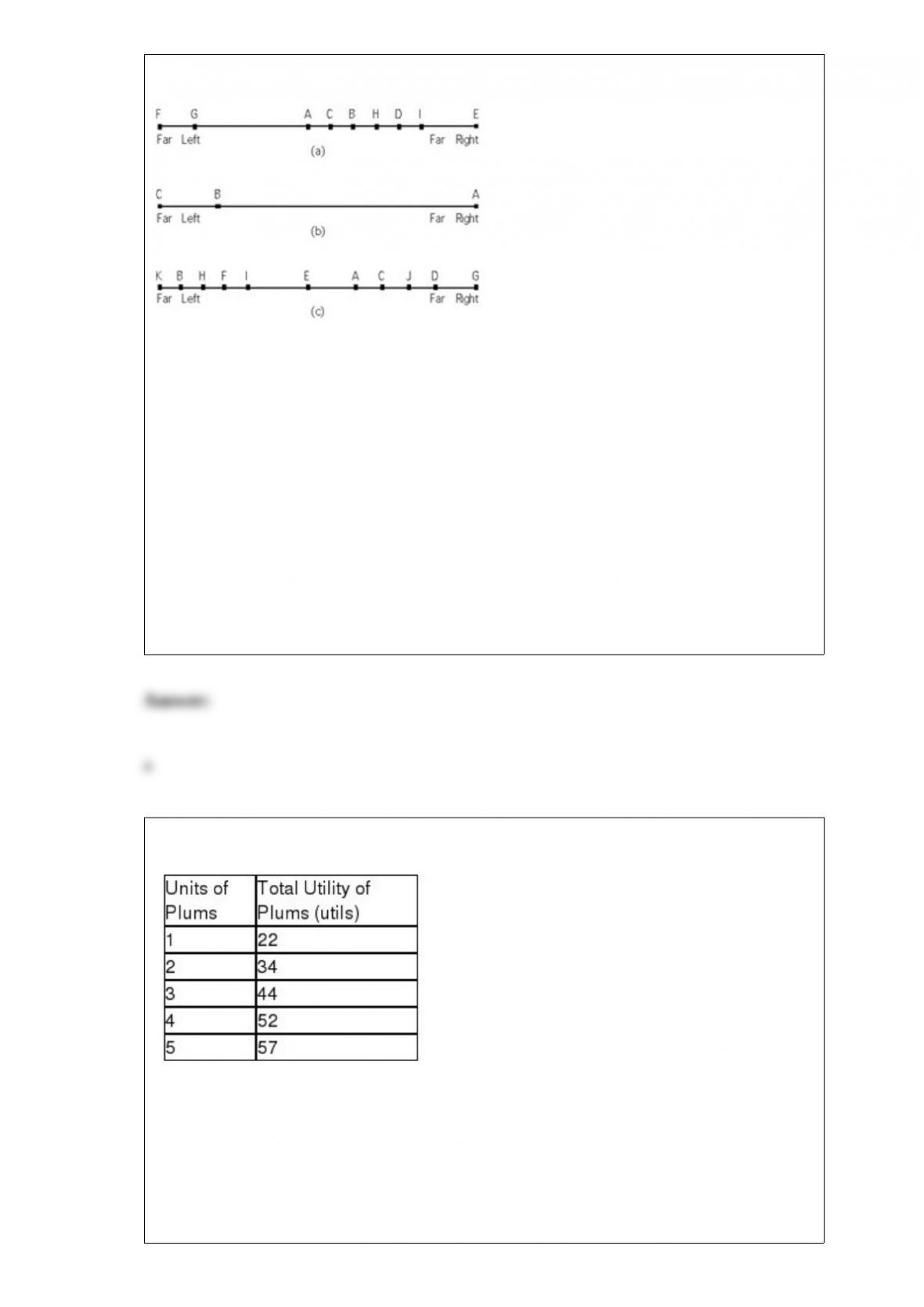
Two candidates are competing for an electorate consisting of 3 voters labeled A, B, and
C shown positioned with respect to their ideological stands on issues. The median voter
theory would predict that candidates will assume the ideological position(s)
a. of voter B.
b. of voters C and A, respectively.
c. halfway between voter C and voter A.
d. halfway between voter B and voter A.
e. halfway between voter C and voter B, for one candidate, and of voter A for the other.
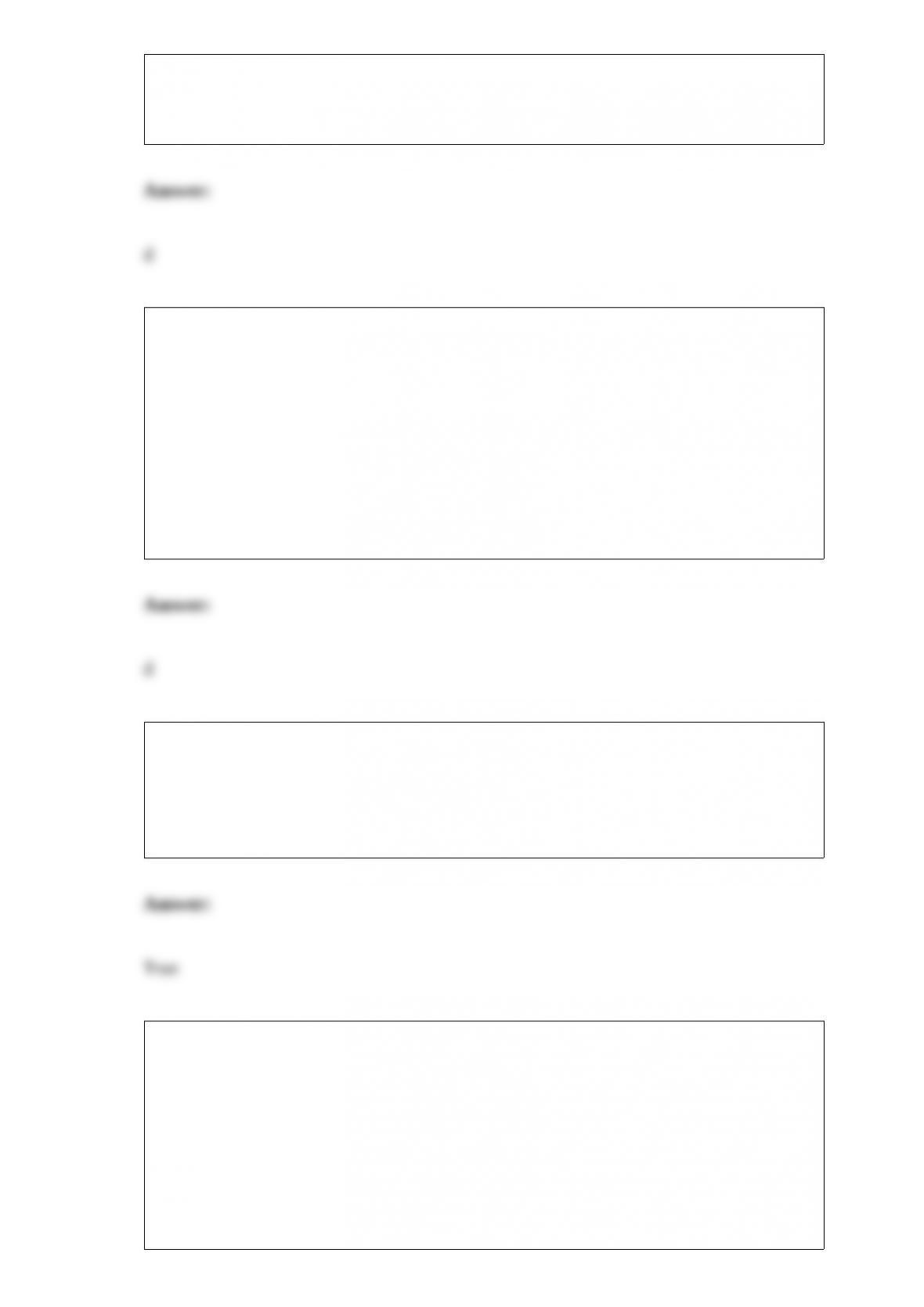
Exhibit 21-1
The marginal utility of the second plum is
a. 18.5 utils.
b. 7.5 utils.
c. 37 utils.
d. 12 utils.
At a price for which quantity demanded exceeds quantity supplied, a __________ is
experienced, which pushes the price __________ toward its equilibrium value.
a. surplus; downward
b. surplus; upward
c. shortage; downward
d. shortage; upward
Economists use the terms resource and input as synonyms.
a. True
b. False
The study of an economy’s price level is explicitly a part of
a. macroeconomics.
b. microeconomics.
c. positive economics.
d. normative economics.
If the average variable cost curve is falling,
a. the MC curve must be below it.
b. marginal cost is greater than average variable cost.
c. the MC curve is necessarily falling.
d. the MC curve is necessarily horizontal (neither rising nor falling).
e. the MC curve is necessarily rising.