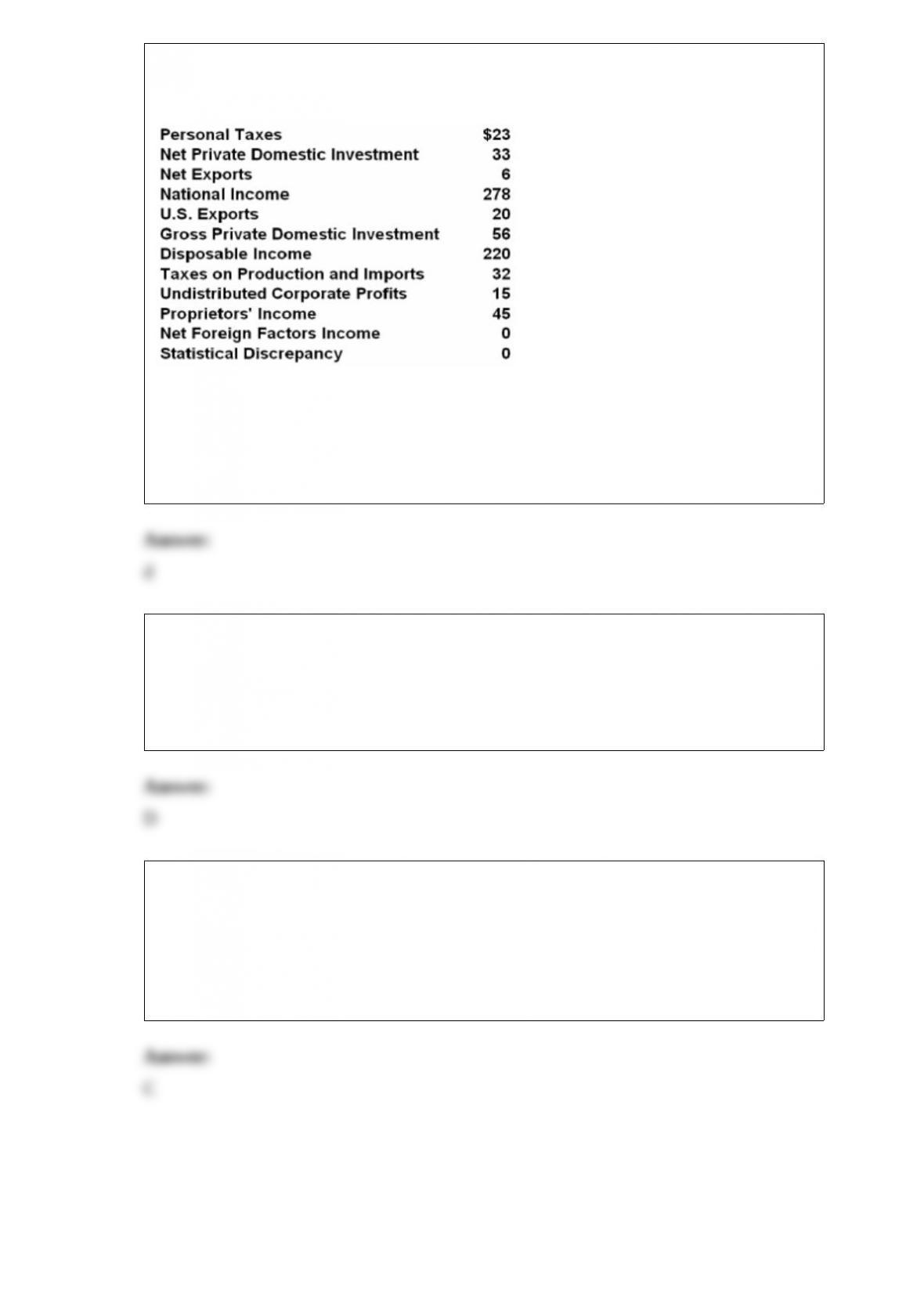
1) answer the next question(s) on the basis of the following national income data. all
figures are in billions of dollars.
refer to the above data. u.s. imports are:
a.$26.
b.$16.
c.$24.
d.$14.
2) A firm will find it profitable to hire workers up to the point at which their:
A.marginal resource cost equals their wage rate.
B.wage rate equals product price.
C.MP is equal to their MRP.
D.marginal resource cost is equal to their MRP.
3) A normal profit is:
A.the average profitability of a firm over one complete business cycle.
B.calculated by subtracting explicit costs from total revenue.
C.the return required to retain entrepreneurial talent in some particular line of
production.
D.the amount by which total revenue exceeds total costs.
4)
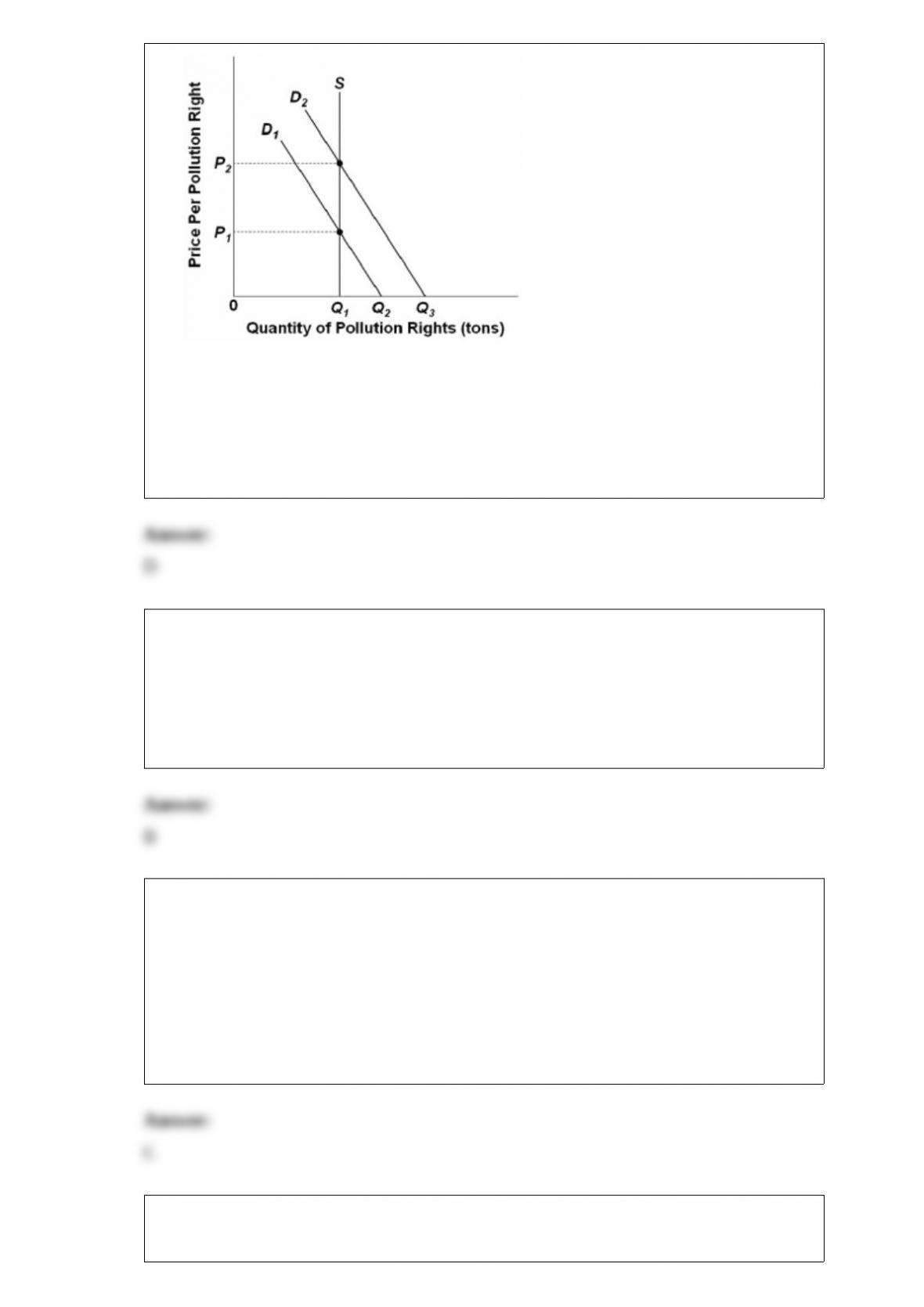
Refer to the above diagram of a market for pollution rights. The increase in the price of
pollution rights from P1 to P2will:
A.reduce the quantity of pollution rights.
B.increase the quantity of pollution rights.
C.increase the incentive for environmental groups to buy pollution rights.
D.increase the opportunity cost of polluting.
5) Suppose the price level is fixed, the MPC is .5, and the GDP gap is a negative $100
billion. To achieve full-employment output (exactly), government should:
A.increase government expenditures by $100 billion.
B.increase government expenditures by $50 billion.
C.reduce taxes by $50 billion.
D.reduce taxes by $200 billion.
6) Elephant populations have:
A.expanded everywhere because of state control of elephant populations.
B.declined in countries where they are owned by local villages, and expanded where
they are owned by the state.
C.expanded in countries where they are owned by local villages, and declined where
they are owned by the state.
D.declined everywhere, regardless of whether property rights over elephants are
recognized.
7) (Last Word) In 2001 Congress appropriated $273,000 for the Blue Springs (Missouri)
Youth Outreach Unit for educational training in combating the Goth culture. This is an
example of:
A.the paradox of voting.
B.pork barrel politics.
C.the benefits-received principle.
D.the fallacy of limited decisions.
8)
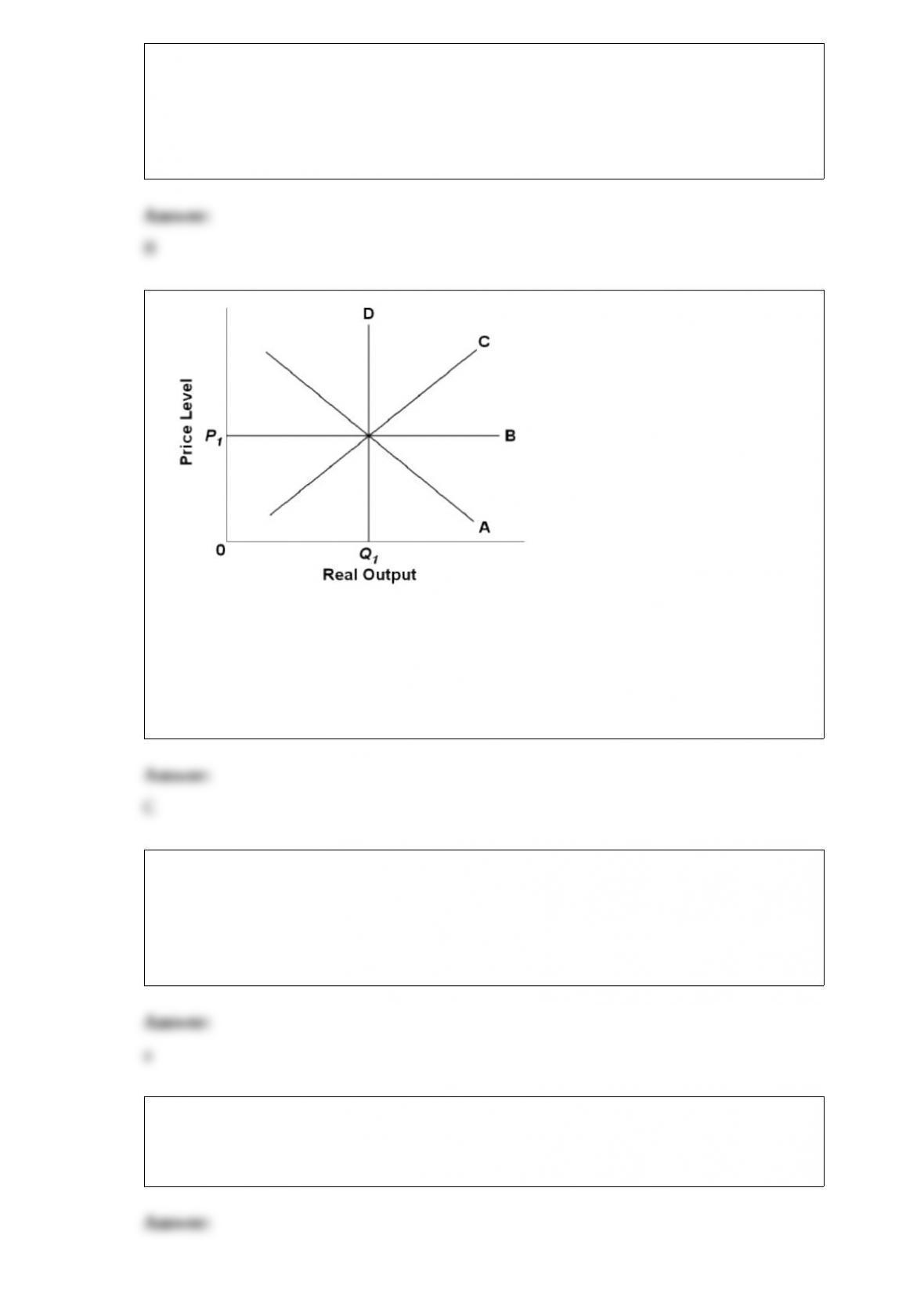
Refer to the above diagram and assume that prices and wages are flexible both upward
and downward in the economy. In the extended AD-AS model:
A.demand-pull inflation would involve a shift of curve D to the right.
B.cost-push inflation would involve a shift of curve B downward.
C.recession would involve a leftward shift of curve A.
D.frictional unemployment would be zero in the long run.
9) tariffs and quotas:
a.benefit producers of protected products, but harm domestic consumers.
b.benefits both producers of protected products and domestic consumers.
c.benefit neither producers of protected products nor domestic consumers.
d.benefit domestic consumers at the expense of producers of protected products.
10) The table below shows the price index in the economy at the end of four different
years. (a) What is the rate of inflation in years 2, 3, and 4? (b) Using the rule of 70, how
many years would it take for the prices to double at each of these three inflation rates?