1) If a market is allowed to adjust freely to its equilibrium price and quantity, then an
increase in demand will
a.increase producer surplus.
b.reduce producer surplus.
c.not affect producer surplus.
d.Any of the above are possible.
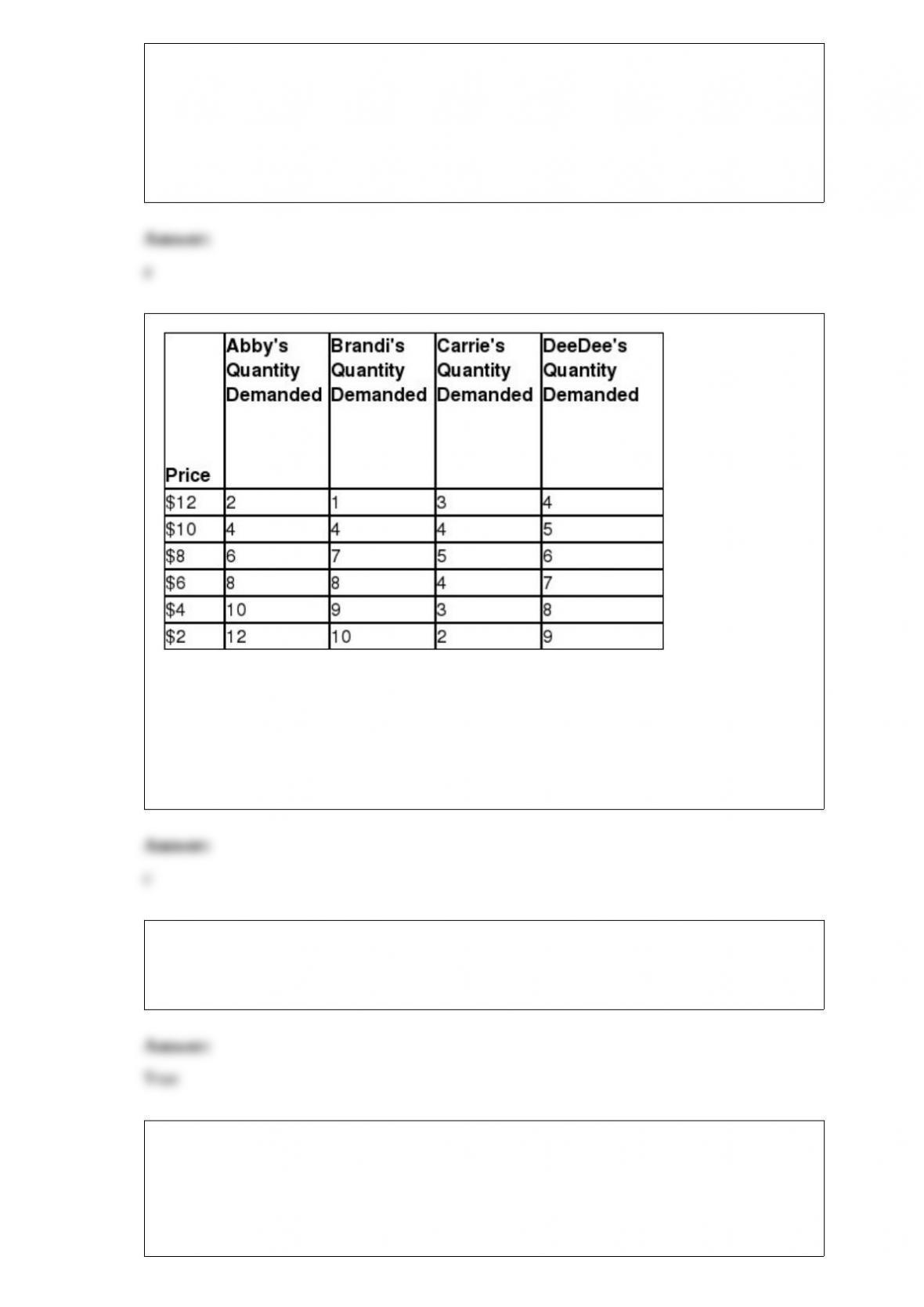
2) Suppose Abby, Brandi, Carrie, and DeeDee are the only four buyers in the market. If
the price is $8, then the market quantity demanded is
a.4 units.
b.6 units.
c.24 units.
d.32 units.
3) Giffen goods violate the law of demand.
a.True
b.False
4) In markets where restrictions on advertising have been used to curtail competition,
the U.S. courts have generally
a.referred the matters of advertising restrictions to executive regulators.
b.enforced industry-wide agreements to restrict advertising.
c.been silent on the effect of explicit advertising restrictions.
d.overturned laws that prohibit advertising.
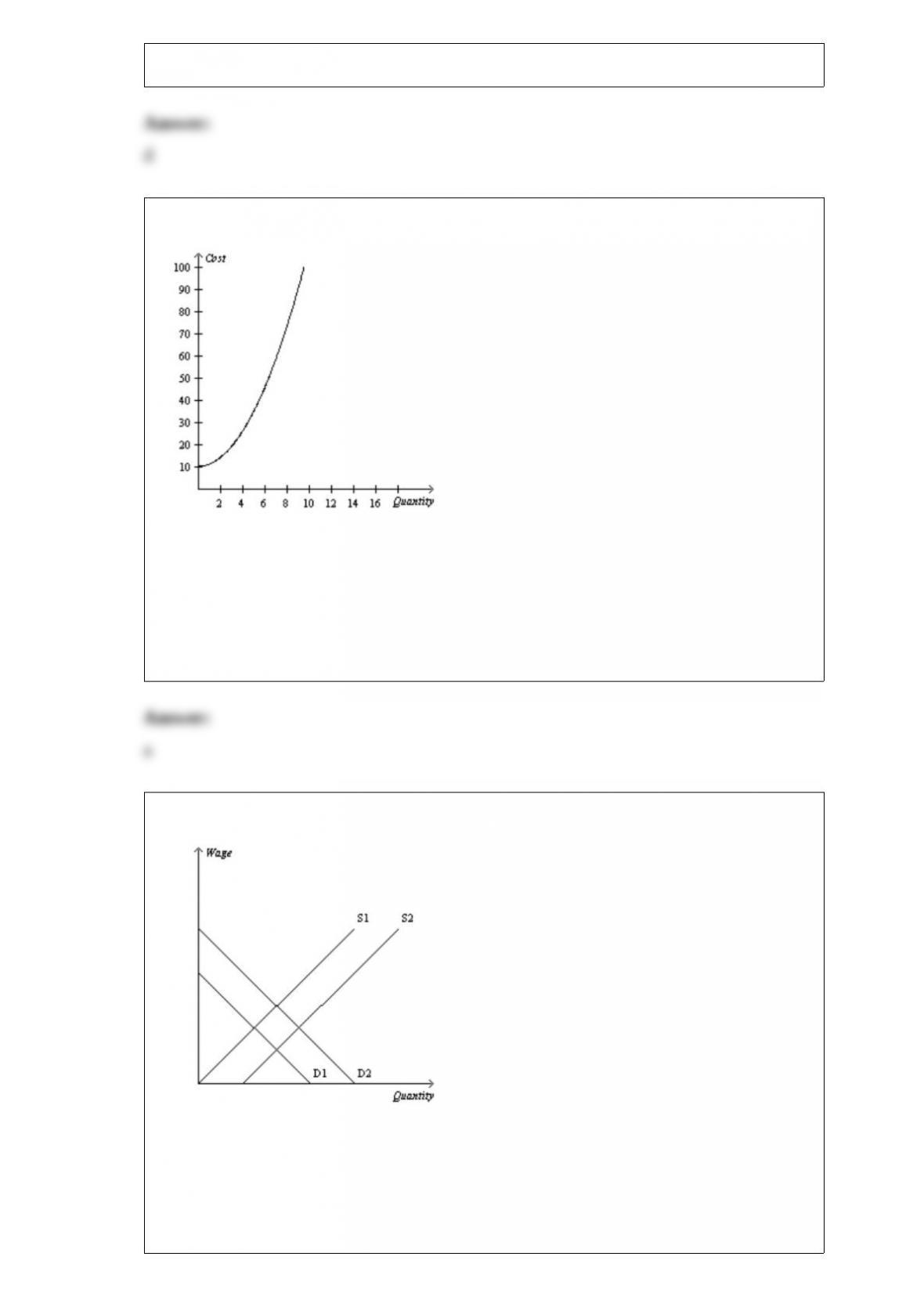
5) Figure 13-3
Which of the following statements best captures the nature of the underlying production
function (not pictured)?
a.Output increases at a decreasing rate with additional units of input.
b.Output increases at an increasing rate with additional units of input.
c.Output decreases at a decreasing rate with additional units of input.
d.Output decreases at an increasing rate with additional units of input.
6) Figure 18-6
Refer to Figure 18-6. The graph above illustrates the market for bakers who make
homemade breads and breakfast pastries. If the wages paid to wedding cake bakers
increase, what happens in the market for bread bakers?
a.Demand increases from D1 to D2.
b.Demand decreases from D2 to D1.

c.Supply increases from S1 to S2.
d.Supply decreases from S2 to S1.
7) A monopolist’s profit is equal to (Price – Marginal Cost) x Quantity.
a.True
b.False
8) Which of the following is true about the percent of total income all levels of
government in the U.S. take as taxes?
a.In 1902 the government collected about 7 percent of total income. In recent years, it
collected about 30 percent of total income.
b.In 1902 the government collected about 30 percent of total income. In recent years, it
collected about 7 percent of total income.
c.In 1902 the government collected about 7 percent of total income. In recent years, it
collected about 7 percent of total income.
d.In 1902 the government collected about 30 percent of total income. In recent years, it
collected about 30 percent of total income.
9) Since restored historic buildings convey a positive externality, local governments
may choose to
a.regulate the demolition of them.
b.provide tax breaks to owners who restore them.
c.increase property taxes in historic areas.
d.Both a and b are correct.
10) A monopoly is an inefficient way to produce a product because
a.it can earn both short-run and long-run profits.
b.it faces a downward-sloping demand curve.
c.the cost to the monopolist of producing one more unit exceeds the value of that unit to
potential buyers.
d.it produces a smaller level of output than would be produced in a competitive market.
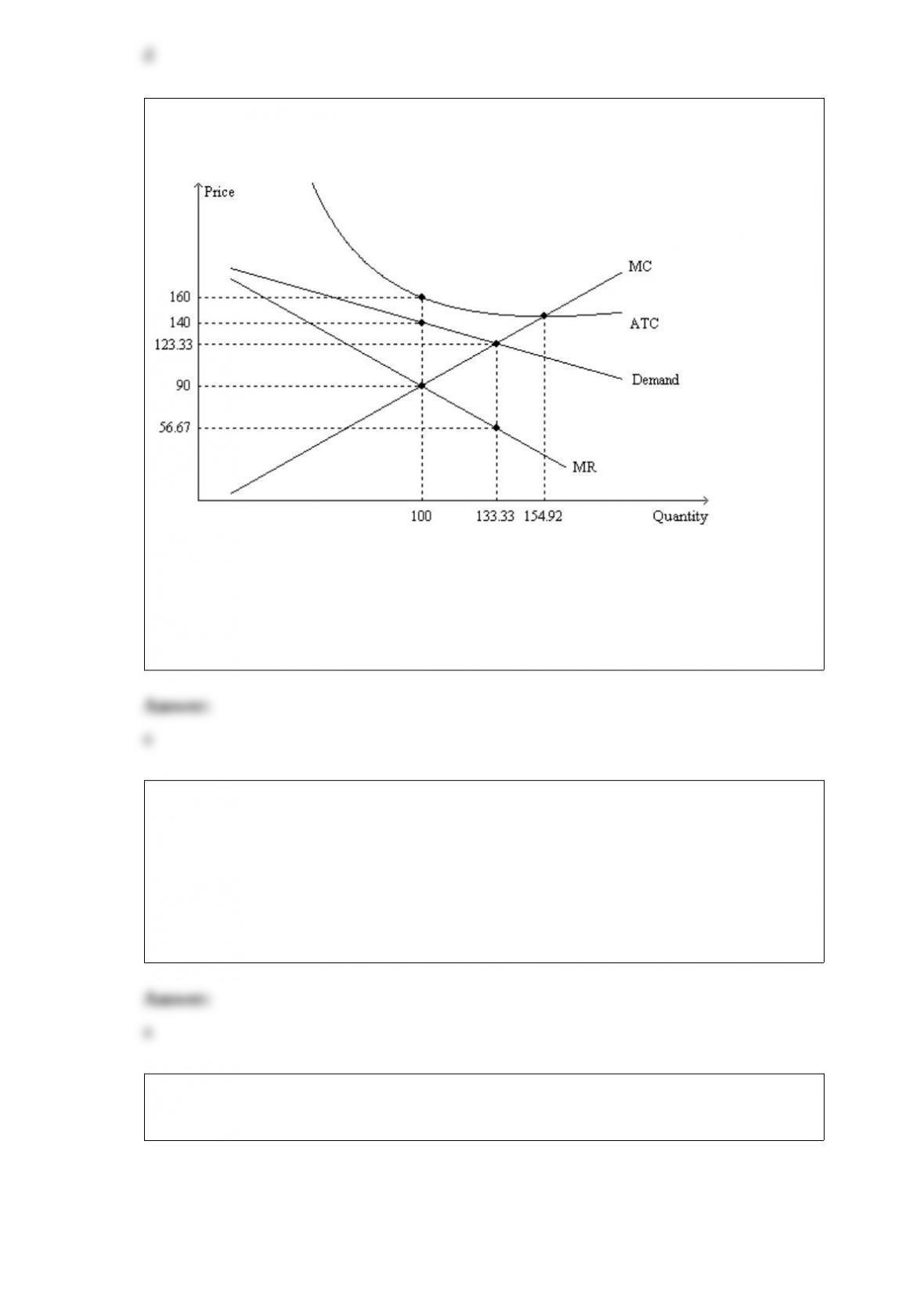
11) Figure 16-10
The figure is drawn for a monopolistically-competitive firm.
In order to maximize its profit, the firm will choose to produce
a.100 units of output, and its profit will be negative.
b.100 units of output, and its profit will be zero.
c.133.33 units of output, and its profit will be negative.
d.133.33 units of output, and its profit will be zero.
12) When the price of a good is $5, the quantity demanded is 120 units per month;
when the price is $7, the quantity demanded is 100 units per month. Using the midpoint
method, the is about
a. 0.55
b. 1.83
c.2
d.10
13) The following table contains some production possibilities for an economy for a
given month.
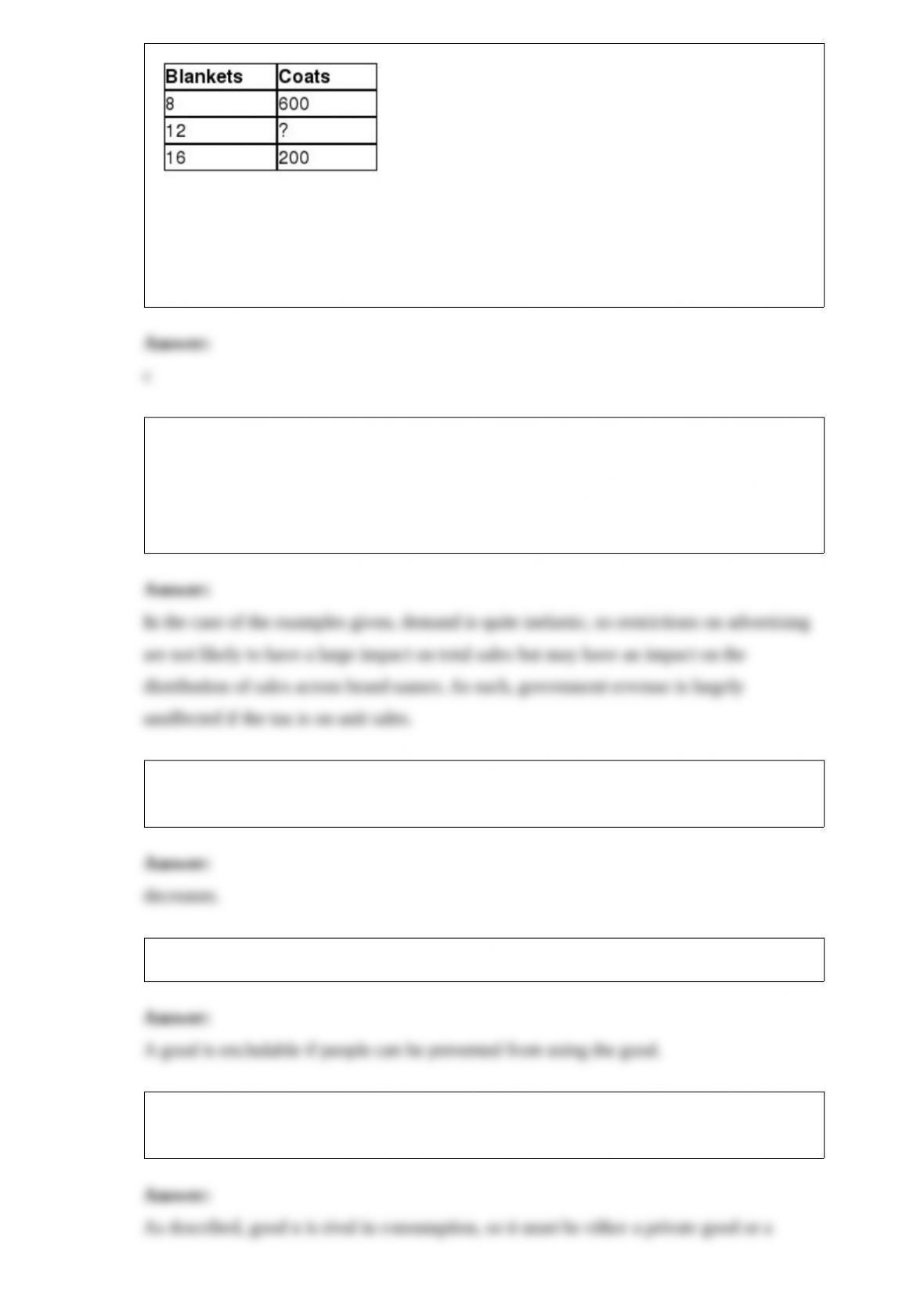
If the production possibilities frontier is a straight line, then “?” must be
a.200
b.300
c.400
d.500
14) In markets where the government imposes an excise tax on unit sales, it also has a
tendency to dabble with restrictions on advertising (for example, cigarettes and hard
liquor). Do potential (or actual) restrictions on advertising in these markets serve the
interest of a government that is interested in maximizing its tax revenue from the sale of
these products? Explain your answer.
15) According to the law of demand, when price increases the quantity demanded of a
good
16) What do we mean when we say that a good is excludable?
17) If one person’s use of good x diminishes other people’s use of it, then good x is one
of two types of goods. What are those two types?

18) The mayor of Newton is considering proposals to deal with an unsafe intersection.
She could install a traffic light at a cost of $50,000 or she could install stop signs at a
cost of $5,000. The traffic light is expected to reduce the risk of fatality by 0.45 percent
and the stop signs are expected to reduce the risk of fatality by 0.054 percent. If the
value of human life is estimated to be $10 million, what choice should the mayor make?
Briefly explain.
19) In the US, is it more likely that someone will become a millionaire by making
money on his/her own or by inheriting a fortune?
20) Why does a typical monopolistically competitive firm face a downward-sloping
demand curve?
21) Just like other scientific models, economic models simplify reality using
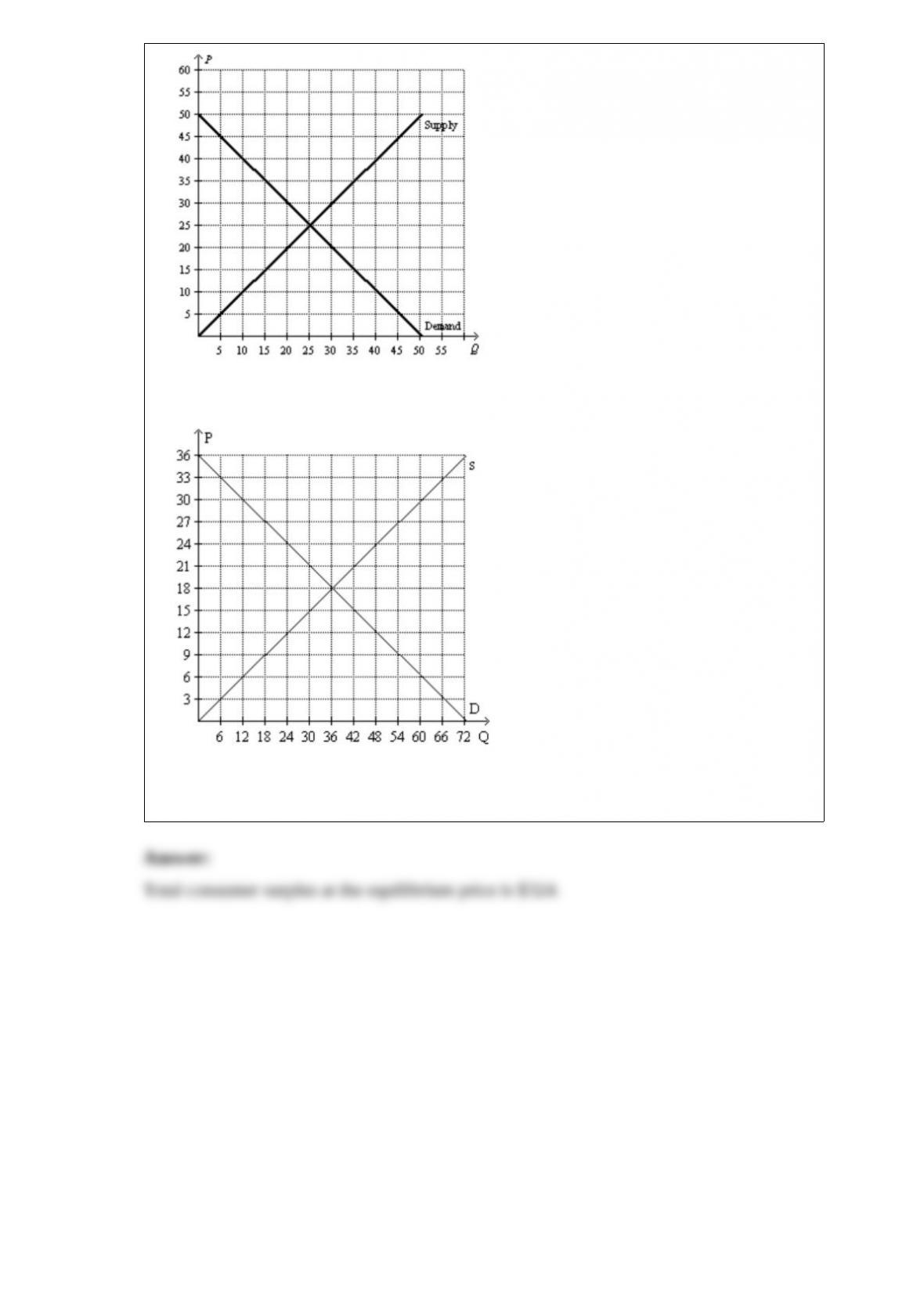
22) Figure 7-33
Refer to Figure 7-33. How much is total consumer surplus in this market at the
equilibrium price?