According to the law of one price, identical products should sell for the same price
everywhere if
A) consumers have knowledge of the prices charged for products in different markets.
B) transactions costs are zero.
C) firms can prevent consumers from engaging in arbitrage.
D) there are no tariffs or other restrictions on imports or exports.
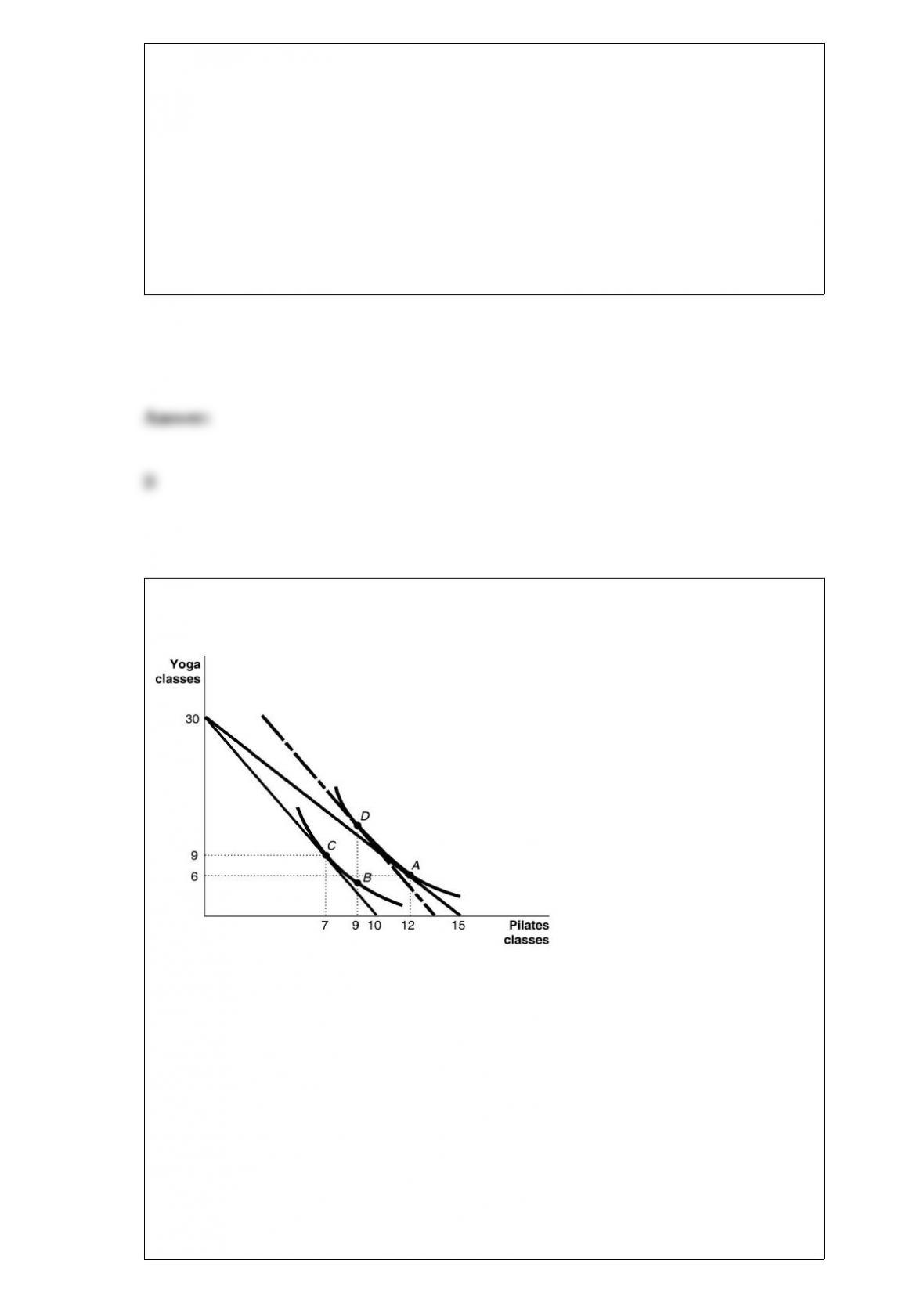
Figure 10-7
Manuri has $300 to spend on Pilates classes and Yoga classes. The price of a group
Pilates class is $20 and the price of a group Yoga class is $10. Manuri’s optimal bundle
is given by “A” in Figure 10-7.
Refer to Figure 10-7. Suppose the price of Pilates sessions rise to $30 while income
and the price of Yoga sessions remain unchanged. The income effect of this price
change is represented by the movement from
A) A to B.
B) B to C.
C) D to B

D) D to C.
Linesha, a college student working part-time receives a wage increase. An avid movie
buff, she increased her purchases of Blu-ray discs and reduced her purchases of DVDs.
Based on this information
A) DVDs and Blu-ray discs are substitutes.
B) Blu-ray discs are normal goods and DVDs are inferior goods.
C) DVDs and Blu-ray discs are normal goods.
D) the cross-price elasticity between DVDs and Blu-ray discs is negative.
There are two firms in the residential paint industry, Cool Shades (C) and Warm Hues
(W). They collude to share the market equally. They jointly set a monopoly price and
split the quantity demanded at that price. Here are their options:
i. They continue to collude (no cheating) and make $12 million each in profits.
ii. One firm cheats and the other does not. The firm that cheats makes a profit
of $14 million whereas the firm that doesn’t makes a profit of $9 million.
iii. They both cheat and each firm makes a profit of $7 million.
a. Construct a payoff matrix for these two firms.
b. How does this situation relate to the prisoner’s dilemma?
c. If each firm acted noncooperatively, how much profit would each make?
d. Are the firms better off colluding (with no cheating) or competing? Explain.
An increase in the price of pineapples will result in

A) a smaller quantity of pineapples supplied.
B) a larger quantity of pineapples supplied.
C) a decrease in the demand for pineapples.
D) an increase in the supply of pineapples.
The satisfaction a person receives from consuming goods and services is called
A) contentment.
B) psychic income.
C) wealth.
D) utility.
Figure 4-3
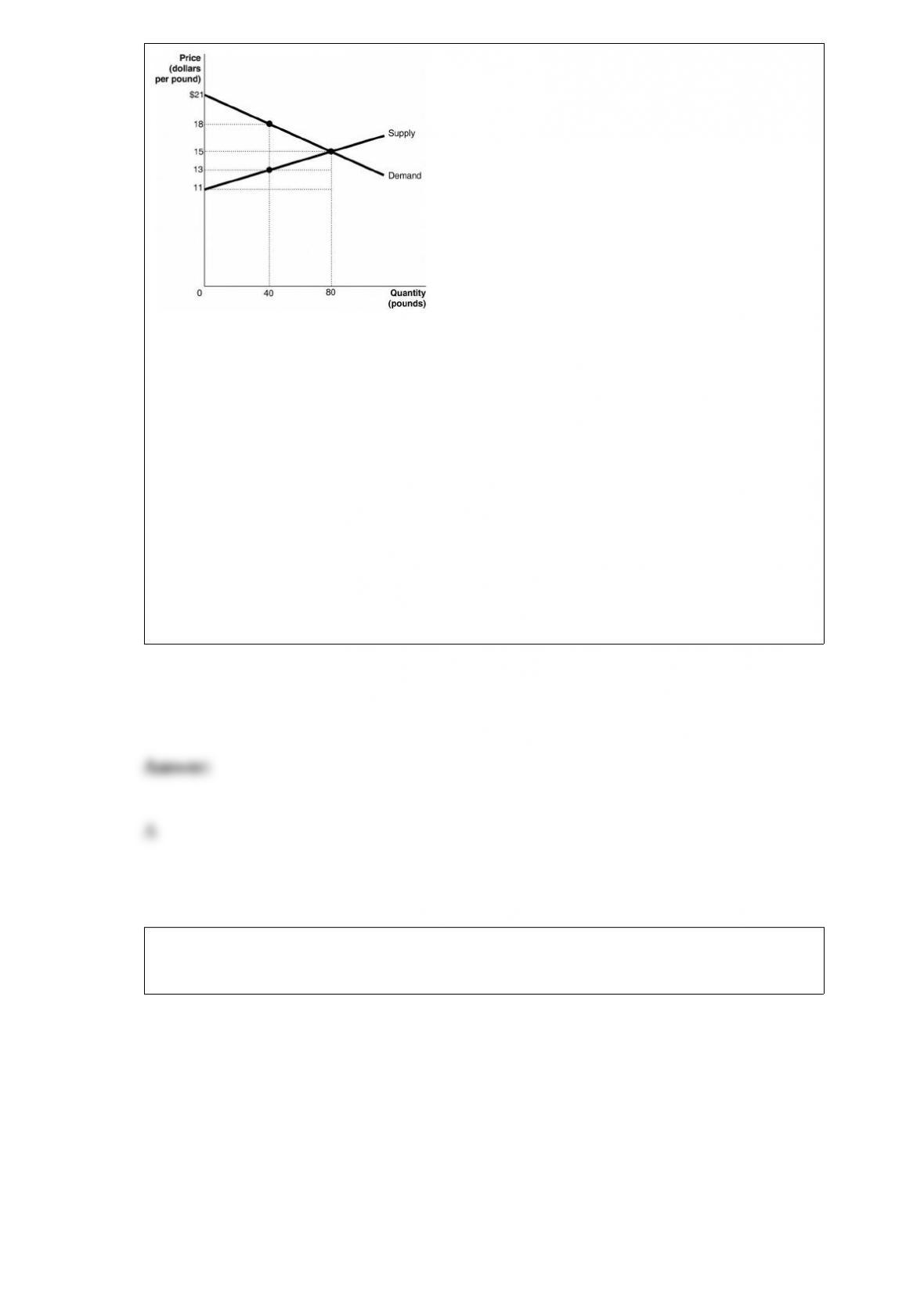
Figure 4-3 shows the market for tiger shrimp. The market is initially in equilibrium at a
price of $15 and a quantity of 80. Now suppose producers decide to cut output to 40in
order to raise the price to $18.
Refer to Figure 4-3. At a price of $18 consumers are willing to buy 40pounds of tiger
shrimp. Is this an economically efficient quantity?
A) No, the marginal benefit of the 40th unit exceeds the marginal cost of that 80th unit.
B) Yes, otherwise consumers would not buy 40 units.
C) Yes, because $18 shows what consumers are willing to pay for the product.
D) No, the marginal cost of the 40th unit exceeds the marginal benefit of the 40th unit.
Figure 12-15
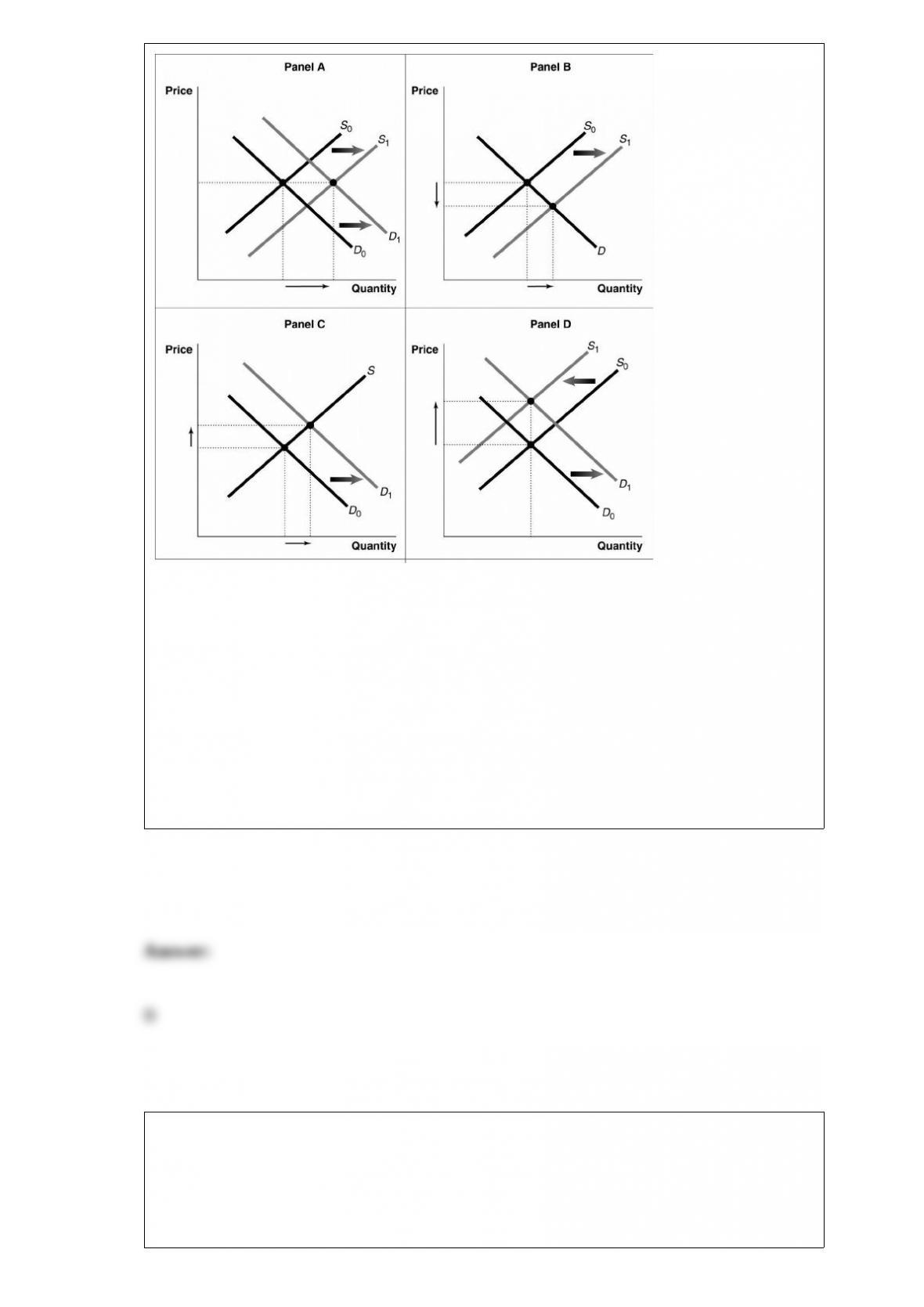
Refer to Figure 12-15. Suppose a typical firm in a perfectly competitive market is
earning economic profits in the short run. Which of the diagrams in the figure depicts
what happens to in the industry as it transitions to along run equilibrium?
A) Panel A
B) Panel B
C) Panel C
D) Panel D
A member of a corporate board of directors that is also a manager of the business is
known as
A) a shareholder.
B) an inside director.
C) a partner.
D) a corporate governor.
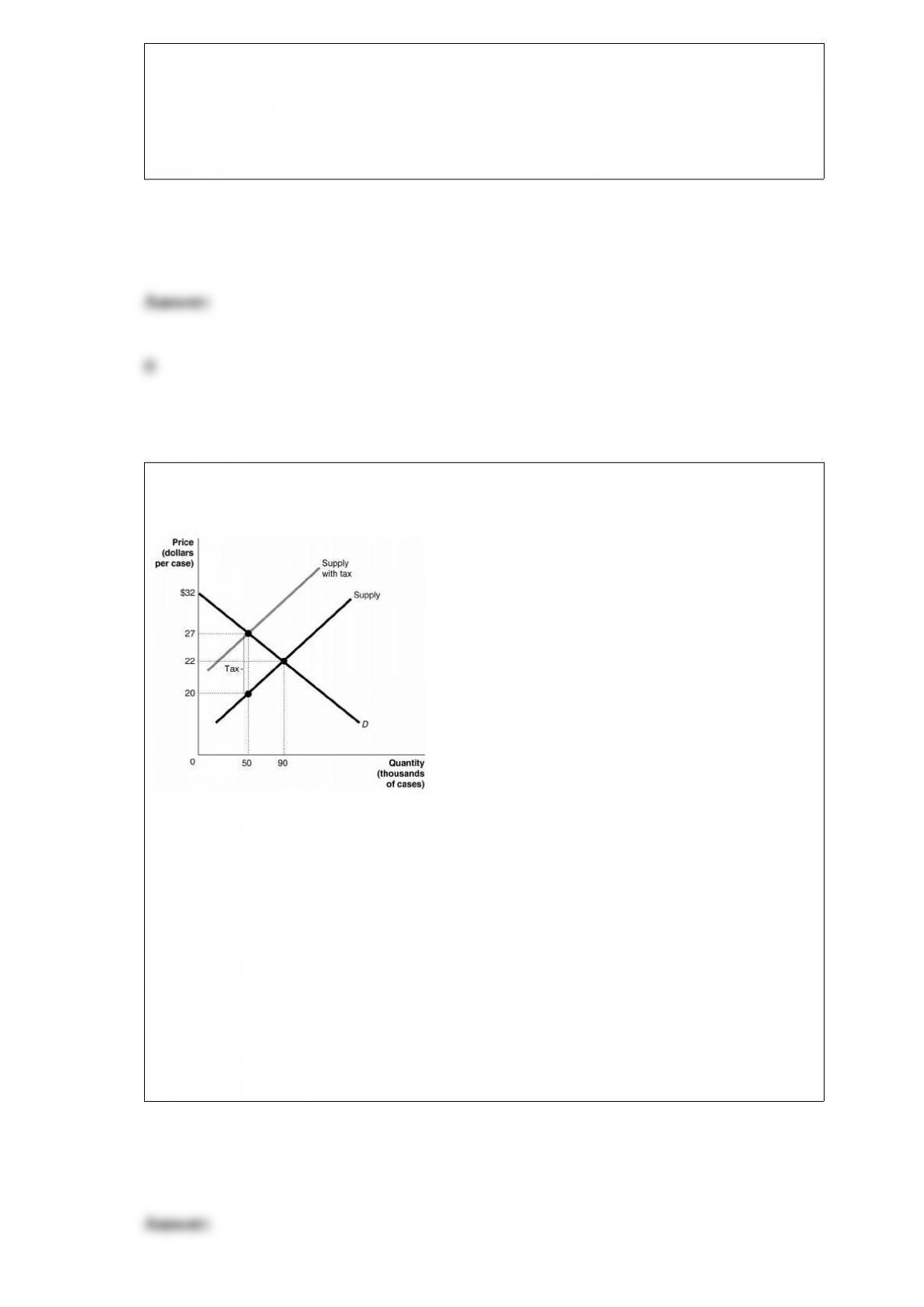
Figure 4-8
Figure 4-8 shows the market for beer. The government plans to impose a unit tax in this
market.
Refer to Figure 4-8. For each unit sold, the price sellers receive after the tax (net of tax)
is
A) $20.
B) $22.
C) $27.
D) $32.

A characteristic of the long run is
A) there are fixed inputs.
B) all inputs can be varied.
C) plant capacity cannot be increased or decreased.
D) there are both fixed and variable inputs
Which of the following is not a characteristic of a monopolistically competitive market
structure?
A) There is a large number of independently acting small sellers.
B) All sellers sell products that are differentiated.
C) There are low barriers to entry of new firms.
D) Each firm must react to actions of other firms.

Decision trees are commonly used to illustrate how firms make business decisions that
depend on the actions of rival firms. A decision tree has boxes that contain points that
represent when firms must make the decisions contained in the boxes. What are these
points called?
A) option points
B) decision nodes
C) either-or terminals
D) decision options
The three main goals of the World Trade Organization (WTO) are to help the free flow
of trade, help negotiate the further opening of markets, and ________.
A) measure the extent of globalization across the world
B) settle trade disputes between its members
C) accelerate technological innovation
D) fund small traders in developing nations
Although some economists believe network externalities are important barriers to entry,
other economists disagree because
A) they believe that the dominant positions of firms that are supposedly due to network
externalities are to a greater extent the result of the efficiency of firms in offering
products that satisfy consumer preferences.
B) they believe that most examples of network externalities are really barriers to entry
caused by the control of a key resource.
C) network externalities are really negative externalities.
D) they believe that the dominant positions of firms that are supposedly due to network
externalities are to a greater extent the result of economies of scale.
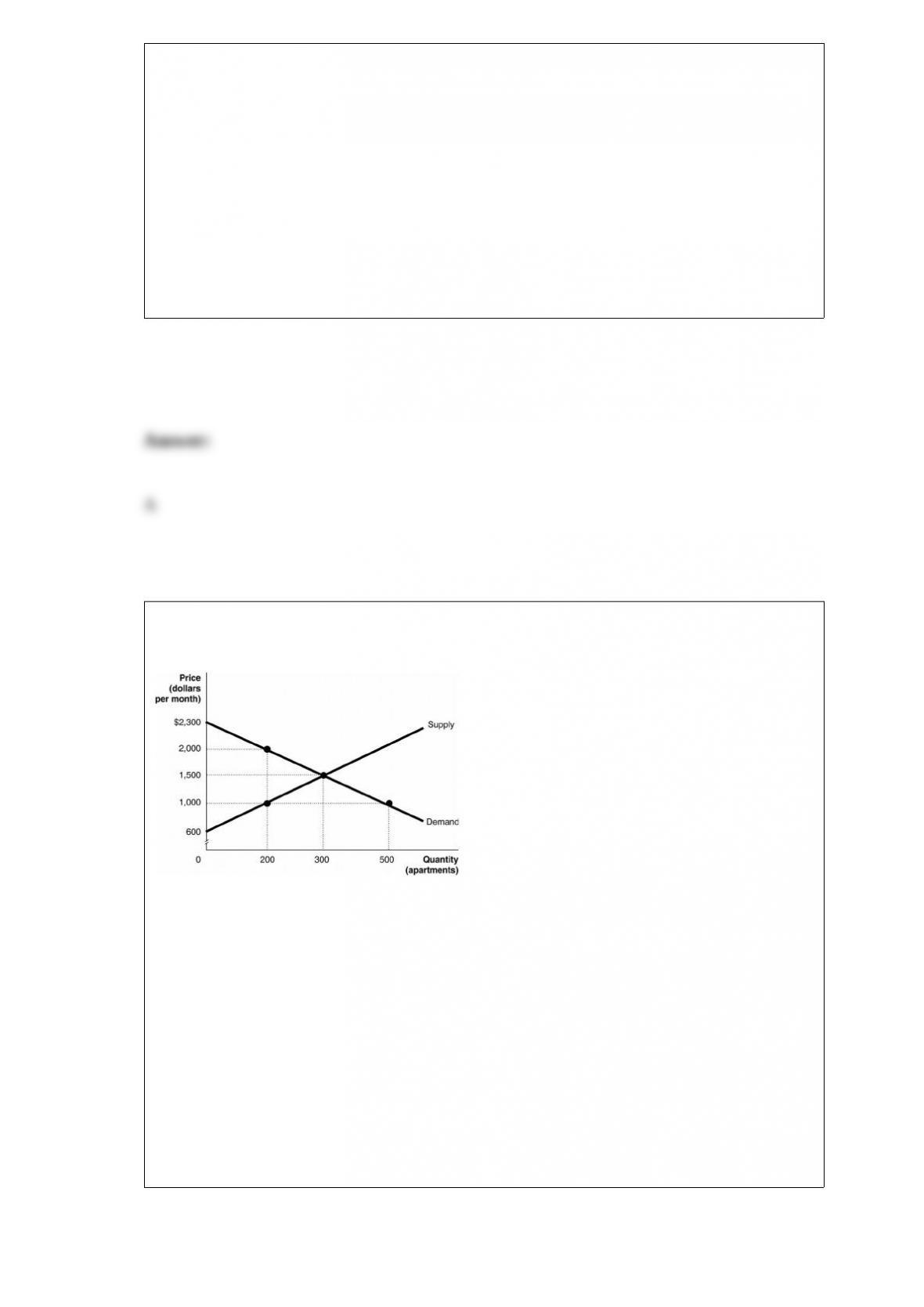
Figure 4-5
Figure 4-5 shows the market for apartments in Springfield. Recently, the government
imposed a rent ceiling of $1,000 per month.
Refer to Figure 4-5. What is the value of the deadweight loss after the imposition of the
ceiling?
A) $50,000
B) $125,000
C) $175,000
D) $260,000

The resource income earned by those who supply ________ is called wages.
A) labor
B) capital
C) natural resources
D) entrepreneurship
The social cost of cutting trees for firewood in a government forest is
A) the increased likelihood of flooding as more trees are cut.
B) the increased likelihood of flooding as more trees are cut plus the private cost of
cutting the trees.
C) opportunity cost to the individual of cutting the wood.
D) the marginal costs of cutting the last tree.

The existence of the principal-agent problem
A) increases the risk of buying stock in a corporation.
B) increases the risk of becoming the sole proprietor of a business.
C) implies that managers that have the same incentives as the board of directors.
D) does all of the above.
In order to avoid the imposition of other types of trade barriers, foreign producers will
sometimes agree to voluntary export restraints. With voluntary export restraints, foreign
producers
A) agree to meet specific quality standards required by the importing country.
B) limit their exports to a country.
C) pay a tax on all products they export.
D) must agree to import an equal quantity of products that they export.
Figure 17-1
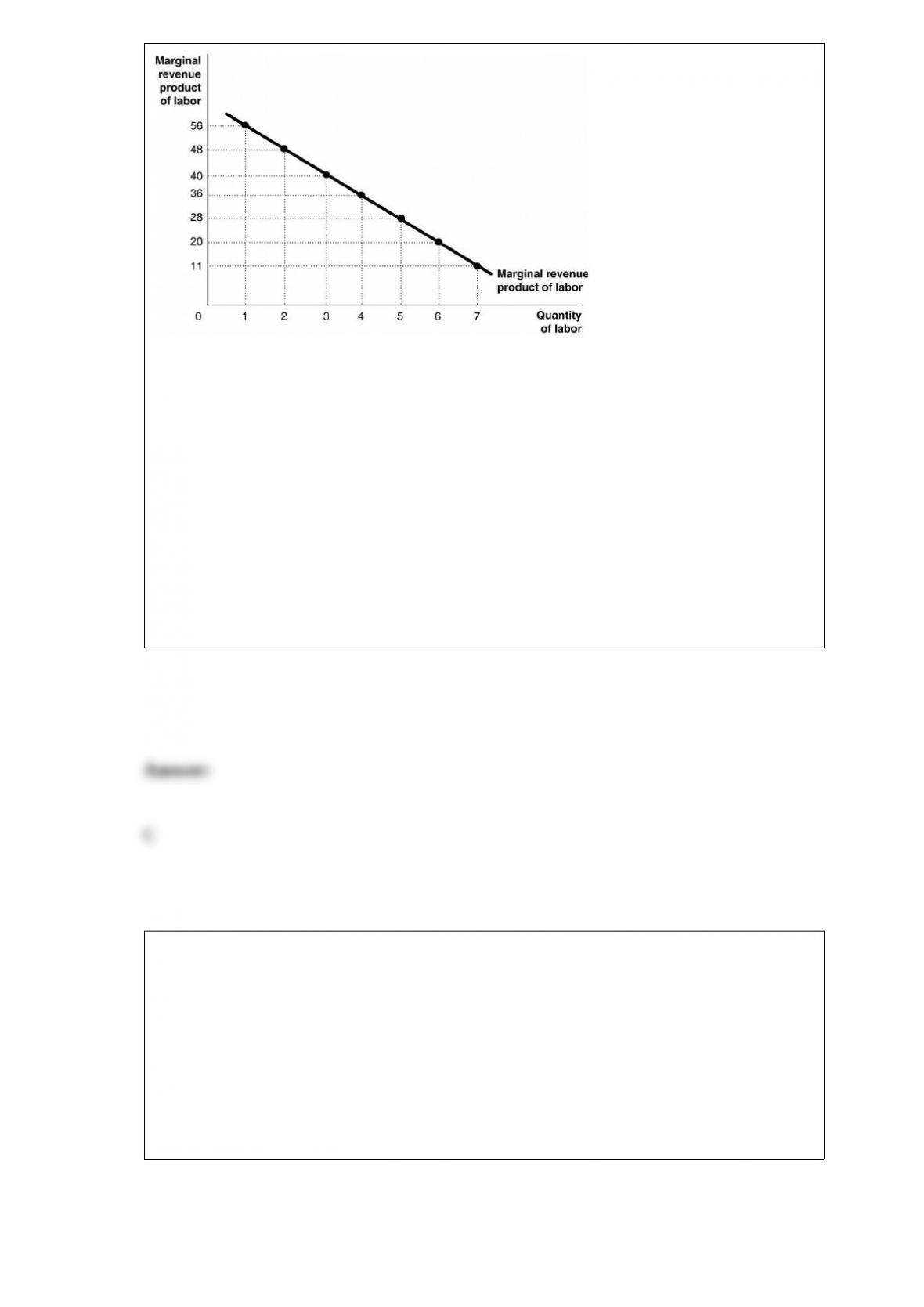
Figure 17-1 shows the marginal revenue product for Dale’s Hand-Sewn Doilies, a
producer of linen doilies.
Refer to Figure 17-1. If Dale can sell her doilies at $2 each, what is the marginal
product of the 5th worker?
A) $28
B) 28 doilies
C) 14 doilies
D) $56
A firm that can effectively price discriminate will charge a higher price to
A) customers who have the more elastic demand for the product.
B) customers who have the more inelastic demand for the product.
C) buyers who belong to the largest market segment.
D) buyers who are members of the smallest market segment.

Suppose the value of the price elasticity of supply is 4. What does this mean?
A) A 4 percent increase in the price of the good causes quantity supplied to increase by
1 percent.
B) A 1 percent increase in the price of the good causes the supply curve to shift upward
by 4 percent.
C) A 1 percent increase in the price of the good causes quantity supplied to increase by
4 percent.
D) For every $1 increase in price, quantity supplied increases by 4 units.
Which of the following is evidence of a shortage of walnuts?
A) Firms lower the price of walnuts.
B) The price of cashews is lowered in order to make up for the walnut shortage.
C) The equilibrium price of walnuts falls due to a decrease in demand.
D) The quantity demanded of walnuts is greater than the quantity supplied.
Economists use game theory to analyze oligopolies because
A) real markets are too complicated to analyze without using games.
B) it is more enjoyable for economists and students to learn by playing games.
C) game theory helps us to understand why interactions among firms are crucial in
determining profitable business strategies.
D) game theory is useful in understanding the actions of firms that are price takers.
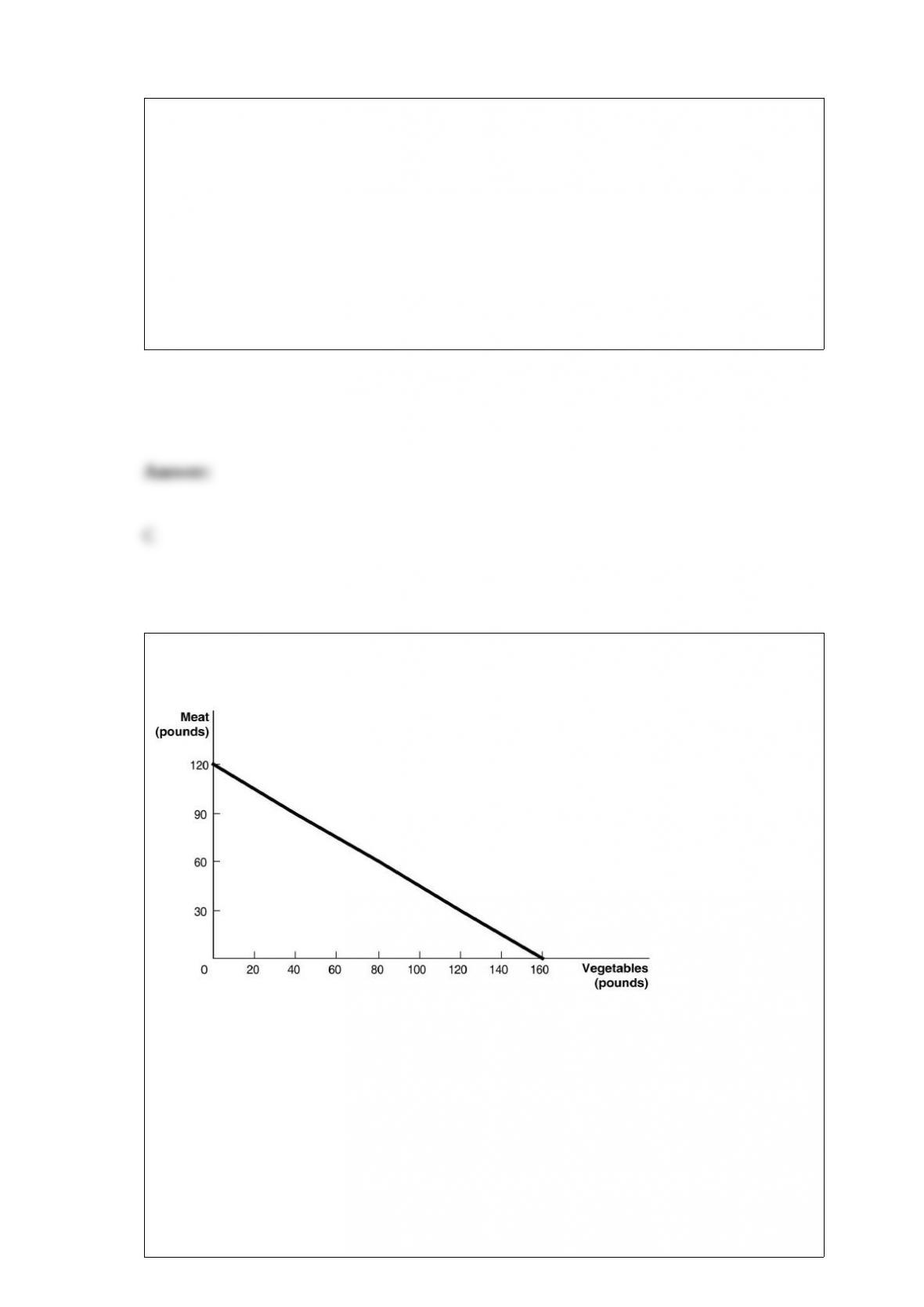
Figure 2-2
Figure 2-2 above shows the production possibilities frontier for Mendonca, an agrarian
nation that produces two goods, meat and vegetables.
Refer to Figure 2-2. The linear production possibilities frontier in the figure indicates
that
A) Mendonca has a comparative advantage in the production of vegetables.
B) Mendonca has a comparative disadvantage in the production of meat.
C) the tradeoff between meat and vegetables is constant.

D) it is progressively more expensive to produce meat.
Dividends are
A) financial securities which represent ownership in a corporation.
B) the yearly payments associated with bonds.
C) the interest rate paid on shares of stock.
D) payments by a corporation to its shareholders.
According to the Department of Justice merger guidelines, a proposed merger between
two firms may be challenged if the post-merger Herfindahl-Hirschman Index
A) lies between 1,000 and 1,800 and the merger raises the Index by 50 points.
B) lies between 1,000 and 1,800 and the merger raises the Index by more than 100
points.
C) lies above 1,800 and the merger raises the Index by less than 50 points.
D) lies below 1,000 and the merger raises the Index by 100 points.

The intention of the U.S. tariff on Chinese tries was to
A) protect jobs in the U. S. tire industry.
B) protect infant industries in tire U.S. tire market.
C) insure that Chinese tires meet U.S. quality and safety standards.
D) save the government money by restricting the sale of more expensive Chinese-made
tires.
The bargaining power of buyers increases if
A) there are many large buyers.
B) the input in question has few substitutes.
C) the input in question is not a critical component of production.
D) there are wide variations in the quality of inputs from supplier to supplier.