
Which of the following is not an example of a government-imposed entry barrier?
A) patents
B) occupational licensing
C) barriers to international trade
D) antitrust legislation
In the long run, if price is less than average cost
A) there is an incentive for firms to exit the market.
B) there is profit incentive for firms to enter the market.
C) the market must be in long-run equilibrium.
D) there is no incentive for the number of firms in the market to change.
Which of the following is not a result of government price controls?
A) Some people win and some people lose.
B) Price controls benefit poor consumers but harm producers and wealthy consumers.
C) Price controls decrease economic efficiency.
D) A deadweight loss will occur.
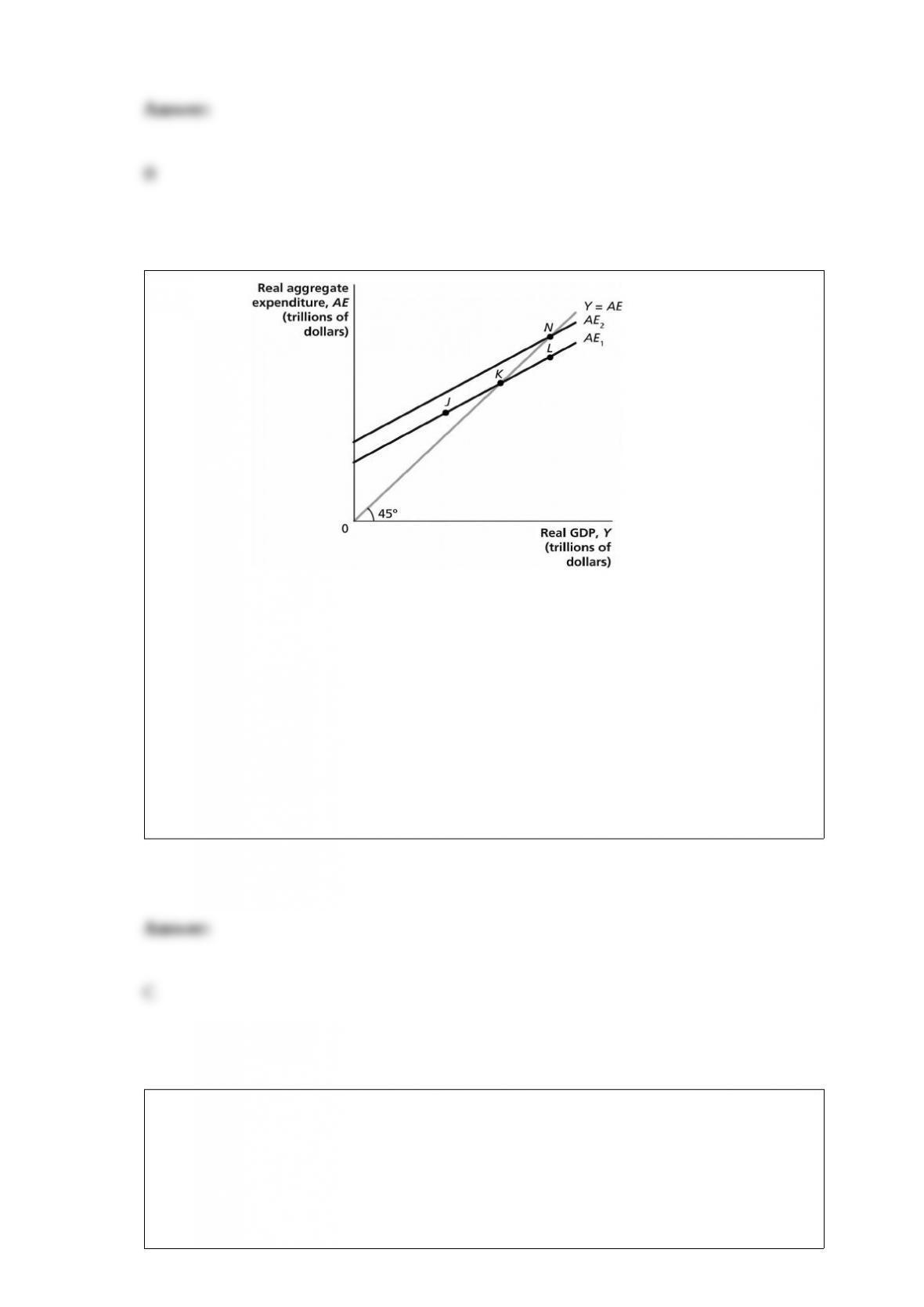
Figure 23-2
Suppose that the level of GDP associated with point K is potential GDP. If the U.S.
economy is currently at point N,
A) firms are operating below capacity.
B) the economy is at full employment.
C) the economy is in an expansion.
D) the level of unemployment is above the natural rate.
Identify the type of merger in each of the following situations and indicate how the
post-merger concentration ratio for the industry is affected.
a. A steel company merges with a coal and iron ore mining company.
b. Staples, a retailer of office supplies, acquires Office Depot, another retailer of office
supplies.
c. An oil company merges with pipeline, shipping, and railroad companies as well as
refineries and gas stations.
Which of the following is one reason for the decline in aggregate demand that led to the
recession of 2007-2009?
A) falling oil prices
B) increases in housing prices
C) the financial crisis
D) a decline in government spending
How does the increasing use of digital cameras affect the market for traditional camera
film?
A) The demand curve for traditional camera film shifts to the right.
B) The quantity of traditional camera film demanded decreases.
C) The quantity of traditional camera film demanded increases.

D) The demand curve for traditional camera film shifts to the left.
The quota on imported sugar costs U.S. consumers more than $2 billion annually and
protects very few jobs. Why does Congress maintain a sugar quota that protects only a
few thousand workers while forcing millions of people to pay higher prices for sugar
products?
A) Most U.S. citizens do not buy sugar products and want to help workers in the sugar
industry.
B) Voters fear that if they oppose the sugar lobby, the lobby may oppose issues that they
want Congress to support.
C) Citizens are not as involved in social and political issues as they used to be.
D) The per person cost of the sugar quota is too small for many people to lobby
Congress to make their views known.
Paper currency is a
A) commodity money.
B) fiat money.
C) barter money.
D) bond.

Public goods are distinguished by two primary characteristics. What are they?
A) nonrivalry and nonexcludability
B) government intervention and low prices
C) market failure and high prices
D) rivalry and exclusivity
The “Buy American” provision in the 2009 stimulus package required that stimulus
money be spent only on U.S.-made goods, effectively acting as a quota of zero imports
when stimulus money was being spent. For the U.S. steel industry, a “Buy American”
provision would create gains for all of the following except
A) U.S. steel companies.
B) U.S. taxpayers.
C) U.S. steel workers.
D) All of the above would gain from the provision.

If the GDP deflator rises from 185 to 190, what is the rate of inflation between the two
years?
A) 270%
B) 50%
C) 5%
D) 2.7%
Long-run economic growth requires all of the following except
A) technological change.
B) increases in capital per hour worked.
C) government provision of secure property rights.
D) political instability.
Stockholders
A) select the board of directors of a corporation.
B) select the employees of a corporation.
C) select the managers of a corporation.
D) all of the above.
The town of Saddle Peak has a fixed supply of mountain view lots. In this case, the
price per square foot of mountain view lots is
A) determined only by supply.
B) determined only by demand.
C) set by government officials of Saddle Peak.
D) negotiated by environmental groups and property developers.
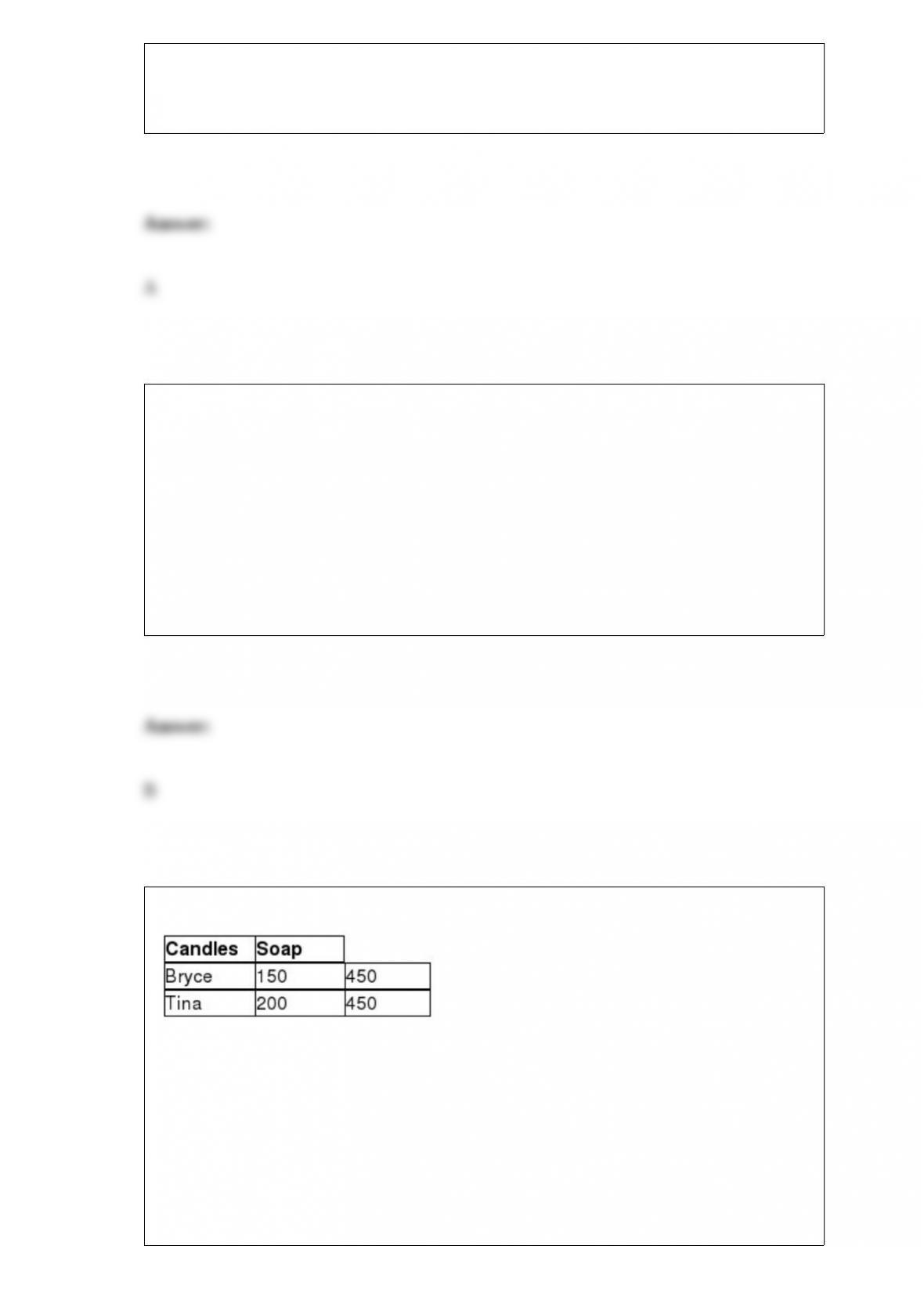
Table 9-3
Bryce and Tina are artisans who produce homemade candles and soap. Table 9-3 lists
the number of candles and bars of soap Bryce and Tina can each produce in one month.
Select the statement that accurately interprets the data in the table.
A) Bryce has an absolute advantage in making candles and Tina has an absolute
advantage in making soap.
B) Bryce has an absolute advantage in making soap and Tina has an absolute advantage
in making candles.

C) Bryce has an absolute advantage in making soap.
D) Tina has an absolute advantage in making candles.
Because ________ in the government budget deficit increase the real interest rate,
budget deficits can ________ firm investment.
A) increases; increase
B) decreases; increase
C) decreases; decrease
D) increases; decrease
All of the following are part of the “regulation of health insurance” provision of the
Patient Protection and Affordable Care Act (ACA) except
A) individuals with pre-existing medical conditions will be able to acquire health
insurance.
B) all policies must provide coverage for dependant children up to age 26.
C) lifetime dollar maximums on coverage will be prohibited.
D) limits on the size of deductibles and on waiting periods before coverage takes effect
will be eliminated.

If productive efficiency characterizes a market,
A) the marginal cost of production is minimized.
B) firms produce the goods that consumers desire most.
C) the output is being produced at the lowest possible cost.
D) firms use the best technology available to produce the good.