Suppose there is a bank panic. Which of the following would not be a consequence of
this bank panic?
A) Bank total reserves would decrease.
B) Required reserves would increase.
C) Bank checking account balances would decrease.
D) Individual banks would have to shrink the value of loans they made.
E) The economy would likely enter into a recession.
Which of the following would cause both the equilibrium price and equilibrium
quantity of cotton (assume that cotton is a normal good) to increase?
A) an increase in consumer income
B) a drought that sharply reduces cotton output
C) a decrease in consumer income
D) unusually good weather that results in a bumper crop of cotton
Which of the following do not suffer the costs of inflation?
A) persons on fixed incomes
B) persons whose incomes rise more rapidly than inflation
C) firms that have to devote more time and labor to raising prices
D) an investor that has to pay higher taxes because of the inflation
If the slope of the per-worker production function is 1/4 in a given range, how will a
$10,000 increase in capital per hour worked affect real GDP per hour worked in the
same given range?
A) Real GDP per hour worked will increase by $2,500.
B) Real GDP per hour worked will increase by $40,000.
C) Real GDP per hour worked will increase by $10,000.
D) Real GDP per hour worked will decrease by $40.000.
Autarky is a situation in which a country
A) only exports products.
B) only imports products.
C) does not trade with other countries.
D) has no absolute advantage in any production.
If currencies around the world are based on the gold standard, and Japan raises the
amount of gold for which the yen will trade, then holding all else constant,
A) the yen will depreciate against the dollar.
B) the yen will appreciate against the dollar.
C) the value of the yen relative to the dollar will stay constant.
D) the value of U.S. exports to Japan in terms of the yen will increase.
Figure 5-2 Figure 5-2 shows a
market with a negative externality.
The true marginal cost of the last unit produced is represented by the price
A) Pa.
B) P.
C) Pc.
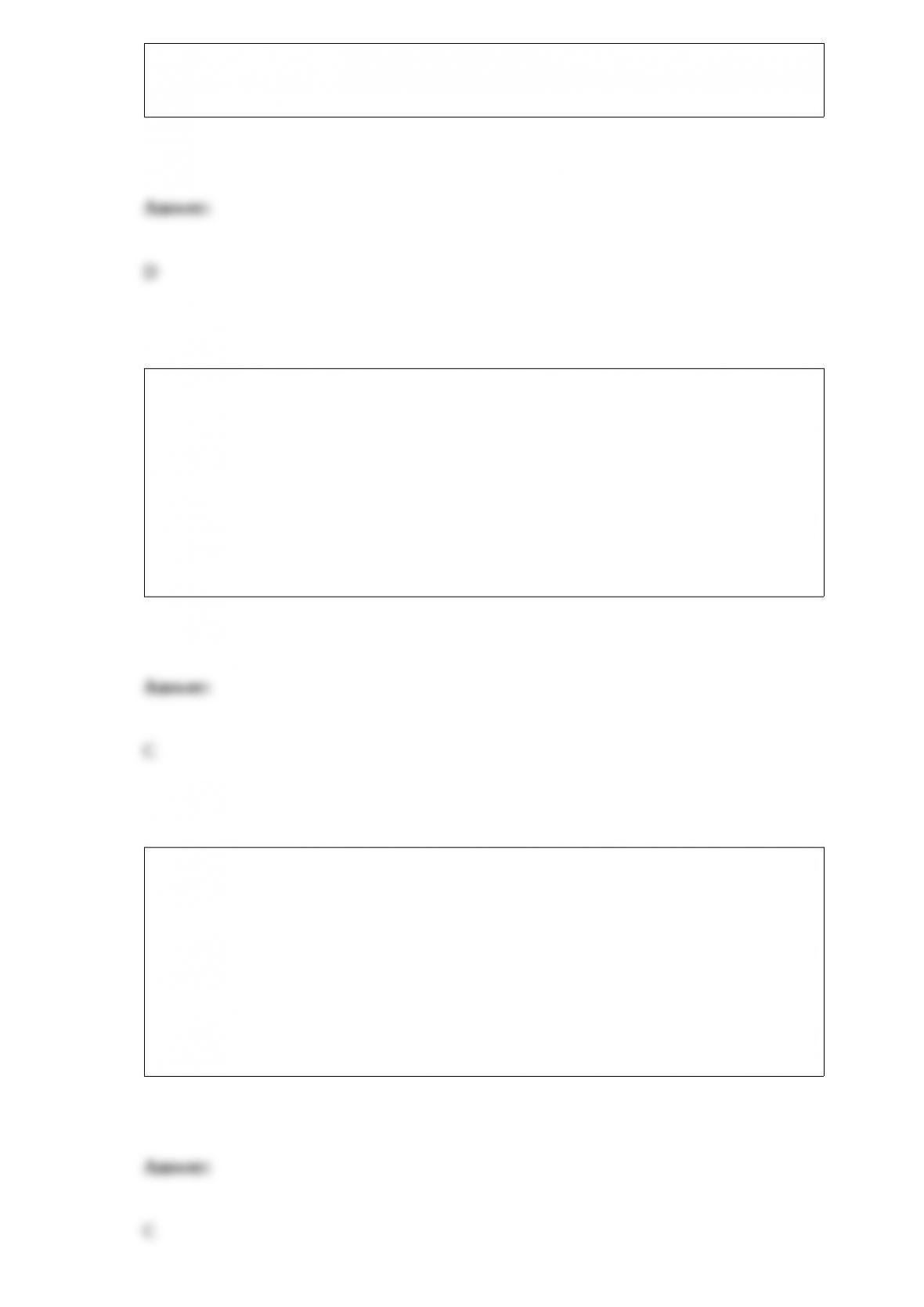
D) Pf.
The Taylor rule links the Federal Reserve’s target for the
A) money supply to shifts in money demand.
B) money supply to changes in interest rates.
C) federal funds rate to economic variables.
D) federal funds rate to the money supply.
If a perfectly competitive firm’s total revenue is less than its total variable cost, the firm
A) should raise its price above its average variable cost.
B) should continue to produce and increase its demand.
C) should stop production by shutting down temporarily.
D) should adopt new technology in order to lower its costs of production.
Over the past 160 years in the United States, life expectancy
A) has remained fairly constant.
B) has slightly declined.
C) has more than doubled.
D) increased up to the 1950s and then declined for the next 60 years.
Which of the following must be present to reach a private solution to an externality
problem?
A) A majority of the parties affected by the externality must agree to a solution.
B) The transaction costs to negotiate a solution must be relatively low.
C) The total number of people, creators of the problem and those affected, must be
relatively large to justify negotiating a solution.
D) The government must approve the solution for it to be a legal solution.
The change in a firm’s total cost from producing one more unit of a good or service is
the firm’s
A) explicit cost of production.
B) marginal cost of production.
C) average cost of production.
D) implicit cost of production.
The “ability-to-pay” principle of taxation is the normative idea that
A) an equitable tax system is one in which high income individuals should bear a
greater burden of taxes than low income individuals.
B) each individual should voluntarily contribute according to her ability to pay taxes.
C) progressive taxes are more equitable than regressive taxes.
D) two individuals earning the same income should have equal ability to pay, all else
constant.
Figure 12-16
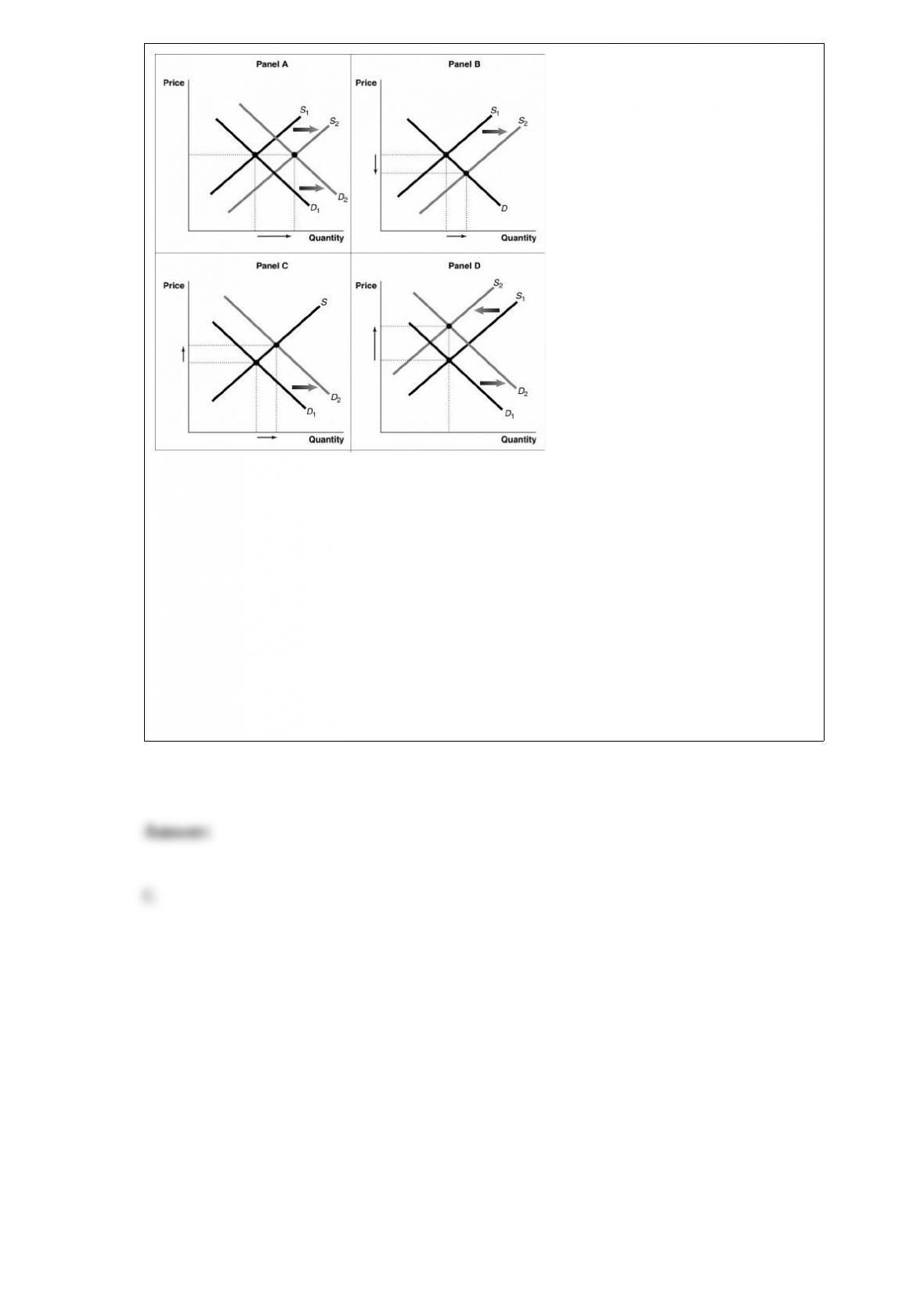
Which panel best represents the perfectly competitive organic produce market in which
firms are breaking even, economically, organic produce is considered a normal good,
and the average income level of consumers is rising?
A) Panel A
B) Panel B
C) Panel C
D) Panel D
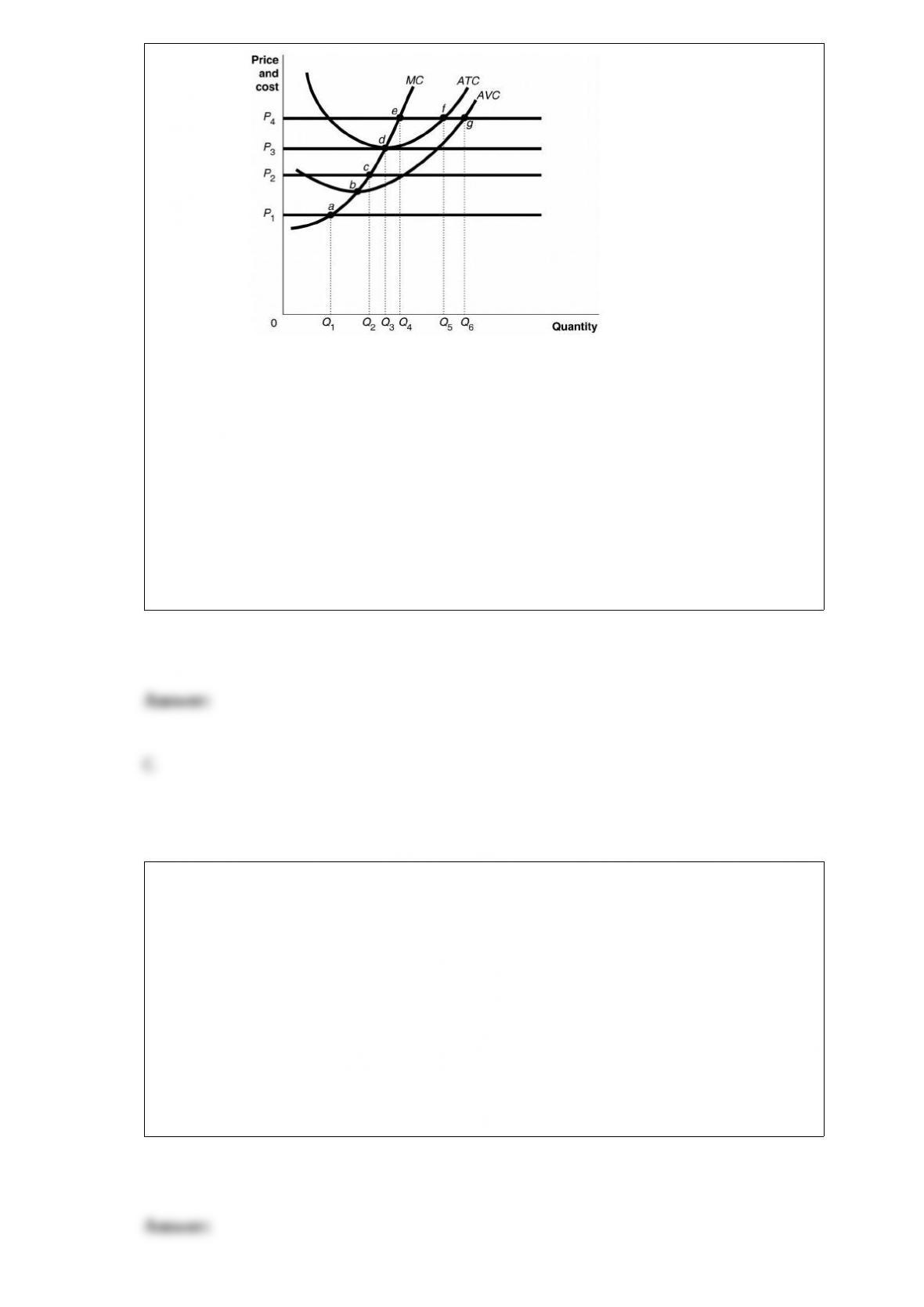
Figure 12-9 Figure 12-9 shows cost and
demand curves facing a profit-maximizing, perfectly competitive firm.
At price P2, the firm would
A) lose an amount equal to its fixed cost.
B) lose an amount more than fixed cost.
C) lose an amount less than fixed cost.
D) break even.
The three main monetary policy tools used by the Federal Reserve to manage the
money supply are
A) interest rates, tax rates, and government spending.
B) tax rates, government purchases, and government transfer payments.
C) open market operations, discount policy, and reserve requirements.
D) open market operations, the exchange rate of the dollar against foreign currencies,
and government purchases.
The Walt Disney Company is in a position to use a two-part tariff policy in setting
prices for admission and rides at Disney World. If this strategy resulted in maximum
profit, Disney would convert all consumer surplus into profit. Which of the following
explains why Disney does not maximize its profits from admission and rides?
A) To maximize its profits, Disney would have to know the demand curves of each of
its customers. Since this is not possible, Disney is not able to convert all consumer
surplus into profit.
B) Disney purposely charges less than the profit-maximizing price for admission to
Disney World because it does not want to risk alienating its customers.
C) Disney purposely charges less than the profit-maximizing price for admission to
Disney World in order to earn more profit from sales of food, lodging and other related
services.
D) Disney does not charge the profit-maximizing price for admission because it wants
to keep admission affordable for children who will be more likely to visit Disney World
when they become parents.
Monetary policy has a ________ effect on aggregate demand in a(n) ________
economy, and fiscal policy has a ________ effect on aggregate demand in a(n)
________ economy.
A) weaker; open; weaker; open
B) weaker; closed; stronger; closed
C) stronger; open; weaker; closed
D) stronger; closed; weaker; open