
If the CPI overstates the true rate of inflation, then
a. the economy will grow more slowly than if inflation was measured accurately
b. the economy will grow more rapidly than if inflation was measured accurately
c. social security payments will increase in real terms
d. social security payments will decrease in real terms
e. so will other means of measuring the inflation rate
Markets clear
a. in the short run
b. when a depression occurs
c. when a recession occurs
d. roughly every ninety days
e. eventually
Government policies designed to increase the skills of the work force shift the labor
demand curve to the right, increasing employment and total output.

Full employment occurs only when the unemployment rate is 0%.
If a change in investment spending is due to a change in the price level, then the
aggregate demand curve will shift.
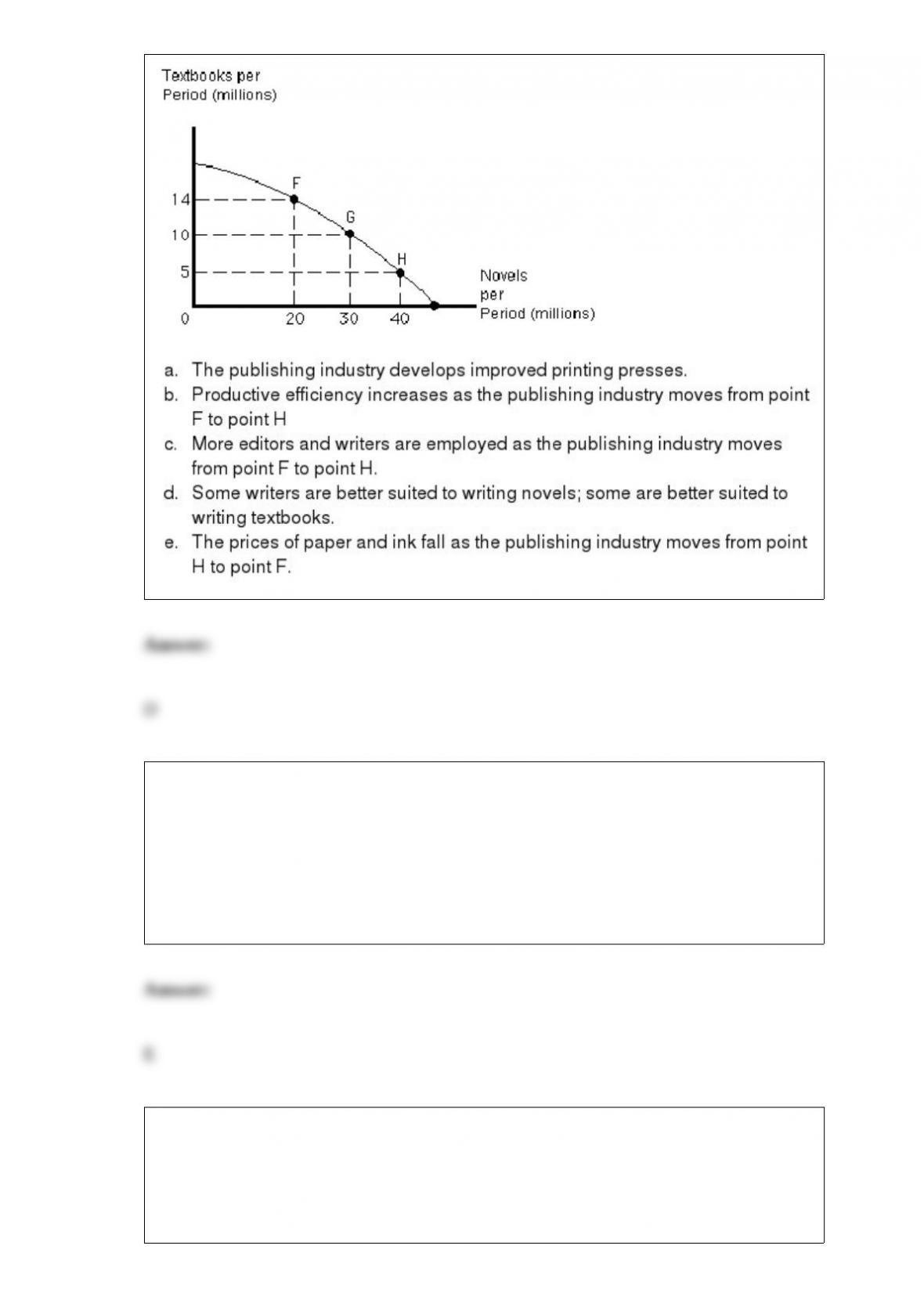
Which of the following statements could explain the concave shape of the production
possibilities curve in Figure 2-9?
Figure 2-9
If the marginal propensity to consume is 0.75 and investment spending increases by
$200 billion, by how much will equilibrium output increase?
a. $350 billion
b. $150 billion
c. $200 billion
d. $266.7 billion
e. $800 billion
Given an opportunity cost of 10 bicycles per 1 sewing machine in Germany and 20
bicycles per 2 sewing machines in Hungary,
a. Neither country has a comparative advantage in the production of either good.
b. Germany has a comparative advantage in the production of sewing machines.
c. Germany has an absolute advantage in the production of sewing machines.

d. Hungary has an absolute advantage in the production of bicycles.
e. Hungary produces more bicycles than Germany does.
If the rate of technological change increases, the result will be that
a. the growth rate of productivity will decrease and firms’ profits will increase
b. the growth rate of productivity will increase and firms’ profits will decrease
c. most individuals will likely lose their jobs due to lack of skills
d. the growth rate of productivity will increase and living standards will increase
e. firms’ profits will increase and living standards will decrease
The slope of the production function reflects
a. capital expenditures.
b. government expenditures.
c. Constant returns to labor.
d. Increasing returns to labor.
e. Diminishing returns to labor.
If the U.S. inflation rate is 3 percent annually and the Japanese inflation rate is 1
percent annually, by what percent would the dollar price of the yen need to change
according to purchasing power parity?
a. Appreciate by 2 percent
b. Appreciate by 1 percent
c. Depreciate by 2 percent
d. Appreciate by 3 percent
e. Depreciate by 1 percent

If the demand for automobiles increases, which of the following would also experience
an increase in demand?
The EITC tends to
Demand for a good is likely to be less elastic
Which of the following statements is true?

a. The U.S. Treasury deals in newly issued bonds and the Fed deals in previously issued
(second-hand) bonds.
b. The U.S. Treasury deals in previously issued bonds and the Fed deals in newly issued
bonds.
c. The U.S. Treasury deals in only newly issued bonds and the Fed deals in both new
and second-hand bonds.
d. The U.S. Treasury deals in both new and second-hand bonds and the Fed only deals
in second-hand bonds.
e. Both the U.S. Treasury and the Fed deal in both new and second-hand bonds.
A positive supply shock causes stagflation in the short run.
If the required reserve ratio is 0.25, what is the demand deposit multiplier?
a. 4.00
b. 0.50
c. 0.75
d. 1.33
e. 1.25
If the marginal propensity to consume is 0.5 and disposable income decreases by
$10,000, by how much will consumption spending decrease?
a. $10,000
b. $500
c. $50
d. $5,000
e. $9,524